🧘♂️ Improve Your Balance Workout Routine
When most people think about building strength, they picture heavy weights and intense training sessions. But here's what often gets overlooked: your body's ability to stabilize itself is the foundation that makes all other strength gains possible.
Balance and stability training doesn't just help you stand on one leg or walk on uneven surfaces—it directly impacts your performance in the gym. When your stabilizer muscles are strong and your proprioception (your body's awareness of where it is in space) is sharp, you can lift heavier, move more efficiently, and significantly reduce your risk of injury.
Think of it this way: you can't fire a cannon from a canoe. Building a stable base through balance work gives your body the solid platform it needs to generate real power.
Bodyweight training is one of the most underrated tools in fitness, especially when it comes to building this foundational strength. It allows you to work within your body's natural ranges of motion without the added stress of external loads, making it an ideal starting point whether you're new to exercise, returning after time off, or recovering from injury. These movements teach your body to work as a coordinated unit rather than isolated parts, which is exactly how you move in real life.
Plus, mastering bodyweight exercises builds the movement patterns, joint stability, and body awareness you'll need before progressing to more challenging training. It's not about the exercises being "easy"—it's about them being smart, sustainable, and setting you up for long-term success.
Check out the workout below, designed to build your balance and mobility from the ground up.
We'll start with core stability work to strengthen the muscles that keep your spine stable and your torso controlled—because balance starts in your center.
From there, we'll progress through increasingly challenging balance positions, moving from two-legged stances to staggered positions, lunges, and wide stances.
Each superset pairs strength-building exercises with stretches to help you develop both the stability and mobility you need for better movement.
By the end, you'll have worked your body through multiple planes of motion while building the foundational strength that transfers to everything else you do!
Workout Instructions:
Do a 5-10 minute cardio warmup before starting this workout. Then complete the exercises in the order listed below, starting with the Warmup Dynamic Stretches.
Then watch the tutorial videos to learn how to perform each exercise and complete the suggested number of reps for each round of the exercises.
During the challenge exercises, pay attention to how hard your muscles are working. Your goal should be to approach muscle failure--that's the feeling you get when your muscles are tired and about to give out. Approaching muscle failure usually feels like a "burning" sensation in the muscles, or you might find your reps are slowing down, and it's harder to keep good technique. Stop your set and rest when either your reps slow down or you find that you're not able to keep proper technique.
Superset 1 (2 Rounds)
1 Reverse Crunch
10-20 repetitions
Reverse crunches are an exercise for strengthening your abdominals muscles in the front of your torso. You don't need any equipment to perform this exercise, but you may want to put an exercise mat or a yoga mat on the floor to cushion your back.
Begin lying on the floor. Face up with your knees bent and your feet on the floor. Take your hands to either side here.
Take your legs up, keeping your knees bent until your knees are stacked over your hips.
To begin the exercise, inhale. And then as you exhale, imprint on the floor by pushing your lower back into the floor and engage your abdominals to bring your knees towards your shoulders.
Then inhale to release back to the starting position with your knees stopping right over your hips.
Continue to repeat, exhaling as you bring your knees towards your chest, and then inhaling to bring your knees back to the starting position. One time up and back down is one repetition.
Continue for the recommended number of repetitions in your training program.
As you perform this exercise, you should begin to feel your abdominals muscles along the front of your torso, firing up and getting tired.
2 Knee Drop Twists
8-12 reps both sides (alternating side to side)
Floor knee drop twists are an exercise for working on your core stability and flexibility. This exercise particularly works the obliques muscles in the side of your torso. You don't need any equipment to perform this exercise, but you may want to put a yoga mat or an exercise mat on the floor to cushion your back.
Begin on the floor, face up with your knees bent and your feet on the floor.
Take your arms out straight to the side to form a T shape, and then lift your knees up over your hips so that your feet are in the air. Keeping your knees bent.
Take a deep breath, and as you exhale, drop your knees over to one side, twisting through your torso. Keep your shoulders firmly on the ground by pressing your hands into the ground.
Inhale as you engage your oblique muscles to bring your knees back to the center position, and then exhale and take it to the other side.
Continue to inhale as you bring your knees up to the center and exhale to twist them to either side.
As you perform this exercise, you should begin to feel the obliques muscles in the sides of your torso activating. You want these muscles to start to burn and feel tired towards the end of your set. One time to both sides is one. Repetition. Continue for the recommended number of repetitions in your training program before returning your feet back to the ground and resting.
3 Laying Hip Flexor Stretch
30-60 seconds both sides
The floor hip flexor stretch is an exercise for stretching out the front of your hips. Your hip flexors are a muscle group that tends to get tight if you spend a lot of time seated. So if your hip flexors are tight, this stretch should feel really good. You don't need any equipment to perform this exercise, but you may want to put a yoga mat or an exercise mat on the floor to cushion your joints.
Begin lying face up on the floor with your knees bent and your feet on the floor.
Take your hands underneath your left side knee and pull it towards your chest as you straighten out your right leg and let it rest on the floor with your knee straight. Hold this position until you feel that stretch activate along the front of your right hip in your hip flexor muscle.
You may also feel the stretch in the adductors or inner thighs of your lifted leg. Hold this position and continue to breathe at a natural pace for between 10 and 60 seconds.Release your left knee and take it to the other side, grabbing underneath your right knee and straightening out your left leg on the floor and pulling that knee towards your chest until you feel the stretch activate in the front of your straight leg hold and continue to breathe at a natural pace before releasing your leg and resting.
(Repeat Superset 1x)
Superset 2 (2 rounds)
1 Center Plank
15-45 seconds
The center plank is an exercise for training upper body and core strength. There are several different variations of this exercise, so pick the variation that feels best for you.
Level 1 (Kneeling Plank on Hands):
Begin in an all four position with your knees underneath your hips, and your hands underneath your shoulders.
Take your knees back slightly and then straighten out your body as you lower your hips to form a straight line from your head through your hips to your knees. Hold this position as you continue to breathe, while you squeeze your abdominals, your glutes, and your quadriceps, and your legs to maintain this position.
Hold for 15-45 seconds in your training program
Level 1 (Kneeling Plank on Elbows):
Begin in an all fours position and walk your arms down onto your elbows.
Step your knees slightly back and lower your hips down towards the floor. As you engage your abdominals, make sure to keep your shoulders right over your elbows here as you squeeze your abs, your quads, and your glutes, and maintain this position as you continue to breathe for 15-45 seconds.
Level 2 (Full Plank On Elbows):
Begin in an all fours position and walk your arms down onto your elbows.
Step your feet back behind you as you tuck your toes under and lift your knees up and form a straight line from your shoulders through your hips, all the way to your heels. Engage your abdominals, squeeze your glutes and quadriceps, and try to keep your shoulders right over your elbows here for 15-45 seconds.
Level 2 (Full Plank On Hands):
Begin in an all fours position with your hands underneath your shoulders.
Step your legs out behind you as you tuck your toes under and straighten out your legs forming a straight line from your shoulders, through your hips to your heels. Engage your abdominals, squeeze your glutes and your quadriceps as you continue to breathe and hold this fixed position for 15-45 seconds.
2 Hip Thrust
10-20 reps
The hip thrust is an exercise for training the glutes and hamstrings muscles in the back of your legs. For this exercise, you will need a sturdy bench.
Begin seated on the floor on one side of the bench with your knees bent and feet on the floor, a little bit wider than hip width apart from each other.
Lean back against the bench so that the edge of the bench is just below your shoulder blades.
Press your heels into the floor and lift your hips up to come into the starting position. Keep your abdominals engaged and your back straight throughout the exercise.
To begin, engage your glutes by squeezing your butt and press your heels into the ground to lift your hips up and then return back to the starting position with your hips bent and hovering above the floor. One time lifting your hips up and back down to the starting position is one repetition.
Continue for the recommended 10-15 reps.
3 Sitting Glute Stretch
30-60 seconds
The floor seated glute max stretch is an exercise for stretching out your gluteus maximus muscle in your bottom. You don't need any equipment to perform this exercise, but you may want to put an exercise mat or a yoga mat on the floor to cushion your hips.
Begin seated on the floor with your knees bent and your face forward.
Extend your left leg straightening out your left knee, letting your left leg rest on the floor.
Hug your right knee with your left arm and pull it towards your left shoulder.
Twist to look over your right side shoulder and continue to hug your knee in until you feel that stretch activate in your glutes or gluteus maximus muscle in your bottom on the side of your bent knee.
Hold and continue to breathe at a natural pace for between 10 and 60 seconds, and then release your leg and switch over to the other side.
4 Fig 4 Hamstring Stretch
30-60 seconds both sides
The seated figure four stretch is an exercise to stretch out your hamstrings, hip adductors, and hip abductors muscles. You don't need any equipment to perform this exercise, but you may want to put a yoga mat or an exercise mat on the floor to cushion your joints.
Begin seated on the floor and stretch out one leg as you bring the sole of the foot of the opposite leg to the inner thigh of your straight leg with your other knee bent. Sit tall to begin here and pull your toes back towards your chest to get a stretch in your calves as well as your hamstrings.
If you want to go deeper into the stretch, you can continue to hinge at the hips, reaching towards your ankle, but try to keep your back straight here and in alignment hold for 30-60 seconds before switching to the other side.
(Repeat Superset 1x)
Superset 3 (2 rounds)
1 Bear Plank 3-Sec Hold
10-15 reps
The bear plank 3-second hold is an exercise for training core stability as well as strength and endurance in your legs and shoulders. You don't need any equipment to perform this exercise, but you may want to put a yoga mat or exercise mat on the floor to cushion your hands and knees.
Come down to the floor in all fours and a tabletop position with your hands underneath your shoulders and your knees underneath your hips. Make sure that your back is flat here.
To begin, tuck your toes under and push the floor through your hands and the balls of your feet to lift your knees up off of the floor. Hold for three seconds and then slowly lower your knees back down to the floor with control.
Repeat by lifting your knees up and holding for three seconds before bringing your knees back down, up and back down is one repetition. Continue for 10-15 repetitions.
As you get towards the end of your set, you should start to feel your quadriceps in the front of your thighs, as well as your abdominals and your shoulders or deltoids burning here. You may also feel some fatigue building up in your triceps along the back of your arms.
2 Dirty Dogs
10-15 reps both sides (one side at a time)
Dirty dogs are a great exercise for developing the strength in your gluteus medias and gluteus minimus. You'll also develop some strength and stability in your core and shoulders. You can perform this exercise with no equipment, or you can add a circular resistance band to add a little bit more challenge for the dirty dogs with no equipment.
Begin in a tabletop position facing the floor with your knees underneath your hips, and your hands underneath your shoulders.
Shift your weight over onto one knee as you lift the leg up on the other side, keeping your knee bent and trying to keep your hips level with the floor, and then lower your leg back down to the starting position.
Continue to lift up and back down to one side for 10-15 repetitions before resting and then switching over to the other side leg. Do the same number of repetitions on both sides towards the end of your set.
You should begin to feel a burning or fatiguing sensation in your hips where the gluteus medias and gluteus minimus muscles are. If you don't feel enough challenge here, you can add a resistance band wrapped around your knees to give you additional resistance to make the muscles have to work harder.
3 Child’s Pose
30-60 seconds
Child's pose as an exercise for stretching your lower back quadriceps, glutes, and the tibialis anterior muscle in the front of your shins. You may also feel a stretch in your lats muscles in your mid back if you reach your arms forward. You don't need any equipment to perform this exercise, but you may want to put an exercise mat or a yoga mat on the floor to cushion your joints.
Begin in a tabletop position on your hands and knees, and then untuck your toes and push your hips back towards your heels.
As you reach your arms straightforward, allow your hips to sink towards the floor, as far as your flexibility allows, and let your forehead rest on the floor if that's comfortable for you. Feel that stretch activate in your lower back, your glutes, quadriceps, and the front of your shins.
Reach forward a little bit more if you'd like to activate a deeper stretch in your lats muscles, in your mid back and under your armpits. Hold this position for 30-60 seconds before coming back up into a tabletop position to rest.
(Repeat Superset 1x)
Superset 4 (Stagger Stance Balance, 1 round)
1 Stagger Stance Arms Open & Close
Right leg forward, 5-10 reps
The Stagger Stance with Arms Open & Close is a balance-training exercise to help you develop your balance, coordination, and strength in your legs from a static standing position. You don’t need any equipment to perform this exercise.
Begin standing and step your right foot directly in front of the left foot, with your heels and toes forming a straight line.
Bend your knees slightly, and stand with a tall posture (with your hips level, shoulders right over your hips, chest forward, shoulders down and back, and eyes forward).
Hold this position as you reach your arms straight forward in front of you at the level of your chest.
Then open your arms reaching straight out to either side of your body.
Continue to repeat reaching your arms forward and opening them back up for 5-10 repetitions.
2 Stagger Stance Arms Up & Down
Left leg forward, 5-10 reps
The Stagger Stance with Arms Up & Down is another balance-training exercise to help you develop your balance, coordination, and strength in your legs from a static standing position. You don’t need any equipment to perform this exercise.
Begin standing and step your left foot directly in front of the right foot, with your heels and toes forming a straight line.
Bend your knees slightly, and stand with a tall posture (with your hips level, shoulders right over your hips, chest forward, shoulders down and back, and eyes forward).
Hold this position as you reach your arms straight up overhead.
Then drop your arms reaching straight down to either side of your body.
Continue to repeat reaching your arms up and down for 5-10 repetitions.
3 Hip Hinge Stretch
30-60 seconds
The static hip hinge stretch is an exercise for stretching out your hamstrings along the back of your thighs. This exercise will also help you to practice your hip hinge technique so that you can use it later on in more difficult hip hinging exercises like deadlifts.
Begin standing with a tall posture with your feet right underneath your hips and your shoulders down away from your ears and chest forward.
Bring your hands to the front of your thighs and push your hips back as you keep your back straight. Stop when you feel that stretch activate in the back of your thighs or hamstrings and hold this position with your hands on your thighs for between 30 and 60 seconds as you continue to breathe at a natural pace.
To stand, drive your heels into the floor and squeeze your glutes to return your hips back forward and come back to a standing position to rest.
Superset 4 (Lunge Balance, 1 round)
30-60 seconds both sides
The High Lunge Hold is an exercise to help you develop your balance, coordination, and strength in your legs from a static standing position. You don’t need any equipment to perform this exercise.
Begin standing and take a big step back with one leg, keeping your front foot planted on the floor with the front knee bent. Keep your back knee straight and your back heel off the ground.
Stand with a tall posture (with your hips level, shoulders right over your hips, chest forward, shoulders down and back, and eyes forward).
Hold this position as you breathe for 30-60 seconds.
Step your back leg forward and switch to the other side
2 Hip Hinge Stretch
30-60 seconds
The static hip hinge stretch is an exercise for stretching out your hamstrings along the back of your thighs. This exercise will also help you to practice your hip hinge technique so that you can use it later on in more difficult hip hinging exercises like deadlifts.
Begin standing with a tall posture with your feet right underneath your hips and your shoulders down away from your ears and chest forward.
Bring your hands to the front of your thighs and push your hips back as you keep your back straight. Stop when you feel that stretch activate in the back of your thighs or hamstrings and hold this position with your hands on your thighs for between 30 and 60 seconds as you continue to breathe at a natural pace.
To stand, drive your heels into the floor and squeeze your glutes to return your hips back forward and come back to a standing position to rest.
Superset 6 (Wide Stance Balance, 1 round)
1 Sumo Squat Hold
30-60 seconds
The Sumo squat hold is an exercise for helping you to develop strength in your legs—particularly your quadriceps, hamstrings, and glutes. This exercise will also help you to develop mobility in your hips while stretching out your hip adductor muscles. You don't need any equipment to perform this exercise.
Begin standing and step your feet out wide apart so that your toes are turned out at 45 degrees. Stand with the tall posture and bring your hands up right in front of your chest.
To begin the exercise, hip hinge and bend your knees at the same time to lower your body down towards the floor, stopping when you feel a stretch in your hip adductor muscles in your inner thighs. Hold this position as you continue to breathe. Try to maintain a flat back and also keep your torso upright. The longer you hold this position, you should begin to feel some burning in your quadriceps, inner thighs, and glutes. Hold as long as you can between 30 and 60 seconds
To rest, straighten out your legs and returning to standing.
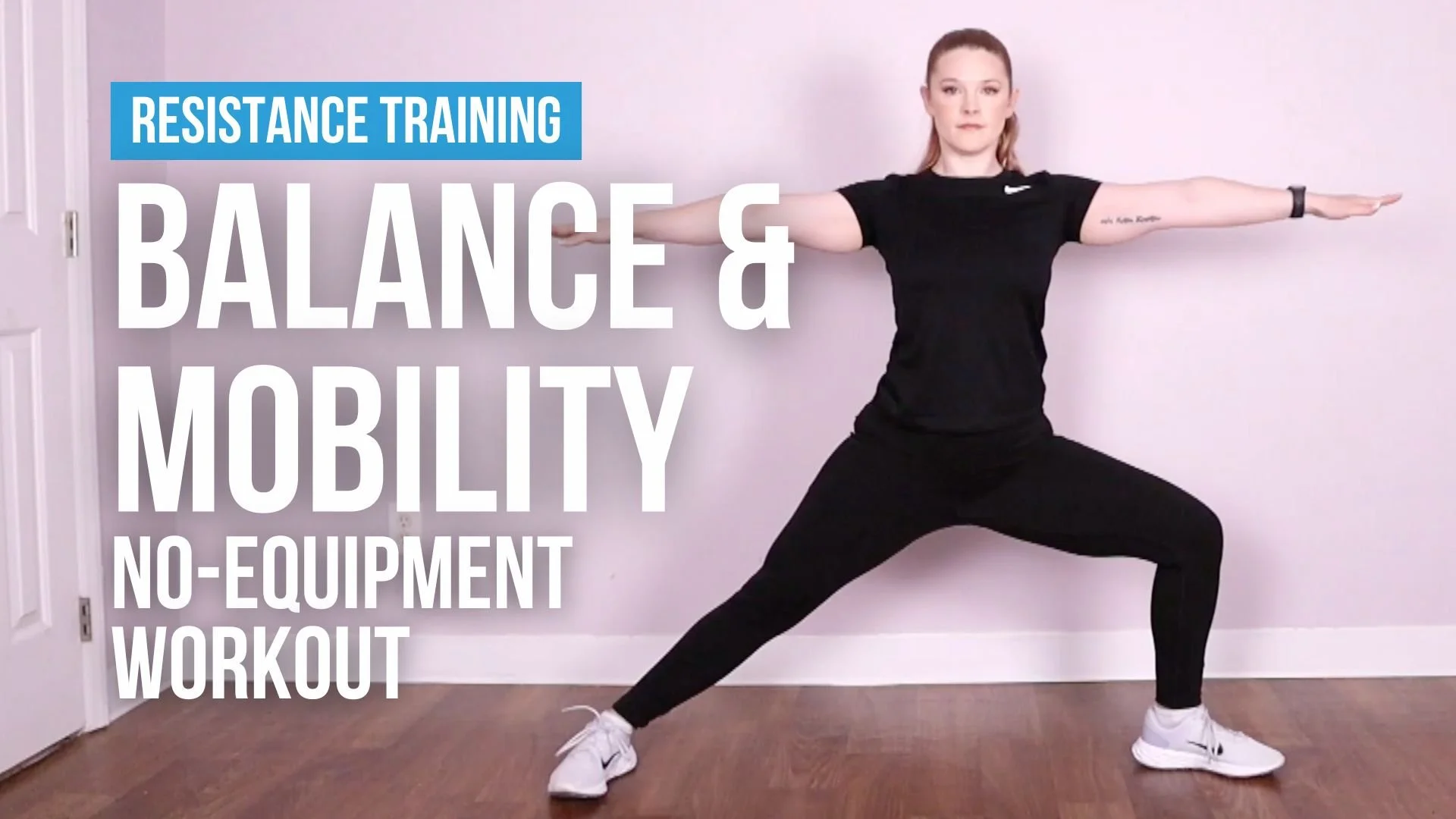
2 Warrior II Yoga Pose
The Warrior II Yoga Pose is an exercise for helping you to develop balance, stability, and strength in your legs—particularly your quadriceps, hamstrings, and glutes muscles. This exercise will also help you to develop mobility in your hips while stretching out your hip adductor muscles. You don't need any equipment to perform this exercise.
Begin standing and then step your left foot back about 3-4 feet (adjust for your height and comfort)
Turn your back (left) foot out to about 90 degrees. Keep your front (right) foot pointing straight forward. Align your front heel with the arch of your back foot
Bend your front knee until it's directly over your ankle (or close to it) - aim for your thigh parallel to the floor if comfortable
Keep your back leg straight and strong, pressing through the outer edge of your back foot
Extend your arms out to the sides at shoulder height, reaching in opposite directions with palms facing down. Keep your torso upright and centered between both legs (resist leaning forward)
Turn your head to gaze over your front fingertips and hold this position for 30-60 seconds before switching to the other side.
Keep your hips open toward the side of your mat rather than square forward, and distribute your weight evenly between both feet.
30-60 seconds
The static hip hinge stretch is an exercise for stretching out your hamstrings along the back of your thighs. This exercise will also help you to practice your hip hinge technique so that you can use it later on in more difficult hip hinging exercises like deadlifts.
Begin standing with a tall posture with your feet right underneath your hips and your shoulders down away from your ears and chest forward.
Bring your hands to the front of your thighs and push your hips back as you keep your back straight. Stop when you feel that stretch activate in the back of your thighs or hamstrings and hold this position with your hands on your thighs for between 30 and 60 seconds as you continue to breathe at a natural pace.
To stand, drive your heels into the floor and squeeze your glutes to return your hips back forward and come back to a standing position to rest.
Want more?
Download the full workout for additional exercises for the upper body:
Get on-demand workouts delivered straight to your smartphone or computer by signing up for the ABC Trainerize App:
👉 Join for $29 per month (cancel anytime)
For more accountability, apply for 1-on-1 coaching below:
Feel free to reach out if you have any questions or difficulties with the workout plan! You can comment below or chat with me when I’m live on my Twitch channel twitch.tv/jaydigains.