
Episode 12: 5 Types of Resistance Training Programs
In this week’s episode of the Coaching Corner Podcast, we’re talking about 5 different options for scheduling your workouts according to your experience level and goals.
Check out these 5 ways to organize your resistance training to get strong and build muscle consistently each week.
A great way to stay consistent and make gains is to get onto a program that focuses your training on specific muscles or movements in each session.
In this week’s episode of the Coaching Corner Podcast, we’re talking about 5 different options for scheduling your workouts according to your experience level and goals.
-
(00:00):
When it comes to resistance training, it's one of the best ways that you can keep your metabolism high and increase your daily calorie burn if your goal is to burn fat. And it's also the pathway to developing that toned look that a lot of people are after. A lot of people don't just want to lose weight and be skinny. They want to look strong and healthy and resistance training is the way to do that. So there's lots of reasons to do resistance training.
(00:33)
Hey there, Jayd Harrison here, AKA Jaydigains. Welcome to the Coaching Corner podcast. In today's episode, I'm excited to share with you five different ways that you can organize your resistance training. This is one of my favorite topics to discuss with my Twitch chat and to write about and talk about with my clients because resistance training is honestly the secret magic bullet of getting in shape. A lot of people don't realize just how powerful it is to do resistance training and develop your muscles. Now, resistance training isn't going to automatically turn you into Arnold Schwarzenegger, which is a common fear that a lot of people have, especially women. But resistance training is so much more than just trying to get your muscles to be big. Also, side note, if you are a woman, it's actually really, really hard to get your muscles to grow big.
(01:22)
Even if you're a man, it's hard to get big muscles. It takes many, many years of training, training in a specific way, eating a specific way to grow big muscles. So if you have some hesitance about starting to incorporate resistance training into your weekly exercise routine, and you're afraid that you're going to turn into a bodybuilder and look super masculine and look like Arnold Schwarzenegger, it is just not going to happen. Okay, so rest at ease. It's not going to happen. I'm telling you, even if you were to try to get big muscles as a woman or as a beginner, it's just literally not going to happen. And if you want to get big muscles, that's another discussion for another day that takes a lot of work and a lot of specific training. So when we talk about resistance training and its role in a healthy, active lifestyle, we do it because it has so many benefits for our bodies.
(02:28)
Did you know that actually as we age, our bodies get weaker over time and we actually lose muscle as we get older? This is a process called sarcopenia, and it especially is a threat to people who have a sedentary lifestyle. So when it comes to your muscles, it's use it or lose it unfortunately. So if you don't use your muscles, you're going to lose them. Your body will break that tissue down to access the energy that's there. Remember that our bodies are super systems and they will react to whatever stimulus you give it. So if you don't need to be strong in your everyday day-to-day life, then your body is going to be like, but we don't really need much muscle because we're not really using our bodies anyway. Now, the problem with this, with sarcopenia and the loss of muscle is that it has a direct negative impact on our overall health.
(03:23)
As our muscular strength declines, as our lean muscle mass declines in our bodies, we lose coordination. We lose bone density and we lose balance, which are all things that can contribute to injury as people age, there's a common saying that as soon as someone falls down and breaks a hip and has to get a hip replacement and then they're sedentary, it's really not long after that that they end up actually passing away. This is a really common thing, but if we keep our muscles strong, we can improve our coordination, we can improve our bone density and our overall mechanical control and ability to live longer, live healthier for longer. Now, there's a bunch of other benefits of keeping your muscles strong. For example, whenever you build muscle, you actually improve your body's insulin and glucose sensitivity. So if you are at risk of diabetes or if you have diabetes, performing resistance training and building muscle is one of the best things that you can do to help manage that condition.
(04:26)
Resistance training and building muscle can also help to improve your blood lipid profiles. That is your cholesterol as well as your blood pressure. So you'll actually improve your heart health and reduce your risk of developing heart disease or having a heart attack or a stroke. As you make your muscle stronger, you also improve your bone density. And this is especially important for women because as we age, our bone density tends to decline pretty rapidly and we develop a high risk of osteoporosis, which is when our bones become more porous, which means that they're more likely to break and have a harder time healing when they do break. And then of course, when it comes to resistance training, it's one of the best ways that you can keep your metabolism high and increase your daily calorie burn if your goal is to burn fat. And it's also the pathway to developing that toned look that a lot of people are after, right?
(05:20)
A lot of people don't just want to lose weight and be skinny. They want to look strong and healthy and resistance training is the way to do that. So there's lots of reasons to do resistance training, and for that reason resistance training is a huge part of the personal training sessions that I run for my one-on-one clients and in the training programs that I create. So in today's episode, let's take a look at the recommendations for resistance training, incorporating it into your weekly exercise routine, and we'll go over five different ways that you can organize your weekly schedule to make sure that you are hitting the as often as they need to be hit to stay strong and improve your lean muscle tissue. Now, what is resistance training specifically when you think of resistance training, you probably imagine people going into the weight room at the gym and pumping some iron, right?
(06:12)
They might be doing some bicep curls, maybe some deadlifts and some squats. All of these are examples of resistance training exercises, but specifically resistance training is any type of exercise where you are challenging your muscles to perform or do their job against some form of resistance. So if I want to make my bicep muscles stronger, then I'm going to make my bicep do its job, which has bend the elbow using some kind of resistance. A lot of times people use weights like dumbbells or barbells, maybe kettlebells. Sometimes you can use machines which add resistance using a pulley system, usually with some weights that are scaled against some kind of mechanism that you're sitting in. But you can also use resistance bands and even your own body weight to add more resistance to a movement. So in the example with the biceps, I could perform a biceps curl with the dumbbells or with a resistance band, and the goal here is to make the bicep do its job against resistance to the point where the muscle starts to fatigue or get tired.
(07:22)
Now, in practice, what this often looks like for a lot of people is that the muscle starts to burn. That's typically the sensation that people describe it as. It's like a burn. As the muscle starts to get tired, you can feel it getting tired. And for building strength and growing muscle, we want to allow the muscle to approach the point where it would completely tire out, which we call muscular failure. So muscular failure is the point where your muscle just completely gives up and it cannot do even a single rep more. Now for beginners and even intermediate exercisers, you don't necessarily need to train all the way to muscle failure to the point where your muscles give out. In fact, it may not really be safe, especially when you're still learning the technique of different exercises. In general, what we want to do is what we call approach muscle failure, where you do an exercise fatigue the muscle to the point where it's close to the point where it would give out or stop working.
(08:19)
And usually what I tell my clients is you want to stop when you feel like you could do maybe one, two, or three more reps. So at the end of a set, when you have just maybe one, two, or three more reps in the tank, you stop your set, you stop the exercise, and then you rest. You let the muscles recharge for about 30 to 60 seconds, and then you do the exercise again to fatigue the muscle. You do this usually two to three sets. Sometimes you'll do more sets, but in essence, you're doing these sets to try to fatigue your muscle practice doing repetition after repetition until your muscles are burning and you feel like you could only do 1, 2, 3 more reps. So what this does is you are actually causing microscopic damage to your muscles while you're training like this, and that microscopic damage is what your body is going to read as injury.
(09:10)
So after you finish your workout, when you go home, you eat a good meal with protein, carbohydrates, and healthy fats, and then you go to sleep and while you're sleeping, your body is going to start the repair process. It's going to flood that area with some healing hormones, protein, white blood cells, and it's just going to send all of that into that muscle area and your body is going to start the repair process. So it's going to repair the damage that's done to the muscle fibers, and it's also going to fortify them. So that next time you go to do that same task, your body is stronger, you're able to perform that same task, that same amount of weight, that same number of reps. You'll be able to do it without getting as tired. So this process of over and over and over again, over the course of weeks, if not months, of doing microscopic damage to the muscles, letting them heal, get fortified, and then doing it again is how your muscles get stronger and stronger over time.
(10:08)
So now let's talk about what the recommendations would be for how often you should do resistance training, how hard you should train. We'll go a little bit more into detail of that, and then I'm going to talk about how you can actually split up your resistance training over the course of a week to make sure that you're hitting all of the muscles and you're going to be improving the strength of your muscles throughout your whole body. So let's talk about how often you should train. So this really depends on a lot of factors. First and foremost, it depends on your level of experience. So if you're a brand new beginner to resistance training, you really don't need more than two or three days a week to improve your muscular strength and build some muscle. So if you've been exercising for less than six months consistently, I would recommend starting with two to three days a week of incorporating resistance training into your routine, and you don't need to set more than 30 to 60 minutes aside for resistance training here.
(11:08)
If you are more intermediate and you have been doing resistance training for more than six months, then you can add on another day and work out for three to four days a week. However, I do have to say there are plenty of advanced exercises who only train resistance training two or three times a week, and it does depend on the block of their training and what they're focusing on, but don't feel like you have to add in more days. But just keep in mind that as you get stronger and as you get more advanced, your muscles are going to need more of something to continue to get stronger and improve their strength. So for some people, that might look like adding in another training day or adding two more training days, but for some people they might not have the availability to do that. In that case, you might just add more exercises or more difficult exercises or more weight so you don't have to add on another day.
(12:01)
But I wouldn't recommend as a beginner starting out with four, five, or six days of training a week, if you have been training for less than six months, stick to that two to three day range. Now, if you are advanced and you have been working out for one to two years and you've been doing resistance training, you can do four to five days a week according to the American College of Sports Medicine. Now, keep in mind that the more frequently you train, the more you're going to have to moderate what we call the intensity, which is how hard you push yourself and what muscles you're pushing during your resistance training workouts. We'll talk about that a little bit more when we get into the different training program, splits or schemes and how you can split out what muscles you're working. If you're doing something that's like a body part split, you can get away with training six to seven days, but in general, you do not need to train for six or seven days a week in order to make gains.
(12:59)
Now today we're going to talk about five common ways that you can organize your resistance training to split out which muscles you're hitting every time you train, when you're a beginner, when you've been training for less than six months, I recommend taking your two to three days a week of resistance training and doing what we call a total body training. So in a total body training session, you are hitting muscles everywhere. You're hitting upper body, lower body, and your core. So upper body would be the muscles in your arms as well as in your back and in your chest. Lower body exercises are going to target the muscles in your legs primarily, and then your core is the muscles in your torso, so your abs obliques your back muscles. So in a beginner level training program, I'm usually going to recommend total body training two to three days a week.
(13:52)
So you're hitting each muscle group one time with one to two exercises for two to three sets per exercise. I like this because when you are a beginner, you don't really need that many exercises on a muscle group to make gains. You might only need to hit the quadriceps for three sets with one exercise in order to get stronger, which is usually the case with beginners. You can do maybe two exercises per muscle group and that's fine, but you really don't need a whole lot of stimulus to build strength and build muscle as a beginner when you're in the first six months of your training, there's plenty of people who are more advanced who train total body as well, but just keep in mind that the more advanced you get, the more you're going to have to put load on your muscles during your total body training sessions.
(14:43)
So as you get more advanced, you're going to have to push a lot harder in those sessions. So a lot of intermediate and advanced exercises say that total body training days are killer and they're really hard to recover from because you have to hit the muscles a lot harder than you did when you were a beginner in order to make gains. But plenty of people do it, especially people who are limited in their availability and the amount of days that they can train. A lot of them will stick to a total body two or three times a week training split even when they're more advanced and they just know going into it that they're going to be really, really tired. Also, for my athletes who are in season, a lot of times I'll have them do two to three days a week of total body, but their intensity will be a little bit lower.
(15:30)
We'll incorporate a lot more mobility, style training, lower intensity, lower volume because when they're in season, their workouts need to be really supplementary to the sport that they're in. So in general, total body splits work for everybody, but a lot of times I'm going to start beginners off with total body. Now a second really common intermediate level, I would say type of splitting out your workouts is to do what's called an upper lower split. So in upper lower splits, we focus each training session either on your upper body or your lower body. So for upper body days, you're going to be doing exercises that are focused on your arms and probably your core as well. Although sometimes people will train core on lower body days as well. You can kind of fit in core training, abdominals, obliques your back, you can fit that in on either day, but the focus of an upper body day is going to be a lot of exercises for the chest, the shoulders, biceps, triceps, et cetera.
(16:29)
Now, the benefit of this, especially for intermediate people is it allows you to hit the same muscle group with a few more exercises. So if you have kind of hit a plateau trading total body two to three times a week, splitting out your workout sessions so that you're hitting the same muscle group with a couple more exercise varieties, a few more sets, performing the exercises to fatigue will help kind of stimulate those muscles to get stronger again or to start growing again For a lower body day, that's going to incorporate a couple of different exercises that all hit the legs, your quadriceps, your hamstrings, your glutes, your calves, all of those. All of those are going to get hit multiple times with multiple different exercises. Though I really like the upper lower body split. You can do this in two days a week. You can do this in four days a week.
(17:22)
Now another way that you can split out your workouts that's similar to the upper lower split is what's called a push pull legs split. Now, this can be practiced between 3, 4, 4 or five, six days a week. Essentially what you do is every workout session, you alternate between push focused exercises, whole focused exercises and exercises that target your legs. This split of your workouts is focused more around types of movements and a type of performance for your body versus just hitting a muscle group. So for athletes, push pull legs is a really great workout split that helps them to develop different movement patterns. So it's really great for training like functional movement. So a push day would include all of the muscles involved in different types of pushing exercises or pushing movements like pushups, bench press, overhead press, tricep dips or tricep push downs. The muscles that we're going to hit on a push day are going to be mainly like the chest, the shoulders, the triceps.
(18:32)
Anything that would be involved in pushing away from the body against some kind of resistance pull day is mainly going to feature muscles like the lats as well as the back of the shoulders and your back as well as your biceps because these muscles are all involved in pulling things closer to your body against resistance. So with the push day, we want to push out away from our body with the pull day. We want to be pulling things toward our body in different movements involving these muscle groups. Usually. Now you might have some exercises that you do on both a push day and a pull day. They fit for both. For example, like face pulls, I sometimes put those on a push day because they target the back of the shoulder, which is an important stabilizer for the shoulders in different push exercises. But I might also put it on a poll day because it's a literal polling exercise, so it doesn't have to be like a super black and white distinction or split, and you can mix it up over the course of your different blocks of training to give yourself some variety.
(19:35)
But in general, this is the theme of the workout. And then your leg day is just all legs. All legs. You can split these out between doing squats and squat based movements, or you can incorporate some deadlifts. Sometimes people will put deadlifts on their pole day because it is a literal polling exercise. Some people will prefer to put that on their leg day though because the deadlift is heavily involving the legs. So again, there's not really clear cut like black and white where everything goes. Just think about it as this is the theme of this training scheme. Push pull legs, and I really like this for my athletes. I really like this for people who are training for functional strength because these are movements that we practice in our everyday life, and especially if you're an athlete, you need to be able to perform these different types of movements.
(20:24)
Now, another way that you can split out your resistance training based on movement patterns is to do something where you are splitting out your days focused on different kinds of more specific style movements. So for example, you might have one day that is a squat emphasis that does exercises that are squat based. So you squats, lunges, different types of movements that involve squatting or that support the strength involved in squatting. And then you may have a hip hinge focus day where you're not really focusing on bending the knees very much. It's all about hinging at the hips. So this kind of a day would involve things like deadlifts and kettlebell swings, leg curls, these types of movements that involve your hips bending and straightening, and then you may have a push day and a pull day just like you would in a push pull leg split.
(21:23)
But also another important movement pattern that's included in the movement pattern emphasis type programs is rotational, which I really love because it's so important to involve rotational exercises because our bodies move in rotation, rotation through the spine rotation in our legs and our hips. So rotation and stabilizing type exercises, which you might put on a separate day would include things like wood chops, like with a cable or with bands, Turkish get ups, Russian twists. All of these are exercises that involve some kind of rotation and then some type of stabilizing exercises where you have to hold a plank or hold a squat while one part of your body is moving and doing something else. All of these are very functional movement patterns that you need for life. This style of training is really what the physical therapists at the office that I do personal training out of, they typically will train their clients using the movement pattern split because for them, they're trying to specifically diagnose and strengthen different movement patterns to help people move more functionally.
(22:36)
So this is a really common style of training. If you work with someone who is a physical therapist and a personal trainer, right, they're a lot of times going to give you a movement pattern split, which is a great way to train. And then finally, you have what is called the body part split or often the bro split. Now the bro split or the body part split is a style of splitting out your workouts so that each day you're focusing on one or just a couple different muscles at a time. Now, the bro split is really good for people who are specifically interested in building muscle size. So bodybuilders will often train according to a body split program or a body part split or a bro split because they're specifically trying to develop their muscles in isolation to develop them and give them more size.
(23:29)
So this is what I'm talking about what it takes to build big muscles. Bodybuilders have to do a lot of different exercises for the same muscle group to get the muscles to grow big, so they'll have an entire day that's just devoted to chest or an entire day that's just devoted to biceps or triceps, right? There's a lot of different ways that you can split this out, but that's essentially the idea is that each day you're really slamming one or just a couple of muscles in that training session to try to get them to grow and try to get as much of those little microscopic tears in the muscles as you can get, training the muscles to fatigue over and over and over again with different types of exercises from different angles, from different equipment so that you can maximize muscle growth. So a common bro split that we see is usually people will start the week off.
(24:20)
Their first date of the week will be training chest or chest and shoulders or chest and triceps. There's a joke that we like to call Monday International push day or international Chest Day because when you go to the gym, a lot of the people who are there are there to grow big muscles, and so they're going to be hitting chest and triceps or chest and shoulders or push on a Monday. So it's going to be really hard to get the bench available on a Monday if you go, because usually with a bro split, a lot of people are starting the week off with chest or chest, shoulders, chest triceps or chest, shoulders and triceps, and a common day for them to follow that up with is back day or back and biceps day. So this is going to be a lot of pulling exercises. So deadlifts might be included, but sometimes people will save their deadlifts for leg day pull-ups, lap pull downs, different types of rows and lots of different bicep curl type exercises.
(25:14)
And then for a third day, they might focus on a muscle group like the shoulders, and then they finish off with legs. There's lots of different ways that you can do a bro split. There are some people who train a bro split across seven days where they hit chest one day, shoulders the next day, back the next day, biceps the next day. They're hitting everything in isolation every single day of the week. Now, a lot of people are able to get away with this without developing symptoms of over-training because each muscle group is only getting hit one day a week, so they're slamming that muscle group, but they have seven whole days before they hit that muscle group again to recover and build. Now, this works for people who have been training for a long time and their body is really efficient and effective at recovering.
(26:00)
However, if you try to go into a six or seven day bro split as a beginner, you're probably going to risk developing the symptoms of over-training, which is when you are doing too much and your body is having a hard time recovering. So if you feel like super overly fatigued, even though you've been training consistently for three or four weeks, your body isn't getting better at recovering and your recovery is just like it feels like garbage. You might experience dips in your appetite or intense appetite, cravings. It could go the other way. You might be feeling tired all the time, but you're having trouble sleeping or you are getting lots of chronic aches and pains or injuries. These are all signs that you're doing too much in the gym. You're doing more than what your body can effectively recover from. And when we do more than what our body can recover from, it doesn't matter what you're doing in the gym, you're just not going to grow as much muscle and you're not going to get as much strength.
(26:52)
You're actually harming your body at that point. So in order to keep your training effective, you want to make sure that you're only doing as much as your body can properly recover from. So if you're interested in doing a bro split and you're a beginner, I would say do no more than four days a week and do day one chest and triceps, day two, back and biceps day three, shoulders day four legs, something like that. But I mean, I still personally, I'm never going to recommend a bro split to someone who's been training for less than six months, right? At that point, you do not need to spend an entire training session on your chest or an entire training session on your shoulders. You don't really need to hit those muscles more than with one exercise for 3, 2, 3 sets. So it just keep that in mind.
(27:36)
You don't need to blast your body to make progress, especially in the beginning. A little bit is going to go a long way, whichever way that you decide to split out your workouts. In general, we want to shoot for 10 to 20 sets for each muscle group total over the course of a week. That's how you want to organize it, and then you can split it out however you like. Again, I recommend that when you're starting out to start with total body training, because if you do a leg day and you're a beginner and you hit your quads for 10 sets in one training day, your legs are going to be cooked, you are going to have a really hard time recovering from that, right? So this is why I recommend starting with total Body. Now, what do I mean by a set? Okay, so a set is a period of time where you're actually doing the exercise.
(28:26)
We usually define a set by a number of repetitions. Now, a repetition is one time doing the exercise. So if you're squatting one time down and back up, that's one rep in general, especially for people who are beginners or even intermediate. The American College of Sports Medicine recommends doing roughly between eight and 12 repetitions for each set of every exercise. That's a good general recommendation personally for me in how I teach my clients. And if you do one of my training programs, one of my body sculpt programs, a lot of times you're going to see that I actually recommend doing between 10 and 15 reps per set, and I like to do this rep range because one, it's memorable, eight to 12 is kind of like weird numbers for people, especially if they've never done any kind of exercise before. So I would say 10 to 15, easy to remember.
(29:28)
Two, it also is a higher rep range, which means that you're going to not need to use as heavy resistance or as heavy of a weight, and you're going to get more reps in to practice the technique. So especially for beginners, 10 to 15 is my favorite rep range to recommend for people. You don't have to stay to that. You don't have to do that yourself. I just find that that is what my clients respond best to. And I've trained both. I've done eight to 12, I've done six to 10, and I've done 10 to 15. And in general, 10 to 15 seems to be the Goldilocks zone for my especially beginner clients because it's memorable. And again, they don't have to use quite as much weight to get the muscles burning when they're going to 15 reps or somewhere between 10 and 15 reps.
(30:19)
Now, over time, as someone gets stronger, I'm going to reduce their reps as they get closer to wanting to develop more strength and power training. However, when you are just starting out, you can stick to one of those larger rep ranges. We call this high volume training. High volume meaning a high number of repetitions, 10 to 15 is a high number of repetitions. Eight to 12 is also a high number of repetitions, especially when you consider advanced lifters who are lifting really heavy weight for up to six reps, right? You'll see heavy lifters or power lifters doing super heavy weight for just one rep or two or three. We call that singles, doubles or triples. I don't recommend trying to do singles, doubles and triples with heavy weight until you have been training at least one or two years. You want to have one to two years of resistance training, exercise and solid technique before you start trying to mess with the heavy stuff.
(31:17)
Now, another note that we should take is you don't really need to set aside more than one hour or an hour and a half at most for resistance training. When you go to the gym and you're going to do a resistance training session, you don't need to be in the gym for hours and hours and an hours. Now, I know that some people do like to train for two or three hours, but keep in mind that when it comes to resistance training and working out in general, that you're going to get a diminishing return on the investment of energy that you put into your workout. So whatever you do at the beginning of your workout is what is going to benefit the most. And if you work out for hours and hours and hours, what you train towards the end, you're not really going to get a whole lot of benefit from it.
(31:57)
Versus if you were to train that within an hour and an hour and a half, our central nervous systems, they fatigue over time and you're just not going to get the muscle activation that you would get if you kept your workouts to a shorter period of time. And so when we're trying to grow the muscles, when we're trying to build strength, we want the central nervous system to be able to activate as much of the muscles as possible. So keep that in mind. You do not need to be working out for hours and hours and hours. Some people do it because they think it's fun. Some people do it because they feel like they need to, but that's just not the case. And in fact, you may actually be hurting your gains if you are in the gym for more than an hour and a half hitting those muscles because again, you may put yourself at risk of over-training.
(32:41)
Your body is only going to yield as so much benefit from those exercises. There's a diminishing return on that investment. Now, with that said, I recommend putting your compound or more technically difficult exercises at the beginning of your workout because that's when your body is fresh. That's when your central nervous system is able to activate everything. And so you want to put your technically complex things like squats and deadlifts at the beginning or towards the beginning of your workout. You don't necessarily need to do it first, but when you are more fresh, that's going to be safer for you because you're going to be able to activate your muscles more. Your central nervous system is going to be more connected to your muscles, so you're less likely to slip on your technique, and then you can kind of finish off as your workout goes along.
(33:29)
You can finish off the little muscle groups in isolation with more isolation exercises like bicep curls, tricep, kickbacks that work just one muscle. Save those towards the end of your workout. So we get the more complex compound exercises first, and then work your way down to the isolation exercises. And then one more note when we're talking about resistance training. If you want to continue to build muscle over time, you want to continue to get stronger over time, you need to make sure that you are always giving your muscles a little bit more challenge than what they're used to. So over time, as your muscles get stronger, you're going to need to add more repetitions or you're going to need to add more weight or more exercises or more frequency, something more to your muscles to give them the challenge that they need to keep getting stronger.
(34:20)
Remember, your body is a smart system. It's going to adapt to whatever stimulus you give it. So if you work out for weeks and weeks and you use the same amount of weight and you do the same number of repetitions for the same exercises, you're going to reach a plateau. And a plateau is a point where your body doesn't change very much or it doesn't change at all, right? You're not getting stronger, you're not burning more fat, you're not burning more calories. Your body is just staying like this. So if you have been doing the same exercise, the same routine, and you haven't changed anything or added more reps, added more weight, you're going to be in that plateau. So if you've hit a plateau, change something, do something different in your workouts, add something more, add more reps, add more weight, add another training day, add another exercise to hit the same muscle group.
(35:06)
We call this the principle of progressive overload. So we always want to be giving the muscles a challenge a little bit more than what they're used to. That said, I highly recommend tracking your workouts. Write them down or use some kind of a workout tracking app. Now, I have actually created some workout tracking worksheets that you can download, print out and put into a little notebook for yourself to write down and track what you do every time you go to the gym. You want to write down what exercises you do, how many reps you do in each set, how much weight you use or whatever resistance you're using, and then how hard it was for you, your scale of one to 10 rate of perceived exertion, or write down how many reps you had in the tank. And you want to use this data to help yourself know when it's time to progress.
(35:55)
For example, if you have been working out and you've done the same routine three or four times, and you look back at your workout tracking logs and you've used the same weight, you've done the same number of reps, you know it's time to advance. So keeping a record of your workouts, writing them down is a great to consistently practice that principle of progressive overload. I've also very recently come out with some new journals that you can buy off Amazon. These are monthly fitness tracking journals that you can use to track your progress, including your workouts, and they come in a variety of different designs. So check out the link in the show notes for those. And the link to the free downloadable tracking sheet is also in the show notes. Now, if everything that I said went way over your head and you're just like, I still am not sure how to organize my workouts, it's okay.
(36:50)
A lot of people really don't like to program for themselves, meaning they don't like to schedule what exercises they're going to do and how they're going to organize their workouts. So in that case, I recommend getting onto a pre-planned program, which is an exercise program where someone tells you this is the schedule, these are the exercises you do on day one. These are the exercises you do on day two. You can look up different workout programs on bodybuilding.com. There's a ton of free programs available on the internet if you specifically want to try one of my programs. There's a couple of different ways that you can do that. I do have some follow along workouts that are available on Vimeo. If you go to the link underneath this video or the link in the show notes, I have a subscription service where I'm adding new follow along workouts to my Vimeo channel every month.
(37:39)
And you can just follow along with those. And you don't have to think about splitting up your workouts because those workouts are already planned out for you. So you can follow along with those. There's also an app version of those workouts that you can access through the Trainer Eyes app and the link for that, the Body Sculpt Program on Trainer Eyes is in the description and in the show notes as well. So if you specifically want to do my programming and access my videos, and I'll break down how to do these exercises, check out those links. Thank you so much for watching or listening to this episode. Again, I'm Jayd Harrison, AKA Jaydigains, and if you found this episode helpful, I would love if you could leave a like and a comment on the YouTube or subscribe wherever it is that you get your podcasts. I'll see you again soon in the next episode. And in the meantime, make sure that you stay hydrated, drink some water, eat some protein, eat your veggies, and I'll see you soon.
1: Total Body Training
If you’re in the first 6 months of your resistance training, I suggest sticking to a 2-3 day program doing Total Body training in all of your workouts. Total Body workouts train all major muscle groups in each session (upper body, lower body, and core).
This style program is recommended for beginners because you don’t really need to hit each muscle group for more than 1 or 2 exercises per day to get stronger and build muscle. Once you have been training consistently for at least 6 months, then you can split out your workouts to focus on one or a handful of muscle groups (like in the options below).
Note that this style program is also great if you have limited time available to train during the week, even if you are more intermediate or advanced.
2: Upper-Lower Split
Once my clients have been doing resistance training consistently for 2-3 days per week for 6 months, I move them into an Upper-Lower 4-day split program.
This style program focuses each training session on either upper body muscles (arms, chest, back, etc) or lower body (legs & glutes).
Training like this allows you to increase the amount of load each muscle group gets in your training sessions (doing 2-3 exercises for the chest, then the lats, etc). In a beginner-level Total Body program, for example, you might do 1 or 2 exercises for the legs in one training session. However, with an Upper-Lower split, you’ll hit the legs with 3 to 5 different exercises. This increase in load will give the muscles the increased challenge they need to keep making gains.
3: Push, Pull, Legs (PPL)
Another way to split up your exercises throughout the week is to do a Push, Pull, Legs routine. This type of workout split is based on movement patterns and is especially helpful for athletes.
For a Push, Pull, Legs split, each workout focuses on a specific type of movement pattern involving a certain group of muscles.
Push Day exercises usually include movements primarily targeting the muscles of the chest, shoulders, and triceps (like chest press, shoulder presses, and triceps dips).
Pull Day workouts are focused on exercises that emphasize pulling movements, primarily targeting the muscles of the back and biceps. This often includes pullups or pulldowns, rows, biceps curls, and different deadlift variations.
Legs Day workouts include exercises that heavily involve the legs muscles, like squats, lunges, leg press, and certain deadlift variations.
4: Movement Pattern Emphasis
Similar to a Push, Pull, Legs split, a Movement Pattern Emphasis split program focuses on movement patterns such as squatting, hinging, pushing, pulling, and rotating. This can help improve functional strength and athletic performance.
5: Body Part Split (“bro split”):
Body Part Split programs are popular among people who are interested in building muscle and achieving an aesthetic physique. In this style of programming, each gym session targets a specific muscle or muscle group with at least 2 exercises, usually with high volume (many reps). Bodybuilders and “gym bros” often train with a body part split to maximize hypertrophy (muscle size).
Plan your program and track your gains with one of my monthly fitness journals, now available on Amazon.

ABOUT JAYD HARRISON
Jayd Harrison (Jaydigains) is a personal trainer and content creator. She helps people to build muscle, burn fat, and clean up their diets with her online coaching programs and social media content. Check out some of Jayd’s coaching videos on Youtube, or join Jayd live on Twitch and follow on social media:
Sign up for updates ✉️
Sign up to get notified whenever new episodes drop. Opt in for more tips on training, fat loss, and nutrition by filling out the form below:
Your privacy is important to me! I will never share your information with any third party. Unsubscribe from the email list at any time.
Episode 11: The Ultimate Guide to Starting Your Fitness Journey
Getting in shape can be overwhelming! In today’s episode, I’ll share the 3-step process that I use to help my clients get started on their fitness journeys.
Personal trainer Jayd Harrison gives step-by-step guidance for building a body that you love.
Getting in shape can be overwhelming, but I’ve broken down the process into 3 steps that you can add to your life at your own pace:
👉 Step 1: Get More Active
👉 Step 2: Clean Up Your Diet
👉 Step 3: Work Out Effectively
I’ve used this 3-step process to help my clients over the last 10 years to make meaningful and sustainable changes to their body composition.
One of the things that makes this process so powerful is that it incorporates habit stacking. This involves attaching a new desired healthy habit to something you already do every day. Once something becomes firmly settled as a habit in your life, you “stack” another healthy habit on top of the existing one. This process repeats again and again as you build your healthy lifestyle.
This slow reshaping of your lifestyle is an effective way to change your body composition because it works with your body and brain—not against it. We humans are creatures of routine and habit. Any changes to our routines (no matter how healthy) are going to be resisted. This is why so many people struggle to lose weight and keep it off in the long run.
However, when we take the time to slowly integrate healthier behaviors into our daily routine by attaching them to already-existing habits, it makes the transition to a healthier lifestyle a lot less stressful on our systems. Although this method may be slower than the “quick fixes” that short-term diets, cleanses, and extreme workout problems may promise, in the long run, you’ll end up losing more weight, building more muscle, and maintaining your physique for a much longer time.
For this process to work most effectively, I suggest starting with the easiest-to-implement behaviors and attaching them to already-existing routines. From there, you can add on more pieces over time as your new healthy habits settle into place.
Step 1: Get More Active
One of the easiest healthy habits to start adding to your life is everyday movement. Our bodies are built for movement, and so they look and feel their best when we get up and moving frequently every day.
To stack this habit, I suggest incorporating things like going on short walks or doing some light stretches to something that you know you’re going to do on most days. For example, you could go for a 10-20 minute walk on your lunch break at work. Or add a short yoga stretch session to your bedtime routine to help you relax. Check out the list below for more “stackable” activities to increase your everyday movement:
Ways to Get More Active:
Take the stairs
Take the long route
Walk or bike to work or to the store
Desk exercises
Active breaks
Lunchtime walks
Use a standing desk
Standing meetings
If you’re a goals-driven person, you could set either a daily steps goal or a total-minute goal of activity each week.
> Daily Steps Goal: Use a pedometer, a fitness tracker, or your smartphone to track your steps every day:
Level 1: 3,000 and 5,000 steps (for sedentary individuals)
Level 2: 5,000 and 7,000 steps (for individuals who have some activity already)
Level 3: 7,000 and 10,000 steps (for individuals who are already somewhat active)
> Weekly Activity Goal: The American Heart Association recommends getting a total of between 150 and 300 minutes of moderate-intensity activity each week to be healthy and maintain a healthy body weight. Moderate-intensity activity is anything that gets your heart rate elevated in a moderate-intensity zone (between 64% and 76% of your max heart rate). Wear a fitness tracker or heart rate monitor to keep an eye on your heart rate as you do your daily movement.
Step 2: Clean Up Your Diet
Another easy “stackable” healthy habit that will help you clean up your diet is to follow what I call the Healthy Plate model. This is my take on the MyPlate & Harvard Plate models for healthy eating.
Whenever you sit down to plan a meal, keep in mind the following graphic:
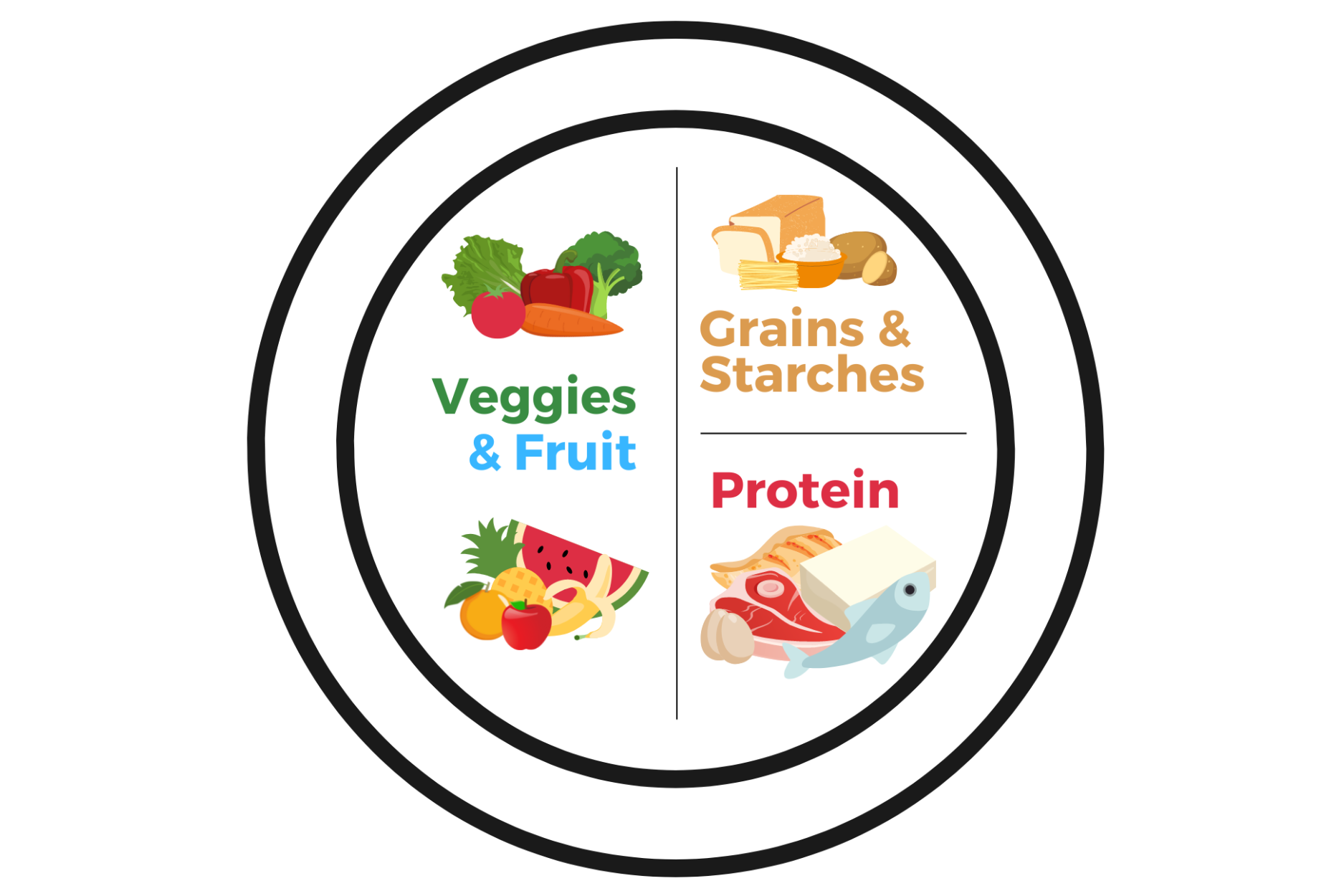
On half of your plate, fill it up with 1-2 servings of vegetables. On the other half of the plate, split the plate between a lean source of protein and either a grains-based food or starchy vegetable.
What I love most about the Healthy Plate model is its simplicity and adaptability. The Healthy Plate model encourages you to “plug and play,” using what you have available. Keeping the Healthy Plate graphic in mind, there are infinite combinations of healthy meals that you could create. All you have to do is know your food groups:
🍖 Protein: On at least a quarter of your plate, include a lean source of protein. Protein is both a source of energy for your body and a building block for your body tissues (like muscle). Eating a high-protein diet will help your body to more efficiently build muscle and keep your metabolism boosted (high-protein in this context means 20% of your daily calories come from protein). Prioritize lean sources of protein–items that come with little to no saturated fat like white meat (chicken breast & turkey breast), egg whites, fish, plant protein sources (tofu, tempeh, & edamame), and lean cuts of red meat.
🥦 Veggies (Vegetables): On half of your plate, include 1-2 servings of veggies. Veggies (or vegetables) are plants (or parts of plants) that you can eat. Fruits and grains are also plants, but we usually reserve the term “vegetable” for specific parts of the plant like the roots (like carrots and turnips), leaves (like lettuce and spinach), stems (like celery), bulbs (like garlic and onion), and flowers (like broccoli). Veggies are a great source of carbohydrates and healthy fats (i.e., unsaturated fats).
🌽 Grains/Starches: On the remaining quarter of your plate, include a grain or starchy food. Grains are essentially seeds and include foods made from wheat (bread & pasta), rice, quinoa, and oats. Try to include whole grains as much as possible (things like brown rice, oatmeal, whole wheat, quinoa, etc) in place of refined grains (white wheat, white bread, or white rice). Whole grains are more generally more nutritious, having more vitamins, minerals, and dietary fiber than refined grains.
Some vegetables (like potatoes, corn, yuca, and plantains) are high in Starches (complex carbohydrates). Starchy vegetables tend to be high-calorie, and may not be suitable for every diet (for example, people with Type II Diabetes may want to avoid them). These kinds of vegetables should be limited to no more than a quarter of your plate, especially if you are trying to burn fat.
🍎 Fruit: Fruits are plant products that tend to be higher in sugar content, giving them a sweet taste. This group is optional and can take up 1 portion of the vegetables side of your plate. They include things like berries, cherries, apples, grapes, pears, and mangoes. The higher sugar and calorie content of fruits make them a food to be eaten in moderation–no more than a quarter of your plate at meal times.
Give yourself time to practice and master building a Healthy Plate at every meal. If you feel overwhelmed, I suggest starting with just one meal a day. For example, you could say “At lunch time I’m going to follow the Healthy Plate model and eat like I normally do for breakfast and dinner.” Once you feel more comfortable with following the Healthy Plate at lunchtime, then you can begin to work on making your dinners follow the Healthy Plate model.
Another way to gradually “stack” this behavior is to break the Healthy Plate model down into its different food groups and work on adding just one at a time gradually to your daily diet. For example, you could say “I’m going to add a serving of vegetables at lunchtime” every day until it becomes a habit. After that, you could say, “I’m going to focus on getting a good source of protein in my lunch every day.” Once that habit is established, you could say “Now I’m going to focus on getting whole grains into my lunch every day.” So on and so forth.
The Healthy Plate model is a great place to start when it comes to cleaning up your diet. It will allow you to give your body the much-needed nutrition it needs to look and feel its best.
Many people make a ton of progress in their fat loss journeys by following the Healthy Plate model alone. However keep in mind that if you hit a plateau (i.e., stop making progress), then it may be time to consider tracking and managing your calories and macros.
When you’re ready to dive into calories and macros, you’ll need to track what you eat every day. But don’t feel like you have to track what you eat if you don’t feel ready for that yet! Just focus on the Healthy Plate model first.
If you’d like more support, check out my Healthy Diet Makeover program where I’ll walk you step-by-step through cleaning up your diet in more detail. In this program, I’ll teach you how to incorporate the Healthy Plate Model, set a calorie & macronutrient goal, and plan your meals around your goals. Click below to learn more:

Healthy Diet Makeover
Clean up your diet in 5 simple steps with nutrition coach Jayd Harrison.
Step 3: Add Workouts
Once you have a well-established routine of getting active every day, you can take your activity to the next level by turning some of that activity every week into workouts.
“Workouts” are just sessions of focused exercise. There are many different types of workouts, and some are better than others at helping your body to burn fat and build muscle.
I suggest turning 2 or 3 of your activity times each week into mobility & resistance training workouts. These workouts will help to improve your coordination, balance, and flexibility while combating the loss of lean muscle tissue that often happens when you lose weight.
Check out my series of guided workout videos on my vimeo channel if you’d like to learn how to tone your body and get strong:

Body Sculpt
Build strength and tone your body with expert-guided workouts by Jayd Harrison.
It takes a lot of brain power to incorporate new habits—so give yourself time in each step. With enough time and consistency, you’ll reach a point where you’ll be able to do each thing without having to think about it too much or push yourself to show up as much.
You’re not going to be perfect, but you don’t have to be. Just focus on doing 1% better every day 😊
And remember—I’m here to help. Come hang out with me while I’m live on my Twitch channel throughout the week. You can also connect in the Coaching Corner Discord server to find community and get your questions answered there. Check out the programs mentioned above if you’d like more help on eating better or working out.
-
(00:00):
If you don't make lifestyle changes and you're not constantly being aware of how you're eating and if you're not constantly managing an active lifestyle and living an active lifestyle, what happens with a lot of people is they finish their program, they reach their fat loss goal, and then they go back to what they were doing before they went on their program. That is why so many people end up gaining all of the weight back, they end up gaining all of the weight back, or even worse, they gain the weight back and then they end up heavier than when they lost all of that weight. And the problem is that they go back to the lifestyle that yielded a body that they weren't happy with. So again, there's no quick fixes. You can't just go on a fat loss diet or get into this workout program for a year, finish it, and then just go back to where you were before and expect your body to stay what you just earned. If you continue to engage in the types of lifestyle choices that yield weight gain or that make your body unhealthy, then of course the weight is going to come back.
(01:20)
Hey there, I'm Jayd Harrison, AKA Jaydigains, and welcome to the Coaching Corner Podcast. I'm really excited about today's episode because in it I'm going to share with you the three steps that I use with my clients to help them to achieve sustainable fat loss and build a body that they love for life. If you have tried to get in shape in the past, you've probably gone on a short-term diet that has you eating a super low number of calories, or maybe you've tried a cleanse that had you eating a super restricted diet of just a handful of things, or maybe you have tried a really extreme workout program that had you killing yourself in the gym and working really, really hard to get a sense of having a good workout and getting your butt kicked. I have been a personal trainer for 10 years and I'm here to tell you that there is another way You do not have to starve yourself or kill yourself in the gym to achieve a body that you love.
(02:17)
So today I'm going to share with you the three main action items that you need to take to build a life that supports a body that you love. Remember that your body is a reflection of your lifestyle. So if you go on and off extreme diets, on and off workout programs, you're going to really struggle to see sustainable progress. But if you followed these three steps that I lay out in today's episode, you're going to set yourself up for success. And not only that, you're going to keep that success for a longer period of time. This episode was recorded while I was live on my Twitch channel, which you can check out at twitch.tv/jaydigains. I go live throughout the week in the fitness and health category, and I also play some games there. So come and hang out anytime. Also, keep in mind that I do have an email newsletter. Make sure that you sign up for that at jaydigains.com to get notified when I post new episodes to the podcast, and you'll also get some discounts and news about different services and products that are coming this way. And without further ado, let's get into this episode and learn the three steps to set up the ultimate fitness journey.
(03:31)
A super common problem that a lot of people experience when they first try to start their fitness journey is they try to just do all the things at once. They try to do too much too soon, and this causes a lot of problems, like it can cause you to burn out, it can cause you to feel overwhelmed, and that overwhelm paralysis super, super common. So when people come to me to work with me as a personal trainer, a lot of times that's where they're coming from. Is this like I've been trying to do it on my own, I'm overwhelmed. I don't know what to do, I don't know how to sort through all of this stuff. I'm going to break down today, the framework and the process that I use to help my clients to go from never having worked out ever before in their lives to getting into a steady routine that's going to sustain them and help them reach their goals.
(04:20)
But when it comes to getting in shape, there are no quick fixes. Okay? There's a lot of fitness influencers out there. There's a lot of content out there that will kind of sell you this idea that, oh, you just do this one week detox or this one week cleanse, or you do this short workout plan that's only a couple of weeks and you'll burn all of your fat and you'll be good to go and you'll have a body that you love that is not the way to build a body that you love. That's a way to burn out, get injured. And a lot of times when people do these short-term detoxes or short-term cleanses or whatnot, a lot of times what happens is they might lose a lot of weight really, really quickly. Some of that weight is likely going to be water weight, especially if you're, if you've changed up how you eat drastically and you've cut out processed foods or simple carbs or high sodium foods, your body is going to retain less water, so it will weigh less and you may burn some fat.
(05:23)
But a lot of times with these crash diets where you drastically reduce what you're eating, they're not sustainable for the long run, and that's the problem with them. They're not sustainable. And what happens to a lot of people is that they do the detox, they do the whole thing, they may lose some weight, and then they go off of the detox or the cleanse and then they go right back to what they were doing before. And for a lot of people, what this means is that all of the weight comes back, or worse, the weight comes back with more weight, then you end up heavier than what you started with. And this is a really common pattern. And then what people will do is like, oh no, I need to do that again. And so they'll go on their crash diet a couple weeks later and they'll do it again.
(06:05)
They'll lose a bunch of weight and then they'll go off the diet and then they go back to what they normally do, and it's just over time they are getting heavier in the long run. So if you want to break out of this kind of binge restrict pattern, the best thing that you can do is set yourself up with something that you can sustain without having to go on and off diets. So what you want to do is build up kind of an approach to eating and an approach to exercise that you can sustain most of the time without having to starve yourself or without having to go without your favorite foods or killing yourself in the gym to burn off the calories that you eat, which you want, is to build something moderate and sustainable, and I can help you with that. So this is the approach that I use to help people to build little bit by little bit step by step by step, a healthy lifestyle that will allow you over time to build a body that you love.
(07:04)
So the best way to do it is to slowly build out a lifestyle that supports health, wellness and your body weight being where it needs to be in order for it to be healthy. The first step to building a healthy lifestyle that actually sets your body up for success is to get active. This is one of the easiest, quickest things that you can start to incorporate in your day-to-day life that can yield pretty substantial results. I know a lot of people who are able to just incorporate more walking into their life, just get moving, or they go for a walk for 30 minutes a day, something like that. And if you have just been doing no activity, if you just sit all day for work and then you sit when you come home from work or you get off work and you start building in some activity, what you're going to do is you're going to get your body burning more energy and you know what body fat is, it's your stored energy.
(07:58)
So as your body energy expense goes up, it's going to be more likely to tap into its energy stores. So a lot of people without making any other changes, are able to make substantial progress in their fat loss by just getting up and getting moving every day. So get active is what I recommend as the first step because this is also going to help you to build this sense of daily habits. Daily habits and lifestyle are what build up to a body that you love. What are you doing every day or what are you doing every week? So you can start to kind of build in this sense of I do something every day for my health, even if it's just one time a day, I'm doing something for my health, which is going for a walk, going for a swim, walking my dog, going, putting on some music and having a little dance party in the living room.
(08:47)
Do something that gets you up and active, even if it's just once a day, because what we're going to do is what we call stacking habit. Stacking is when you're just trying to incorporate one habit at a time and allow it to become a habit, allow it to get fully immersed into your lifestyle and how you just run your life, and as it becomes a habit and you don't have to think about it as much anymore, then you can add other stuff rather than adding in everything at the same time and overloading your system. So it's kind of like a little bit by little bit adding more stuff into your life. So getting active can look like one of two main ways that I usually encourage people to start getting active. One is that you can set a daily step goal for yourself. A daily step goal is one where you're actually keeping track of how many steps you take.
(09:38)
So if your goal is to get up and moving more and go for walks or walk more in your everyday life, setting a steps goal can help keep you accountable to this. So you can use a fitness tracker. I have an Apple watch. A lot of my clients use Garmin or Fitbits, right? You can also just get a cheap little pedometer that clips on your pants and it will count your steps, and if you have a smartphone, you can actually set your smartphone to track your steps. If you keep your phone on you, it's not going to be quite as accurate as using a fitness tracker device or a pedometer, but it's something. So track your steps in some way and set a daily goal for yourself of how many steps you want to take. If you are completely sedentary and you don't get any exercise at all, or you're very out of shape or very overweight when you first start getting active, remember that a little bit is going to go a long way here.
(10:35)
Okay? Initially I would say figure out how many steps you take on an average day first. So kind of get a sense of go ahead and get your fitness tracker or set your smartphone or use a pedometer to track your steps, get a sense of what your daily step intake is to start off with, and then I would set a goal of doing more than what you do right now. I typically will break it down in three different levels. For level one, your goal is going to be to get 3000 to 5,000 steps a day, somewhere between 3000, 5,000 steps a day. That's going to get you to the point where you are at the minimal requirement recommendations. Find out for yourself how many steps you take, and if you are getting 1000 steps a day, I would start with that level one goal, 3000 to 5,000 steps.
(11:23)
If you're already getting somewhere between 3000 and 5,000 steps, then shoot for between 5,000 and 7,000 steps a day. A level two goal, if you are already somewhere between 5,000 and 7,000 steps, then you can set a level three goal, which is between 7,000 and 10,000 steps a day, right? So you're setting a goal for yourself to move more than we already are, and this is a great way to do it. Give yourself at least a month to practice this to try to reach these step goals, this step goal every day, try to give it at least a month and that alone, you'll already notice that you're able to improve your health. You might be feeling more energized. You might start to lose some fat from that as well. You might also be sore. You might build some muscle from that because if you're going from very little activity, anytime you add in more activity, you're going to be challenging your muscles.
(12:15)
So you're going to be getting a little bit of strength in there as well by getting active more. So that's one way. Another way is to set a total minutes goal, and you can do this for every day or for every week total. The American Heart Association recommends getting a minimum of a 150 minutes total per week of moderate intensity activity or exercise. So moderate intensity activity or exercise is any activity or exercise that gets your heart rate up. Specifically if you're tracking your heart rate, you want it to be 64 to 76% of your maximum heart rate, and you can break up these 150 minutes, however works best for you. You can set a daily movement goal of getting 15 to 20 minutes in every single day, or you can say, on five days a week, I'm going to get my heart rate up for 30 minutes.
(13:04)
If you only have three days that you can exercise, then you'll say, okay, I'm going to go on a walk for 50 minutes, five, zero or almost an hour, and you can break it up however you like. Again, you want to kind of figure out what your starting base level is and kind of set your goal to something that's a little bit above that so that you're reaching a little bit further above what you already are doing. So I would start with 150 minutes total and try to get that in every day or a couple days a week. I'm going to tell you one thing to keep in mind is the more frequently you move, the better it's going to be for your health. You could technically do all 150 minutes in one day by going on this big walk over the weekend, but it's actually going to be better for your long-term health.
(13:44)
If you spread those minutes out and you get moving and get active a little bit every day, that's going to be best because especially when it comes to building habits, we're trying to build habits into your everyday life. Setting a movement goal for five to seven days a week is going to much better help you incorporate the future healthy habits that are going to help you build that body that you love. I have a little list of ways that you can increase your steps or just get more active if you usually use the elevator, if you live on a top floor of an apartment building or if you work in a higher floor, try taking the stairs instead of taking the elevator. That's going to help get your heart rate up. It's also going to give you more steps in your day-to-Day life. You can also park further away from the store or from work so that you get more steps in as you're going to the place between the place and your car.
(14:37)
If you do commute to work and it's close enough, you could also try an active way to get there. If it's close enough for you to walk or bike or skateboard, then start considering other modes of transportation that are more active. And the same goes for going to the grocery store or somewhere else that you frequent. If you can walk there or cycle there, if it's safe, if you live in a safe place for you to be able to do that, then try to do that more. That will get you more activity in your day-to-Day. Life Desk exercises is another one. I encourage my clients to break up their workday throughout the day. Set a timer for an every hour, hour and a half to two hours. When that alarm goes off, you can step up and just pace a little bit, do some stretches, get moving just at your desk just to get some blood flowing.
(15:26)
That's going to help increase your daily calorie burn. It's also going to help you to get more active. Take some walks throughout the day as well. You can take a break if you can from your work. Take a break and every hour or two get up. Go for a little five minute walk or on your lunch break, eat your food, and then go for a 20, 30 minute walk afterwards. That's going to help you. Let's see. You can play with your pets. That's one of my favorite ones. Or garden. Just try to look for ways to when you get off of work or when you're not working to do activities that keep you up and moving for fun. So gardening is one of my favorite activities that gets me active where I'm moving around a bunch or playing video games that are movement games or rhythm games like Beat Saber.
(16:11)
Nintendo has a bunch of fitness games as well. You could also join a kickball league or a softball league. I have clients who play cricket. That's a great way to socialize, but be active. Using a standing desk can be helpful, but only if you're moving around a little bit here and there. Again, whether you're doing a seated or a standing desk, you want to get moving and get that blood flowing every hour or two. You could also take some classes like some exercise classes or martial arts classes so that you learn a new active skill. Start learning a new active skill like Brazilian Jiu-jitsu. Why Thai boxing or some other skill that's active. Taking a class like a workout class is another great way to do this. However, I want you to keep in mind that you want to be careful of the intensity. Sometimes workout classes will make you work super, super hard.
(17:03)
I think body pump or bootcamps, these are the type of workouts that are really known for pushing you to the edge of your capacity, which can be really fun, but it's very easy to get hurt doing one of those. You don't necessarily need to do a crazy high intensity bootcamp style group fitness class. A cycling class might be good for you or a yoga class, something that's more gentle. You don't have to push yourself to the max in order to make gains. So just be mindful of that. If you are going to be taking some kind of high intensity class that really pushes you in the beginning, I would try to do that no more than once or twice a week. And then for the rest of your activity and exercise, do something that's more gentle. So go for walks, do yoga, swim or something like that, and then try to limit your really intense stuff to once or twice a week, otherwise you risk burning out or getting injured from overuse injuries because your body needs to be able to recover properly from the exercise that you're doing.
(18:07)
Your old pedometer feels like a lifetime ago. That was like a year and a half ago, right? That's when you started. Yeah, you crush it. PA grow. That was how you started your fitness journey, was just getting walking every day, right? I think I remember you walking to work and walking back from work, and that was the first step that you added in as well close to two years ago. Wow. How do you think starting with walking helped set you up for success for your fitness journey? In what way did that impact it's low impact? And if you're also monitoring how you eat, you can see the results. It demonstrates your actions matter. It shows you don't need to kill yourself to get results. Yes, yes. I love it. I love that for you. My personal favorite ways to get active, well, of course one is I love walking my dog.
(18:54)
I put on a podcast or a, what's it called, an audio book. So it is time that I don't feel like I am wasting. I'm not in front of my computer doing stuff. I don't feel not productive because I'm learning things that I need to learn in order to make progress in my business and be more effective. I mean, it's also a good brain break for me to be not in front of the computer. So that's my top favorite way to get active is walking my dog. And I try to do that for 30 to 60 minutes total a day, but I usually break it up in two or three different walks. I also love putting music on and just like dancing, especially if I'm cooking. If I'm cooking, I like to put music on and just kind of like dance as I cook. That's another favorite way to get active.
(19:39)
And also, I mean, my job is active. I train clients and I love it. I love training people. I love it. It's pretty low intensity, but it's constant movement because I'm demonstrating exercises. I'm standing, I'm walking around. I mean, I come alive when I'm teaching, which is one of the reasons why I think I will always have at least a handful of personal training clients always, because it does bring me so much joy. Even as my online business takes off, I so enjoy working with people and my online people too. I so enjoy helping people to get those wins and get those gains. But the one-on-one training sessions are, they're just so fun. They're fun. So activity, get your heart rate up, get moving. It all counts no matter what it is that you're doing because you don't necessarily need to even be in a gym to benefit your heart.
(20:29)
You don't necessarily need to go to the gym to actually start to build more activity into your life and become more healthy. And there's lots of reasons why different people don't like to go to the gym. So any activity that gets your heart rate up a little bit, think of it as a bonus. That's the place to start once you have kind of gotten into the groove of getting more active in your day-to-day life. Step two is cleaning up your diet because what you eat has a huge impact on how your body feels, how your body looks, your energy levels, how you recover from your workouts, and ultimately just the overall results. I mean, you can work out super, super hard every day of the week, and if you are not minding what you eat, your weight is going to go nowhere. You're not going to see results.
(21:23)
You're not going to see those muscles coming in because you're not being mindful of what you eat. So it's really important not only for the sake of getting into a calorie deficit for fat loss, but also just making sure that your body has the nutrients that it needs to stay healthy, because ultimately this is the goal is to build a healthy lifestyle. Our bodies look and feel their best when they're healthy. So health is the foundation here. So to clean up your diet, one easy peasy, lemon squeezy way to get started doing that is just to follow the healthy plate model. The healthy plate model is my take on the MyPlate or the Harvard plate model. So you can see here, this is from my blog. The healthy plate model is a picture of what your plate should look like when you sit down to eat a meal.
(22:11)
So this is something you can do without having to track your calories or track your macros. Generally, if you follow this model, you're going to be able to eat roughly the amount of nutrients and calories that your body needs to be healthy, which is a good place to start with the healthy plate model. You divide your plate in half at meal times and on one half of the plate, you fill it up with one to two servings of vegetables. And you want these vegetables to be like a variety, right? You don't want to eat the same vegetables every meal, every day, every meal. Variety is key here. So we can get a variety of nutrients. So we're talking broccoli, kale, dark green veggies is part of it, but also don't forget about beans, legumes, lentils, chickpeas, these kinds of things. Cucumbers, bell peppers. Think about eating the rainbow when it comes to your vegetables.
(23:08)
We want to eat the rainbow. We want to eat a variety of colors. We don't want to always be eating the same thing. Bodybuilders are notorious for eating, just like chicken, rice and broccoli every day for dinner or for lunch every single day. You don't need to do that, okay? You don't need to do that. Make it a variety. That's going to give you a variety of nutrients. You can do one to two servings of vegetables, or you can do one serving of vegetables and one serving of fruits. Fruits are things like grapes, cherries, strawberries, banana apples, oranges. So they have a higher sugar content. They taste sweeter. They are going to be a little higher calorie than most vegetables. So if you are specifically concerned with fat loss, I would keep this side of the plate just vegetables and only do fruit maybe once a day or twice a day, maybe no more than that on the other half of the plate.
(24:00)
You want to divide it between a good lean source of protein and either grains or a starchy vegetable. So lean sources of protein are going to be lean cuts of meat, white meat, poultry, right egg whites and vegetable proteins like edamame, tofu, Tempe, black beans. These are protein rich foods that are very low in saturated fats. Unsaturated fats are fine, but just keep in mind that we want to limit our intake of saturated fat with the grains you want to most of the time shoot for things that are whole grains. They're usually going to be labeled if it's made with whole grains. It's usually going to be on the label. These are things like whole wheat, quinoa, barley, and then starchy vegetables, which you can do instead of grains, which would be like potatoes or yams, squash, that kind of thing. So this is kind of an image of what you want your plate to look like.
(24:57)
And in general, if you follow this initially, after you have maybe been not eating so well, maybe you eat a lot of processed or packaged foods, a lot of high sugar foods, a lot of high sodium foods. If you switch to this model, it can help to improve your nutrition and your nutrient intake, and it might also help you. It's likely that it will also help you to burn fat because you'll probably reduce your calorie intake and give your body the nutrients that it needs and just the right amount of energy to be its healthiest. So this is a good place to start. Now, for some people, just by getting more active and following the healthy plate model, they're able to make a lot of progress in their fat loss journey, but also just like getting healthier. But especially if your concern is fat loss, eventually it may become important for you to consider your caloric intake, your calories.
(25:54)
This is not for everybody, and especially it can be really intimidating initially if you're a beginner to track your calories and then shoot for eating a specific number of calories. For a lot of people, that's very overwhelming and intimidating. In that case, I would say just try to follow the healthy plate model and just try to focus on increasing your veggies, increasing your protein, usually the parts that people struggle with the most. But eventually, you're probably going to reach a point where in order to continue making progress, you're going to need to consider how much energy you're bringing into your body every day, and is that energy matching up with your goals? I can walk you through the process of figuring out how many calories you should be eating every day and how to track your calories and how to plan your eating around your calorie goal.
(26:42)
In my Healthy Diet Makeover program, which is live now, you can find it, oh, stream elements, learn to eat better stream Elements. Just posted it in the chat. Learn to eat better with Jade's Healthy Diet Makeover program, which is live on Vimeo right now. So I go into much more detail in the lesson in the lessons calories count. So the first part of this program is how to eat the healthy plate model. And then once we get to get past that point and you want to go a little bit deeper, that's where we start to talk about calories. So the calories count intro, how to find your maintenance level, how to set a new calorie goal, how to reverse diet if that's something that you need to do, and then everything else kind of builds on that. So if that's something that you're interested in and you want to take that next step, I would suggest going to the Healthy Diet Makeover program.
(27:32)
But I'm going to leave it at that because what we're talking about is getting started as a beginner. So get the Healthy Plate model settled first, I would say. And then when you're ready to take that next step, you can join the Healthy Diet Makeover program and learn how to figure out how many calories you should be eating and balance your calorie intake. So those are the first two pieces. Get moving more, build a little bit more activity into your life, and then start cleaning up your diet little bit by little bit. You don't have to go crazy and do all the things. Just try your best to follow the healthy plate model. Try your best to get up and moving every day at your level. As long as you're doing a little bit more than what you were doing before, you're going to make progress.
(28:10)
I promise you, you'll make progress if you just start to do a little bit more than what you did before. And this is a huge mindset shift that you want to incorporate. If you want to have success and you want to build a body that you love for life is 1% better every day. You want to do 1% better than what you did the day before. Okay? If every day you try to do 1% better, make 1% better choices for your health, what you eat, 1% better choices for how much you get up and get moving, and by the end of the year, you're going to be 365% better than how you started. So try not to get too overwhelmed with this and just step by step by step, okay? And I got you. Okay? That's why I'm here. If you're feeling overwhelmed, that's why I'm here.
(29:00)
So let's continue to break this down into easy peasy, actionable step-by-step framework. Once you've got those two pieces in place and it's settled, it's a habit. You don't have to force yourself to show up as much because it's just part of what you do. It's just part of what you do. You get active every day. You go on a walk at lunchtime. It's just what you do. You don't even have to really sit with yourself and push yourself to do it. You just do it. It's just part of what you do. And also, you don't have to force yourself to eat vegetables or force yourself to put protein on your plate. It's just what you do. It's just how you think about food, right? Once you're at that place, you've got those first two steps in place. It's all a matter of refinement. From there, it's all a matter of turning up little knobs here and there, depending on what's easiest for you to manage at a given point and also according to what's important to you.
(29:59)
So the next little thing that I would suggest as your step three to building a fitness lifestyle and building a body that you love is to start incorporating actual workouts. Now, I know workout, but the word workout or fitness may seem like I don't want to do that because maybe your association with working out is super hard fitness classes like bootcamps or beach body type of thing. Maybe you've done group fitness for a while and you burned out on it. You don't need to do that. You don't need to kick your own ass. Remember, you just have to do 1% better. You just have to do a little bit more than what you did before. So when I'm talking about adding in workouts, for most people when they come to me, they're saying, I just want to burn fat and I want to be toned.
(30:47)
And by be toned, it means that they want to look like they've got some muscle. They want to look strong, but not like don't want to look like Arnold Schwarzenegger. They just want to look strong and healthy. So in order to be toned or look strong and lean, you don't have to work that hard. You really don't have to work that hard in the gym. In fact, a little bit goes a long way when you're doing resistance training. Resistance training is another secret elixir of building a body that you love. And resistance training is the type of workouts you're specifically trying to challenge your muscles to get stronger. Or I mean, you can do resistance training at home. You don't necessarily need to go to the gym. You can do it with body weight, you can do it with bands. A lot of times people do it with weights, weight training, or with machines.
(31:35)
But the whole point is that you're challenging your muscles to encourage them to get stronger. And resistance training, you don't need a whole lot of it to go pretty far, especially as a beginner, you only need to do two or three times a week. So you can take that activity time that you set aside for yourself as you've built up your activity levels for on two or three of those days, make your activity an actual resistance training workout. And for that, I have lots of resources for that. I would be careful about following along with just looking up workouts on YouTube, because a lot of times the workouts that you're going to find on YouTube are going to be more cardio than anything else. They're going to try to get you to burn a lot of calories. Our goal is not to burn a lot of calories within the space of the workout.
(32:20)
Our goal is to build muscle that is in the long run, going to make your body burn more calories. So it's kind of a time investment. It's kind of an energy investment. I have some programs that if you are interested in learning how to build muscle, I have my Vimeo guided workout videos. So you can go to my Body Sculpt program on my Vimeo channel. I also have workout plans on the Trainerize app. You can follow along with the workout plans that are specifically for teaching you how to do resistance training, and I have beginner level workouts that are available there regardless of what equipment you're using, whether you're just using bands, minimal equipment, or if you just want to learn with weights or if you have access to a full gym, there's several six month programs that will take you from zero to now on building muscle new workouts every single month.
(33:08)
The cool thing about those, especially working with the app, is that you can track your progress, which is something I encourage you to do is track your progress, track how much weight you're using for the different exercises or what bands you're using. Track how many repetitions you do in each set so that you can kind of see yourself as you make progress and get stronger, because that is going to be one of the key ways to keep you motivated as you build your healthy fit lifestyle, tracking your progress, seeing the data of like, oh, I was only able to use 10 pounds on my squat at the beginning of this, and now I'm squatting 60 pounds or something like that. Now I'm squatting 200 pounds maybe eventually. So seeing that progress can be very, very motivational. It's very helpful. So I have a bunch of information.
(33:56)
I have a bunch of programs that you can try, but the goal of resistance training is to challenge your muscles to stimulate muscle growth so that you get stronger and you can get that toned body. Don't be afraid that you're going to blow up and look really, really big and turn into a bodybuilder overnight. This is a common fear that a lot of women have. It's just not going to happen, okay? It's not going to happen. Even if you are trying to make it happen like me, even if you want big muscles like me, it's very, very hard. It takes a very, very long time. It takes eating a specific way, and it takes working out in a specific way, my friend. It is just not going to happen. Even if you want it to. It's hard even for men to build muscle and their bodies are the best equipped for that.
(34:44)
Their bodies are set up the most to be able to build muscle the best, and even men struggle with it. So if you're worried about getting too bulky, I promise you it's just not going to happen. If you do want to build big muscles, feel free to talk to me. I can help you with that. There's a specific way to do it, but you do need to get your foundation settled. So I would still go with one of my workout programs either on Vimeo or Trainerize, because you need to get your foundations first. You need to get a foundational level of strength and technique, and those programs will help you because that really is the next step. And once you start doing that, I promise you, you're going to be set for life if you can maintain this. Step one, step two, step three.
(35:24)
Step one, get more active. Step two, clean up your diet. Step three, do some resistance training. A couple times a week, you will be able to build a body that you love. Those are the foundations, and from there, it's just a of turning some dials up, turning some dials down, fiddling a little bit with the details, but this framework is going to sustain you for life, but you have to be ready to commit to maintaining this for life. It's not just that you add this step one, step two, step three, and then you just do that for a couple of months, and then you go back to what you were doing before. If you go back to what you were doing before, then your body is going to return to what it was before. Okay? Our bodies are smart, smart systems. They will yield results of whatever stimulus we give them.
(36:13)
So if you continue build a lifestyle where you're habitually giving your body the type of stimulus that it needs to build muscle, burn fat, have energy, fight off infection, which is what these three steps will allow you to do, if you commit to maintaining that for life, it's not actually that hard. It's hard initially because changing anything about our habits is always going to be hard, but once you get those habits established, you don't even have to think about it anymore. How awesome would that be to have a body that you love that you're able to maintain without feeling like you're depriving yourself or starving yourself or forcing yourself to do things that you don't want to do, because all of these things are just habits that you just do, just like going to work. Although I would say for a lot of people, going to work is something that you have to force yourself to do, but they become so ingrained into what you do that it doesn't become so much of a heavy weight.
(37:11)
So it may be overwhelming now, and if that's the case, I would say step one, just focus on one step at a time and have it stack just one thing at a time, step by step. Start with step one, one, step one feels like it's established. Then you move on to step two. Once step two feels like it's established, then you move on to step three. If you want to go crazy and you're super excited and you want to do all the things, feel free to try to do all three steps at the same time. Nobody's going to stop you. You're the hero of your journey. The world is your oyster. Do whatever you want. You're an adult, okay? Just keep in mind that the more things you try to do new at the same time, the less frequently you're going to be able to do it just right, right?
(37:56)
You're going to mess up a lot. Just know going into it that you're going to drop the ball a lot because you're learning and it's okay. Some people perform best when they feel overwhelmed or overloaded. They give themselves a lot to do. Just be patient with yourself. Let yourself be bad at it for a while. Just keep trying, keep trying, keep trying. Just give yourself, I say promise yourself for three months, you're going to try three months to incorporate this. Step one, step two, step three. Give yourself three months to try it before you say, this is garbage. This is not going to work for me. Give it three months of trying. Let yourself fail. Do something different. Okay? If you don't like what you see in the mirror, if you don't like how you feel in your body, then you have to do something different.
(38:47)
So give it a try. Let me know how it goes, and if you have any questions, thank you so much for watching or listening to this episode of The Coaching Corner podcast. I'm Jayd Harrison, AKA, Jaydigains. If you'd like more information on the content that I create or my coaching programs, check out jaydigains.com. You can also join the email newsletter to stay up to date on what I have going on in the Jaydigains community. And if you would like to join me while I'm live on my Twitch channel, make sure to follow me at twitch.tv/jaydigains. Now, I'll see you in the next episode. Make sure that in the meantime, you stay hydrated, drink some water, eat veggies, eat protein, and prioritize your self-care. I'll see you soon.

ABOUT JAYD HARRISON
Jayd Harrison (Jaydigains) is a personal trainer and content creator. She helps people to build muscle, burn fat, and clean up their diets with her online coaching programs and social media content. Check out some of Jayd’s coaching videos on Youtube, or join Jayd live on Twitch and follow on social media:
Sign up for updates ✉️
Sign up to get notified whenever new episodes drop. Opt in for more tips on training, fat loss, and nutrition by filling out the form below:
Your privacy is important to me! I will never share your information with any third party. Unsubscribe from the email list at any time.
Episode 10: Build a Healthy Mindset
In this episode, I talk about the essential mindset shift you need to make if you want to achieve long-term success in your fitness journey. Cultivate a mindset of body positivity that keeps you motivated as you build a body you love.
Kick negativity to the curb in this heart-to-heart mindset chat.
In this episode, I talk about the essential mindset shift you need to make if you want to achieve long-term success in your fitness journey. Cultivate a mindset of body positivity that keeps you motivated as you build a body you love.
Links:
-
(00:00):
I think that the first thing that you need to do is start to cultivate a mindset of body positivity in the sense that you tell yourself, I'm going to take the best care of myself that I possibly can.
(00:21)
Hey there, friend. Welcome back to another episode of the Coaching Corner podcast. It's been a minute since I last posted to this podcast and I want to let you guys know that I have been thinking about you every single day. Long story short, this has happened several times over my career as a personal trainer over the last 10 years, but I always reach this point where I'm maxed out in terms of how many clients I can take on, but I want to be able to serve my community with more resources that you guys can use to put your healthy fitness lifestyle into action. So I have been working on distilling my coaching that I give to my one-on-one clients into several different formats that you guys will be able to use to help move along in your fitness journey. So I've got courses coming along as well as follow along workouts on my Vimeo channel, as well as some books and workbooks that you guys can use.
(01:21)
All of that stuff has taken a lot of my time, so I apologize for not being more present here, but I promise the time has been well spent and we've got lots of goodies coming your way. So don't worry, we are getting back on track with regularly coming out with new episodes of the Coaching Corner podcast, and I am still showing up live on my Twitch channel a few times a week to answer your questions and create new content. Make sure though that you have subscribed to my email list because that is where I'm going to be sending a lot of the goodies and announcements as these things come out. You can go to jaydigains.com or jaydharrisonfitness.com. Make sure to also subscribe to this podcast wherever it is that you listen to your podcasts or subscribe on YouTube if you're watching me there.
(02:08)
Now, today's episode I'm super excited about because we are starting back up with a bang moving forward with the Coaching Corner podcast. I'm going to be giving you guys tons of tips on how to implement healthy habits into your life to improve your relationship with yourself and improve your relationship with your body as we move along. This episode was recorded when I was live on my Twitch channel. You can follow me on Twitch. That's twitch.tv/jaydigains. If you'd like to hang out with me while I'm live and ask your questions there. So without further ado, let's get into the episode.
(02:44)
I tell my clients, they always come to me with these ideas of like, I want my arms to look like this, and I want my belly to look like this, and I want my legs to look like this. Instead of focusing on trying to get our bodies to look a specific way, like that one fitness influencer or that one model, what I teach my clients is, first of all, let's focus on health.
(03:06)
A lot of things that you're doing right now that are not healthy and the result of those things is the way that your body looks and how it feels is in a lot of ways, things that you don't like. So I say, let's first focus on getting healthy, doing all of the things that your body needs in order to be its healthiest and however it is that your body looks when it is at its healthiest is how it should look, and your body will reveal to you what it's supposed to look like once you have all of those things in place where you are living your healthiest, when you're eating your healthiest, when you're exercising in a healthy way, when you are drinking plenty of water, when you're sleeping as much as you should, when you're managing your stress, what your body looks like at that point is how it should look when your body is at a healthy body fat percentage.
(03:58)
We can't tell our body where to store fat and where not to store fat. For some of us just genetically, we're going to be more predisposed to our body, storing more fat in our bottoms or up top, and we can't really change those genetics. But what you can control is the health of your lifestyle and how you eat and how you exercise. And I would challenge you to start trying to absorb the idea of I'm going to love my body and I'm going to appreciate my body and how it looks when I'm taking the best care of it that I can, and however it looks when I'm taking the best care of it that I can is how it should look. And I love it for that, right? I think that we need to approach it is more of a body positivity type mindset, but not the type of body positivity that says, oh, it's totally okay that I am unhealthy.
(04:58)
I mean, it is okay. I mean, at the end of the day, you're a grownup. Do whatever the fuck you want it is your life. But if you're unhappy with how, look, if you're unhappy with how you look now before you've made any healthy changes to your life, it's still very possible that you could be unhappy with how you look even when you are your healthiest because you may have a poor relationship with yourself and you may just always be wearing these lenses of looking at yourself, picking apart the things that you don't like. Because I'll tell you right now, there's bodybuilders who have gorgeous aesthetic bodies, and when they look in the mirror, they're looking for their faults and they've already decided in their mind to look for their faults. And so even though they had these beautiful bodies that are sculpted and amazing, they still don't like themselves very much because their relationship with theirselves has not changed.
(05:50)
So I can absolutely help you to change how your body looks by getting healthier, and I can help you to get the most toned or lean and just healthy looking. But if you don't do the inner work to change your relationship with yourself and to question and challenge the beliefs that you have about your body and about yourself, you're going to be right back where you started. Maybe you'll look different, but in terms of how you feel about yourself, nothing will have changed. So I think that the first thing that you need to do is start to cultivate a mindset of body positivity in the sense that you tell yourself, I'm going to take the best care of myself that I possibly can. We're not going to work out to punish ourselves. We're not going to starve ourselves to punish ourselves for how we look or for overeating.
(06:45)
Our mindset going into this journey is going to be, I'm going to learn to take the best care of myself that I possibly can because let's be honest, nobody else is going to do that for you. Almost all of my friends have small children. Almost all of my friends have babies. I'll be bouncing little Kai on my knee and just looking at him or little Addie or little Annie, and I'm just like, how amazing it must be to just have a giant person totally in tune with your needs, just taking care of you When you're unhappy, you need a nap, you need to eat something, maybe you need some exercise, you need to get your wiggles out. There's some giant person who can be like, you know what? Let's go outside and play. Let's have a snack and then make you a snack and orchestrate your day.
(07:35)
But as adults, we don't have that. There's no giant person who's going to take care of us unless you're in a particular kind of relationship, but for most of us, you are it. You are the big person in your life. You're the person who has to take care of you, and nobody is going to do it better than you because you alone are able to be in tune with what you actually need. Once you learn how to listen to your body and trust it, to tell you what it needs something, once you learn how to listen to your body, once you learn how to listen to your brain and to your central nervous system, then you learn how to take better care of yourself. So we want to enter into this journey with this mindset of, I am going to take the best care of myself that I can and I'm going to learn how to take better care of myself, and as I learn to take better care of myself, I'm going to take better care of myself.
(08:31)
So that's kind of the mantra that I want all of us to have as we enter into this journey of trying to eat better or into this journey of trying to exercise and just take care of ourselves. The whole point is why you're here. Why you want to start eating better is because you want a better life. You want to thrive, but you're not going to thrive if you make all of the changes that I teach you how to make and you haven't changed your relationship with yourself, and you haven't changed how you see yourself and see your body. So moving forward, we're going to try to fix that mindset. We're going to cultivate it. We're going to practice things to ourselves. We're here to take the best care of ourselves that we can. I am the only one who can take care of me, so I'm going to strive to take the best care of me that I can, and I'm going to keep learning how to take better care of myself.
(09:22)
So that's the first thing that I want all of us to think about when it comes to our fitness journeys. And I want us to try to move away from that shame-based mindset that everybody, if you've tried to get in shape before or if you tried going on diets or if you tried those crazy high intensity programs like beach Body or whatever, it's all about it trying to exhaust yourself. It's all these extreme things of, it's almost like you're going this, I got to punish myself. I got to whip myself into shape. And that is based on a really old fashioned authoritarian model of influencing, and it doesn't work. At least it doesn't work, and it's not healthy. If you want to establish a healthy dynamic with yourself or with any person, whether it's like your child or an animal, if you want to be in a relationship with someone and you want to have a good relationship with them, if you have a dynamic with that person of if they mess up, you're going to punish them and you're going to make them suffer, that's not going to be a healthy relationship.
(10:32)
And I'm sure you probably have been in relationships like that. Maybe you were in a relationship like that with your parents or with a romantic partner or with a friend. It doesn't feel good to be in a relationship with somebody who when you mess up and even if you mess up because you don't know better, you know that you're just going to be punished for it. All this does is create a cycle of fear and shame, and you cannot grow, right? You cannot grow in that kind of a context. So instead, if you want to develop a better relationship with yourself, you're going to have to develop some compassion for yourself. And self-acceptance, we're going to have to practice some self-acceptance. At the end of the day. Most of the time, people's behavior is driven by survival. We're all just trying to survive. We're all just trying to survive.
(11:24)
We're all just trying to stay alive from one day to another. And a lot of the behaviors that you have are likely coping mechanisms that you picked up at some point in the past, and they worked at some point in the past and helped you to survive from one day to another. Even behaviors like overeating and binge eating, a lot of times people engage in those types of behaviors because they are under extreme stress and they have no dopamine and binge eating or returning to food and comfort eating may be the only kind of comfort, the only relief from the stress of their environment or the relationship or whatever it is. So that behavior was a coping mechanism that helped you to survive this very, very stressful period. And the problem becomes when that coping mechanism no longer serves us. So if we want to switch that behavior, if we want to stop that behavior, we're not going to do it by causing more stress on our system, by shaming ourselves and punishing ourselves either by over-exercising or starving ourselves a bunch.
(12:30)
That's why people end up on these binge-restrict cycles, because you're not going to fix the binging behavior, which is a coping mechanism of stress by adding more stress to your life. Do you see what I mean? It's not going to work. So changing your relationship with yourself to where I want you to take this approach of I'm trying to build a healthy relationship with myself, one that is accepting of where I am, and also approach yourself with a little bit of gratitude because some of the behaviors that you have may have been the one thing that kept you alive at some point in the past. So in that context, they were a good thing. But now, once we understand, once we learn the role that those things played in our lives and keeping us alive at that time, we can give ourselves other options that don't cause these negative side effects like weight gain or messing up our insulin sensitivity, for example, with the example of overeating or eating lots of sugary food.
(13:30)
So just try to keep that in mind, these behaviors that you are struggling with with your eating, try to have a little bit of compassion for yourself because those behaviors at some point probably saved your life, or they at least helped you to survive something that you were going through that was really stressful or hard. But you can give yourself other options. And here's the thing is if you don't change that relationship with yourself and learn how to give yourself other stress relief mechanisms, you're going to find yourself falling back on those behaviors again and again and again because they're kind of programmed into your system at this point. So you're going to have to open your mind to maybe accepting these behaviors is like, yeah, this is something that I did and it helped. It did have its place, but I can grow and I can learn other coping mechanisms.
(14:22)
I can learn to self-soothe in other ways while I also learn to eat in a way that supports how I want to look and how I want to feel. So as I teach you how to eat better, I want you to really try to reflect on your current patterns and view them with compassion. You bored eat. Sometimes dopamine, dude, people with ADHD are really susceptible to this people with ADHD and people with autism, ASD, because it's stimulus, right? And a lot of times we need the stimulus or we think we need that stimulus, but when you learn how to give yourself other stimuli that help to give your brain the dopamine release that it needs, or to help stimulate you the way that you need in a way that you're not adding more calories than what your body needs or putting food into your body that isn't really good for you, you can learn other methods.
(15:21)
So that is the mindset shift that I just kind of want to introduce as we head into this journey of transforming our bodies and transforming our lifestyle around how we eat or how we exercise. We want to have that relationship with our body. We want to develop a healthy relationship with ourselves, and we want to approach ourselves with compassion and understanding while at the same time we're learning how to do better. Because you know what? In the past, if you had had access to the knowledge that you're going to gain through your time here, and if you were put into an environment that was healthy, you probably would've made different choices. You can only do so much with the information that you had at the time, so you did the best that you could with what you had. And a lot of these behaviors, they start as when we're children, right?
(16:17)
If you're a child in a high stress environment, that might be where you learn to stress, eat, or binge or restrict or whatever. And as children, we don't know any better, or even maybe later in life when you're a young adult and you're just sprung out onto the world, it's just there you go. Get a job and pay bills and whatever situation that these behaviors may have started and you were doing the best that you could with what you had at the time, and you might not have had the knowledge or the stability to be able to do better. And that's okay. It's okay. You're still alive, you're still here. So as long as you're still alive and you're still here, we can still do better. So we're going to learn how to do better, but I just want to make sure that we have that attitude moving forward or that we're going to try to practice having that attitude moving forward.
(17:08)
Thank you so much for watching or listening to this episode of The Coaching Corner podcast. Again, I'm Jayd Harrison, AKA Jaydigains. Make sure to stay subscribed to this podcast because I've got a lot more juicy content coming your way about how to eat better and exercise to build a body that you love. I'll see you in the next episode. In the meantime, make sure that you are eating your veggies, eating your protein, drinking water, and prioritizing your self-care. And I will see you soon.
ABOUT JAYD HARRISON
Jayd Harrison (Jaydigains) is a personal trainer and content creator. She helps people to build muscle, burn fat, and clean up their diets with her online coaching programs and social media content. Check out some of Jayd’s coaching videos on Youtube, or join Jayd live on Twitch and follow on social media:
Sign up for updates ✉️
Sign up to get notified whenever new episodes drop. Opt in for more tips on training, fat loss, and nutrition by filling out the form below:
Your privacy is important to me! I will never share your information with any third party. Unsubscribe from the email list at any time.
Episode 9: How to Combat Body Dysmorphia
Check out these tips if you’re struggling with body dysmorphia after losing weight.
Check out these tips if you’re struggling with body dysmorphia after losing weight.
One of the first things to happen when you stop eating a calorie deficit is that you begin to lose muscle definition. This can send some folks into a panic. They begin to think: “Oh no! I’m going to lose my gains and end up exactly where I started!”
If you’ve experienced that yourself, then make sure to give this episode a listen or watch it on Youtube.
Body dysmorphia is an obsessive preoccupation with perceived flaws in your appearance and body image. It makes it difficult to see your own body accurately since you focus on what you perceive to be flaws or defects.
People who have lost fat often experience body dysmorphia in the form of perceiving themselves as overweight or “fat,” even when they are within a healthy body fat percentage. They often struggle to see their own progress and are very sensitive to the normal, healthy fluctuations of body weight and size. Any slight change in their weight or waist size can send them into a panic or depressive state.
Hyper-focusing on the shape of your body or weight can negatively impact your motivation to keep going in your fitness journey—especially when it comes time to build muscle.
In this podcast episode, I talk about the importance of doing the inner work to develop a healthy relationship with yourself and your body to help combat body dysmorphia. Seeing a licensed therapist, journaling, and practicing mindfulness meditation are all great ways to develop a better connection with one’s self.
I also suggest focusing on celebrating your gains and the positive changes you’re making in your life to combat the inner critic. Use a journal or the ABC Trainerize app (if you’re subscribed to one of my workout programs below) to track your workout progress, stay disciplined, and identify obstacles.
-Jayd
ABOUT JAYD HARRISON
Jayd Harrison (Jaydigains) is a personal trainer and content creator. She helps people to build muscle, burn fat, and clean up their diets with her online coaching programs and social media content. Check out some of Jayd’s coaching videos on Youtube, or join Jayd live on Twitch and follow on social media:
Sign up for updates ✉️
Sign up to get notified whenever new episodes drop. Opt in for more tips on training, fat loss, and nutrition by filling out the form below:
Your privacy is important to me! I will never share your information with any third party. Unsubscribe from the email list at any time.
Episode 8: Tips for Staying Consistent
In this short episode, I give 3 main tips for building that consistency. When it comes to reaching your fitness goals, staying consistent over a long time is crucial!
In this short episode, I give 3 main tips for building that consistency.
When it comes to reaching your fitness goals, staying consistent over a long time is one of the most important things.
Quick-fix diets and intense workout plans might get you fast results--but these results rarely stick in the long term for most people.
If you want to burn fat and keep it off for good, you need to change your lifestyle to something you can sustain over the course of many weeks, months, and years.
First, I suggest that you get on a schedule. I'm a big fan of time blocking. Each week, I use an appointment calendar to block out my time for my workouts, personal training sessions, and other work. This helps me to stay organized by ensuring that I'm setting time aside for my workouts.
In addition to getting on a regular schedule, I also recommend getting onto an actual training program. Many people just show up to the gym without a plan and wonder why they never seem to make progress. Getting on a training plan will ensure that your workouts are the most effective for pushing you toward your goals. Check out my programs for beginners listed below!
If you struggle to stick to a schedule and training plan, I also recommend working with a personal trainer. Meeting with a personal trainer every week has helped many of my clients to stay consistent and make consistent gains. Look for a trainer at your local gym or check out my online personal training program.
Programs for Beginners
Check out my collection of DIY programs for building beginner strength, delivered via the ABC Trainerize app. DIY programs are $27 monthly, cancel at any time.
Beginner Body Sculpt Foundations (Bands)

Beginner Body Sculpt Foundations (Weight Training)
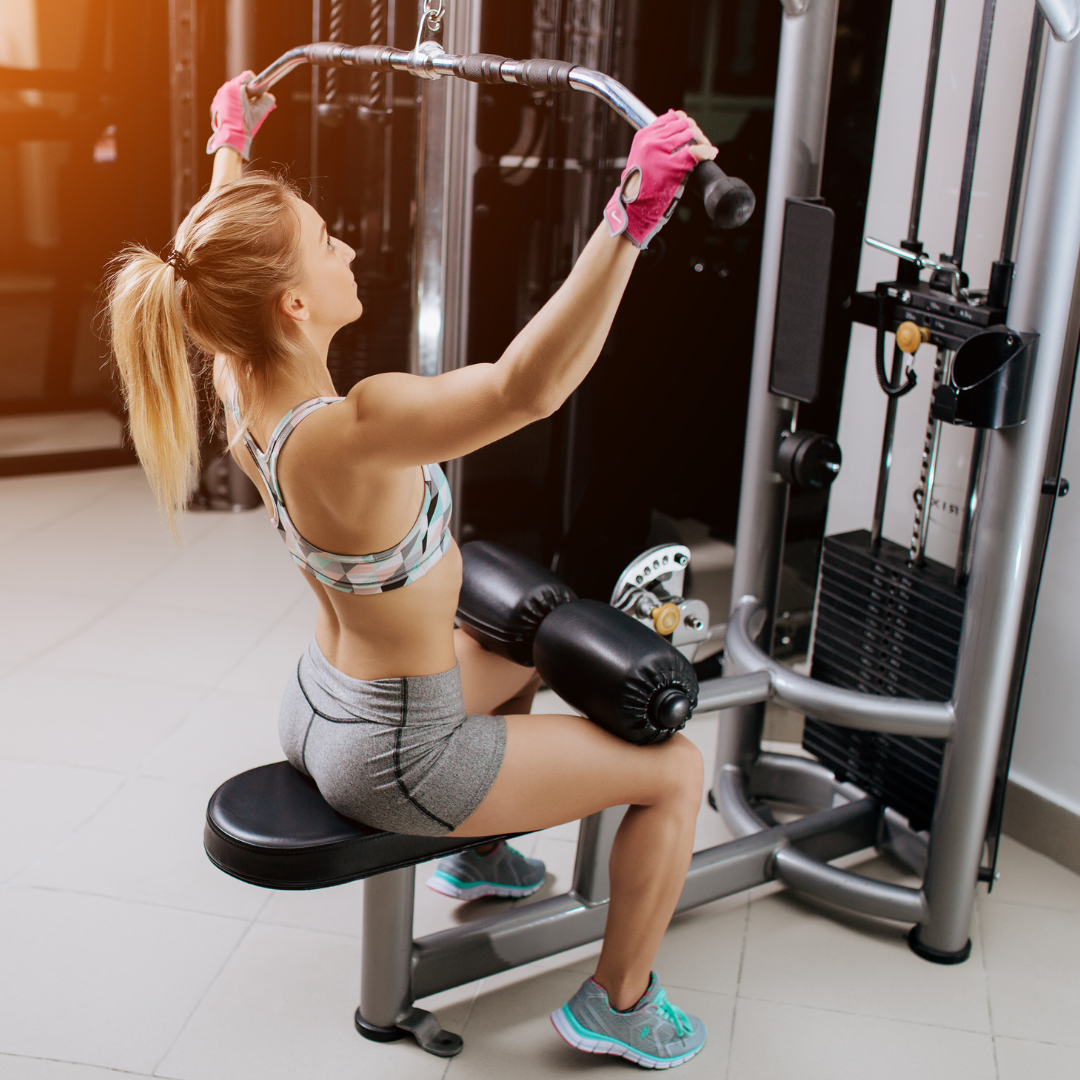
Beginner Body Sculpt Foundations (Full Gym)
ABOUT JAYD HARRISON
Jayd Harrison (Jaydigains) is a personal trainer and content creator. She helps people to build muscle, burn fat, and clean up their diets with her online coaching programs and social media content. Check out some of Jayd’s coaching videos on Youtube, or join Jayd live on Twitch and follow on social media:
Sign up for updates ✉️
Sign up to get notified whenever new episodes drop. Opt in for more tips on training, fat loss, and nutrition by filling out the form below:
Your privacy is important to me! I will never share your information with any third party. Unsubscribe from the email list at any time.
Episode 7: Tips for Building a Home Gym
Build your home gym one step at a time with my equipment suggestions. Start with resistance bands and progress to weights over time.
Build your home gym one step at a time with my equipment suggestions. Start with resistance bands and progress to weights over time.
I don’t know about you, but I’m not a big fan of big-box gyms. They seem to often be crowded and noisy—whereas I prefer to work out on my own in a quiet space. For this reason, a few years ago I turned my living room into a home gym and filled it with the equipment that I love to use in my workouts.
In this podcast episode, I give tips to help you build your own home gym as a beginner. You don’t have to go all-out like me and get a squat rack, barbell, weights, and cardio equipment immediately. In the beginning of your fitness journey, you can start building strength at home with relatively inexpensive equipment that doesn’t take as much space. Check out the episode and equipment list below!
Resistance Bands
The first thing I recommend you get for your home gym is resistance bands. These are relatively inexpensive and don’t take up much space.
if you don’t have much space available in your home, bands are a great option. You can just store them away in a drawer when you’re not using them—so you don’t need a dedicated “gym” room or area in your home.
Bands are also a great option if you’re a beginner to fitness. They provide a relatively safe way to learn resistance training exercise technique while building foundational strength.
Intermediate and advanced exercisers can also benefit from using bands—especially for muscle-building and strength accessory exercises.
There are 3 main types of resistance bands I recommend you stock up on: mini bands, tube bands, and superbands.
Mini Bands (Loop Bands)
These small, loop-shaped bands are great for exercises like monster walks, banded squats, and my favorite rear delt exercise—the single-arm high row.
I recommend getting a set that is graded for different resistance levels so that you can track your progress over time. Personally, I almost always recommend the Fit Simplify 5-pack of mini bands to start with. These bands are rated for different resistance levels, which allows you to better track your progress as you get stronger.
Tube Bands (Handle Bands)

Tube bands are great for many upper-body exercises. You can anchor the band to a door or hook in the wall for exercises like lat rows, chest presses, and pull-downs.
There are many brands and varieties of tube bands, however I recommend getting a set that is graded for different resistance levels. For instance, the set that I use is labeled from lightest to heaviest according to weight equivalence (10lb, 20lb, 30lb, etc). This will allow you to track your progress as you get stronger as over time you’ll need to use heavier bands.
Superbands (Monster Bands)
Superbands are long loop-shaped bands that are great for a variety of exercises like kickbacks, good mornings, deadlifts, and mobility exercises. You can also use them as support for pullups and other hanging exercises.
As with the other bands, I recommend getting a variety set of superbands that are rated for different levels of resistance. Some exercises you’ll need lighter bands whereas others will require heavier bands.
Floor Mats
Another great piece of equipment to include in your beginning home gym is an exercise mat. I recommend getting two types of exercise mats. First, you should have one that is thick and squishy to give some cushion to your body while doing exercises on the floor like crunches, bridges, and planks. Second, you should also have a thinner yoga mat that will provide some grip to your hands and feet—especially if you plan to do standing balancing exercises or work out barefoot.

Dumbbells
Dumbbells are my go-to recommendation for beginners to weight training. These handheld weights allow you to perform various exercises for your upper body and lower body, like dumbbell chest presses, rows, lateral raises, goblet squats, Romanian deadlifts, and weighted lunges.
For many exercisers, dumbbells are a staple equipment item that allows you to target different muscle groups for bodybuilding and strength accessories effectively.
I suggest starting your home gym with an adjustable set of dumbbells like power blocks or spin-lock weights. These don’t take up much room and will allow you to progressively overload your muscles with heavier weight over time.
Personally, I use spin-lock dumbbells, but I also have several clients who use some variation of powerblocks. The spin-lock weights are a little more time-consuming to adjust, but they do tend to be more solid than powerblocks.
Bench

It’s also a good idea to invest in a sturdy, adjustable bench. This allows you to perform exercises like chest presses, chest flys, and box squats.
I always recommend that my clients get a bench for their home gym that can lay flat or go into an incline or decline. This will give you more options for variations of exercises that will allow you to target different muscle groups.
Barbells & Plates
As you get more into intermediate and advanced training, having a good-quality barbell will be important for making gains in your home gym. The bands and dumbbells alone should provide enough resistance for you as a beginner to build muscle and get stronger for the first 3-6 months.
Eventually though, you’ll need more resistance to keep your muscles challenged. Barbells like the one featured below allow you to add significantly more weight to exercises by adding plates to the bar. You can use the barbell for exercises like barbell deadlifts, back squats, and bench press.
When you’re ready to get a bar, I recommend investing in a few sets of barbell plates as well. Start with 2 of each: 2.5lb, 5lb, 10lb, 25lb, and 45lb plates. This will allow you to progressively overload your exercises by adding more weight to your exercises up to 220lb total.
Make sure to also invest in a set of plate collars (also called locks or clamps). These secure the plates onto the barbell to keep your lifts safe and sturdy. I use a variety of collars, including plastic clip-ons as well as stainless steel weighted ones.


Squat Rack/Power Rack
Some barbell exercises (like squats and bench press) are much easier to do if you have a squat rack or power rack to hold the weight between sets. The Fitness Reality squat rack is a surprisingly inexpensive and good-quality rack that can be ordered from Amazon. Make sure to also get a set of J Hooks to hold the weight between your sets.

ABOUT JAYD HARRISON
Jayd Harrison (Jaydigains) is a personal trainer and content creator. She helps people to build muscle, burn fat, and clean up their diets with her online coaching programs and social media content. Check out some of Jayd’s coaching videos on Youtube, or join Jayd live on Twitch and follow on social media:
Sign up for updates ✉️
Sign up to get notified whenever new episodes drop. Opt in for more tips on training, fat loss, and nutrition by filling out the form below:
Your privacy is important to me! I will never share your information with any third party. Unsubscribe from the email list at any time.
Episode 6: When to Add More Weight to the Bar
Learn how to keep getting stronger by challenging your muscles with more weight over time.
To keep getting stronger, you need to challenge your muscles with more stimulus over time.
In this episode, I share valuable insights on how to determine the right time to progress in your training program, whether you're focused on muscle building or high-intensity strength training. Join me as I breaks down the key differences between these two approaches and explain how to gauge progress effectively.
This episode was recorded during a live stream on the Jaydigains Twitch channel. Join live streams every Tuesday and Friday on Twitch.
-
(00:00):
Hi there. Welcome to the Jaydigains Coaching Corner podcast. I'm Jayd Harrison, AKA Jaydigains, and I'm here to share some training tips and nutrition tips to help you build a healthy fit lifestyle. In today's episode, I'm going to share with you a coaching call that I had with some of my clients in my Coaching Corner Discord server. Every month I host a one to one and a half hour training session with my clients and subscribers in my Coaching Corner Discord server. These calls are like a private live stream where you get to ask your questions in the chat and I respond to them live, and I usually have some kind of a lesson or a message prepared to share with my subscribers as well based on the kinds of questions that I've gotten from my clients throughout the week or things that we have talked about on stream.
(00:44):
If you would like to participate in those coaching calls, you'll just need to join my Coaching Corner Discord server and I'll provide the link for that below. You'll also need to make sure that you are a subscriber plus and that will get you access to the monthly coaching calls in the future. I do plan on adding more coaching calls throughout each month, but for now we're having them on every fourth Sunday of the month. I hope to see you there. Now let's get into today's episode. One of my clients asked a really great question during the coaching call, which was How do I know when to progress in my training program? Now, this person is someone who is a power lifter and has followed a couple of different programs before coming to work with me as his personal trainer, and in the last couple of months of working together, we have been focusing just on muscle building and keeping him consistent on his fat loss.
(01:35):
But as we get into bulk season the winter, he wants to switch back into focusing on strength training or moving big weight. So in the coming weeks, I'm going to be putting him through what's called a max test. And a max test is when you test your 1, 2, 3, 4, 5 rep maxes on a given lift to see where your strength is. The goal of this kind of a test is to see how much weight you can possibly lift in 1, 2, 3, 4, or five reps at a time. Doing max tests is a great way for you to see where your current strength is. It also gives you an idea of what kind of weight you should be using in your workouts in order to build more muscle and build strength. Many power lifting programs recommend that you train with a given percentage of your one rep max or your estimated one rep max in a lift when you test your maxes every six to 12 months.
(02:30):
This gives you an idea of your progress as you get stronger over time. Ideally, we want to see those numbers going up over time, so six months from now you'll want to be able to lift more weight in 1, 2, 3, or four or five repetitions. Now testing your progress in this way is very different from the way that you would get a sense of progress when you are doing a muscle building phase and when you're in a muscle building phase, a bodybuilding or accumulation phase of your training, it's going to be a little different in assessing when it's time to progress. IE add on more repetitions, more sets, or more weight. So in this episode, I do talk about the difference in what it feels like to do these two different styles of lifting and how we can get a sense of when it's time to add on more based on whether you are in a muscle building phase or if you are working for strength and intensity.
(03:21):
So I hope that you find this discussion really helpful. I will say before we get into this that if you are in the first year or two of your resistance training journey, first off, welcome. We're so happy to have you as part of the club, but you should be focusing mainly on muscle building, developing your mobility and learning the technique of different lifts during this first year to two, getting into higher intensity lifts where you're lifting a really heavy load is something that you really want to reserve for when your technique and your muscle mass are solid. So you want to have a good foundation of a year to two of consistent lifting before you head into higher intensity lifts. The people that I'm talking to in this coaching call are experience lifters and they have been working with me, each of them for at least a year, and before they started working with me, they did power lifting.
(04:10):
Okay? So these are experienced lifters who are ready for those high intensity lifts, but in working with me, they're getting a stronger sense of the differentiation between the different styles of training and lifting. So if you're just a beginner or you're in that first two years of your training, put this information in your back pocket because you're going to need it later on. When it comes time to testing your one rep maxes and beginning to work with higher intensity load, make sure that as always you listen to your body anytime you train. All of this information is given for educational purposes only. You are responsible for your own gains, but if you are looking for a coach, I am taking on clients currently. So go to my website, jd gaines.com or jade harrison fitness.com and you can check out my coaching program there. I also do have some DIY workout programs.
(04:59):
If you would like to start building muscle using my programming and my videos, that will get you into the community and you'll be able to join the coaching calls live. So check out that information on my website. Wherever you are, make sure that you subscribe to this channel to get notified anytime I post a new episode. And also make sure to follow me on my social medias. I'm JD Gaines everywhere, and without further ado, let's get into it. Here is how we kind of differentiate in terms of when to progress. When you are in a muscle building workout or a muscle building phase versus a high intensity workout or strength training phase where you are trying to hit high intensity numbers, it's going to feel very different on your body and knowing when to progress is also going to feel very different. So let's talk about the muscle building phase first. When we're doing muscle building workouts, our goal is muscle fatigue. Our goal is to approach muscle failure because that's what our bodies
(05:56):
Need in order to build muscle, in order to put on more lean muscle tissue, we need to actually break that tissue down. We need to cause little tiny microscopic tears in the muscle fibers. So the way that we typically do this is with what's called higher volume work, higher volume exercises. So you may do your big lifts, you might do squats, bench deadlift, or you might just do bodybuilding style exercises like chest press with dumbbells, single leg dead lifts with dumbbells, right machine work. And each of these exercises, your goal is to fatigue the working muscles to the point that you are close to muscle failure. In some exercises, you may actually be asked to go to muscle failure, get to an RPE 10, but typically I'm going to be suggesting an RPE eight, nine or 10, sometimes a seven, leaving three reps in the tank depending on what the lift is and what we're trying to work on.
(07:00):
Now that RPE seven, eight or nine or 10 is going to feel like muscle burning for a lot of people, right? That's what a lot of people associate the approaching muscle failure with is a burn. Not everybody feels the burn, okay? But often people do associate approaching muscle failure in a hypertrophy exercise as like burning in the muscles and that burning that you feel is lactic acid setting in and the muscles as your body goes through the lactic acid system for giving the muscles energy, we know that we need to progress when we are able to do the max number of repetitions. I usually give you guys a range of repetitions for each exercise six to 12 or something like that. When you're able to do the max number of repetitions with whatever given weight and it feels like an RPE seven, like you have three reps left in the tank, that's when you know it's time to progress.
(07:58):
So ideally, pay attention to the RPE that I give you if it's a RPE seven, whatever weight you need to use to stick within that range of repetitions and feel like you have three reps in the tank. If it's RPE eight, I want you to use whatever weight allows you to get the recommended number of repetitions and feel like you have two reps in the tank. If it's a RPE eight, if it's RPE nine, then I want you to use whatever weight within the recommended number of repetitions that leaves one rep in the tank, and if it's RPE 10, you're going to failure, okay? So have your safeties up, have your safeties up all the time. But in accumulation or muscle building, that's what we're generally going for. So I usually will put what weight I think you probably need based on the numbers and what I'm seeing in your videos in trainer eyes, what the recommended amount of weight is.
(08:52):
If you feel like you had five reps in the tank using the weight that I recommended, then go ahead and add more weight. Just try to only add no more than 20% at a time, so add 20% to the weight that you're lifting, go for another set and listen to your body scale of one to 10 where you at on RPE and adjust and add more until you are at the RPE. That's suggested where you're finishing your sets and you feel like you have only two reps in the tank or only one rep in the tank or three reps in the tank depending on the RPE, and that's how we handle it with accumulation. RPE is ultimately our number one guide, and it's very similar when we head into intensification or into your higher intensity lifts. It's similar, but reading RPE is a lot harder when you get into your high intensity lifts because it just doesn't feel the same as it did when you were at your hypertrophy.
(09:49):
You're not going to feel that burning, so it's a lot harder to judge like how many reps did I have in the tank? I don't know. That's another reason why people like to use percentage of their one rep maxes. I like to do a max test after you've reconditioned or after you have built up your work capacity with some muscle building for a good couple of weeks, if not months. When we test our maxes, we can use that whatever number that we lift, we can use that to inform what weight we should be training with. In our practice training sessions in general, depending on the block that you're in, you're going to be working with a lower percentage of your one rep max when you are in a muscle building phase or an accumulation phase. And then when you enter into an intensification phase, then you're going to be working with slightly higher percentage of your previous one rep max.
(10:42):
And then when you get close to peaking when you're going to test again, then you're going to be lifting as much as 90, 95 and a hundred percent of your previous one rep max so that when it comes to you actually retesting, you hopefully see those numbers improve and go up. So we have our high volume sets. Generally you're going to be working with between like 50% to 80% of your one rep max. That's generally what we go for. Sometimes 85%, okay? And we're going to be doing higher numbers of reps, okay? Something like 5, 6, 7, 8, all the way up to 12 or 15, and our goal is to feel the burn or approach muscle failure. If you don't feel the burn, you'll feel the effort because your muscles just reach a point where they're just, you can't move at the same rate. It starts to slow down or you feel like you're just, your muscles are going to give out.
(11:44):
The muscles. Giving out is a lot closer to what you experience in high intensity sets or high intensity days or blocks and high intensity lifts. We're going to be working with 85% to 100% of your previous one rep max, and we're going to be sticking to a low number of repetitions. One rep per set, 2, 3, 4, up to six six is really on the border there between strength and power versus hypertrophy. So usually when working with smaller number of reps, but a much higher weight that's closer to your tested one rep max and RPE feels a little different there. The rate of perceived exertion is going to feel less like, oh, my muscles are burning and more like the weight just isn't moving, or now I'm slowing down, or I am going to have to change something about how I'm doing this lift in order to get the weight to move.
(12:44):
So those are the things that we look for at higher rates of perceived exertion with higher intensity lifts with your strength lifts and very few people feel a burn when they approach failure in a high intensity lift because you're just not exhausting the lactic acid system in the same way that you would when you're doing a longer set, but you will experience just like it's not moving or it's very, very slow and I just can't get it quite back up. And so that's why I say this is a skill that has to be practiced over the course of a couple of weeks to a couple of months because learning what it feels like when you are approaching failure with a high intensity lift, it takes some adjustment when you have been doing muscle building for a long period of time, even if you have previously done high intensity lifts in the past, you're going to have to reteach your system and reteach your brain what it feels like as you're approaching the higher intensity stuff, and you're going to have to learn how to push in a completely different way and grind in a completely different way than how you had to when you were approaching muscle failure in muscle building.
(13:55):
For me, I do and I do prefer to teach people to listen to their bodies, learn what it feels like to lift at these higher intensities. This is why I'm such a big proponent of RPE. It's always a good idea to listen to your body to stay safe. Safety is my number one concern with all of you guys when you're working one-on-one with me. My number one concern is keeping you safe and injury free. So that's why learning RPE is such an important part of my programming, and there are criticisms of RPE for sure. There definitely are criticisms of RPE because your perception of how hard you're working, it's subjective. So what feels like an RPE seven one day may actually be an RPE five things feel harder than what they actually are or things feel easier than what they actually are. If you suspect that you are sandbagging, if you suspect that you can lift more than what you actually are, if you feel like you're being held back or if you feel like you're holding yourself back following a program that just says this percentage this week, this percentage that week, and you just have to follow the numbers regardless of how you feel, we can train that way.
(15:08):
You don't necessarily need to think so much about how the weight feels to judge whether you need more weight or not because you're just following the program. So that makes it very easy to just kind of turn your brain off and just no think, just lift, right? Because if we we're just going by numbers, then we're sort of progressing on a bi-weekly or tri-weekly basis where we're adding more reps or we're adding a higher percentage of your one rep max. That is a way to train just purely off of one percentage of one rep max. It's very challenging and you have to be in the right mindset. You have to be on your game. You have to be consistent in your sleep, you have to be consistent in your nutrition. You have to be very consistent in following your workout plan on a week by week basis so that you're properly recovering.
(16:02):
Because if you're not getting your recovery time and you're also not getting the frequency and the consistency, you're going to have a really hard time keeping up with that percentage progression, which is why what I like to do is work roughly within a certain percentage of your one rep max, but I'm always going to give you a range of reps that I want you working with so we can progress using a certain weight and we're going to stick within three to six reps or one to three reps or two to three reps, three to four reps, something like that. That way you have that space to listen to your body, and if you're having a day where everything feels really hard, you have the percentage of your one rep max that you're supposed to lift. But if you're just feeling like crap, then you can just lift three reps instead of going to six that day.
(16:49):
And then if you're having a really solid day, you take your percentage of the one rep max that's suggested and then go to six. And if you do a set of six and you feel like, wow, I feel super duper strong, then add on another 10%, no more than 20% at a time. That's what I encourage you guys to do. Listen to your bodies and your training should be responsive. I think when we are trying to train according to keeping you injury free, I think that that's the smartest way to train. If we were leading up to a powerlifting competition, it might be a little bit more disciplined in terms of following the program on a week by week basis, making sure that we're hitting this number of reps total with this percentage. We might be a little bit more disciplined about it. That's something that we're going to have to kind of adjust and play by ear based on one, how you're feeling.
(17:43):
Huge. That's huge to me. How are you feeling? How do the lifts feel? How are they moving? Are you feeling any pain while you're doing them? Two, how are you recovering after your lifts? Because high intensity lifts, a lot of times you don't feel that burn, but in your 24 to 48 hours after lifting, are you experiencing any joint pain, any inflammation, that kind of thing. And then also, are you able to progress over time? If I give you a higher percentage that I want you to lift with, are you able to do that? So I'm going to pace you gradually through this so you have in terms of when to progress, I'm going to be also looking at your lifts, and this is why it's such a good idea to be taking your videos and sending them to me because I can watch you and see how fast the weight is moving, see if we're getting any form failure as we get into these higher intensities. And I can help you to judge when it's time to put more weight on the bar. Now, not everybody trains according to one rep max. You don't necessarily have to in order to make progress, in order to build muscle and in order to get stronger.
(18:50):
It is a very effective way of training, and it can be very nice because it does help you to know on a week by week basis exactly what you should be lifting in terms of what weight you should put on the bar. I like to start everybody off in, let's get a max test. Let's get a starting point. Use that as a percentage point for what our lifts are going to be moving forward and try to add more weight over time to our one rep maxes. I think that that's a really great way to pace yourself and to see yourself getting measurably stronger.
(19:19):
Thank you so much for watching or listening to this episode of the Jaydigains Coaching Corner podcast. Make sure to subscribe to the channel if you haven't already, and leave a comment in the comment section if you're here on YouTube to let me know what you thought about the episode. If you would like to receive emails from me with coaching and nutrition tips, make sure to sign up for my email list on my website. Just go to jaydigains.com. I will talk to you guys again soon. Thank you again for being here with me, and don't forget to drink your water, eat your veggies and protein, and I'll see you next time.
ABOUT JAYD HARRISON
Jayd Harrison (Jaydigains) is a personal trainer and content creator. She helps people to build muscle, burn fat, and clean up their diets with her online coaching programs and social media content. Check out some of Jayd’s coaching videos on Youtube, or join Jayd live on Twitch and follow on social media:

Sign up for updates ✉️
Sign up to get notified whenever new episodes drop. Opt in for more tips on training, fat loss, and nutrition by filling out the form below:
Your privacy is important to me! I will never share your information with any third party. Unsubscribe from the email list at any time.
Episode 5: TwitchCon 2023 Fitness Panel
Over the weekend, I met up with other streamers in the Fitness & Health community of Twitch as well as some of my followers and online clients for this year’s TwitchCon. On Saturday, I spoke on a panel put together by TominationTime called The Streamer's Workout: Gaining XP in Fitness & Streaming along with other streamers Smashley, Smexi, AceofAllTrades01, and theHOLDERHEK.
Over the weekend, I met up with other streamers in the Fitness & Health community of Twitch as well as some of my followers and online clients for this year’s TwitchCon. It was so great seeing so many of you in person 🤗
On Saturday, I spoke on a panel put together by TominationTime called The Streamer's Workout: Gaining XP in Fitness & Streaming along with other streamers Smashley, Smexi, AceofAllTrades01, and theHOLDERHEK.
TheHOLDERHEK was kind enough to stream the panel on his channel and let us watch the VOD on my recap stream this past Monday. I’ve edited the video and added the audio that I recorded for most of the session and posted it to my Youtube channel, which you can watch below:
It’s been so incredible to watch as this community has taken shape over the last 3 years.
I started live streaming on Twitch at the beginning of the pandemic as a gamer playing the game Subnautica. Many of my IRL friends who followed me encouraged me to stream my workouts on Twitch—to which I responded “that’s a thing?”
Sure enough, Twitch had recently added a Fitness & Health category to the platform as more people were joining the platform to stream their workouts and streamers like MartiniMonsters, BenRice_PLG, and TominationTime were growing in popularity. The Fitness & Health category on Twitch brought hundreds of people together, allowing us to find community and “fitspiration” with each other during lockdown.
For me, joining the category and interacting with other streamers and community members has led to so much personal growth and development as a coach and athlete. Events like the Twitch Powerlifting Meet put on by EatItPal_ and AverageJoes_oc as well as the Twitch Rivals Tyler1 tournaments brought the community closer and even encouraged people outside the community to get involved with fitness.
Twitch Con 2023 was another of those cornerstone events that I think we’ll look back on as one of the defining moments of this community. In the last year or so, as the world begins to open up in the wake of Covid lockdowns, the Twitch Fitness & Health community has felt a bit adrift. Many streamers have left the platform or stopped streaming altogether, which has led to a general feeling of 🤷♀️ “what are we doing here?”
But getting so many of us together in one place and spending time together helped us to see the potential of this community moving forward. Not only did we actually all get along (despite 15 of us staying in the same house together!) but we also felt inspired to work together moving forward and take this community to the next level.
I think that there’s a huge opportunity for the Twitch Fitness & Health community to become a major hub where people can learn about fitness, stay motivated, and find personal connection in their fitness journey. One thing that Twitch as a platform does very well is providing the foundation for the development of communities. However it’s up to the streamers and community members to craft those communities and make them grow.
Many of the communities on Twitch are centered around a single streamer who cultivates a group of loyal followers and subscribers. The thing that makes the Fitness & Health community special is that we are each involved and invested in each other’s communities and fitness journeys. We share knowledge, encourage each other, and support each other in our growth in fitness and wellness. And everyone involved benefits from the collaboration—including viewers and lurkers.
The thing I’m most excited about is that so many of us who stream to the Fitness & Health category of Twitch are now interested in working together to grow the community at large. There’s so much value that we have to offer to people who are looking for motivation and community in their fitness journeys.
Interested in checking out the Fitness & Health community on Twitch? There’s many different ways to get involved!
If you’re just getting started on your fitness journey or if you want to start a fitness journey, the Twitch Fitness & Health category is a great place to hang out.
Many people watch streams while they’re at work during the day and have them on in the background while they are doing things at home or in the gym—kind of like how people listen to podcasts or watch Youtube videos. However with Twitch livestreams, you can interact with the streamer directly by participating in chat. This is a great way to ask questions, share your progress, or just goof around and make friends in real time. Many of the fitness streamers are certified personal trainers and are a great resource for free advice and live lessons (I do this on my channel, as does CoelRunnings, JoWorkouts, and theHOLDERHEK).
Other streamers on the platform have been on a fitness journey for many years and also give excellent advice in a number of different areas. For example Acroiono is a great resource for learning about bodybuilding, posing, and training towards an aesthetic physique. There are also many streamers who do powerlifting and offer great advice for getting strong (like BenRice_PLG and AverageJoes). Other streamers give great general fitness, wellness, and fat-loss advice and are excellent at teaching general health.
Many of these streamers also have interactive Discord communities and are active on social media. You can find many of us on Instagram, TikTok, X (Twitter), and other platforms. Some of us (like myself) also have websites for promoting fitness education and even take on 1-on-1 coaching clients.
So there are many ways that this community can help you to get started and learn more about fitness!
If you’re already on a fitness journey, plugging into the Twitch Fitness & Health community is a great way to stay motivated. We all experience ups and downs in our fitness journeys, and maintaining the drive to keep showing up is difficult when you’re doing it on your own. This community can help you cultivate deep and meaningful relationships that can help you grow as a person and take your fitness to the next level.
There’s so much information being shared on this platform, and people are truly there to support each other. For this reason, I’m a massive fan of the community and have decided to stick with it—despite the bumps in the road that we’ve had to endure in the last year or so.
I think there’s also a huge opportunity here for other coaches like myself who are interested in growing their brand online. You can use Twitch streams to connect and build relationships with your existing clients and followers by letting them “hang out” with you. Also, each stream is an opportunity to showcase your knowledge and teaching style to new people. Offering fitness advice to your chatters and viewers can help you cultivate authority, credibility, and on-camera presence needed to grow your brand online.
I’m still working out the kinks of how to do this for myself, but I think that the capacity to grow as a coach by streaming on Twitch is still huge. I personally don’t like making pre-recorded content talking to a “cold” camera or microphone, so for me livestreaming on Twitch is a great way to capture my conversational coaching style in a way that works for me and my brain. Most of what I post to my socials and YouTube channel is first recorded live on Twitch streams.
Another beautiful thing about this platform is that you don’t even have to be a coach or super experienced in fitness to have a channel and grow a community. Many people use the platform to document their fitness journey and cultivate friendships with people who hang out with them while they’re streaming. There’s a lot of encouragement and knowledge that gets shared among the viewers and chatters in fitness streams—which can be invaluable to your fitness progress. It can also give you the structure and accountability you need to stay consistent, especially if you get onto a streaming schedule.
If you’re interested in starting to live stream on Twitch, check out the Creator Camp series “Getting Started on Twitch.”
Sign up for updates ✉️
Sign up to get notified whenever new episodes drop. Opt in for more tips on training, fat loss, and nutrition by filling out the form below:
Your privacy is important to me! I will never share your information with any third party. Unsubscribe from the email list at any time.
Episode 4: How to Stay in Shape When Life Gets Busy
When our schedules get hectic and disrupt our regular routines, fitness and nutrition often take a back seat. During these times, it's easy to fall into the trap of self-criticism, which only makes it harder to get back on track. For several years, I've been guiding my clients in breaking free from this cycle through a strategy I've named the MVP, which stands for the Minimally Viable Plan.
Struggling in an on-again, off-again relationship with fitness? You’re not alone!
It’s difficult for many people to make consistent gains, thanks to the demands of everyday life.
Whenever life gets busy and disrupts our normal routines, fitness & nutrition are the first things to go out the window. When this happens, it can be tempting to get stuck on the self-shaming cycle—which only makes it more difficult to start up again.
For several years, I have helped my clients break out of this cycle with a concept I call the MVP: the Minimally Viable Plan (MVP).
The MVP is your bare minimum, “nothing but the basics” plan for exercise and nutrition that you fall back on when you’re struggling to keep up with your normal plan. In this episode, I go over the importance of having an MVP for your fitness and how to create your own MVP.
In general, your personal MVP just needs to hit the basic requirements for health & fitness:
Follow the Healthy Plate Model
Hit a Daily Movement Goal
Total Body Resistance & Mobility Training 2x per week
The MVP allows you to scale down your nutrition and exercise plan to something simpler and more manageable. It allows you to keep some momentum going in your fitness journey and avoid a full stop. This, in turn, will make it much easier to scale your efforts back up when you have the availability in the future.
This episode was recorded during a group coaching call with my clients. Group coaching calls happen in my Coaching Corner Discord server on the 4th Sunday every month at 4:00pm EST. You can attend the group coaching calls by subscribing as a Supporter+ in the Discord or as a Tier 3 subscriber on Twitch. Personal Training Clients and DIY training program subscribers are also free to attend!
Sign up for updates ✉️
Sign up to get notified whenever new episodes drop. Opt in for more tips on training, fat loss, and nutrition by filling out the form below:
Your privacy is important to me! I will never share your information with any third party. Unsubscribe from the email list at any time.
Episode 3: How to Do Resistance Training to Tone Your Body and Get Strong
In this episode, I’ll teach you how to start doing resistance training in your weekly exercise routine. The best way to keep your muscles healthy is to do resistance training at least 2-3 times each week. As we age, our muscles naturally get weaker in a process called sarcopenia. This can lead to a decrease in coordination, balance, and bone density—which puts us more at risk of injury and certain illnesses. By challenging your muscles every week, you can reverse the effects of sarcopenia and get stronger.
In this episode, I’ll teach you how to start doing resistance training in your weekly exercise routine.
The best way to keep your muscles healthy is to do resistance training at least 2-3 times each week. As we age, our muscles naturally get weaker in a process called sarcopenia. This can lead to a decrease in coordination, balance, and bone density—which puts us more at risk of injury and certain illnesses.
By challenging your muscles every week, you can reverse the effects of sarcopenia and get stronger. Build your own resistance training routine, try one of my DIY programs, or work 1-on-1 with me for personal training.
Getting Started
To get started in resistance training, your first task will be to get on a schedule and set up a regular training routine. You should aim to do resistance training 2-3 days each week. Plan to spend 45 minutes to 1 hour and a half on each workout.
As a beginner, focus on what is called Total Body training—meaning you train muscles throughout your entire body in each training session. Later on, as you get more advanced, you can focus your training sessions on one muscle group (upper body vs. lower body) or movement pattern (push vs. pull) and also increase the number of training sessions you do each week.
In the first few weeks of doing resistance training, your goal should be to master the technique of the exercises in your program, first using light or no resistance and later using moderate resistance/weight. As a beginner, you should also focus on developing strength in your core (abdomen and back) while learning how to hold your body in alignment with good posture. Also, try to learn the names of the major muscles and their functions.
Workout Format
When training my clients, I divide each resistance training workout into 3 parts:
Warmup & Priming
Challenge Exercises
Mobility Exercises/Stretching
Each of these three parts is important and serves a different purpose to keep your workouts safe and effective. Let’s look at each in more detail below.
1 Warmup & Priming
Each resistance training session should begin with a warmup and some priming exercises to prepare the muscles for the challenge exercises.
Your warmup & priming should include 5-10 minutes of moderate-intensity steady-state cardio and a variety of light exercises and dynamic stretches done for 10-25 minutes.
The steady-state cardio portion of your workout serves to increase your core temperature and get blood circulating to your muscles. We don’t want to challenge the muscles while they’re cold!
The priming portion of your warmup can include myofascial release, dynamic stretches, and/or light exercises:
Myofascial release can help to relieve tension in tight muscles by putting pressure on the fascia using equipment like a foam roller, medicine ball, lacrosse ball, or other tool. This has a similar effect to getting a deep tissue massage on the affected muscles. Do this for 30-60 seconds per muscle group, but try not to spend too long on this portion at the beginning of the workout (otherwise, you risk bringing your heart rate and core temperature back down towards resting).
Dynamic stretches are like normal stretches, however, you only hold the stretch for a second or two at a time. The focus of dynamic stretches is to bring the muscles through their full range of motion (both contraction and extension) with light or no resistance. This allows you to identify and gently work out any tension or tightness in the muscles before putting them under load during the challenge portion of the workout.
Light exercises are sets of exercises you might use in the challenge portion of your workout, however in the beginning of the workout they’re done with light or no resistance. This gives you a chance to warm up the muscles involved in the exercise and rehearse the movement before putting the muscles under a challenging load.
Keep in mind that during priming exercises, your goal is not to fatigue your muscles. Instead, focus on connecting with your muscles and getting them ready to work during the challenge portion of your workout.
If you’re working with me or doing one of my DIY programs, you’ll notice that priming exercises are labeled in the workout as “(priming)” to help you know which exercises are part of your warmup.
2 Challenge Exercises
Once you have finished your warmup and priming exercises, then it’s time to challenge your muscles 💪
Key terms to know:
A rep (“repetition”) is when you perform the movement of the exercise 1 time, beginning and ending in the starting position.
A set is the total number of reps you complete before resting.
Your rest period may be as short as 30 seconds or as long as 2-5 minutes between each set or between different exercises.
The challenge exercises are the portion of the workout in which we focus on building muscle and increasing strength.
If you’re working with me or doing one of my programs, watch the exercise tutorial video for each new exercise and pay attention to the target muscle group of the exercise.
Then do 1 or 2 practice sets with light or no resistance—focusing on doing the movement with good technique. Perform each rep at a controlled pace, 2-3 seconds “up” and 2-3 seconds “down.”
Once you have practiced the technique of the movement, then you can begin to add more resistance (i.e., heavier weight or bands) to add more challenge to the exercise.
Keep in mind that your muscles need to be challenged to grow and get stronger. This means that you’ll need to fatigue the target muscles in every set of an exercise. You can do this by doing the exercise with an amount of weight or number of reps that leave the muscles feeling tired or “burning” by the end of the set.
Once you finish a set, rest your muscles for 30-60 seconds before doing another set or moving on to another exercise.
Over time, your muscles will get stronger and you will need to do either more reps, more weight, or more sets of an exercise to keep your muscles challenged. This is called the principle of progressive overload.
In my programs, I usually suggest a range of reps for each set of an exercise (for example 10-15 reps). In the first week of your program, try to find a weight or resistance that allows you to feel challenged with the bottom number of reps (in this case, 10 reps). As the weeks go by, try to increase the number of reps that you do in each set until the top number of recommended reps (15) becomes easy. At that point, increase the weight again until you feel challenged at the bottom number of recommended reps (10).
As you perform your challenge exercises, pay attention to the muscles that you feel working and try to name them. This will help you to develop the mind-muscle connection that is important for safe, effective exercise.
Make sure to record what you did for your workout either in a journal, fitness tracking app, or in the ABC Trainerize app (if you’re working with me or doing one of my DIY programs).
3 Mobility & Stretching
After you have completed each of the challenge exercises in your program, take a few moments to stretch your muscles and bring your body back down to a resting state.
This portion of the workout might include more myofascial release (i.e., using a foam roller) and static stretches. Static stretches involve holding a stretch for 10 seconds or more to promote relaxation and flexibility in the muscles. It’s a good idea to do static stretching at the end of a workout while the muscles are warm (both after resistance training and cardio workouts).
Stay Consistent!
Stick with your resistance training routine for a few weeks and you’ll begin to feel the results pretty quickly! Most of my clients to report feeling stronger overall within 2-3 weeks after starting their resistance training.
ABOUT JAYD HARRISON
Jayd Harrison (Jaydigains) is a personal trainer and content creator. She helps people to build muscle, burn fat, and clean up their diets with her online coaching programs and social media content. Check out some of Jayd’s coaching videos on Youtube, or join Jayd live on Twitch and follow on social media:
Sign up for updates ✉️
Sign up to get notified whenever new episodes drop. Opt in for more tips on training, fat loss, and nutrition by filling out the form below:
Your privacy is important to me! I will never share your information with any third party. Unsubscribe from the email list at any time.
Episode 2: What is Resistance Training?
The best way to stay strong and keep your metabolism boosted is to do resistance training every week. In today’s episode, we’ll go over what resistance training is and how to add it to your exercise routine.
The best way to stay strong and keep your metabolism boosted is to do resistance training every week. In today’s episode, we’ll go over what resistance training is and how to add it to your exercise routine.
What is Resistance Training?
As a personal trainer, one of my favorite styles of exercise to teach my clients is resistance training. This style of exercise focuses on improving the health & strength of the muscles.
This is important because our muscles naturally deteriorate over time in a process called sarcopenia. As our muscles naturally weaken, we experience an increased risk of injury due to a loss of strength and coordination as well as an increased risk of weight gain due to the slowing of our metabolisms.
The best way to reverse this process is to incorporate resistance training into your weekly exercise routine.
Resistance training is also key for developing a sculpted or “toned” physique. But there are lots of other benefits to building muscle!
Building muscle can improve your everyday life by increasing your overall strength and coordination, making daily tasks easier to perform.
If you’re an athlete, building muscle can also improve your performance in sports and other physical activities.
Strengthening your muscles can also reduce your risk of injury. By improving your coordination and fortifying your tissues, you’ll be less likely to experience falls or other accidents.
Building muscle can also strengthen your bones, which can reduce your risk of developing osteoporosis and fractures, especially as you age.
Many people also use muscle-building as an aid in fat loss. Building muscle is a calorie-expensive function for the body–it takes a lot of energy to build muscle and to maintain it. By increasing your muscle mass, you can boost your metabolism and avoid a fat loss plateau.
Finally, building muscle can also help to improve your overall health. Regular strength training has been associated with improved cardiovascular health, better insulin sensitivity, reduced risk of chronic diseases such as diabetes and heart disease, and improved mental health
This episode was recorded during a live stream on the Jaydigains Twitch channel. Join live streams every Tuesday and Friday on Twitch starting around 11:30am EST.
ABOUT JAYD HARRISON
Jayd Harrison (Jaydigains) is a personal trainer and content creator. She helps people to build muscle, burn fat, and clean up their diets with her online coaching programs and social media content. Check out some of Jayd’s coaching videos on Youtube, or join Jayd live on Twitch and follow on social media:
Sign up for updates ✉️
Sign up to get notified whenever new episodes drop. Opt in for more tips on training, fat loss, and nutrition by filling out the form below:
Your privacy is important to me! I will never share your information with any third party. Unsubscribe from the email list at any time.
Episode 1: Technique Reviews, Deadlifts Tips for Conventional vs Sumo, GZCLP programming, OHP, & Squats
In this episode, I give my Twitch community and clients feedback on their exercise videos posted in my discord server while live on Twitch.
Hey there 👋 I'm personal trainer Jayd Harrison, and in this recording of my live stream on Twitch, I give some feedback on exercise videos posted by members of my Coaching Corner Discord community.
In this stream, I go over technique tips for deadlifts, overhead press, and squats for my strength training clients and followers.
If you'd like to participate in future Technique Tuesdays, make sure to join the Discord and subscribe to post your exercise videos in the #🏋-technique-review channel.
I go live around 11:30am EST on Tuesdays to review lifts and get my own workout in at twitch.tv/jaydigains.
Programs

Learn to Lift
with Jayd Harrison
Check out my 3-month Weight Training Foundations program to build muscle while learning safe & effective exercise technique! You’ll discover the best methods for using dumbbells, barbells, and machines to “tone” your body and get strong.

28-Day Fat Loss Challenge
with Jayd Harrison
Learn how to burn fat and keep it off for good with this 4-week crash course. Discover how to eat and exercise to keep your body burning fat to reach your weight loss goals.
About Jayd Harrison
Jayd Harrison has been a fitness coach and personal trainer for ten years. She works with exercisers of all experience levels, helping them to build muscle, burn fat, and eat better. Her upbeat and positive coaching style will motivate you to keep showing up for yourself! Jayd believes that there’s always something you can do to improve your health & fitness. No matter your limitations, experience level, or equipment access, you can achieve a toned, strong body and healthier lifestyle.
For more personalized programming, check out Jayd’s personal training program. Also check out Jayd’s coaching videos on Youtube and follow her on social media:
Sign up for updates ✉️
Sign up to get notified whenever new episodes drop. Opt in for more tips on training, fat loss, and nutrition by filling out the form below:
Your privacy is important to me! I will never share your information with any third party. Unsubscribe from the email list at any time.