
Episode 31 Mythbusting: Will Tracking Your Food Give You an Eating Disorder?
Welcome to the Coaching Corner podcast! I'm Jayd Harrison (@Jaydigains), a personal trainer and wellness coach. I created this podcast to share helpful tips to help you make gains in your fitness journey 💪
In this episode, I discuss the common misconception that tracking food intake can lead to an eating disorder.
Tracking involves logging what you eat and drink every day either in a food journal or in an app like MyFitnessPal.
This strategy can help you identify your eating habits and become more self-aware. It can also help you to stick to your diet plan to ensure you're eating the right number of calories and macronutrients every day.
Some people find tracking to be a trigger for obsessive behaviors (i.e. eating disorders). As a tool, tracking can be used healthily or unhealthily, depending on your existing relationship with food and with your body.
In this episode, I give some tips for how to tackle a disordered relationship with food and alternative strategies that you can use if you find tracking to be triggering.
Links:
Sponsors/Affiliate Links:
Legion Athletics Supplements use code Jaydigains to get 20% off for new customers - Double loyalty points for returning customers
Hello Fresh: Use code POGHF140793 to get 10 free meals and 1 free appetizer in each box for life
-
(00:00):
Tracking is not necessarily going to make you have an eating disorder, which is what some people are afraid of. When we talk about tracking, they're like, isn't that going to make me have an eating disorder? No, not necessarily. The eating disorder is something that comes from a negative relationship with yourself or a negative relationship with food that likely probably already exists. Regardless if you have a poor relationship with food, whatever tool that you use to try to clean up your diet could become toxic for you or could become triggering for you.
(00:41):
Hi there. Welcome to the Coaching Corner podcast. My name's Jayd Harrison, AKA Jaydigains, and I've created this podcast to help you to eat better, get strong and lose weight. In today's episode, we're going to talk about a common misconception that many people have about tracking their food. Tracking is the strategy of writing down or logging what you eat every day In a calorie tracking app like MyFitnessPal, many people mistakenly believe that doing this will lead you to have a disordered relationship with food. We tracking itself is a symptom of having an eating disorder. So in this podcast episode, I'm going to explain how you can use food tracking in a way that is healthy. Now, tracking is a strategy that can be used by anybody regardless of whether they are trying to lose weight, build muscle, or just eat better. What determines whether it's an unhealthy or healthy practice for you, it really depends on your relationship with food and your relationship with your body. So in this episode, we're going to go over how to track in a healthy way and also how to address if you do have a disordered relationship with food and tracking is triggering for you. So without further ado, let's get into the episode.
(01:56):
Whenever I talk about tracking your food, if I mention it on social media, I almost always get somebody in the comments saying, well, isn't that kind of obsessive? And isn't that basically having an eating disorder? There's a big difference between tracking your food to keep an eye on your calorie intake versus tracking your food obsessively because you hate your body and you have this bad relationship with food and a bad relationship with your body. Tracking is just like any other thing, any tool that you can use for your wellness, depending on how you use it and the relationship that you have with yourself and with your body and with that strategy that kind of determines whether it's going to be healthy for you or not healthy for you. So tracking is just a tool and it can be used for good or for bad. So let's back up and talk about what tracking is.
(02:48):
What do I mean by tracking? The strategy of tracking is when you use either a food journal or a tracking app like MyFitnessPal and you basically log everything that you eat and drink over the course of a day, and the goal here is to keep an eye on what you're eating so that you are staying within your goals. Or you can also use tracking to just figure out what your diet looks like, like what it is that you're eating every day. You can use it just to kind of get a sense of a snapshot of what your current diet looks like. So it's just the act of writing down or logging what you eat using a journal or using a calorie tracking app like my FitnessPal. The reason why we do this, number one, I usually have my clients start tracking what they eat if they are interested in fat loss because when it comes to fat loss, fat loss is 90% what you eat.
(03:49):
It's partially your workouts, but the majority of it is going to happen by managing your calorie intake, managing your energy intake, because body fat is just stored energy. So in order to get your body to tap into its stored energy, you have to control the amount of energy that you eat, and if you eat more energy than what your body uses, then your body is going to store that extra energy as fat. But if you eat fewer calories than what your body spends, then your body taps into its fat stores. So that's in general kind of the principle that we follow. So tracking what you eat and developing an awareness of what you eat can help you to identify habits that may be sabotaging your fat loss efforts. It can also help you to identify foods that are super high calorie that maybe you weren't aware of, and then by becoming more aware of that you can reduce or control the amount of that food that you eat.
(04:44):
I also have my clients track what they eat when they're trying to build muscle because on the flip side, building muscle is a very calorie expensive activity, and if you're not eating enough calories, your gains are going to be really, really slow. So if you are struggling to build muscle and you've been struggling for a while, one of the first things that I usually recommend people do is eat more calories so we can track our calories and make sure that we're eating according to a calorie goal that way. So we can track just to see what am I eating, to develop some awareness or you can track towards a specific calorie goal, whether you're trying to lose weight or build muscle. You can also track what's called your macros. That's your amount of grams of protein, carbohydrates and fat that you eat every day. Some people do that instead of tracking their calories.
(05:33):
Instead they look at their macronutrients to make sure that they're eating plenty of protein and they're getting the right distribution of carbohydrates and fat, which are the carbohydrates and fat are the two energy macros. So you want to have the right distribution of those to power whatever type of exercise you do. If you do a lot of cardio, if you do a lot of high intensity exercise, you generally want to eat more carbohydrates like a higher percentage of carbohydrates than fat. If you're following the keto diet, you want more of your intake to come from dietary fat than carbohydrates. So those are different ways that we can track, but also you can track without looking at calories and without looking at macros in a way that we're just kind of focusing on becoming aware of what you're eating. This is a strategy that helps people who feel overwhelmed by the numbers or find the act of calculating calories or tracking macros to be really tedious.
(06:31):
A really good first step is just to help them become aware of what they're eating, so they'll write down what they're eating or they'll take pictures of what they eat and send it to me in our training app. And this is really good for helping you to just be aware of when you're eating. This helps also with if you have certain habits of you tend to mindlessly snack, writing down what you eat when you eat it and question yourself of why you're eating can be a great way to help you break that mindless snacking habit. So tracking has many, many uses. As you can see, it's it's useful in a lot of different ways and can be used regardless of whether you are looking at calories or not. Where it can become triggering and unhealthy is in the case of a lot of people who use calorie tracking to keep themselves at a super low calorie deficit and they're essentially starving themselves or the act of tracking sends them into a negative spiral where they begin to beat themselves up.
(07:42):
It's almost like their self-worth is tied to the number of calories that they eat every day. That's what I see with a lot of people who struggle with tracking and who are triggered by tracking. I have another client who many, many years ago had a different personal trainer who made him track his calories and the act of tracking was triggering his eating disorder and he told his coach, this is causing me to go into my eating disorder mindset, and his coach was like, it's fine, just keep doing it. Just keep doing it. That's something that I myself never want to do. When a client says that they have a disordered relationship with food and it's triggered by tracking, then that's when I'm not going to have them track calories and instead try to help them become aware of what they're eating through just logging, logging their food without the calories, right?
(08:45):
So you don't always have to track the calories, but I will say when it comes to healing that relationship with food and reaching your fitness goals, if you have an eating disorder that is triggered by tracking, one of the most important things that I think you should do is work on that with a dietician or with a therapist because usually eating disorders or disordered relationships with food are linked to life experiences or traumas or limiting beliefs that you have about yourself. And the eating disorder is a symptom of that. It's an expression of that. And so if you have trouble, if you have a disordered relationship with food or tracking sends you into this place where you start to have this shame spiral, you need to do some inner work either with a therapist or doing some shadow work or journal to try to get to the bottom of where that is rooted for you.
(09:50):
For a lot of people, it's rooted in traumatic childhood experiences or maybe rooted in some faulty beliefs about their self-worth, and in somewhere along the line they picked up this idea that their self-worth is tied to their weight and rather than congratulating themselves, rather than being able to celebrate when they make progress, they tend to have this obsession with when they go wrong, when they make a mistake. If you have a disordered relationship with food and tracking can trigger that for you, don't feel like you have to track, you don't necessarily have to track in order to make gains in your fat loss or in your muscle building. In those cases, what I would recommend is generally trying to follow a healthy model of eating because if you're overweight or if you're having trouble building muscle, it may be that the foods that you're choosing are not necessarily in a line with your goal.
(10:54):
So for that reason, that's why I usually recommend people memorize and start following the healthy plate model as a first step to cleaning up their diets, whether they're looking for fat loss or muscle gains. And when you're following the healthy plate model, you put half of the plate is veggies or veggies and fruit. You get a serving of veggies or two servings of veggies at every meal or a serving of veggies and a serving of fruit every meal. And then on the other half of the plate, you feel a little bit over half with a good source of protein, lean protein, things that are low in saturated fat like chicken breast or Turkey breast or lean cuts of meat. And then you also have restricted to a little bit less than a quarter of the plate is your grains and starches, and here you want to prioritize whole grains, things like whole bread or quinoa, oats, that kind of thing.
(11:42):
So generally start following this model and trying to apply this model as a good first step to establishing a relationship with food where you're focusing on reaching a goal and you're checking off following this goal every day for every meal. That is a good place to start to help you clean up your relationship with food. You want to move away from this relationship of food where you're looking at the calories and you're looking at, especially when it comes to fat loss people, when they overshoot their calories, they get into that negative shame spiral, and so they're in this sort of deprivation mindset focus where they're thinking about, I can't have this, I can't have that, I can't have this, I can't have that. If you're in that kind of a mindset in your approach towards cleaning up your diet, you're going to have a really hard time.
(12:34):
You're going to feel like shit all the time, and you're also just not going to have the best relationship with food because your approach to food is always going to be from this deprivation mindset. Instead, you want to switch your focus towards trying to reach a daily goal. I need to reach my daily goal of veggies. I need to reach my daily goal of protein. I need to reach my daily goal of greens and starches. So trying to think about building your diet rather than controlling it and contracting it, if that makes sense. And as you seek to reach this goal every day, what often happens as you change that relationship with food and you're thinking about, I need to add more, I need to add more, I need to add more. That changes kind of like your brain's approach toward food and how you think about food.
(13:25):
And many times, my clients who follow the Healthy Plate model and get into that mindset of meeting their daily quota and trying to reach their daily quota of adding more vegetables, adding more protein, as that switches their relationship with food up, eventually we get to a place where we can talk about calories and look at calories, and I haven't had a client yet who hasn't eventually gotten to the point where they're like, okay, I feel better about this. I want to start actually looking at my calories and tweaking the way that I eat so that I am moving a little bit faster towards my fat loss goals. Following the Healthy Plate model will help you to probably reduce the calories that you're taking in if you haven't been eating a lot of vegetables or lean protein before. Just following that model alone will help you get started, and it will also start to change your relationship with food, but you'll reach a point where you probably will need a little bit more if you hit a plateau, and at that point you can look at calories, but again, if the calories itself is triggering for you, you can also just think about the macros.
(14:35):
If you find tracking calories to be triggering for you tracking macros where again, you're shooting every day for trying to reach a specific goal, right? It's kind of like following the healthy plate model where you're trying to get your daily veggies in, trying to get your daily protein group in and your daily starches and veggies. In this sense, you're tracking to reach your daily goal of protein, your daily goal of carbohydrates and fats. Some people will track calories and protein together, but this is a great way to focus on, again, not thinking about, oh, I can't have this. I can't have that. You're more tracking to think about, I need to make sure I get enough of this, enough protein and that focus of make sure that I get enough can help change that relationship with food and make tracking more helpful for you and also less triggering.
(15:27):
But I do have to say, again, you may never reach a point where tracking doesn't trigger your eating disorder if you have an eating disorder, and in that case, I really would recommend working with a therapist or a dietician to work on your relationship with food a little bit more, but in the experience with me and my clients, my nutrition coaching clients and my personal training clients that focus on the healthy plate model first and then let's track just protein or the other macros and focus on getting enough of X, Y, Z, just focusing on getting enough protein, enough veggies, et cetera, that helps to kind of switch the mindset around where you're not thinking so much about deprivation and sending yourself into that negative shame spiral, and instead more about like, it's like a game at that point. You got to collect enough coins, you got to collect enough protein, got to collect enough veggies.
(16:22):
You know what I mean? So that is what I would recommend when it comes to tracking, but tracking is not necessarily going to make you have an eating disorder, which is what some people are afraid of. When we talk about tracking. They're like, isn't that going to make me have an eating disorder? No, not necessarily. The eating disorder is something that comes from a negative relationship with yourself or a negative relationship with food that likely probably already exists. Regardless, that eating disorder is going to exist regardless of whether you're tracking your calories or not. If you have a poor relationship with food, whatever tool that you use to try to clean up your diet could become toxic for you or could become triggering for you, and that can be tracking your food or just keeping a food journal or taking pictures of your food. It's about your relationship with food. So if you have a poor relationship with food, you need to work on that. That way you can reach a point where you can use whatever tool or strategy you need to use in order to reach your goals.
(17:27):
Thank you so much for watching this episode of The Coaching Corner podcast. I'm Jayd Harrison, AKA Jaydigains, and I hope that you enjoyed this episode and you found it useful. Now, what questions do you have after listening to this episode? If you're watching on YouTube, you can leave those in the comments below. If you are listening to the podcast, you can go to the YouTube link for this episode and leave comments in the comment section. I look forward to seeing you in the next episode. In the meantime, make sure that you drink some water, eat your veggies, eat your protein, and prioritize your self-care, and I will see you soon.
Episode 30: Tips to Lower Your Stress and Optimize Your Gains
In this episode, I suggest a few strategies to identify key stressors in your life and make changes to reduce triggers. These include practicing mindfulness and relaxation techniques, maintaining good boundaries in relationships and work, and prioritizing sleep. There are many options, but it's important to find what works best for your brain to relax and feel regulated.
Hey there! 👋 I'm personal trainer Jayd Harrison (Jaydigains), personal trainer and host of the Coaching Corner podcast. In this episode, I discuss how to handle stress and cortisol levels for fitness.
Not all stress is bad stress. Acute stress can be beneficial to help us get up and out of bad situations. But chronic stress can have negative impacts on your health and fitness by suppressing the immune system, impairing cognitive function, and increasing inflammation. All of this can hinder muscle building and recovery from workouts.
In this episode, I suggest a few strategies to identify key stressors in your life and make changes to reduce triggers. These include practicing mindfulness and relaxation techniques, maintaining good boundaries in relationships and work, and prioritizing sleep. There are many options, but it's important to find what works best for your brain to relax and feel regulated.
Links:
-
(00:00):
If you want to handle your cortisol and your stress levels, one of the first things that you need to do is kind of take an audit of your life and look at what are your stressors, and also kind of ask yourself, am I living in a situation or an environment that's keeping me chronically stressed, where I'm just chronically being triggered chronically, having my cortisol level spike, constantly experiencing fight or flight? And depending on the answer to that question, you're going to have to ask yourself some further follow-up questions, which is, what are some things that I can do to reduce that constant triggering?
(00:48):
Welcome to the Coaching Corner podcast. My name's Jayd Harrison, AKA Jaydigains. I am a personal trainer and streamer. And in today's episode, I'm going to share a discussion that I had when I was live on my Twitch and TikTok channels. Now, during this discussion, one of my chatters from TikTok asked how to handle stress and cortisol levels for fitness. This is an awesome question, and I think it's super important to consider because when it comes to making gains, you have to be mindful of your stress levels and the ways that it impacts your ability to make gains and burn fat. So in answering this chatter, I go over some of the ways that stress and cortisol impact your fitness, and then I also give some actionable tips for how to reduce and control your stress levels in your life. And without further ado, let's get into the episode.
(01:43):
What's the best way to handle cortisol and stress levels? That's a really good question. As living creatures, a little bit of stress is good for us, right? Cortisol is one of many different hormones that our bodies use. Remember that our hormones tell our bodies and our brains what to do, right? They tell us when to sleep. They tell us when to eat. They tell us when to get the fuck up and move because we're being attacked and we're going to get eaten by a predator. Okay? So stress hormones like cortisol and as well as adrenaline, they're actually good for you. They have a beneficial function to play. So acute stress, the kind of stress that is in an instant, you got to get up, you got to move, you got to run, right? You are experiencing a threat right now. Your body's going to release cortisol and adrenaline and other hormones to get you up and moving, to get you to safety.
(02:42):
That is a good system when it is acute, when it is within a short period of time. What is killing us is prolonged or chronic stress When we are in living situations that keep our bodies pumping, cortisol that keep our bodies pumping out adrenaline. And over time, the more that we stay in situations that get our body pumping out, that cortisol over long periods of time, this suppresses our immune systems, it suppresses our abilities to recover from our workouts, and it just doesn't feel good. It doesn't feel good to be anxious, right? This is where a lot of the anxiety comes from. So we want to first of all recognize that there is good kinds of stress, and then there is too much, which is too much. So if you want to handle your cortisol and your stress levels, one of the first things that you need to do is kind of take an audit of your life and look at what are your stressors, and also kind of ask yourself, am I living in a situation or an environment that's keeping me chronically stressed, where I'm just chronically being triggered chronically, having my cortisol level spike, constantly experiencing fight or flight?
(04:06):
And depending on the answer to that question, you're going to have to ask yourself some further follow-up questions, which is, what are some things that I can do to reduce that constant triggering? Sometimes we have to reexamine our home environment where we live, because home is where you should be able to relax. You shouldn't feel like you're being constantly triggered. And in a state of fight or flight when you're at home, that should be your space to relax, rejuvenate. But if you live in an environment that is stressful and it's constantly triggering that acute stress response, then you probably need to make some changes. And those changes might look like getting into a different home environment. That might look like having a conversation with the people that you live with. So there may be some changes that you need to make in your home life to make your home less stressful.
(05:12):
It may be work stress. One of the biggest reasons why I think people experience chronic stress is a lack of good boundaries. If you don't have good boundaries in your relationships, if you don't have good boundaries in your relationship with your work, when you're constantly being pushed and pushed and pushed, and there's no boundary to protect yourself, this is one of the reasons why a lot of people experience chronic stress. Sometimes your cortisol levels can be really high because you won't sleep enough. A lot of us don't really prioritize sleep enough. So that's another thing that you want to take a look at. You want to kind of take a step back and look at your life. If you've experienced chronic stress and you are more often than not in a state of being stressed out or anxious, you may want to seek help with a counselor or a therapist or a life coach to kind of step back and analyze your life and figure out what are the main stressors in your life, and then come up with some strategies for dealing with that.
(06:21):
And you definitely want to, because no human being, no creature should live in a state of constant stress because it will definitely impact your gains. The more that you experience chronic stress, again, your immune system is going to be suppressed. You're more likely to get sick, which could take you out of the gym. But also if your immune system is suppressed, remember that building muscle is an effect of the immune system. It's an immune system response to repair and fortify tissue. So keeping your immune system boosted by trying to reduce your stress levels or reduce your triggers and sleeping more, eating plenty of good food. All of these are ways that you can help to balance your hormones and reduce your cortisol levels. There's a lot of ways that chronic stress impacts your muscle building and impacts your gains. One of the things that it impacts is your readiness to train. So your ability to show up to the gym and perform in the gym and get the amount of stimulus that you need in order to build muscle. Because when you experience chronic stress, it impairs your cognitive function. And remember that, especially if you're lifting heavy ass weight, like doing deadlifts and squats, that's a lot of cognitive work, and you're not going to be able to get the muscle recruitment that you need in order to move big ass weight if you have cognitive impairment.
(07:54):
Let's see. It also affects your ability to pay attention, which can potentially put you at risk of injury, increasing your heart rate, elevating blood pressure, heightening your muscle tension is just going to lead to also chronic fatigue, which again, can impact your ability to recover. So it has you feeling super tired. It's really, really hard to concentrate it. Also, if you are in a state of chronic stress all the time, it increases your inflammation, which makes it really, really hard to recover and also can lead to just pain while you're training because corti, cortisol and other stress hormones, they increase inflammation. They're trying to get blood flowing to your body, get blood flowing to your muscles so you can run away or fight for your life. But when you are in this state all the time, it makes it so just everything hurts. And when everything hurts, it's hard to train.
(08:51):
It's hard to train, and it's hard to recover from training. And then that impacts your mental ability to cope with the stress of training because you're going to feel really fucked up after a regular old training session because you're already inflamed, you're already stressed. And then you add on the additional stressors of, I don't know what kind of training you do, bodybuilding or strength training. All of these put additional stress on the body, and there's only so much that the body and the mind can handle, right? I mean, stress is something that you have to manage.
(09:31):
If you have high levels of stress, then that's going to impact your ability to further stress your body and the amount of gains that you're going to get from the stress of training. So there are times that you might need to reduce the load of your lifts in order to accommodate for the chronic stress and maybe lack of sleep that you're experiencing. And then when you get into periods where you're able, your chronic stress is more managed, then you probably find that you can push yourself a little bit more in the gym. Let's see. Other things that you can do to help manage your stress is practice mindfulness and relaxation or somatic healing type of practices. I'm a big fan of yoga for the mindfulness practice aspect of it, the learning how to meditate, learning how to be mindful. Learning how to be aware and present in your body is really important because when you're stressed, a lot of times you're not really present, right?
(10:37):
You're thinking about the future or you're thinking about the past, but you're not really present in your body. And so the practice of mindfulness is to focus on your breathing and focus on the sensations that you feel in your body in the present moment and come back to the present moment. So practicing mindfulness meditation, you can use the CALM app or go to calm.com. They have a lot of really great guided meditations for different types of themes. There's also a ton of, I've actually taught this to a couple of my personal training clients, different somatic techniques for relaxation. So one of the things that you want to keep in mind, this is something I've had to learn because I'm A DHD as fuck, and I also have autism. So one of the things that we are, I think gets triggered as well, if you have PTSD or chronic stress is when you are in a chronic stress state, you're dysregulated.
(11:33):
You're not able to regulate your feelings, you're not able to think clearly. So one of your first things that you want to be able to do is get regulated so that you can think clearly, so that you can make good decisions. And so you can just feel better. And for me, in the way that my brain and my body works is I have to use a somatic to regulate myself. Somatic meaning I can't just meditate in my mind. I need to do something in my body to bring myself back to the present. And so EMDR, which is eye movement desensitization and reprocessing, is a whole branch of therapy and therapeutic practice that helps you to regulate your nervous system and get into a regulated state. And basically the whole premise of it is that you take, you give your body some kind of stimulus that moves the stimulus from the left side of your brain to the right side of your brain, left, right, left, right, left.
(12:36):
And so they have EMDR music where you put headphones on and the music moves from the left side to the right side, left side to the right side. You can also just move your eyes from left to right, scanning your environment. Another technique is called the butterfly hug, where you take your hands here and you just tap side to side like this. And then there's also tapping exercises where you tap your face, you tap your shoulders, you tap your hands or your arms, you tap your legs. Just something that gives your body a sensation that moves left, right, left, right, left can be very helpful for getting you into a regulated state. And you're also breathing right. You're also focusing on your breath. I've found those to be so, so helpful when I'm in a state of chronic stress and I really need to regulate and I need to bring myself back down.
(13:31):
If I am overstimulated by my environment, which happens a lot, or if I'm understimulated doing something that gives me that left, right, left, right, left, right stimulus, whether it's listening to music or doing the taps or just bringing my attention to, I think about my left hand, and then I think about my right hand, and I keep moving my attention from what does my left hand feel like right now? What does my right hand feel like right now? These are good for helping you in the moment of acute, of an acute stress response to get yourself regulated. But if you're finding yourself getting into this acute stress response, very often, even once a day is too much, I think. But if you are in an acute stress response often, then you need to take a look at your lifestyle and assess what things can be changed in order to help you to reduce the amount of time that you spend with your stress response getting triggered.
(14:31):
It has a cost, right? The good thing about the stress response is it motivates you to get up and moving when it's only acute, when it only happens every once in a while, it makes you get up, jump up, run away. But when you are staying like that, there's so many negative effects on your health and on. And one of them also is just the constant tension that you feel if you are stressed all the time. What I see with a lot of my clients who have stressful desk jobs, they have their shoulders are like this, and they're cemented like this, and they get a lot of neck pain, a lot of back pain because when we're stressed, we kind of curl inward. And then for a lot of us, we don't ever come out of that position. And so when I train clients, I spend a lot of time opening up their shoulders, opening up their chest, doing external shoulder rotation, that kind of thing, because that helps to undo the damage to the body, that being in chronic stress and the posture that chronic stress has you sitting in does.
(15:41):
I would start practicing external rotation if I were. You have chronic stress, actually, anybody, if you have chronic stress, if you spend the day seated at a computer or at your phone, you need to have external rotation, external shoulder rotation exercises in your weekly training routine just to maintain the health of your shoulders and to improve your posture. Is there any of that mindful stuff that's good for a DD? I tried Headspace or whatever, and it kind of stressed me out. Headspace? Headspace. Is Headspace a meditation app? I don't think I've used that one. It's a meditation app like guided stuff and breathing work. What did you find? It stressed you out? Lack of movement, focusing on stuff like breathing, relaxing was too hard for me to just stop and relax. There's one app that I used called Yoga Studio. I haven't used it in a long time, and I know that they've changed a lot of it, but the Yoga Studio app has a series of guided meditations, and one that I really, really liked was this intensive body scan doing the body scan.
(16:47):
Normally when you do a body scan meditation, you're either sitting still or you're laying down, and you are bringing your attention to the different parts of your body and breathing and focusing on relaxing the muscles in that part of your body. But there's one of the meditations that when you bring your attention to whatever part of your body, it goes through your arms, right? And it has, you bring your attention to your right side arm, and it actually has you squeeze all of the muscles in your arm and tense it up and hold it, and then you relax it, and then you go to the other side and you squeeze and tense up all of the muscles, and then you relax it and you go through the whole body like that. That's one of my favorite ways to get really relaxed because it's hard for me to do that without some kind of a somatic cue.
(17:40):
So you might try a body scan where when you are scanning your body, actually contract the muscles that are there and then try to relax them might help. But the thing is, you can also practice mindfulness. You don't have to just sit still and practice mindfulness. It can be helpful, and I think it's a good thing to learn how to practice, but you can practice mindfulness going for a walk or swimming, doing something embodied like fidgeting, just like sitting still and fidgeting with something, giving your hands something to do, some kind of stimulus. If you have a DD, it might be that just sitting still and meditating is under stimulating. You need some other stimulus, so get something that you can fidget with. This is why I have so many fidgets.
(18:31):
I have so many squishies. They need to be, I need to clean them. They've collected dust, but I have so many squishies, and when I need a moment to just relax my brain, I'll just sit and play with my squishy and just let my brain relax and I'll do my breathing exercises, and I'll just focus on the squishy squish quish squish. It works for me. So you may need to fidget, you may need to fidget in order to get into that mind space. And for those of us with spicy brains, that's more often the case than not. I got the time to work on stuff now. So I'd like to work on just relaxing, not having to go do something. I mean, if you have a DD or a DHD, you have to keep in mind that to a certain extent, in order to feel okay, your brain is going to need a certain level of stimulation, and that's okay.
(19:29):
Don't hold yourself to a neurotypical standard of I should be able to sit still and relax. Maybe not. Maybe what helps you relax is doing something, and that's totally legitimate. That's a totally legitimate way to be. And if that's what you need to do in order to get into a state where your brain is able to be calm, then do it. You can accommodate yourself. You're a grown ass person, so you get to choose the idea of a vacation stresses you out. Well, I mean, that's a very neurodiverse idea or feeling. That's a totally normal neurodiverse idea is, I mean, same thing. I don't really, if I have going to take some time off to relax, if I'm going to take some time off to relax, my first thought is not going to be I'm going to go on vacation because that means I have to plan.
(20:30):
I have to pack, I have to think about my route. I have to think about where am I staying, where am I going to get food? It's a huge disruption to my routine. I hate that, but I'm neuros spicy. Of course. I hate that. Of course, I hate that. And that's okay. So when I take time off for myself and I take a break, guess what I do? I do staycations and I fucking love them. And neurotypical people will be like, oh, man, I wish you would've gone to the beach or Gone to the mountains or something. You should. No, I don't have to should anything. I'm 35 years old and I have been deconstructing for over 10 years. All of the should statements that I was raised with or that I cultivated as a part of living in this culture and in this country.
(21:26):
And one of the things that I think has helped me the most is deconstructing the idea that how I need to spend my time needs to look like someone else. How someone else likes to spend their time to relax. I'm allowed to do whatever works for my brain. And the same that's true for you too. I don't want to go on vacation because that's going to stress me out, and then I'm going to need a vacation. I'm going to need a staycation at the end of my vacation to get regulated again. I much prefer a staycation because you know what happens during a staycation? I get to wake up. I do whatever the fuck I want, and then when a relaxed brain, I am able to take care of things that I don't get to take care of during the hustle and bustle of my everyday life. And that relaxes me. So I did a little bit of work on my house.
(22:25):
I did some spring cleaning in my living space upstairs, over Memorial Day weekend, and it feels so luxurious up there now, and I'm so happy I did that. But someone else might look at that and be like, oh, I hate that you did work. I wish that you would've gone on vacation and relaxed. And I'm like, you don't understand. That did relax me, and not only did it relax me in the moment, but now my living space is nicer. Do what makes your brain happy and helps your brain to relax. And that means driving and getting out of your house and going on adventures and being really active. And I have clients who hike. They go on hiking, adventures, skiing, adventures for vacation, and they're very active, and then they come back and they're feeling refreshed. Do what makes your brain happy, and don't let other people's ideas of what makes them happy, make you feel pressured to do something that's ultimately going to make you feel more drained. But that was a really good discussion that we had on stress. I'm really glad that we had that question. It was a good one.
(23:43):
Thank you so much for watching this episode of The Coaching Corner podcast. I hope that you found it helpful. If you would like to join me while I'm live on my Twitch or TikTok channels, just go to Twitch.tv/jaydigains, or you can follow my channel, which is called Jaydigains on TikTok. I go live at least once a week to answer fitness questions and do one of my workouts. You can also join my email list on my website. That's jd gaines.com or jade harrison fitness.com. I will see you in the next episode. I hope that you have a wonderful rest of your day. In the meantime, make sure that you drink some water, eat your veggies, eat some protein, and take care of yourself.
Sign up for updates ✉️
Sign up to get notified whenever new episodes drop. Opt in for more tips on training, fat loss, and nutrition by filling out the form below:
Your privacy is important to me! I will never share your information with any third party. Unsubscribe from the email list at any time.
Episode 29 Mind Over Muscle: Strengthening Mental Health on Your Fitness Journey
In this episode, I talk about how having low self-worth contributes to the most common struggles that I see in clients as a personal trainer. I also give some tips for how you can work on changing your beliefs and improve your self-esteem through cognitive behavioral therapy, EMDR, mindfulness, and shadow work. We'll dive deeper into these and other strategies in future podcast episodes.
Hey there! 👋 I'm personal trainer Jayd Harrison (Jaydigains), personal trainer and host of the Coaching Corner podcast. In this episode, I discuss the importance of focusing on your mental health while working towards your fitness goals.
Many people struggle to stay consistent and prioritize their health due to low self-esteem and limiting beliefs. To stay consistent and make gains, it's important to examine the beliefs that you carry.
In this episode, I talk about how having low self-worth contributes to the most common struggles that I see in clients as a personal trainer. I also give some tips for how you can work on changing your beliefs and improve your self-esteem through cognitive behavioral therapy, EMDR, mindfulness, and shadow work. We'll dive deeper into these and other strategies in future podcast episodes.
-
(00:00):
When you're not in touch with your body and you're not able to listen to your body because you've just been taught not to, then you have a hard time taking care of yourself. It's important to consider your belief systems. If you're not ready to really look at your belief systems and your operating systems, the beliefs that you're operating under, you just really are going to struggle to stick to a fitness and wellness plan, and you're also going to struggle just to be happy with yourself, regardless of whether you make progress or not.
(00:39):
Welcome to the Coaching Corner podcast. My name is Jayd Harrison, AKA Jaydigains. I'm a personal trainer and content creator, and I have created this podcast so that I can share tips to help you make gains and stay consistent on your fitness journey. In today's episode, we're going to talk about the role that your self-esteem and your self-worth play in your ability to make gains and stay consistent and ultimately enjoy your gains in your fitness journey. So if you struggle with your self-Worth, this episode is a good one to give a listen to. I also give some tips on things that you can do to help develop more self-worth and self-esteem, and ultimately be able to reach your goals in the gym and actually enjoy the gains that you make. This episode was recorded while I was live on my Twitch channel. That's Twitch.tv/jaydigains. If you would like to join me live and ask questions, give me a follow there. Without further ado, let's get into the episode.
(01:42):
So I haven't been super, super active on social media because I've been going back to the drawing board and trying to just refine what it is that I'm going to be offering in my online business rather than just trying to be a generic online personal trainer. I've been in conversation with my clients and the impact that they say I've had on them. And here's what I'm thinking so far is my strength and what sets me apart as a coach is my emphasis on the psychological side of things like the psychology. Because I am trying to make this online coaching thing work. I've noticed there's many, many, many fucking things that get in the way and keep people from being able to stick to their programs. I know that my programs work. I have lots of examples of success of people losing a bunch of weight, building a bunch of muscle.
(02:34):
I know that when someone follows my programs, what I've written for them, they reach their goals. So the programs themselves are good. My programming is good. Where I get hung up in my business and where I get hung up with my clients and why not all of my clients experience that level of success is that they have various, various reasons why they're able to stick to their program. And that's been the main frustration of my business. That's been the main frustration for my clients is it's been difficult to identify why is it that these people cannot stick? Why is it that people have a hard time sticking to their program? So I've been thinking about that a lot and I think I have developed some ideas around that, just having conversations with people about that. So ultimately I think why so many people in the western world, in particular in the United States, which is where most of my clients are, the reason why they're overweight and they have a hard time moving and eating better and eating healthy in the first place is because our society that we've grown up in.
(03:51):
On the one hand, so many of us are basically taught from very, very young age, either in the household or at school that our needs don't matter and we learn to dissociate from our bodies and not listen to our bodies. And in many cases, many of us, especially if you have a DHD or if you have autism or if you had shit going on at home, you were taught at some point to mask or to not listen to what your body's saying that it needs. So we have a lot of people walking around just have this ability to completely disassociate from their bodies. And when you're not in touch with your body and you're not able to listen to your body because you've just been taught not to, then you have a hard time taking care of yourself. It starts as early as you have to ask the teacher to go to the bathroom when you have to go to the bathroom, and they're not always going to say yes.
(04:53):
And so you learn how to just sit with the feeling of having to pee and then you're not going to the bathroom or it starts in the home trigger warning and you have a parent who is mean to you or they just are neglectful and you have needs that your caretaker is not meeting and you learn how to suppress your needs or to just try to have less needs. And so you dissociate from your body and from your own needs. In that way. We're taught to hate ourselves as well, regardless of whether you had a happy home life growing up or not. A lot of what our economy is based off of is creating a problem that probably didn't exist before so that they can sell the solution. That's what the beauty industry is all built on. Give people crippling anxiety around what they look like and make them obsess over how skinny they are or how fat they are or the shape of their face or the texture of their hair. Get people to see themselves as a problem so that they buy all of these solutions, and that's what keeps the economy strong. So messaging from magazines when I was younger, magazines that taught us as little girls beauty routines and stuff, and we were taught to hate our bodies and to be ashamed of our bodies and to starve our bodies.
(06:29):
So there's a lot that we're just kind of raised with that make us hate ourselves, and that's not a bug in the system, that's a feature. It's literally built into it and it goes as deep. I mean, it just goes. It's in every single level of everything that we do as individuals and as a society, including the major religions. I grew up in a very fundamentalist understanding of Christianity, and according to that philosophy, every single person is inherently sinful and flawed and deserves to burn in hell for an eternity. But Jesus came down and saved you. He died for your sins. But that's like a gloss over of the fact that it's like you're taught a worldview of yourself, that your body, that you as a person, no matter how hard you try to be good and kind and empathetic, is you're inherently simple and you deserve to be tortured for eternity.
(07:31):
So it's on so many different levels. We're taught to hate ourselves. And so of course people have trouble eating healthy. Of course, people have trouble just taking care of their bodies, getting up and moving throughout the day. We're going to the gym and getting strong because you believe that you don't deserve to be taken care of and being in that state of mind is what makes it so easy to sell you stuff. Being in that state of mind is what keeps you showing up to that job, got to keep making money so that you can keep buying these things to make you feel a little bit better and give you a little bit of relief from the self-hate that we have taught you. Our society is very, very, very much built on cultivating shame in individuals and putting a lot of onus on the individual to hate themselves.
(08:30):
And so ultimately that's what it comes down to for me as a coach. And that's why I see so many people struggle when they work with me. They want to start working out, they want to start eating healthy, but they struggle just to do the very basic things of going for a walk every day for just 10 minutes. It's just 10 minutes. But people struggle to do that. They struggle to prioritize time to take care of themselves because on some level, they don't think that they deserve to be taken care of on some level. They don't believe that they deserve to be happy with their bodies because I mean, can you think of a time ever in your life that you were actually happy with your body or that you didn't obsessively look at yourself and pick apart all the things that you don't like?
(09:19):
There's a reason why we all struggle with anxiety when we look in the mirror. That's why body dysmorphia is such a constant in our culture. It's feature not a bug. In some ways we've been groomed to think the way that we think, not for our own benefit, but for someone else's, got to keep the economy running what this country's all about. So honestly, I think that if you hate yourself, you're going to have a hard time taking care of yourself. It doesn't matter if you hire a personal trainer, it doesn't matter if you hire a nutritionist, if you hate yourself and you don't do anything to try to deconstruct that self-image, that negative self image that you've cultivated over a lifetime, you're going to have a hard time getting anything to stick. And then once again, here comes our hyper individualism that we have in this culture, and you're going to like, oh, why can't I stick to this?
(10:25):
And then shame yourself even more because you're having trouble sticking to the plan and then you're having trouble making any progress, and so then you hate yourself even more, and then it makes it even harder for you to take care of yourself. I've just seen so many clients struggle with that cycle. It's hard because as a personal trainer, it's like there's only so much I can do. How do I deconstruct patriarchy? How do I deconstruct capitalism in my clients so that they can make gains? Because ultimately that's kind of what needs to happen for the clients who I've seen struggle the most. That's what needs to happen. But deconstruction is not really within the realm or the scope of a personal trainer's job, maybe a life coach, maybe a therapist, but there's very little that I can do on that front with personal training. But I do actually believe that that's the number one hurdle for my clients.
(11:25):
It's the number one hurdle. It's negative self-image shame, internalized capitalism internalized because capitalism also places so much emphasis on a person's value and their productivity that if you struggle, you feel like you have no worth as a person. People feel like their worth as a person is tied to the number on the scale, right? Or the arbitrary number of size clothing that they wear. So it takes a lot of deconstruction if that's a hurdle for you. And I want to be able to help people overcome that hurdle. If someone hates themselves, they've internalized many, many cultural beliefs that just teach them to hate themselves. And until that is addressed, they're going to have a hard time making progress and making use of the coaching programs that I create and making use of the nutrition coaching that I provide. As long as they hate themselves, as long as they're still operating on these very toxic belief systems, they might.
(12:39):
I mean, it happens. It still happens. You see people who are able to achieve a lot of progress while still hating themselves, but they're not happier, right? By the end of the program, by a year or two later, they still hate themselves. They're not actually that much happier. So what's the fucking point? The main reason why people hire a personal trainer is because they want to feel better about themselves. They want to be happier, they want to love their bodies more. And a lot of that is not going to come down to just an exercise plan or nutrition plan, especially if you're not able to stick to it. It's important to consider your belief systems, and a lot of people are just really not ready to question their belief systems. If you're not ready to really look at your belief systems and your operating systems, the beliefs that you're operating under, you just really are going to struggle to stick to a fitness and wellness plan.
(13:38):
And you're also going to struggle just to be happy with yourself regardless of whether you make progress or not. So from my limited scope as just a personal trainer, all I can say and what I can recommend is cognitive behavioral therapy is awesome. Seeking out therapy, working with a therapist can be very, very helpful. But especially cognitive behavioral therapy, I'm a big fan of also EMDR. If you have any kind of PTSD, learn how to listen to your body and be present in your body. Cultivate a practice of mindfulness, really prioritize cultivating self-love. Also, I would highly encourage everybody to do shadow work. Shadow work is the practice of examining the things that subconsciously drive your behavior and your thoughts and how you see yourself and how you see the world. Your shadow is basically the parts. It's basically the rug that you tend to sweep under all the things about yourself that you don't like to think about or things that you don't even realize are a part of you, but they drive your behavior, they impact your behavior, they impact how you see the world.
(14:49):
They impact your happiness and your ability to love. So shadow work is really, really important. You can do shadow work in the context of therapy or you can do it solo. I actually just ordered a shadow work journal for my parents, and we'll see what they do with that. But a little while ago, my dad was talking about how he's been struggling with his mental health lately, and he seemed really receptive to listening to the things that I've learned through shadow work about meeting and taking care of your inner child and doing that work of examining your subconscious belief systems and bringing them to the conscious. So yeah, I've done the Shadow work journal before they've updated it. I'm going to order a new one for myself. The one that I ordered last year that I sent to Paro and I sent to Mal and a couple of other people, they've added a lot more content to it.
(15:45):
Let me give you guys a link to it. So I'm going to order another one. So here's also what I'm thinking of doing because shadow work therapy, all of these things are so important and I think that they are a foundation to actually making progress in your fitness, but also being happy with the results and actually achieving what you're after, which is like I want to actually be okay with myself. I want to actually like myself moving forward. I want to change how I've been showing up online in my social media and also in my email list. Yes, I'm going to continue to create training programs. Yes, I'm going to continue to create nutrition programs, and I'm going to continue to offer personal training and coaching and nutrition coaching. But in this next chapter of my business, I'm going to put a lot of focus on creating content around the interplay between mental health and your fitness.
(16:38):
And I'm going to start a series of discussions on different aspects and different strategies of improving mental health and how they directly apply to fitness and are impacted by fitness. I've already started a couple of writing prompts for myself, and I'm going to be sending them to my email list and posting about them on my TikTok and other social media. But basically we're going to take a look at the different kind of questions that a therapist would ask or that the shadowed work journal asks. And we're going to take a look at how I'm going to talk about how I have seen those questions play out with my clients in the context of their fitness journeys and their just personal growth journeys. And so we're going to go over all kinds of things about what is the type of mindset that you need to have in order to make progress in your fitness.
(17:33):
But I'm not just going to tell you this is what you need to have. I'm going to give some suggestions about how you can cultivate those parts of that mindset, and there's going to be a direct link back to and suggestion back to find a therapist, get the Shadow Work journal. And I want to point you towards other resources to take these things a step further, but I do want to just kind of introduce people to the world of mental health in the context of if you want to improve your fitness, you need to take care of your mental health. I'm going to give you a little baby example of how to do that, but take it further. And here's how. So I am not a therapist. I would love to be a therapist, and I'm thinking about going back and studying cognitive behavioral therapy and getting licensed, but what I can do as a coach is kind of point you in the direction.
(18:22):
So we're going to talk about how to develop a growth mindset versus a fixed mindset. Fixed mindset is the mindset where you believe that your traits or your skills, your abilities are fixed. You just are how you are, and it's never going to change. Versus a growth mindset which says, I can actually change and develop these things about myself by working on them, by considering them, by doing shadow work, by working with a therapist, by doing different types of therapy. I can grow and I can change things about myself, or I can grow to accept and work around things about myself. You're not stuck how you are, and that's the kind of limiting belief that a lot of people have about themselves. They're just stuck. You're not stuck. You're limiting yourself, and it's not all your fault because we grew up in this society that kind of teaches you to think that way.
(19:16):
So how to get unstuck and how to cultivate a growth mindset. That's one thing that we're going to talk about. Learning how to listen to your body, getting away from that dissociated state, dissociative state where you're like we talked about before, that example of even in the classroom you were taught to hold your pee or hold having to go to the bathroom. You couldn't go to the bathroom because you had to wait until the teacher said so. And there's all these little ways that we're taught to not listen to our bodies and try to take our attention out of our bodies and not listen to our bodies, and that ultimately feeds into our inability to take care of our bodies later in life when we're adults and we're in charge of our own schedules and everything. Cultivating mindfulness, cultivating being able to be present in your body, listen to your body, love your body, nurture your body, nurture yourself, how to become resilient to failure. Change your relationship with failure. A lot of people are terrified of failure, and that terror of failure holds them back from so much in their life, including making gains in the gym or even starting the journey of taking care of themselves, fear of failure and how to approach failure and how to embrace failure and see failure as something that's good. Failure is a launchpad. Failure is where we learn where we get data and where we can grow from. How to set boundaries for your fitness, but also just for yourself.
(20:51):
One of the things a lot of us have trouble with is boundaries, setting boundaries on ourselves, setting boundaries on other people around what we want and standing up for ourselves and standing up for what we want. A lot of us are kind of trained to not do that. So how to set boundaries. We're going to be talking about that. We're going to be talking about the difference between having a reactive mindset versus a responsive mindset. Instead of being reactive and just constantly just trying to escape something, you're actually going to learn how to move toward a goal, how to desham your fitness, how to approach shame and develop a better relationship with it so that it's not ruling your life and sabotaging your ability to stick to your training program. So a lot of this stuff is similar to a lot of that coaching advice that you'll get from business coaches or self-help, but we're going to look at it specifically in the context of how it impacts your ability to stick to your fitness programs or to your fitness plan, or to your ability to eat healthy and your ability to show up for your workouts or just your basic activity routine.
(22:05):
Yeah, so I created a list of 50 writing prompts that I'm going to be discussing with you guys here on Twitch and on my other socials, and then also on my email list just so that we can all just cultivate a better mindset so that no matter where you are in your fitness journey, whether you are getting ready for a powerlifting competition or you're just struggling to take basic care of yourself and eat vegetables and eat enough protein and go for a walk, or just get more active, no matter what level you are on, mindset is always applicable. It's always helpful to think about your mindset towards yourself and towards your fitness. That's a long-winded way to say that's a way that I can talk to everybody in a way that is helpful for everybody, but also kind of can generate, help me to grow basically on social media because there's not a lot of people who in the fitness spaces, on social media that are talking about these things, and that is something I'm excited to talk about.
(23:09):
That's something that I actually am excited to make content around rather than the generic. How much cardio should you be doing to warm up for your workouts? All of those are important messages, and I'm going to continue making them, and I'm going to continue making content on those things, like how to actually do the fitness thing. But I'm super excited about this marketing and messaging around how to think about your fitness and how to think about yourself in a way that ultimately feel better about yourself regardless of how many pounds you lose, regardless of how much you can lift. Because at the end of the day, that's the most important thing, is how do you feel about yourself, inner gains and outer gains. Exactly. In this reflecting time, what I found is that is why those of you who are sort of like my diehard community members, many of you I think who have really identified with my streams is because of the mental health talks that we have, because there's 1,000,001 fitness streamers and there's 1,000,001 personal trainers.
(24:20):
There's tons of people online who could give generic fitness advice. You can just Google how many steps a day should I walk? You can Google, how often should I change my workouts? You know what I mean? And I think it's good to talk about those things. I still need to create that content for my clients and for people who want want it. But I think what makes this community so special, and I think what sets me, and this is what my clients have told me when I've talked to 'em about it, what makes them love working with me is that we, in individual coaching, but also in my stream, we go deeper to underneath what is at the root of your behaviors and what's at the root of your difficulty in doing the things that we talk about. So I don't want to be like, here, just do this.
(25:15):
If you're struggling to just do this, I want to get to the bottom of like, well, why are you struggling with this? And I just want to offer some of the insight that I've gotten from teaching for 10 years, and also from my own deconstruction journey and how I've grown to see how much shame and self-hate held me back in my own and still do still do to this day. Many of my episodes where I struggle to take care of myself and where I self neglect, which expresses itself in my inability to eat consistently, I self neglect through starvation, and that is how my trauma has manifested. It doesn't help that I'm A DHD and I hyperfocus on stuff too, so I'll dissociate through hyper fixation too, but that has a direct effect on my gains. And so I'm trying to get a 300 pound deadlift by the end of the year for myself.
(26:11):
This is an example of what I'm talking about. I'm trying to get a 300 pound deadlift. I really want it, but in order to get there, I have to grow some more muscle. I need to build bigger glutes and quads. I need bigger legs, and I need to be able to hold that weight. So I need to build muscle, and I have struggled to build muscle over the last few years because my personal manifestation of self abandonment is not eating the amount that I need to eat in order to build that muscle. That's been a blind spot in my own personal self-care. So now using cognitive behavioral therapy techniques, I'm working with myself to try and make sure that I'm keeping myself fed and prioritizing it, prioritizing it in my schedule, and really making it something that I put a lot of importance on, and I'm trying to journal and learn what my triggers are so that I can eat more, so that I can build more muscle so that I can reach my fitness goals.
(27:19):
But when I learn how to take better care of myself and using these cognitive behavioral therapy techniques and learning how to feed myself more consistently, it's not just my gains that are going to benefit from that. My whole life is going to benefit from that because that mindset of I deserve to be taken care of and really trying to deconstruct the things that are blocking me from taking care of myself, everything else is going to benefit. So it's worthwhile. And I think that's why a lot of people say when they go on a fitness journey, I think it's something that a lot of people subconsciously do is they're on a personal growth journey at the same time. But what I want to do, which is the essence of shadow work, is I want to make that unconscious part the personal growth side of things that happens and needs to happen if you want to be successful in your fitness journey.
(28:06):
And if you want to be happy with the results, I want to bring that conscious. I want us to be very conscious of what kinds of things we need to do, what kinds of mindsets we need to attack, what kinds of mindsets we need to cultivate in order to maximize our gains, and also just reach the ultimate gains, which is like I'm happier with myself. I'm really going to be leaning into that a lot more in the podcast and on social media and here on stream moving forward. And I feel really good about it. I feel really good about it. What do you guys think?
(28:45):
Thank you so much for watching or listening to this episode of The Coaching Corner podcast. Again, I'm Jayd Harrison, AKA Jaydigains. If you would like to join me while I'm live on my Twitch channel, give me a follow at Twitch.tv/jaydigains. You can also go to my website, jaydigains.com to find more resources on how to start or stay consistent on your fitness journey, and I'll see you in the next episode. In the meantime, make sure that you drink some water, eat your veggies, eat your protein, and take care of yourself, and I'll see you soon.
Sign up for updates ✉️
Sign up to get notified whenever new episodes drop. Opt in for more tips on training, fat loss, and nutrition by filling out the form below:
Your privacy is important to me! I will never share your information with any third party. Unsubscribe from the email list at any time.
Episode 28: How Often to Change Up Your Workout Routine
To avoid hitting a plateau in your gains and fat loss, It’s important to keep your muscles challenged with novel stimulus. But that doesn’t mean you have to change your workouts up every week!
Youtube | Spotify | Apple | Google | Amazon
To avoid hitting a plateau in your gains and fat loss, It’s important to keep your muscles challenged with novel stimulus. But that doesn’t mean you have to change your workouts up every week!
Welcome to the Coaching Corner podcast! I'm Jayd Harrison (@Jaydigains), a personal trainer and wellness coach. I created this podcast to share helpful tips to help you make gains in your fitness journey 💪
In this episode, I discuss the importance of introducing novel stimulus to your workout routine to avoid plateauing.
Our bodies are smart machines. They’re highly adaptable and are geared towards making things you do regularly as efficient as possible. This means that your body will spend less energy (i.e. calories) doing things you do often.
So when you keep the same training and exercise routine over an extended period of time (more than 6-12 weeks), your body will start to burn fewer calories during your workouts. You’ll also build less muscle as a result of your workouts than you did at the start of the program. This is bad news if you want to continue to burn fat or make gains!
So to continue making progress, it’s important to keep introducing a novel stimulus in your exercise routine often. Novel stimulus is anything that challenges your muscles to do something they aren’t used to doing. This could involve adding more reps or weight, changing the type of exercise or stance, adjusting rest periods, or adding more training days.
If you don’t introduce a novel stimulus often enough, it’s easy for your body to adapt to your training and hit a plateau (where your body changes very little or not at all for an extended time).
-
(00:00):
I used to see this all the time when I worked at a big box gym where I saw them come in, they did the same routine every single day, if not every week, using the same weights, same number of repetitions. They had their routine, they never changed it, and their bodies never changed. Their bodies kind of stuck like reached a certain point and just kind of plateaued, and that's what happens if you don't change anything, if you don't give your body novel stimulus.
(00:35):
Hey there. Welcome to the Coaching Corner podcast. I'm Jayd Harrison. I'm a certified personal trainer and I created this podcast to share some tips with you on how to eat better, make gains, and lose weight. In today's episode, I'm going to share a conversation that I had with my Twitch chat when I was live on my Twitch channel, Twitch.tv/jaydigains. Now, this chatter wanted to know how important it was to change up exercises in your workout program to continue making gains. So this episode is all about how to introduce novel stimulus to progressively overload your muscles and continue making gains to avoid a plateau. Now, remember that you can always join me when I'm live on my Twitch channel by following me at Twitch.tv/jaydigains. If you follow me, you'll get notified whenever I go live so that you can ask your fitness questions. Also, make sure to join my email list at Jaydigains.com or jaydharrisonfitness.com so you can get notified anytime I've got new products and services or when I open my coaching programs to accept new students. Now without further ado, let's get into this episode.
(01:42):
I've heard mixed things. How important is it actually to change up your exercises? Changing up your exercises is not as important as it is to step back and consider the importance of giving your muscles novel stimulus. Novel stimulus is the most important thing for you to continue to make progress. Novel stimulus is when you give your muscles some kind of a new challenge and because your muscles are going to adapt to whatever type of challenge you give it, whatever type of workouts you do, your body at some point is going to adapt to that and it will not respond like it used to when you first started doing that type of exercise. And this is actually a good thing. This is an important system and ability that your body has because if you think about it in the wild, in the wild when humans were hunter or gatherers walking around the savannahs of Africa and we didn't have quite as much food available and we also didn't know what our energy expenditure was going to be on a day-to-day basis.
(02:48):
So our bodies are adaptation machines. They're built in a way that makes whatever type of activity we do on a day-to-day basis and however many calories we eat on a day-to-day basis, our body eventually adapts to that and we'll spend less energy and we'll make it so that we don't have to spend as much energy doing things as we did initially. So the same thing that used to get you to burn a lot of fat is not going to necessarily burn as many calories a few weeks into whatever that routine is than it did at the beginning. Your body is going to adapt and make itself more efficient for that activity. And if you think about it, muscle building is a very inefficient energy expense. You don't want to be constantly building muscle in the wild because you don't know what your food availability is going to be.
(03:47):
So your body doesn't want to be building muscle all the time. It's something that it's going to do in a short period of time and then it's going to rein it in a little bit. If you keep doing the same type of activity, it's going to rein it in and become more efficient at that so that you don't waste precious energy because your body views calories that you take in as precious finite resources as a finite resource. So if you do the same thing all the time, your body's going to slow down the amount of calories that it spends doing that thing, and it's also going to make it so that you don't have to build as much muscle in order to do that thing. So if you want to continue to burn as many calories as you did at the beginning, or if you want to continue to build as much muscle as you did in the beginning, you're going to have to make sure that you're giving your body enough novel stimulus at the right kind of intervals to keep it from slowing down or adapting.
(04:44):
And so it's not really necessary for you to change up your whole workout routine every week, but most people's bodies do actually adapt within six to 12 weeks is kind of the general rule of thumb six to 12 weeks. And that's why when I write programs for my clients, I usually write them to be in six to 12 week chunks and then I change up their exercises or I change up how their workouts are organized. So you don't necessarily have to be changing up your exercises every single week in order to give yourself novel stimulus. I actually would recommend that you keep your workout routine the same for that six to 12 weeks because that allows you to see progress in other ways. Like in the same exercise, if you are constantly pushing yourself to add on more reps or add more weight to the exercise, that's a way that you can give yourself novel stimulus without having to necessarily change your exercises.
(05:42):
You do want to make sure that every time you're training, you're doing something to give your muscles a novel stimulus because eventually your body is just going to get efficient at whatever it was. You'll see people in the gym, I used to see this all the time when I worked at a big box gym. It was usually women, but I saw some guys do this too where I saw them come in, they did the same routine every single day, if not every week, using the same weights, same number of repetitions. They had their routine, they never changed it, and their bodies never changed. Their bodies kind of stuck, reached a certain point and just kind of plateaued. And that's what happens if you don't change anything, if you don't give your body novel stimulus. So what you want to do, I would recommend, and this is how I teach, this is how I program for my clients, settle into a routine of however many days that you want to work out.
(06:37):
Generally speaking, you want to hit each muscle group, 10 to 20 sets per week, and you can split that up however you want. You could do one day, that's all leg stuff. Redoing 10 sets for quads, 10 sets for glutes, 10 sets for hammies, 10 sets for cals if you care about them or you can split them up and every time you train, you do total body. So you do three sets of three sets of quads, three sets of hamstrings on one day that same day. You do a little bit of chest, a little bit of deltoid, you know what I mean? And you mix it up however you want, but you just want to make sure that you hit each muscle group, 10 to 20 sets total. And over the course of each week, you want to be adding on a little bit more each week to push yourself and challenge yourself a little bit more.
(07:21):
Either do more repetitions at each set or add some weight. How do you know whether you should add more reps or add more weight? My general rule of thumb that works really well for my clients is I say, generally speaking, for each exercise shoot for 10 to 15 reps at the beginning of that six to 12 week block. Pick a weight where you feel challenged doing that exercise for 10 reps and then the next week try to add more reps using that same weight. Don't increase the weight, just try to add on more reps. When you reach the point where you're able to do the 15 reps and it's like, it's kind of challenging, but I could totally do more. I could at least do three more reps, then it's time to increase the weight, go back to doing 10 reps, right? Find a weight where that's challenging at 10 reps and then do that again each week.
(08:19):
Try to add more reps, do more reps until you get reached the point where you're doing 15 reps. So that's kind of how I advance my clients. That's a nice little linear progression that you can use. I would say when you're doing that 10 to 15 reps, you don't need to go to muscle failure. Going to muscle failure means going to the point where you can't do another rep. You try and your just muscles will just not move or your body just won't move or the weight falls. And there's a lot of safety concerns when it comes to doing that. One is the weight could fall on your fucking head or you get trapped under the barbell or something fails and then you counterbalance and then you're out of alignment and then you end up slipping a disc in your back or you could pull a muscle or tear a muscle.
(09:07):
So there's high risk when it comes to training a muscle failure, which is why I don't recommend it. For people who aren't advanced in their training, meaning they've been training consistently for two years or more, but even people who've been training consistently for two years or more don't necessarily always train to muscle failure. It's always a good idea to leave one rep in the tank at least if you can. But then also you have to think about the closer you get to muscle failure, the harder it's going to be for you to recover. So you don't want to push yourself so hard to the point where your body can't keep up with the amount of recovery that you have to do because you're only going to get the gains that you can actually recover from. You don't build anything in the gym. You build muscle when you're asleep, when your body turns the food that you've eaten into actual muscle, that's when the muscle gains actually happen.
(09:55):
The gym is just the stimulus the gym is doing, the controlled damage that your body has to heal afterwards. So the amount of controlled damage that you do is only going to be helpful if you can actually do the repairs to that. And so that's another reason why I don't think it's actually necessary to go all the way to muscle failure. And I only have my clients go to muscle failure every once in a while when I'm specifically trying to figure out what weight they need to be using on their exercises or if there's an exercise that they've kind of plateaued at and I'm like really, really trying to push them past that, but it's very, very rare that I'm going to push to muscle failure. You can go to muscle failure when you're doing a competition, right? If you're doing a power lifting competition or a strongman competition, that's the time to reach, right?
(10:40):
But it's not necessary to do what every single training session, every single exercise, it's always best to just leave one or two reps in the tank. If you don't want to stick with the same program for six to 12 weeks to give yourself novel stimulus, you can swap out exercises here and there. So the way that my friend has written my program, he basically told me, I want you doing this number of sets on this muscle group, this number of sets on this muscle group, this number of sets on this muscle group total, and we're adding more sets every week is the idea.
(11:13):
I don't necessarily need to add more weight, but I'm adding more sets, right? So doing another set of the exercise is another way to add novel stimulus and make your body have to reach the whole point about novel stimulus, introducing some kind of novel stimulus on a week, if not biweekly schedule. The National Strength and Conditioning Association recommends a general rule of thumb, what they tell at least in their books, at least in the book that I read. It may be out of date now, but generally speaking, they advise personal trainers or coaches to do a rule of thumb. If you can do the same weight, the same number of repetitions, two sessions in a row, then know it's time to add more, either add more weight, add more reps, et cetera, et cetera, I'm a little bit more loosey goosey with it. I'm always allowing my clients to push more reps to that RPE, right rate of perceived exertion, leave one or two reps in the tank, however many reps it takes to get to that point of fatigue.
(12:11):
And that's going to change each set. And what my coach actually tells me is, if you're doing it right, you're likely not going to be able to do the same number of repetitions in each set, because if you get more and more to fatigued each set, you're going to be able to do fewer and fewer reps ending at the same level of fatigue when you have one rep in reserve, right? Or three reps in reserve in this case. But we call that progressive overload. Progressive overload is when you are either every week, every session, or every two weeks. Just over time, you're adding more of that novel stimulus in some way to your workouts. I personally recommend generally like rule of thumb, add more reps until you can do 15, and then you add more weight. So that adding on more reps over time and then adding more weight and then adding more reps over time.
(13:06):
That's an example of progressive overload. You'd need to add more to your workouts in order for your muscles to continue to respond in order for you to continue burning the amount of calories that you want to burn, and then also for you to continue building muscle. There's a lot of different ways that you can do a progressive overload. I just think that that is to keep things simple, just think of reps and weight reps and weight, doing more reps over time, more weight, or in the case of my program that I'm doing on my own body more sets, adding additional set each week, right? That's a way to do, but this is also a short program. This program is supposed to run for four weeks, so it's a limited amount of time that I'm starting with a certain number of sets for each muscle group.
(13:50):
And then each week I add on another amount, I add in another set for each muscle group, and then by week four, I'm doing a lot of sets and then I restart the program or I do a different program. But then also just changing up your whole workout routine is another way that you can progress or give yourself novel stimulus. I'm a big fan of changing up and training different stances. So if you normally train conventional dead lifts, conventional dead lifts with your feet underneath your hips and a more of a hip hinge, switch it up and start practicing sumo deadlifts with your feet wider. That's another way that you can introduce novel stimulus, and that will actually make you overall more strong in both movements. So changing up your stance is another way that you can add novel stimulus and progressively overload your muscles and increase your overall strength and muscle definition.
(14:47):
Another interesting way to progressively overload, which I've played with a teensy weensy bit in my own training, is playing around with your rest time. Now this you have to be really clear about what your training goals are for power lifting. I want to rest as much as I can to recharge my muscles, get my central nervous system ready to fire, but not so long that I lose touch with my muscles. And it sometimes takes time to learn how much rest you need. Generally speaking, for power lifting, the recommendation for rest is somewhere between two and five minutes after each set. So you do a heavy set of singles, doubles, triples or whatnot, and then you typically want to rest for two to five minutes for that kind of a heavy lifting. With bodybuilding, it's a little bit different because in bodybuilding, your goal is not so much to move heavy ass weight and move as much weight as possible.
(15:50):
Your goal is actually to fatigue the muscles as much as possible so that they get little tiny microscopic tears, and we get those little microscopic tears by building up fatigue in the muscles. So doing shorter periods of rest can sometimes allow you to build up more fatigue in the muscles, which may allow you to build more muscle. So sometimes doing a 32nd rest instead of a one minute rest or a two minute rest can help you build more muscle because you're accumulating more fatigue in each successive set, right? So say I do a bunch of bicep curls and I go until I have only one more rep in the tank, say, say I did 15 on that, right? Then I rest for 30 seconds, I'm not going to have all that a TP fully recharged in my muscles. A TP is the molecule that we break down to give the muscles energy.
(16:44):
It takes about three minutes When you completely exhaust a TP, it takes about three minutes to fully reconstitute it. So I'm not going to let my muscle fully recover, and then I'm going to start my next set, and I'm going to go until I have only one rep in the tank, which on the set second set is probably going to be more like 13 reps, and then I'm going to stop and I'm going to rest for 30 seconds, and then I'm going to do another set, and then I'm probably going to have to stop at like 10, right? Because I'm not letting my muscles fully recover between sets, and then that way I'm accumulating more fatigue in the muscles and allowing the muscles to get more fatigued and creating more of those little microscopic tears in theory, right? But some people who do bodybuilding style training will actually take full two minutes of rest between their sets, but they'll be able to do more repetitions because their muscles are more recovered.
(17:28):
So that's another thing that you can play with and see how your body responds. If you're playing around with your rest and you want to see what the effect is on your muscle growth, I would recommend making sure that you're tracking your body measurements on a weekly basis so that you can see the effect over time of your different rest periods. And this goes for any changes that you make to your program. If you're trying to build muscle, make sure you are measuring, take those measurements every week to see the progress. You'll know whether it's working, adding more reps, adding more weight, adding more sets, changing the modality of the exercise or stance instead of doing goblet squats, then you do back squats, that kind of thing. Or if you do conventional deadlift, change your stance and do sumo deadlift and then playing with your rest periods.
(18:17):
Those are ways to progressively overload. You also can progressively overload by adding more frequency, like adding another training day. If you've been training for three days a week for a long period of time, add in a fourth day, and it doesn't have to even be a whole hour long workout. You could just do a light sort of extra day where you do maybe some accessories. So adding another day, adding more frequency is another way that you can progressively overload your muscles. When I'm in a strength block and once I switch back into a strength block, I'm going to be doing squats progressively more and more frequently because I'm trying to train my legs and trying to develop my legs and trying to get really, really strong in my sumo deadlift and doing squats more frequently is a great way to actually improve your strength in the deadlift without the cost of your CNS, because deadlifts are really exhausting.
(19:08):
You don't need to do them more than once or twice a week, but squats you can do a couple times a week. So anyway, that's one way that I'm going to be increasing progressively overloading when I switch back into a strength block to keep my squats getting stronger, to keep my legs getting stronger, I'm going to add another day, another day of training where I'm going to do some more squats. So that's another way to progressively overload. So these are all ways that you can keep your muscles stimulated, keep them responding so that you are continuing to get stronger. But just keep in mind though, one thing before we move on. When you first start working out and when you first start in the gym, you're going to make a lot of progress really, really fast. This is called newbie gains. It's a lot easier in the beginning to burn fat and build muscle because you haven't done probably if you haven't been working out for six months or more, or if it's been a long time and you've been sedentary and then you start working out, and then you start, you probably clean up your diet, start drinking water.
(20:04):
You're going to see a lot of changes happen really fast, but eventually your body is going to adapt, right? Because their adaptation machines and the gains are going to get slower. And even if you continue to progressively overload by doing any of the methods that we talked about, it's likely that your gains are still going to be a lot slower. You can still make progress, but just make sure you manage your expectations. You're going to reach a certain point. Once you hit that intermediate, right, that intermediate zone you've been training consistently for a year or two, it's going to be a lot harder for you to continue building muscle or continue burning fat at that point just because your body has gotten really efficient at doing this stuff. And so that's where it becomes really important for you to track what you do. Keep a workout journal, track what you do,
(21:00):
Take your measurements and take notes, reflect on your workouts, reflect on your goals, set new goals, and just measure everything, track everything, because once you reach that point where things start to slow down, it can get really hard to stay motivated, and you can start to feel like you're not making any progress, but you are. It's just slower than it was. So measuring that, recording your workouts, recording your measurements can be really, really helpful, especially when you get into that intermediate phase and the gains slow down. It'll also give you the data that you need to be able to pinpoint what might need to change. If you reach a point where you plateau and something needs to change. If you don't have the data of what exercises you've been doing, what weight you've been using, if you don't have that data, there's nothing to analyze, and it's going to be really hard for you to pinpoint what needs to change in order to give you that novel stimulus, right?
(21:58):
So I'm a big fan of tracking, and that's why I created my little fitness journals. Aren't these so cute? They are. Was it four weeks or six weeks? I think it's four weeks, which was a good chunk of time, and you guys can find those on my website, but also, I posted a link earlier. I'll post it again. I got to come out with some new designs pretty soon. But if you use this or some kind of an app for my personal training clients, I use the Trainerize app. That's where I organize their workouts. But just have somewhere where you're keeping that data because that's going to help you also to know when it's time to progressively overload, introduce novel stimulus and what kind of novel stimulus you need to introduce, and then you can test it, see how your body changes as you test that out.
(22:48):
Thank you so much for watching or listening to this episode of The Coaching Corner podcast. I hope that you found it helpful. Make sure to give me a follow at Twitch.tv/jaydigains. If you would like to participate in some of my fitness q and a live streams. If you'd also like to be notified of the new products and services that I'm offering, make sure to join my email list at jaydigains.com or jaydharrisonfitness.com. I'll see you in the next episode. In the meantime, make sure that you drink some water, eat your protein, eat your veggies, and take care of yourself. Have a great rest of your day.
Some people try to avoid hitting a plateau by doing different exercises every time they train, rather than sticking to a training routine. There’s nothing inherently bad about doing this. It can keep you from getting bored in your workouts, and it certainly introduces novel stimulus. However, the downside in this approach is that it can be difficult to track your progress over time without the consistent data that following a 6-12 week training program provides.
I usually keep my personal training clients on a consistent routine of workouts for 6-12 weeks, during which we work on the same exercises. I follow a general rule of two when it comes to progressing their workouts and introducing new challenges in their program: if my client can do the same exercise with the same weight and the same number of reps two sessions in a row, then it’s time to add a novel stimulus. For that, I’ll gradually add more reps or weight to the exercise—this approach is called progressive overload (giving the muscles progressively more volume or resistance over time).
It’s much easier to know when to add more weight or reps by keeping the training program consistent over the course of 6-12 weeks versus always doing random exercises every time you train. Otherwise, you can find yourself always using the same weight and reps on an exercise without realizing it—which can in itself cause a plateau.
Regardless of how often you change your workout routine, it’s important to track your workouts (including what exercises you do, what weight you use, how many reps you do in each set, and how difficult each set was) and take body measurements frequently. This will help you to monitor your progress and identify when something needs to change. Check out my Fitness Journals (available on Amazon) to help you track your progress!
Links:
ABOUT JAYD HARRISON
Jayd Harrison (Jaydigains) is a personal trainer and content creator. She helps people to build muscle, burn fat, and clean up their diets with her online coaching programs and social media content. Check out some of Jayd’s coaching videos on Youtube, or join Jayd live on Twitch and follow on social media:

Sign up for updates ✉️
Sign up to get notified whenever new episodes drop. Opt in for more tips on training, fat loss, and nutrition by filling out the form below:
Your privacy is important to me! I will never share your information with any third party. Unsubscribe from the email list at any time.
Episode 27: Tips for Healthy Eating While in a Bulk
You don’t have to eat a ton of junk food to meet your daily calorie goal while bulking.
You don’t have to eat a ton of junk food to meet your daily calorie goal while bulking.
Welcome to the Coaching Corner podcast! I'm Jayd Harrison (@Jaydigains), a personal trainer and wellness coach. I created this podcast to share helpful tips to help you make gains in your fitness journey 💪
Let's talk about the importance of keeping that calorie surplus in check for muscle building. In this episode of the Coaching Corner podcast, I'm diving into the impact of good nutrition on muscle building and fat loss. It's all about fueling your body right to achieve those goals.
In this episode, I share tips for avoiding the pitfalls of "dirty bulking," which involves resorting to unhealthy, processed foods to meet high-calorie targets. Instead, I give tips for adding nutrient-dense options (like avocados, nuts, seeds, and olive oil).
For more information on my content and services, check out jaydharrisonfitness.com.
-
(00:00):
Nutrition is something that we have to pay attention to and be careful of all day, every day, multiple times a day, right? What we put into our body, the fuel that we give our system is going to impact everything else.
(00:24):
Hey there. Welcome to the Coaching Corner podcast. I'm Jayd Harrison, AKA Jaydigains, and we talk a lot about fat loss in my twitch streams and on this podcast. But today's episode mainly focuses on tips for eating healthy while trying to build muscle in a bulk phase. By bulking, we just mean prioritizing building muscle, and in order to build muscle, we need to be eating a calorie surplus. However, sometimes people have difficulty eating a calorie surplus while also sticking to a healthy diet and eating nutrient dense foods. So today's episode is all about how to navigate the different phases of your diet, whether you're prioritizing muscle gains or if you're prioritizing fat loss by continuing to focus on eating nutrient dense foods. I offer this information in contrast to what many people often do, which is called a dirty bulk, where they just eat anything in sight and end up actually gaining much more fat than muscle. So if you are interested in building muscle without putting on a whole lot of fat, this is a great episode to listen to. As always, make sure to give me a follow at Twitch.tv/jaydigains. If you would like to participate in my fitness live streams on Tuesdays, you can also join my email list at jaydigains.com or jaydharrisonfitness.com to get notified anytime new products and services drop. Without further ado, let's get into the episode.
(01:47):
It's always a good idea to go back to the basics and think about how we should be eating. Because many training programs, you'll be doing the same routine for at least six weeks, right? Four to six weeks at least. So you've got your routine so you can track your progress, add more reps, add more weight over time. Your training program is something that changes and your body responds to on a really slow scale, right? We build muscle pretty slowly, fat burns pretty slowly as well. However, nutrition is something that we have to pay attention to and be careful of all day, every day, multiple times a day, right? What we put into our body, the fuel that we give our system is going to impact everything else and it impacts everything else on a pretty quick basis, right? If you have a day where you eat a bunch of junk food and you don't drink a whole lot of water, you're immediately going to feel bloated.
(02:45):
You're probably going to feel more inflammation than you normally do, so you'll be more achy. You will notice that you look more bloated, that has a pretty quick turnaround, and then maybe the next day you get your stuff together. You eat more protein, you eat more fruits and veggies, you drink lots of water, and then your body pushes that extra water weight out really quickly. And then also, if you start eating clean, eating more fruits and vegetables, whole grains, nuts and seeds, fresh meat, dairy, eggs, that kind of thing, when you focus on eating whole foods, your energy levels can turn around pretty quickly. Within 24 hours, you notice that you're feeling better. So what you eat has a pretty quick impact on your body, how you feel, but it also, the gains that you make, right? If you're not eating right, that's going to slow down your gains significantly to the point where it doesn't even matter what you do in the gym.
(03:49):
It doesn't matter how hard you train. If you're not feeding your body the fuel that it needs and it doesn't have the building blocks that it needs to build muscle or the calories that it needs to burn fat or build muscle, then you're going to experience very slow change in your body. If not, no change at all or the worst, which is your progress goes backwards. So when you're trying to think of your fitness journey, you can't neglect the importance of how you eat. And just like your training program needs to be focused around what your goals are, right? If you're trying to get strong, then you should be doing strength training program. If you are trying to build up your muscular endurance, then you should be doing a program that has lots of high volume and cardiovascular type of exercise in it. Your diet also needs to support whatever your fitness goal is.
(04:43):
And generally speaking, on a macro scale, on a big scale, we usually center change our diets around. Depending on whether we are prioritizing building muscle or whether we are prioritizing burning fat, we're going to eat slightly differently depending on whether we're trying to build muscle or whether we are trying to burn fat. And notice that it's kind of like a one or the other. You can technically speaking, do both at the same time under a few specific circumstances. One, when you're just getting started in the gym or just getting started on your fitness journey. If you are not used to eating healthy foods, if you're not used to exercising, you can experience both muscle building and burning fat pretty quickly within the first three to six months of your new program. So you might see rapid changes in terms of how much weight you can use on your exercises or how many reps you can do.
(05:45):
And then also in terms of the scale, you can burn fat really quickly. Eventually though most people run into the point where their slow down and it becomes harder to make progress in either direction towards muscle building or towards fat loss, right? And part of the reason why this happens is our bodies are they're smart machines, so they are adapting to the stimulus that you've been giving it or giving them. So we have been eating a certain number of calories for an extended period of time. We have been doing a certain type of exercise that initially it wasn't used to for an extended period of time. Your body is going to get more efficient at doing those things and get more efficient with the number of calories that you're eating and the amount of protein that you're eating. So your body is always trying to bring itself to homeostasis because homeostasis is safe.
(06:43):
If you're in the wild and you have unpredictable food sources, your body doesn't want to continue burning fat on low calorie intake for an extended period of time, it's eventually going to slow your whole system down. That way you don't eventually reach a point where you have no more tissue left to burn and you die, right? So your body is going to adapt to the stimulus that you're giving it, which is why I like to have my clients train in like chunks of six weeks, six to 12 weeks at a time, whether we're working on fat loss or muscle building for that six to 12 weeks because your body is eventually going to adapt and bring itself back to homeostasis where making changes gets harder from that point on. So we have to change something about what we're doing every six to 12 weeks in order to keep the body progressing, whether that's fat loss or muscle building.
(07:39):
So you reach a point, everybody reaches a point where you need to put a focus on one or the other if you've noticed that your body isn't changing as quickly as you would like. And that's why a lot of people, most especially bodybuilders or people who do bodybuilding style training will alternate their nutrition in blocks of fat loss focus, which is a lot of times called a diet or cut where you're cutting calories trying to cut fat, or they will be in a muscle building focus phase, which is also called a bulk where you're trying to build muscle, you're putting more calories into your body. And how we eat in those two different phases is slightly different. Regardless of whether you're bulking or cutting, whether you're on a diet or you're focusing on muscle building, you should continue to eat a nutrient dense diet, okay?
(08:36):
Regardless of how many calories you're eating, you need to focus on giving your body lots of vegetables, lots of whole grains, fruit, nuts and seeds, fresh meat if you are an omnivore, if you eat meat, fresh meat, fresh fish, eggs, dairy, and we to minimize the amount of processed, highly processed food, those packaged foods, the foods that are high in sodium, high in fat, high in sugars, and low in the stuff that our bodies need. We need to give our bodies vitamins and minerals, these nutrients our bodies need, even if you are trying to bulk, okay? Because remember that muscle building is part of our body's immune system response. And so the same advice applies to keeping that system strong and effective as the advice for just avoiding getting sick, right? Which is eat your vegetables, eat your fruit, high nutrient foods. So regardless of the number of calories you're eating, regardless of whether you're focusing on building muscle or burning fat, try to focus on the majority of the food that you eat being nutrient dense.
(09:43):
I say this because some people like to do what's called a dirty bulk, and some people even recommend dirty bulking, which is odd to me, but I as a personal trainer, cannot recommend a dirty bulk. And a dirty bulk is when people are focusing on building muscle. And in a muscle building phase, your goal is to eat a calorie surplus eating more calories than what your body normally spends. That way your body can use those extra calories to build muscle. So some people will do what's called a dirty bulk where they're just eating whatever they want and their diet will include all kinds of stuff. They're not trying to eat nutrient dense, healthy foods. They're just eating lots of processed stuff, lots of junk food, lots of fast food, fried food, the types of foods that we normally caution people against eating for health reasons.
(10:38):
So even if you are trying to eat a calorie surplus, that does not mean that you get it passed to eat whatever the fuck you want. Most of the time, you want to continue getting your body those nutrient dense foods. And yes, nutrient dense foods do tend to be less calorie dense, but that's not always the case. There are plenty of nutrient dense foods or there are plenty of calorie dense and nutrient dense foods that you can use to help your body to reach your calorie goal while not putting stuff into your body that's going to ultimately have a negative impact on your health. So if you have a high calorie intake requirement while you're in a muscle building phase, say you are a really tall guy, you've got a high body weight and you're trying to add three to five pounds of muscle, so some of these guys you'll be looking at and they've got their calorie recommended calorie intake might be as much as 4,000 calories a day.
(11:39):
I actually have a client who's a giant, and when he's bulking, he needs to eat 4,000, 5,000 calories a day, and that's just so that his body can add on a little bit of muscle, right? It takes a lot of calories to maintain and to build new muscle. And so sometimes people who have those high calorie intake requirements can find themselves eating a ton of processed food, fast food, fried food, and then they end up in a place where they don't feel very good, their workouts feel like trash. It eventually will catch up to you, and then your blood fat levels, you put your heart at risk, right? With lots of saturated fats and your diet, and you also can put yourself at risk of developing diabetes as well, because even though exercise can help regulate your blood insulin levels, if that's the majority of what you're eating, you can put yourself at risk of so many things.
(12:44):
So we want to make sure that even when you're in a bulk are eating nutrient dense foods for the most part. And a couple of nutrient dense foods that are really great for meeting that high calorie intake are avocados, right? Avocados, I know they're a little expensive sometimes, depending on the time of year and where you live, but avocados are high in saturated fat or unsaturated fat. They're high in unsaturated fat, so they've got a lot of energy. They pack a lot of energy, and they also have a lot of really good juicy nutrients that your body needs. So avocado is a good one to add for calories as well as nuts and seeds. Stalk your pantry with peanut butter or try to do as much natural as close to natural as you can get natural peanut butter. Other nut butters are awesome, like almond butter.
(13:33):
My personal favorite is sunflower seed butter. I think that's the best out of all of them. Use guacamole sandwich instead of mayo. Oh, hell yeah. Yeah, I love that. That's a great idea. Let's see other things. Olive oil, right? Olive oil. I cook with olive oil all the time. Saiga geek is Italian. He can tell you Italian food, Greek food, Mediterranean food in general uses a lot of olive oil and a lot of olives in general. This is unsaturated fat that's high in calorie. You can pack in a lot of calories and not, and actually increase your good cholesterol levels, your HDL cholesterols cholesterol levels and reduce your LDL or bad cholesterol levels. So that's another way that you can add more calories without necessarily putting shitty food into your body. Let's see, what else? My go-tos, I mean avocado nuts and seeds or nut butters and olive oil.
(14:26):
Avocado oil as well. A lot of people like to cook with avocado oil. Be careful about coconut oil and coconut butter because although most saturated fats are fats that come from animals or animal products, coconut oil is actually saturated fat, so eating lots of coconut oil can raise your LDL cholesterol levels. That's your bad cholesterol levels and lower HDL, so you want to be careful with the coconut, okay? It's delicious and it has other benefits to your body, but especially if you are concerned with cholesterol and you're trying to keep your cholesterol low or lower, your cholesterol, you may want to stay away from coconut and coconut oil, but those are my recommendations. Also, if you have a high calorie intake requirement and you're trying to build muscle, or even if you're trying to burn fat, because some of these guys that I train, even when they're cutting, they still need to eat like 3000 calories.
(15:28):
So another way that you can get in those calories is smoothies, dude smoothies and smoothie bowls, liquid liquid nutrition, blend that shit up. And also soups, right? So like blended soups, chicken soup, that kind of thing. That's a great way that you can pack in a lot of nutrition for your sweet smoothies. Protein sources that you can use include Greek yogurt, non-fat, Greek yogurt. You can use protein powder if you want to use protein powder. You can also use silk tofu. Silk tofu is tofu that is specifically for people who are blending it into smoothies. It's got a much smoother consistency than the type of tofu that you might bake or fry to add to savory dishes, and then nuts and seeds or nut butter, another source of protein that you can add to your smoothies. And then just if you have high calorie needs, the nuts and the seeds are going to be great for that.
(16:40):
But also add in some fruits, right? Some high sugar fruits like bananas. Bananas are a starchy one too, so that's going to give you some more calories and some kind of berries or something like that for your savory dishes. If you're going to make some soup, like some blended high protein, high calorie soup, I recommend getting an immersion blender. That way you can sort of slow cook your ingredients like including chicken or Turkey or whatever, beans and vegetables, cook, all of that. You can slow cook it and then get an immersion blender and could, and it's going to go down so easy and be so tasty that you can have as a nice in-between meals, snack, or you can have it as part of your meals, but liquefying the food is another great way that you can get those calories in. If you have a high calorie intake, need a little honey and fruits go really good together, and that's a great way to increase the calorie density of your foods without necessarily having to go towards Pop-Tarts and other packaged junk food like that.
(17:52):
Even if you're bulking, you want to be very careful about taking in too many too much refined sugar. That refined sugar is going to increase inflammation, which when you're recovering from really hard workouts, is the last thing you want to do. You want to keep your inflammation levels at just where they need to be in order for your body to heal and build muscle, but not so much that you're in a ton of pain and that it's making it so you can't even work out. This is not to say never eat junk food, never eat treats, never eat refined sugar for the gains. Of course, food is fuel, but food is also part of our mental health and part of our social health too, like sharing dessert with friends or going out to pizza with your significant other food is part our social bonding. We have all these emotional ties to it as well.
(18:47):
So eating a healthy diet for the most part, where most of what you're eating is nutrient dense foods that allows for you to enjoy the foods that are high in sugar or are high in saturated fats, as long as it's not the majority of what you eat, those foods should be special because they are special. Those are the kinds of foods that you eat when you're with people that you love. Or for holidays, most of the time, you should be giving your body nutrient dense foods to help keep it operating optimally so that you can get the most out of your workouts and so that you can feel good too. Your body, your mental and emotional health will be better when you are eating nutrient dense foods for most of the time, there's usually a pretty quick turnover in terms of your energy levels and just gut health, but also mental clarity, mental health, emotional health.
(19:44):
What we eat does have an impact on these things. So when you switch to eating more clean foods, the nutrient dense foods, you can notice a pretty quick turnaround in terms of your mental health improving and your emotional health. It's not the whole thing. Still do the other things that you do for your mental emotional health. Still go to therapy, still do shadow work, still meditate, still journal all those things, but also eat in a way that's going to support your mental health as well. Granola is another great resource if you have high calorie needs, if you're focusing on muscle building, because granola is one of those things that when you're cutting, it's like, oh, man, I want more. You can't have very much because the nuts and the seeds that go into making really yummy granola and is high calorie. But if you have high calorie needs, adding granola to yogurt or eating it like cereal with milk or keefer or something like that is a great way to add some calories in a healthy way.
(20:47):
Just watch out for the added sugars. And also the sodium. If you're not making it yourself, if you're buying it pre-made, anytime you buy something that's packaged, it's going to have a lot more sodium than it would have if you made it at home. So just keep that in mind. Pasta is another one that I recommend for people who have high energy needs and also potatoes, any kind of starchy food. Those complex carbohydrate foods include pasta, potatoes, also yucca. I don't know if you guys have ever eaten yucca rice. Of course, rice, and especially if it's brown rice. Yes, these are great ways to add in calories to your food while also adding in nutrients. If you are cutting though, if you need to cut calories and you can't have regular pasta, chickpea pasta is a really good alternative that's also going to have a little bit of protein in it.
(21:39):
And I've tried a bunch of different types of vegetable based pastas, and I feel like chickpea pasta is probably the closest in taste and consistency to regular macaroni based pasta, so that will add more protein, and that's what a lot of people, I have a client who's diabetic, and so he can't have regular pasta because it spikes his insulin, but he uses chickpea pasta instead, and it's fine and it a perfect replacement for him. And beans in general, beans are also pretty calorie dense beans are a food that you can live off of. They're complete food. They have all three macronutrients that your body needs, protein, carbs, and fat, and some beans are going to be higher in fat than others. And so yeah, adding AMI to dishes is another way to add a little bit more protein and more calories. So we went over how to eat in a bulk.
(22:39):
I wanted to talk a little bit more about calorie cutting. So I'm going to be posting a blog post this week, and it's bulking versus cutting. Kind of a rundown on the differences between these two phases of diet, and I feel like I talk a lot about cutting calories and a lot about fat loss tips, and I don't often talk enough about how to help people who are hard gainers people who need to eat a lot of calories in order to reach their calorie goal, regardless of whether they're cutting or bulking. So I'm happy that we did focus on that, and it's also something to look forward to, right? If you are or have been in a calorie deficit for a while, if you've been in a fat loss focus for a while, it's something you want to be mindful of and start learning how to go about bulking or reverse dieting when you're adding more calories, ways to add more calories in a healthy way.
(23:36):
So this gives you something to look forward to because you should not be dieting forever. You should not be in a perpetual fat loss phase if you are constantly in a fat loss phase. There's something wrong. There's something wrong with your approach. There's something wrong with your diet. There's something wrong with your exercise because fat loss is not the fat loss state. That state where your body is burning fat, that is a stressful state for your body to be in, right? It's high stress on your whole system. Literally, your body sees it as an emergency. We got to break down tissue because we're not getting enough calories. So that is just going to have more stress on your overall system when you are in a fat loss phase, a lot of the times, not always, but that it is the case. Being in a cut, being in a calorie deficit phase is going to add a certain level of systemic stress onto you, which is one more thing when we're talking about the mental health thing.
(24:40):
Something you may want to consider if you're going through something difficult, if you're going through grief, if you're experiencing grief or something high stress, remember that being in a fat loss phase or trying to stay in a fat loss phase is going to give you a certain level of systemic stress. And if your overall systemic stress is already super high beyond what you feel like you can reasonably bear, it may be worthwhile considering whether you want to step back, go exit the fat loss phase and just focus on maintenance, right? Maintaining your calories or maybe focus on building muscle. Try to give your body, get your body into a muscle building phase. You can burn that fat off later when your system can handle it, right? So fat loss is my ideal is that for most of the time, most of my clients, I want most of you guys to be trying to build muscle. That's where that's a healthy place to be because it's much easier on your mind and your body. That's where your body is focused on building tissue rather than breaking tissue down.
(25:47):
You're going to feel better overall when you're in a calorie surplus and focusing on eating more rather than in that restrictive stage. So if you are in a fat loss phase, or you've had to be in a fat loss phase for a while, this is why I often recommend diet breaks and we take a break and reverse diet and maybe go into a bulk or a surplus. It's important to alternate these because it just gives you a whole system a break when it needs it. So ideally, most of the time, you should be at least in maintenance, if not in a muscle building phase, if you're focused on fitness. Fat loss is not a lifestyle. It is a sometimes thing that you do, you're trying to cut when you're trying to reduce your body fat percentage, but because of the level of stress that it puts on your system, it's not a state that you should be in perpetually. We want to build a lifestyle that supports your body being healthy. Thank you so much for watching or listening to this episode of The Coaching Corner Podcast. Again, I'm Jayd Harrison, AKA Jaydigains. Make sure to give me a follow on social media. I'm Jaydigains everywhere. I look forward to seeing you in the next episode. In the meantime, make sure that you eat your protein, eat your veggies, drink some water, and take care of yourself, and I'll see you soon.
ABOUT JAYD HARRISON
Jayd Harrison (Jaydigains) is a personal trainer and content creator. She helps people to build muscle, burn fat, and clean up their diets with her online coaching programs and social media content. Check out some of Jayd’s coaching videos on Youtube, or join Jayd live on Twitch and follow on social media:
Sign up for updates ✉️
Sign up to get notified whenever new episodes drop. Opt in for more tips on training, fat loss, and nutrition by filling out the form below:
Your privacy is important to me! I will never share your information with any third party. Unsubscribe from the email list at any time.
Episode 26: 5 Ways to Save Money on Healthy Eating
Healthy eating doesn’t have to be expensive. In fact, it can save you money! Here’s how…
Healthy eating doesn’t have to be expensive. In fact, it can save you money! Here’s how…
Hey there! I’m personal trainer Jayd Harrison (Jaydigains), and in this episode of the Coaching Corner Podcast, I share 5 tips for saving money on healthy eating. Listen or watch the episode on Youtube below .
-
Jayd (00:00):
Many people mistakenly believe that it's too expensive to eat healthy, and the truth is that it actually can save you a lot of money if you know how to eat the right things and shop in the right places. So today's episode, I'm going to give some tips for how to eat healthy on a budget to save money and eat better.
(00:28):
Hi there. Welcome to the Coaching Corner podcast. I'm Jayd Harrison, AKA Jaydigains. I'm a personal trainer and content creator and I've created this podcast to share information on healthy eating and fitness. In today's episode, I'm going to share my five tips for saving money on healthy eating. And one of the reasons why people tend to think that healthy eating is too expensive is because they have kind of a misconception about what healthy eating actually looks like. Healthy eating really comes down to making sure that every day you are getting a variety of nutrients, vitamins, minerals, as well as your macronutrients like protein, carbohydrates and healthy fats, and just the right amount of calories to support a healthy body weight for yourself. As a general rule of thumb, you can just follow the healthy plate model, which looks like this When you go to order from a restaurant or if you sit down to put something on the plate for your meal, you should try to follow this model filling half of the plate with vegetables or vegetables and fruit, and then getting a good serving of lean protein and some kind of whole grain or starchy vegetable like potatoes.
(01:35):
Following this model will in general allow you to eat better. So now that we know what healthy eating actually looks like, let's talk about five ways that you can save money. Eating according to the Healthy Plate model, the number one way to save money on your healthy eating is to cook at home. According to a 2023 survey by US Foods, Americans spend an average of $166 dining out each month. The average person also orders delivery about four and a half times per month, and they usually spend somewhere between 11 and $20 per meal. Now, compare that to the price of cooking something from scratch. Something as simple as chicken, rice and broccoli. If you cook at home using chicken breast, white rice, broccoli, olive oil, kosher salt, pepper, and seasoning, all of these things together and together it comes out to be about $2 and 63 cents.
(02:31):
So compared to that average of $11 and $20 per meal that people tend to spend when they're eating out or ordering delivery, usually delivery is going to be even more expensive. You have to pay the delivery price. You can save a lot of money by just prepping at home. And now the second way to save money in addition to cooking at home is to keep it super simple. You want to use minimal ingredients and those ingredients should come as close to nature as possible. So like fresh produce, fresh meat, and some kind of whole grain or starchy vegetable. For me personally, my sweet spot when it comes to minimal prep is to search for ingredients that use five ingredients or less. This includes things like salads or noodle bowls, pasta dishes, meal prep bowls. The simpler that you keep it and the simpler the ingredients, you keep it, you'll save time and money and it's okay to use pre-prepared things like cooked meat, cooked vegetables and that type of thing.
(03:31):
You just want to make sure that whatever you're eating, you're keeping an eye on, particularly your sodium intake and your intake on added sugars, which are typically added to processed foods. So if you're using pre-prepared or processed foods as part of your meal prep, just make sure that you balance it out with plenty of fresh ingredients. Preparing some of your ingredients ahead of time is also a really great way to save time and money. Now number three is actually the avoid ultra processed food. Now, when you are doing your super simple meal prep, it's okay to use some processed foods, but we do want to kind of avoid as much as possible really ultra processed foods like breakfast, cereals, crackers, and chips. We don't want these to be the majority of your diet because one, they're not that nutritious for you, but also they tend to be really expensive.
(04:21):
A typical box of cereal these days is between five and $7, and that doesn't actually fill you up with much nutrition. For example, if you take a look at the nutrition facts on Special K cereal, which is usually recognized as one of the healthier options, there's not really a whole lot of nutritious benefit per calories in this cereal. So even healthy cereals are pretty low in nutritious value, but they are high in sodium and in sugar and preservatives. And these things we want to minimize for healthy eating because they increase inflammation and add extra calories that your body may not actually need. So you can use them if you need to for convenience, but you do want to keep them to a minimal and make sure that the majority of what you eat is coming from fresh ingredients as close to nature as possible. Now, number four, it is okay to use canned and frozen produce.
(05:17):
Sometimes you'll save a lot of money this way. Ingredients that are already canned or frozen will keep longer. They're preserved and you usually can just add them right to whatever dish you're preparing. You can sometimes eat them right out of the can or right out of the package after you thaw it. I always keep my refrigerator stocked with frozen peas and frozen broccoli, which are staples of my personal diet plan. Now, ounce per ounce, frozen and fresh produce is actually pretty comparable in price, but you can save money by using frozen and canned ingredients because they last longer, they're less likely to spoil and go to waste. How often do you leave fresh vegetables in your refrigerator and forget that they're there or not use them in time and then you have to throw them away? That's just money wasted, but you don't have to worry about that quite as much with canned and frozen options because they stay good for longer.
(06:13):
And then also I love that they save time because you don't typically have to put a lot of prep time into cooking these items. Sometimes the frozen and the canned options are actually better for you. If you take a look at one of my favorite books, Joe Robinson's Eating on the Wild Side, you'll learn that frozen produce is often picked right at the peak of freshness, right when the item is ripe. There's a lot of the food that's on grocery store shelves was actually picked before the food was ripe and then left to ripen in warehouses instead of under the sun attached to the rest of the plant. And what this tends to do is sacrifice a lot of the flavor and even the nutrition benefit of the food. So frozen food is going to, in general, have more nutrients in it because that food has been picked at the right moment and it's frozen right when it's ripe.
(07:05):
And some varieties of produce are actually more nutritious once they have had heat added during the canning process. Tomatoes and blueberries are an example of produce that actually has more nutritious benefit and has phytonutrients that are activated more with heat than their fresh varieties. This isn't to say that the fresh varieties are bad, it's just that you get other nutrients that you might not normally get if you didn't heat up these items. So there's nothing wrong with eating frozen or canned produce, and in fact it may save you money and save you time and even maybe be more nutritious for you sometimes. Number five, buying in bulk at a wholesale retailer is a great way to save money on your healthy eating. When you have a Sam's Club membership or if you get things from Costco, you're going to pay less per ounce or less per pound on your food than you would at a typical grocery store.
(08:05):
So if there is a food item that you tend to eat a lot of, you can save a lot of money by just getting a membership to one of these wholesalers and buying your food from them. This is only going to be helpful if you actually eat the food that you buy. If you buy a lot of produce in bulk and you don't eat it in time, that's money that's going to go to waste. Make sure that you're actually using everything that you're buying from the wholesaler, otherwise you're not going to be saving any money. So those are my five tips on saving money on healthy eating.
(08:42):
I'd love to know what questions you have on healthy eating on a budget. After watching this video or listening to this podcast, you can leave a comment in the comment section below the YouTube video or you can join my Discord server and join the discussion on healthy eating the least for those are in the show notes. If you would like to join me live and ask questions while I'm live on my Twitch channel, go to twitch.tv/jaydigains and give me a follow or subscribe to get notified when I go live on Tuesdays. I usually do a live stream of my workout answer questions and review the technique for exercises of members of my community. If you join my Discord, you'll also be part of my community and get notified whenever I go live and whenever I post a new podcast episode. Thank you so much for watching and I'll see you in the next episode. Have a wonderful rest of your day.
5 Ways to Save Money on Healthy Eating
1 Cook at Home
According to a 2023 survey by US Foods, Americans spend an average of $166 dining out each month and orders delivery 4.5 times per month.
The largest portion of consumers spent between $11 and $20 per meal going out to eat. Compare that to a meal cooked at home of chicken breast, rice, and broccoli, totaling less than $3 per serving:
Chicken breast ($2.67 per pound, $0.57 per 4 oz serving)
White Rice ($0.92 per 16 oz not cooked, $0.06 per 1 oz serving)
Broccoli ($1.16 per 12 oz, $0.77 per 8oz serving)
Olive Oil ($0.462 per oz, $0.23 per tablespoon serving)
Kosher salt ($0.14 per oz, $0.01 per 1/2 tsp serving)
Pepper ($1.38/oz, $0.05 per 1/4 tsp serving)
Seasoning ($0.99/oz serving)
TOTAL: $2.63 PER SERVING
2 Keep it Super Simple
Another way to save money on healthy eating is to keep things super simple. You don’t have to create super complicated meals using exotic ingredients to eat better.
I save the most time and money by preparing simple meals using 5 ingredients or less. This includes salads, meal prep bowls, slow cooker recipes, and stir fry recipes. It’s ok to use pre-prepared items from the grocery store that are already cooked to save time in the kitchen—just try to minimize the amount of highly processed packaged foods.
3 Avoid Ultra-Processed Foods
Many so-called “health foods” are just ultra-processed junk food with added fiber or protein. Highly processed foods like breakfast cereals, crackers, chips, and other similar items tend to be pretty expensive per serving. They also usually don’t have nearly the number of nutrients that fresher foods like vegetables, fruits, whole grains, and fresh meat & dairy provide. They also tend to be packed with added sugars, sodium, and other preservatives that add extra calories and can cause inflammation. Try to minimize or eliminate these foods from your grocery shopping.
4 Use Canned and Frozen Foods
If you tend to buy fresh produce that goes bad before you use it, consider using canned or frozen items instead. These can save you money by avoiding waste while also saving you prep time in the kitchen (since these items are often ready to eat straight from the package). Make sure to select “Low Sodium” canned varieties to keep your blood pressure low and your heart healthy.
5 Buy in Bulk
You can save a lot of money on groceries by buying them in bulk from wholesalers like Sam’s Club and Costco. With a membership, you can buy larger amounts of food for a reduced price per ounce or pound. This works great for food items that you eat a lot of. Just make sure that you either eat or freeze the food before it goes bad.
Links:
ABOUT JAYD HARRISON
Jayd Harrison (Jaydigains) is a personal trainer and content creator. She helps people to build muscle, burn fat, and clean up their diets with her online coaching programs and social media content. Check out some of Jayd’s coaching videos on Youtube, or join Jayd live on Twitch and follow on social media:
Sign up for updates ✉️
Sign up to get notified whenever new episodes drop. Opt in for more tips on training, fat loss, and nutrition by filling out the form below:
Your privacy is important to me! I will never share your information with any third party. Unsubscribe from the email list at any time.
Episode 25: Boost Your Heart Health with Cardio
Improve heart your health for more energy and to recover better from your workouts.
Improve heart your health for more energy and to recover better from your workouts.
There are many ways to boost your cardiovascular system, some of which don't even require doing traditional workouts.
The key is to find activities that motivate you to move. In the episode, I'll introduce a variety of exercise formats to get your heart rate up, including activities of daily living, steady-state cardio, circuit training, and high-intensity interval training.
In addition to moving more in your everyday life, you can also improve your heart health by doing things like eating a healthy diet, limiting alcohol intake, staying hydrated, managing stress, and getting regular health checkups.
-
Jayd (00:00):
There's a lot of different ways that you can improve your heart health that don't necessarily mean traditional workouts. A lot of people are really adverse to going to the gym. They don't want to go to the gym and for many good reasons, the gym can be very intimidating and it's not necessarily everybody's cup of tea, but you can still do things that help your body to be healthier by doing those activities of daily living. And you can even do circuits and high intensity interval training within your own home. So please don't feel pressured to go to the gym and do what's considered a traditional workout to get healthy. Heart health is accessible to everybody regardless of whether you go to the gym or not. The key is to find activities that motivate you to move. If you enjoy it, you'll do it more often.
(01:01)
Hey there. Welcome back to the Coaching Corner podcast. I'm Jayd Harrison, AKA Jaydigains. I've created this podcast so that I can share some tips for building a body that you love and living your best healthy life. In today's episode, we're going to be going over the topic of cardiovascular training or cardio for short. Cardio is a style of exercise or workouts or training that's specifically focused on improving your heart health or the health of your cardiovascular system. Now this style of training is really great for boosting your energy and making your heart more efficient and reducing your risk of certain diseases like heart disease type two, diabetes and stroke. So if you want to have more energy, if you want to recover better from your workouts and feel better while you're doing your workouts, I highly suggest incorporating cardiovascular training into your weekly training routine.
(01:59)
Now as always, whenever I'm talking about a style of training or a way of working out, I'm always going to include some kind of a sample that you can try and follow along with. So check out the show notes to this episode for some sample cardiovascular workouts, and also check out my training programs on the Trainer Eyes app because I have some follow along cardio workouts that you can subscribe to there that include some videos for how to do the exercises. And it makes it really easy to do the workouts because all you have to do is press play and follow along. And without further ado, let's get into the episode.
(02:39)
So cardio or cardiovascular training. Cardiovascular workouts is a style of exercise that's focused on improving your heart health or the health of your cardiovascular system. So your cardiovascular system is responsible for delivering blood, oxygen and nutrients to your whole body, right? So whenever you are working out and your muscles need oxygen, your cardiovascular system is the system that delivers that oxygen as well as other things that your muscles need to function. Cardiovascular system also takes away cellular waste, which is a byproduct of all the chemical processes that are happening in your body when you're working out and also when you're at rest. It's super important to maintain a healthy cardiovascular system just for everyday life and wellness. If you want to have lots of energy, if you want to climb a flight of steps without feeling winded, if you want to be able to do activities like go on hikes, swim in the ocean, walk distances, all of this is powered by your cardiovascular system.
(03:46)
So maintaining a healthy heart will allow you to do all of these fun activities. Also, not to be a downer, but heart disease is the leading cause of death for men, women, and people of most racial and ethnic groups in the United States. So heart disease is like the big boogeyman that's sort of hanging over us all, especially as we get older. Now, a lot of this has to do with the fact that we spend most of our days sedentary. We work at jobs that keep us seated and we don't move around a lot, but a lot of Americans are also just not exercising. And by exercising I don't mean necessarily going to the gym. I mean just getting up and getting moving, maintaining an active lifestyle, having active activities of daily living. A lot of us are not getting that and it is killing us.
(04:34)
And what's really troubling is a lot of heart disease is caused by high blood pressure and high blood cholesterol, which are commonly called silent killers because they have no other symptoms. So you don't even know that you have high blood pressure or high blood cholesterol until you have a heart attack or you have a stroke. So it's serious and it is important that we maintain healthy cardiovascular systems and it's actually really not that hard to keep your heart healthy, but it does take, I would say, concentrated effort. You have to be intentional about it because unfortunately, the way that our culture and our work life is structured, you are often if you're not mindful of it seated for a lot of the day. And when it comes to your cardiovascular system, it's just like your muscles, it's use it or lose it, right? So if you don't challenge your heart, if you don't challenge your cardiovascular system by getting active or doing cardio workouts, your cardiovascular health will decline pretty rapidly.
(05:46)
However, when you do start to get active and when you do start to do exercise and activity that gets your heart rate challenged, it's also pretty quick to improve. It does not take very long for your heart health to improve when you start making little adjustments to how you live your life. So let's take a look at some ways that we can keep your heart healthy or improve your heart health, and we're going to particularly focus on the style of exercise called cardio or cardiovascular training today. Now, there's a lot of things that can affect the effectiveness of our cardiovascular system. We already talked about the effect of inactivity. If you stay sedentary, you're going to lose some effectiveness of your heart, and this is a lot of times measured via what's called your resting heart rate. So your resting heart rate is the number of times that your heart beats in one minute when you're not exercising or moving and resting heart rate can give us a good sense of how efficient your heart is, meaning how much blood your heart is able to push through in one single beat.
(06:57)
Having a higher resting heart rate is usually an indication of a inefficient cardiovascular system that your heart is not as efficient as it could be. Having a low resting heart rate a lot of times is an indicator of having a very efficient heart. Your heart doesn't have to beat as much or work as hard to get the oxygen and nutrients to the rest of your body. Now, some of the things that can impact the effectiveness of your cardiovascular system include things like exercise, but your diet and what you eat and drink also has a big effect on the effectiveness of your heart. Eating a healthy diet that is low in saturated fat, high in dietary fiber, high in protein and healthy sources of carbohydrates is one of the best things that you can do to support your heart health. You especially want to avoid foods that are high in sodium because sodium can raise your blood pressure, which means that your heart is going to have to work harder to get oxygen and nutrients to the rest of your body.
(08:06)
High sodium diets and having a high blood pressure also puts you at risk of heart disease and heart attack. Eating a healthy diet is a great way to try to keep your heart healthy or improve your heart health. If you're interested in learning more about how to eat a healthy diet, check out my Healthy Diet Makeover program that is linked in the show notes and related to this is limiting your alcohol intake. So alcohol has a negative effect on many of our body systems, including your cardiovascular system. And the same goes for activities like smoking, smoking and excessive drinking, both damage your blood vessels and they also raise your blood pressure and increase your risk of heart disease and stroke. So these are two things that if you're already doing, I would suggest thinking about cutting them out or limiting them down and maybe phasing out of your life because they're just doing nothing but wreaking havoc on your system.
(09:00)
Also, you can help out your heart by maintaining a healthy body weight. Being a little bit overweight is really not a huge problem for your heart health. However, being really overweight and carrying around a lot of excess adipose tissue can put a lot of strain on your heart because your heart just has to work harder to move your body around, and it also has to work harder to deliver blood flow and oxygen to your whole body. So maintaining a healthy weight is a great way that you can help to increase your heart health. If you have a lot of excess weight, especially in your midsection, that is the kind of overweightness that is a lot of times associated with heart disease and type two diabetes and some types of cancer. Now, if you want to reduce your belly fat, keep listening to this podcast or check out my website because I've got a lot of information on how to do that.
(09:56)
Also, make sure that you stay hydrated when you are dehydrated, your heart has to work harder, and you actually put yourself at risk of heart failure and heart disease. So make sure that you're drinking plenty of water as well. Also, just know your family history and make sure that you're also getting regular health checkups with your doctor. Get blood drawn and have those tests run for your blood cholesterol, your blood sodium levels, and your blood pressure because this can help you to identify a problem before it becomes a big problem and leads to a heart attack. Another thing that you can do to help your heart is to manage your stress. When we are under chronic stress, this puts a lot of strain on all of our body's systems. It also strains your cardiovascular system. It puts you at higher risk of high blood pressure, heart disease and stroke.
(10:50)
So make sure that you are using stress management techniques to keep your stress levels low and manage. Now, of course, another great way that you can improve your heart health is by doing cardiovascular training or cardio workouts. Now, cardio workouts are workouts that aim specifically at getting your heart rate up and keeping it up at a certain rate for an extended period of time. Usually the goal is to get you into what's called your moderate intensity heart rate zone, and this is specifically between 64 and 75% of your max heart rate. In general. To stay healthy, the American Heart Association recommends that you do every week a total of 150 minutes of moderate intensity exercise, and you can split these 150 minutes up however you like. You don't have to do them all in one go. I don't recommend doing it all in one go.
(11:50)
So many of my clients will split up their 150 minutes by doing 30 minutes a day for five days every week. So they'll go into the gym and they'll walk on the treadmill or they'll get on the elliptical or the bicycle, and they will stay at a moderate intensity work for about 20 to 30 minutes, and then they'll go home or they'll do their weight training. Now, some people have more limited time available for doing their exercise, so they will split this up and do just three days a week and they'll do their cardio for 50 minutes, 5, 0, 50 minutes just under an hour. But you can also split this up in even smaller increments. Personally, my way that I do my cardio is I've got a dog who has a lot of energy, so I take him on a bunch of walks a day, and in total we usually walk between an hour and an hour and a half every day in total, and that's broken up into several walks.
(12:44)
We have some walks that are 15 minutes, some that are 30, some that are 40. And so I break this up morning, afternoon, and evening, and that's how I'm improving my heart health and the heart health of my dog. So really anything that gets your heart rate up really counts here. You just want to make sure that you do a total of 150 minutes per week of all of that together, and you don't have to do the same thing all the time. You don't necessarily even have to go to the gym like my clients, you can work in your garden, you can clean your house, you can go for a walk with your animals or your loved ones. Now, if you are trying to lose weight, the American Heart Association recommends bumping that 150 minutes up to 300 minutes a week. So instead of doing five days a week for 30 minutes, you might do five days a week for 60 minutes.
(13:37)
So that's bonus, but at least try to get that 150 minutes total per week. Now, if you get your heart rate up into vigorous exercise, if you get into that high intensity zone where your heart is beating really, really fast and you can still talk in a few words at a time, but it's really, really hard, the American Heart Association recommends 75 minutes per week of that. So if you are working out a little extra hard or you're moving really fast each minute that you're moving really fast and that your heart rate is up really, really high counts twice towards that 150 minute total. Now, to make the most of your cardiovascular training, it is a good idea to track your heart rate, and you can do this in a couple of different ways. I wear an Apple Watch. You can also wear another fitness tracker like a Fitbit or a Garmin.
(14:29)
These are all great for tracking your heart rate. I have some clients who actually wear heart rate monitors around their chest to keep track of what their heart rate is while they exercise. So tracking your heart rate while you exercise is probably the most accurate way to make sure that you are working within the right heart rate zone. Now to do this, you need to know what target heart rate zone is, and generally speaking, a moderate intensity heart rate zone is between 64 and 75% of your max heart rate. And there is a link in the show notes to help you calculate what your target heart rate zones should be. The link will take you to active dot com's target heart rate calculator, you enter in your age, and then the percentage of your maximum heart rate that you want to be working at, and it will tell you what your low end 64% of your target heart rate zone should be, and your high end 75% of your target heart rate should be when you do that calculation.
(15:29)
And when you're exercising and you check your watch or you check your heart rate monitor, you want to see that your heart rate is between those two numbers. In general, if you don't wear a heart rate monitor or a fitness tracker, you can also track your heart rate manually to do this while you're training. You'll stop for about 10 seconds and take your pulse either at your wrist or underneath your chin here, and you're going to count the number of beats that you feel for 10 seconds. You will need a watch or a clock for this so that you can track 10 seconds and then you multiply that by six and that will tell you what your actual heart rate is while you're exercising, and you want to make sure that that number is within your target heart rate that you calculated. And then of course, you can always just use the talking test to see if your heart rate is in the right zone if you don't want to mess with counting your heart rate or tracking it with a fitness tracker.
(16:26)
And for that, you just use the talking test and you just try to recite the pledge of allegiance or some kind of poem. And if you can, but you're having to breathe every couple of words, then you know that you're in that moderate intensity zone. You should not be able to sing though, so you could sing the national anthem or whatever song or nursery rhyme. And if you can sing, that means that you're not working hard enough and you need to pick up the pace or maybe add more resistance. If you can't talk at all, then that means that your heart rate is too high and you need to slow down or reduce the resistance, reduce the incline, and bring your heart rate down a little bit. So that's a good rule of thumb to just make sure that you are working in the right zone.
(17:07)
Now to improve your heart health, you do not need to be doing super, super hard cardio. It's not really necessary to go even above 90% of your max heart rate to benefit your heart health. You really want to be careful about spending too much time in that heart rate zone that's above 90% of your max heart rate because that's just going to put you at risk of injury. You're going to be working really, really hard and you're going to have a really hard time recovering from that, so you don't need to go higher than 85%, 90% of your max heart rate when you're doing your cardio. I do also want to place a word of caution about high intensity cardio here. I know that classes and programs like HIIT workouts, burn bootcamps, beach body bootcamps, that kind of stuff, they're very popular and they're popular for a reason because people do them and they feel like they got their asses kicked, and that's what a lot of people think they need and order to reach their fitness goals.
(18:08)
However, these types of classes can often work against your goals and they can actually cause more harm than good. You do not really need to be working that hard in order to reach your fitness goals. Experts recommend no more than about 40 to 50 minutes total of high intensity where your heart rate is above 85% per week. So you don't want to really do that more than for a total of 40 to 50 minutes per week. If your heart rate goes above 90%, you really shouldn't be doing that for more than 30 to 40 minutes cumulative per week as well. If you do this more you risk getting injured and developing symptoms of overreaching or over training, your body's going to have a harder time recovering from these workouts. You're going to start to notice probably some nagging aches and pains and injuries that just kind of keep popping up or don't go away, so it's not really necessary to work that hard.
(19:09)
In fact, I usually recommend my clients just stick to moderate intensity cardio where they keep their heart rate between that 64 and 75% because it's so much easier to recover. And with it being easier to recover, that means that they're more likely to actually continue to show up the rest of the week versus where a lot of times people who do these really high intensity bootcamp style classes or they really kick their asses in the gym when they get home, they're just catatonic, they can't move from the couch, and then they're so sore and they're so beat up that they don't even bother going to the gym like the rest of the week. And for me, I feel like that's not a good trade off. I would rather you do more frequent moderate training where you're able to actually stay consistent to your training program versus doing really, really hard training just once a week and then falling off the wagon because you're so sore.
(20:05)
So I usually don't even recommend my clients do high intensity training unless they have already been consistently doing moderate intensity cardiovascular training for a good three to six months. You may be tempted to try that bootcamp. It keeps showing up and you feel like you're getting your ass kicked and you feel like you're doing something good for your health, but it's usually not the case. I wouldn't recommend it. I would stick to more moderate intensity. So let's talk about how to actually do cardiovascular exercise specifically at a moderate intensity level. You're the first type of moderate intensity exercise that I always encourage my clients to do is just activities of daily living. Start moving more in your everyday life, go on walks, go on hikes if you like to run, go on runs and jogs, but you can also build more activity into your life by parking further away when you go to the store or when you go to work, taking the stairs and then tidying up your workspace or your living space.
(21:05)
Activities like mowing the grass and vacuuming are really, really great for getting your heart rate up. So every minute that your heart is up while you're doing these activities counts towards that 150 minutes total. So this is a great way for you to exercise without actually traditionally exercising, and you're also going to improve other aspects of your life, right? Because your house will be more tidy, your yard will look really nice. So I like to encourage my clients to prioritize those activities of daily living as their cardio. And the second type of cardio that I usually recommend is what's called steady state cardio. Steady state cardio is when you deliberately go on a walk, go on a jog, or hop on a cardiovascular machine like a rowing machine or an elliptical, and you stay on that and you stay consistent, you get to a certain level where your heart rate is consistently at that between 64 and 75% of your max heart rate, and you stay there for an extended period of time, at least 10 minutes, usually between 20 and 30 for people who are doing longer workouts.
(22:07)
They'll be there for 50 minutes, five, zero, and you just stay at that state, and that's why it's called steady state for that entire duration of time. This is a really great way to train that is very moderate for your heart. It's very easy to do and you can do it while doing other activities. Like listening to a podcast on TikTok for a while, there was a trend called Cozy Cardio where people were posting videos of them doing their cardio. They were on their treadmill or on their bike at home, and they had the lights low and they had their LED lights going. They had a movie on their TV and it was cozy. They had their yummy drink or their coffee or whatever, and they made it cozy, and then they just got on the treadmill and they walked. They got their heart rate up while they were enjoying these other things.
(22:58)
So that's a great way to make your steady state cardio more enjoyable. A lot of times people think that it's kind of boring, especially if you're not listening to anything or if you're not in an interesting looking environment. Yeah, steady state can be kind of boring, but if you listen to a podcast or you listen to an audiobook or you watch TV or a movie while you do it or you call a friend, do it with a friend, have a friend come with you, there's ways that you can do steady state cardio that makes it more interesting, but it really is one of the best ways that you can improve your heart health, and it's generally pretty safe as well, which is another reason why I like it. You're just walking, you're just cycling and you're staying at a consistent pace versus other types of cardio, like those bootcamp classes that can really damage your body, especially because some of the movements are really high impact with steady state, you generally don't have to worry so much about hurting yourself by jumping a certain way.
(23:56)
So I really like steady state. That's the way that I do most of my cardio. I take my dog on walks throughout the week, and sometimes I'll go on a run as well. And I find it really enjoyable because I listen to a podcast, I'm learning something, my mind is occupied, I'm usually outside, so I get to see things and I smell the fresh air, and that works for me. So you got to find a type of steady state cardio that works for you. You can go to the gym, you can go outside, whichever, but it just essentially means that you're doing the same thing for an extended period of time to keep your heart rate up. Another really fun way of doing cardiovascular training is called circuit training. Now, circuit training is when you perform a series of exercises in a big circuit where you alternate between one exercise, then the next, then the next, either for a period of time, like a number of seconds or for a number of repetitions, and you go from one exercise to the other.
(24:49)
So a good example of this would be doing a circuit of five exercises. So you do 25 seconds of jumping jacks, and then you rest for 10 seconds, and then you do 25 seconds of squats, and then you rest for 10 seconds, and then 25 seconds of mountain climbers rest for 10 seconds, and then you get back up on your feet and you jump rope for 25 seconds, rest for 10 seconds, and then you do some reverse lunges and you're doing that for 25 seconds and 10 seconds, Russ, and you just keep alternating between these five exercises for about 15 to 20 minutes. Now, circuits are a lot of fun because you're not doing the same thing over and over again like you would be in steady state. So a lot of people find these to be more fun, more interesting because you're just constantly switching it up.
(25:35)
One thing that you have to keep in mind though when you're doing circuits is you do really want to make sure you're monitoring your heart rate. If your goal is to stay at a moderate intensity zone, you probably want to stay away from exercises like plyometric exercises, like jump squats or really explosive big movements. You also want to be careful about exercises that take you from the floor to your feet, then to the floor, then to your feet. Some people experience some dizziness when they change the levels like that, and you also want to make sure that the exercises that you're choosing are appropriate for your body and your level of fitness. So jumping jacks may not be appropriate for everybody, especially if you have knee problems and you don't like to be jumping, but you really can combine any type of exercise into a circuit and turn it into a cardiovascular exercise.
(26:29)
Even resistance training exercises like squats or chest presses, they can be turned into cardio because it's really just the main thing is that you stay moving through the entire period of time that you're supposed to be doing an exercise. What I like about circuits is that especially for people who are beginners and who haven't maybe exercised very much, the way that I design my cardio circuits for my clients is I try to give a little bit of a break to one muscle group and have them work a different muscle group and alternate between different muscle groups so that no one muscle group is having to work the whole time throughout the whole workout. And I find that my clients like this because not only is it interesting, but it also helps them to avoid over training one muscle group because when you're first getting started and you're a beginner to fitness, your muscles don't need that much stimulus to grow and to be challenged.
(27:27)
And there is a danger to over training, especially if you're doing the same movement or a series of movements for the same muscle group, then you get really, really tired really, really fast. So I like to alternate circuits between upper body, lower body core, and then maybe some kind of like a fast exercise and alternate between those as a theme. That way the legs can rest while the arms are working, but the heart is still staying up because you're moving and so on and so forth. You just want to make sure that you're monitoring your intensity. Again, if you find that your heart is going up into the high intensity zone for too much of the time during the workout, you may need to slow down how fast you're moving while you're doing your exercises, or you may need to pick some different exercises that are a little less intense for your circuit.
(28:18)
So if you want to see an example of circuit training, check out the link that's in the show notes because I've got a couple of different circuits that you can do for cardio to get your heart rate up and have fun. And last, a fourth type of cardiovascular training is high intensity interval training. This is also often called Hi, HIIT. Now high intensity interval training. I do not recommend it for beginners, for people who have been exercising less than six months because you're going to get your heart rate really, really high and you're probably going to be really, really sore. So this is more for those intermediate and advanced exercises, and that's how I plan it in my own training and in my programs that I create for my clients. But high intensity interval training is essentially when you're alternating between periods of exercise and you're moving usually pretty fast or you're using a lot of resistance and then periods of rest.
(29:14)
And you can do this in a number of different ways. So high intensity interval training could look like what's called a Tabata. A tabata is a specific type of hit workout where you pick one exercise and you do it for 20 seconds and then you rest for 10 seconds, and then you repeat for eight rounds. And by the end of this, which is about two minutes, you rest for a minute, and then you do a different exercise for eight rounds of 20 seconds on and 10 seconds off. This is a great way to challenge your muscles and challenge your endurance, your endurance of your heart, but also of your muscles. And I like it personally because I only have to focus on one exercise at a time, so I can just do the eight rounds and let my mind wonder without having to worry about what's next, what's next, what's next?
(30:01)
Because with circuit training, you have to constantly be like, what's the next thing that I'm supposed to do after this? You only have to worry about the one exercise. You can also do high intensity interval training with an activity that you would normally do as a steady state, right? So running or cycling or swimming with a hit style like running workout for example, you would spend a certain interval running at a high speed or running really hard or maybe at an incline, so it would be an interval of really intense running or exercise. And then you have an interval that's more moderate, so you're maybe not resting completely, but you're running at a slower pace or with less resistance, less of an incline. And these intervals can be anything between a 15 second burst of sprints followed by a minute of jogging, and then a 15 second interval of sprints and then one minute jogging, and you keep alternating between this for 20 minutes.
(30:59)
That's the way that a lot of people will do it. So it's great for if you tend to get bored with steady state cardio. If you get bored with just jogging or just rowing on the rowing machine, doing intervals of higher intensity effort gives you, it makes the time pass a little bit faster, but you're also going to get more benefit out of it. Remember that each minute that your heart is up in that high intensity zone counts twice towards that 150 total goal of 150 minutes of moderate intensity per week. So you're getting a lot more benefit out of it. But remember, there's a limit to how much high intensity exercise you want to do every week, no more than 40 to 50 minutes total with your heart rate at 85% or higher, and no more than 30 to 40 minutes total if your heart rate gets up to 90%.
(31:51)
Otherwise, if you do this too much or too often or you spend too many minutes in that high intensity zone, you do risk over training. So there you have it, a couple of different options for getting your heart rate up and improving your heart health. And before we go, I do really want to stress here that there's a lot of different ways that you can improve your heart health that don't necessarily mean traditional workouts. A lot of people are really adverse to going to the gym. They don't want to go to the gym, and for many good reasons, the gym can be very intimidating, and it's not necessarily everybody's cup of tea, but you can still do things that help your body to be healthier by doing those activities of daily living, and you can even do circuits and high intensity interval training within your own home.
(32:37)
So please don't feel pressured to go to the gym and do what's considered a traditional workout to get healthy. Heart health is accessible to everybody regardless of whether you go to the gym or not. The key is to find activities that motivate you to move. If you enjoy it, you'll do it more often. So sometimes this might look like doing other activities that aren't necessarily traditional workouts like we were talking about before, gardening, tidying up your house. Many of my clients really enjoy playing sports with their friends. They'll meet up with their friends and play pickleball or cricket or basketball.
(33:23)
There's a lot of different ways. Just think of anything that would get you moving that would get your body moving that counts here. I just want to challenge you to find something or think of something that gets your body moving so that your heart can get a little bit of a challenge for. Maybe just start with a couple times a week, say three times a week you're going to get up and you're going to get moving for 20 minutes. Try to find something that you don't hate and maybe that you enjoy, and then just try to do that a little bit more every week. Now, I want to know what kinds of things that you plan on doing to get your heart healthy. Are you going to be doing any of those things that we talked about in the beginning of the episode, like quitting smoking, reducing drinking, eating healthier, or are you going to do cardiovascular exercise? Let me know in the comments below the YouTube video associated with this podcast, or you can let me know in the Coaching Corner. Discord server links for that are in the show notes to this episode. If you want examples of how to do these different types of cardiovascular training, check out the show notes because I've got plenty of examples there that you can use to get started and improve your heart health. And let me know if you have any questions at all.
(34:38)
Thank you so much for watching or listening to this episode of The Coaching Corner podcast. I am Jayd Harrison, AKA Jaydigains, and I hope that you enjoyed this episode. Found it helpful. I'm curious to know if there's any questions that you have after listening to or watching this podcast episode. Make sure to leave them in the comments section of the YouTube video. If you're watching this episode on YouTube. Or you can leave your questions in the public chat channel of the Coaching Corner Discord server. The link for that is in the show notes. Also, make sure to subscribe for the email newsletter so that you always get notified when there's new episodes of the Coaching Corner podcast, as well as discounts on all of my products and services. It's so great to be here with you. I'll see you in the next episode. In the meantime, make sure that you eat your protein, eat your veggies, drink your water, and prioritize your self-care.
Best Ways to Keep Your Heart Healthy
Healthy Diet
Consume a balanced diet rich in fruits, vegetables, whole grains, lean proteins (such as poultry, fish, beans, and legumes), and healthy fats (found in nuts, seeds, avocados, and olive oil). Limit intake of processed foods, red meat, sugary beverages, and foods high in saturated and trans fats.
Maintain a Healthy Weight
Aim to achieve and maintain a healthy weight by balancing calorie intake with physical activity. Excess weight, particularly around the abdomen, increases the risk of heart disease and other health conditions.
Manage Stress
Practice stress-reducing techniques such as meditation, deep breathing exercises, yoga, or spending time with loved ones to help lower stress levels. Chronic stress can contribute to high blood pressure and other risk factors for heart disease.
Get Quality Sleep
Aim for 7-9 hours of quality sleep per night. Poor sleep quality and insufficient sleep have been linked to an increased risk of heart disease, high blood pressure, obesity, and other health issues.
Quit Smoking
If you smoke, quitting is one of the best things you can do for your heart health. Smoking damages blood vessels, increases blood pressure, and raises the risk of heart disease and stroke. Seek support from healthcare professionals or smoking cessation programs if needed.
Limit Alcohol Intake
Moderation is key when it comes to alcohol consumption. Limit alcohol intake to no more than one drink per day for women and two drinks per day for men. Excessive alcohol consumption can increase blood pressure and contribute to heart disease.
Regular Health Check-ups
Schedule regular check-ups with your healthcare provider to monitor your blood pressure, cholesterol levels, blood sugar levels, and overall heart health. Early detection and management of risk factors can help prevent heart disease.
Stay Hydrated
Drink plenty of water throughout the day to stay hydrated. Dehydration can strain the heart and affect its ability to pump blood efficiently.
Know Your Family History
Be aware of your family's history of heart disease and discuss it with your healthcare provider. Genetics can play a role in heart health, so knowing your family history can help determine your risk and inform preventive measures.
Regular Exercise
Engage in regular cardiovascular exercise, such as brisk walking, jogging, swimming, cycling, or dancing, for at least 150 minutes per week. Also, include strength training exercises at least two days per week to improve overall fitness.
Types of Cardiovascular Exercise
Moderate-intensity cardio is any activity that gets your heart rate up into a moderate-intensity zone (between 64% and 75% of your max heart rate) for an extended period of time.
Click the button below to calculate your personal target heart rate zones, and make sure to write these down so you can reference them later!
>>Calculate Heart Rate Zones<<
You can split your 150-minute total however you like, although most people prefer doing between 3 and 5 days per week of 30- to 50-minute cardio training sessions.
Activities of Daily Living
Many activities of daily living also may count as cardio if you stay moving long enough (such as mowing the grass, vacuuming, tidying, or gardening). Even weight training can become a cardiovascular workout if you do many repetitions and take short rest periods. Honestly, any time you get your heart rate up, your cardiovascular system will get some benefit.
Steady State Cardio
One of the easiest ways to get in a cardio workout is to do what’s called Steady State Cardio, which involves doing something that gets your heart pumping at a consistent pace for at least 10 minutes. Choose an activity that involves moving the big muscles in a rhythmic pattern like jogging, biking, hiking, or using a cardio machine at the gym (i.e., treadmill, elliptical, rower, stair climber, etc).
Circuit Training
Circuits are another popular style of high-intensity training, although you can certainly do circuit training at moderate intensity as well. In circuit training, you alternate between a group of exercises for a set number of rounds. For example, you can do a circuit like the one below 5 times for about 9 minutes:
1) 25 seconds Jumping Jacks, 10 seconds of rest
2) 25 seconds Bodyweight Squats, 10 seconds of rest
3) 25 seconds Mountain Climbers, 10 seconds of rest
High-Intensity Interval Training
One popular style of high-intensity cardio is high-intensity interval training (HIIT). For this style of training, you alternate between periods of vigorous activity with your heart rate in the high-intensity zone (between 76% and 93% of your max heart rate) and periods of rest or active recovery bringing your heart rate back down into the moderate zone (between 64% to 75% max heart rate).
You can turn any exercise into a HIIT workout! For example, you can do a HIIT speed-walk workout by alternating between 30-second periods of speed walking and 2-minute periods of slower walking for a total of 20 minutes. You can also do what’s called a Tabata, alternating between 20 seconds of any exercise (like jumping jacks or squats) and 10 seconds of rest for 8 rounds.
Monitoring Your Intensity
Use a heart rate monitor, a fitness tracking device, or track manually while you are exercising to ensure that your heart rate is in the right zone. Check your heart rate every few minutes while you exercise.
Alternatively, you can monitor your exercise intensity by doing what’s called the Talking Test. For the talking test, try speaking a nursery rhyme, the pledge of allegiance, or talk with a friend. Then try to sing a few lines of a song.
👉 At the moderate-intensity level, you should be able to talk in full sentences but you should not be able to sing.
👉 At the high-intensity level, you should be able to talk in just a few words at a time (if you can’t talk at all, your intensity is too high–slow down or use less resistance to come back to where you can talk again).
A note on high-intensity
Keep in mind that doing too much high-intensity exercise can keep your body in an inflammatory state and weaken your immune system—making you more susceptible to illness. Experts recommend no more than approximately 40-50 minutes of intensity above 85 percent per week, and not more than 30-40 minutes cumulative time per week with your heart rate above 90 percent to prevent symptoms of overreaching.
A note on fat Loss
If your goal is fat loss, keep in mind that some activities burn more calories than others depending on how much effort you exert or how quickly you move. Click here to see a list of different activities and the number of calories they burn.
No matter what activities you do for your weekly cardio, try to find something that you enjoy—or at least something you don’t hate! The more you look forward to your cardio activity, the more likely you’ll stick to doing it consistently.
Links:
ABOUT JAYD HARRISON
Jayd Harrison (Jaydigains) is a personal trainer and content creator. She helps people to build muscle, burn fat, and clean up their diets with her online coaching programs and social media content. Check out some of Jayd’s coaching videos on Youtube, or join Jayd live on Twitch and follow on social media:
Sign up for updates ✉️
Sign up to get notified whenever new episodes drop. Opt in for more tips on training, fat loss, and nutrition by filling out the form below:
Your privacy is important to me! I will never share your information with any third party. Unsubscribe from the email list at any time.
Episode 24: Functional Training to Improve Your Posture
Want to improve your posture and move better? Taking a functional approach to your fitness routine can help!
Want to improve your posture and move better? Taking a functional approach to your fitness routine can help!
Any exercise or training style can be considered "functional" as long as it serves the end goal of helping you move better.
Learn more about the functional exercises I use with my personal training clients in this episode.
-
Jayd (00:00):
Any exercise can be functional because it depends on what your goals are and what you're working towards. You should always be selecting exercises for your personal exercise program that are functional toward your goals.
(00:23):
Hey there. I'm Jayd Harrison, AKA, Jaydigains. Welcome to the Coaching Corner podcast. I've created this podcast so that I can share the information that I share with my clients during my one-on-one personal training sessions, this is a place where you can learn how to build a body that you love and eat better for fitness and fat loss. If you have spent any time on the fitness side of social media, you probably will have heard the term functional fitness, and today I'm going to be talking exactly about what we mean in terms of what kinds of exercises are functional and what makes a workout functional. Don't forget that I do actually go live on my Twitch channel a couple times every week. That's twitch.tv/jaydigains, and if you join me on Tuesdays, you can ask your fitness questions and if you subscribe, you can actually submit your exercises. If you want me to do a technique review for more information on my training programs, make sure to visit my website, which is jaydigains.com or jaydharrisonfitness.com. Without further ado, let's get into the episode.
(01:30):
Now, what does it mean for a workout or an exercise to be functional? Functional honestly is mostly a buzzword in the fitness industry. I've been in the fitness industry for 10 years as a personal trainer and as a group fitness instructor, but I also grew up in the fitness industry as well. So over the last 30 or so years, I've seen a lot of different trends that have come through. So in the nineties, we saw a lot of this with aerobics, right? There was a lot of aerobics, especially with the advent of the VHS at home videos that you can watch and follow along with Jane Fonda. My mom had a ton of the firm videos. Pilates was really, really big about 10 years ago. I don't know if you remember Jazzer size. So we go through these different cycles in the fitness industry where certain types of training or certain programs peak in popularity, and I would say right now is definitely one of those periods for what's called functional training, functional strength.
(02:38):
Now, functional training programs or people who teach functional exercises or functional training programs usually position themselves and opposition to styles of training like bodybuilding. So functional training is usually presented as a type of training that focuses on movement and helping you to improve your movement, your mobility, and your strength for everyday life activities. I've also seen functional used in the context of sports or athletics training. So functional exercises, functional workouts to help athletes to perform their sport better. But in actuality, there's no clear cut definition of what makes a movement or a workout functional. So it's largely up to opinion and it's largely subjective to the trainer. It's largely subjective to the person who's doing the program and what makes it functional for them. But overall, what we tend to see with functional programs is an emphasis on movement and that there has to be some kind of practical application of the exercise to whatever the goal is of the person who's doing it.
(03:57):
From my perspective as a personal trainer, any exercise can be functional because it depends on what your goals are and what you're working towards. You should always be selecting exercises for your personal exercise program that are functional toward your goals, but more often than not, functional training is seen as a departure from the focus on aesthetics, but that doesn't mean that training functional won't necessarily improve your aesthetics, and also training aesthetically isn't necessarily not going to be functional. It's kind of more of an approach and a theme towards program design and exercise selection versus a clear cut category of training. It was actually a really good discussion on functional training on Reddit. This was a discussion from about a year ago, but I think it's a good representation of the debate that I have had with other trainers and other athletes in the industry about the definition of functional training, and I will link that discussion in the show notes so you can take a look at it for yourself.
(05:07):
Now, with Reddit, there's no guarantee that the people who are posting are actually certified personal trainers, but I do think that the discussion is pretty comprehensive to the debate within the industry about what functional training is and how you can define it and how it applies to different people's programs. So in that discussion, one poster fast, Sasha says, being functionally strong means that you are strong in many different movement and conditions. If you're strong in one area and weak in another, then you didn't develop the full spectrum of functionality. So we can think of functional fitness as a program that is designed towards helping you to be strong overall in a variety of movement patterns, which I think is a pretty good perspective to have because one criticism of traditional strength is that a lot of traditional strength training happens in a singular plane where you are standing closed chain facing forward, and you're moving up and down like in a squat or a deadlift or bench press, right?
(06:10):
In this sense, functional movement patterns would be exercises that include lateral movement where you're moving side to side, which a lot of traditional strength training exercises don't really do, and also twisting, twisting type exercises, torso twisting, things like Russian twists, torso twisting is super, super important, and not a whole lot of traditional strength training exercises include twisting. So a functional program or making a program more functional would include these kinds of movements or exercises that allow you to practice these kinds of movements. We can also view functional training as whatever allows you to do and practice real world movements, things that you do every day, like sitting down and standing up from a chair, which is a squat, picking things up from the floor, which would be the deadlift movement. So practicing these kinds of movements under resistance would be a functional way to train.
(07:10):
It really has to do with the approach of why you're doing it. Blue Lightning 4, 3 7 says, grip and compounds are most functional for me, I think it depends on the person. I totally agree on this. It depends on the person. It depends on your goals. It depends on what you're trying to do. So functional really is up to the eye of the beholder. As a personal trainer, what I'm going to share today are the types of movements and exercises that I have found to be the most functional in dealing with general population. People off the street who have normal everyday lives. They're not athletes who just want to move better in their everyday life. So first, let's talk about the types of movement patterns and postures that cause problems for normal everyday people in the us, most of us spend the majority of our day seated and sedentary.
(08:01):
We also have this habit of sitting with our shoulders rounded forward and hunched forward, and kind of like a C curve or that cashew spine. A lot of us don't have enough core strength. A lot of us don't have a lot of strength in the back of our shoulders. Another common problem that I see is that a lot of people don't know how to pick things up from the floor safely. How many people do you know who throw their backs out or strain their backs from doing everyday activities, just bending down to pick up a small item from the floor? A lot of people also really struggle with getting up out of a chair by themselves. This is especially true as you get older and your knees get weaker. So when I'm working with a new person, a new client, one of the first things that I'm going to do is work on their posture and their ability to do these types of movements.
(08:52):
I'm going to work on pulling their shoulders back. I'm going to work on getting external shoulder rotation, opening up their chest. I'm going to work on building up their core and their back strength so that they can sit with good posture. I'm also going to teach them how to hip hinge so that they can bend over correctly in a way that's not going to throw their backs out. I'm also going to teach them how to squat properly so that they don't hurt their knees getting up off the toilet. I'm also going to have them work on lateral movement because working on lateral movement is a great way to develop your stability and your balance, which is another thing that tends to go downhill pretty fast the older that you get. So let's talk about external shoulder rotation First. External shoulder rotation is when you are standing with your shoulders externally rotated from the side.
(09:43):
It looks like this. So this type of movement is often really difficult for people who spend the majority of their day seated because we're tending to be like this right in front of our computers or over our phones. So one of the first things that I'm going to do with somebody who's just started training with me is exercises that open up their shoulders, stretch out the front of the shoulders, stretch out the chest, and start to strengthen the back of the shoulders. So you can do this with no equipment by just practicing external shoulder rotation by keeping your upper arm close to your torso, elbows bent, and you're just kind of driving your thumbs back towards the wall behind you. Just doing this with no equipment is a great way to fire up your posterior deltoids, your infraspinatus, your terrace miner, which are your external shoulder rotator muscles.
(10:32):
You probably will also feel good stretch in the front of your shoulders here. You can add resistance to this by using a band, right? A mini band that you can grab around your hands. You can hold onto any kind of resistance band, a Thera Band or one of the tube bands with handles. Just add a little bit of resistance to pull apart to give your muscles a little bit more of a challenge. You can also do this with a cable machine. If you have a cable machine, you add some resistance. You can only usually do this with one side at a time, but you grab onto the cable and drive your thumb the same exact motion. You can also do this with dumbbells. That's one of my favorite exercises. That combines a little bit of a challenge in your biceps while you're holding two weights and rotating outward.
(11:17):
So these are all really good exercises to start training external shoulder rotation. I like to incorporate them in all of my new clients and all of my intermediate and advanced clients programs because it's a movement pattern that we constantly need to focus on because our everyday lives will have us like this rounded forward if we are not careful. We can also do face poles, which is another of my favorite exercises for developing external shoulder rotation. You can do this with a band or with a cable machine. This type of external shoulder rotation brings the resistance from the front of the body, so you're pulling back towards you with your elbows out wide. Another great way to get those back of the shoulder muscles stronger. If you practice these types of exercises frequently, you're going to find it a lot easier to stand with good posture and to sit with good posture throughout the day, which can help alleviate a lot of neck pain and back pain or shoulder pain if you tend to have that.
(12:15):
Another type of movement that I'm going to have a lot of my new clients and my intermediate and advanced clients practice for functioning is spinal extension and flexion. Spinal flexion is going to be things like crunches, reverse crunches, where we are proving the spine forward and engaging the abdominals in front of the body. This is going to stretch out your back, but it's also going to strengthen your abdominals. And then we practice the opposite movement with things like Superman's swimmers. If you have a Roman chair, you can use that as well. Band good mornings is another exercise that I use for this to teach that spinal extension as well as the hip hinge, which we'll get to in a moment. I'm also going to include a lot of torso twisting exercises to help strengthen the obliques and stretch out the back and strengthen the lower back.
(13:06):
And you can do this with very simple exercises. Just standing and doing torso twists or doing wood chops using a cable machine or a band. Russian twists are also a good one. My favorite version of the Russian twist is the seated Russian twist, because it doesn't put you in the type of position that might hurt your lower back bicycle crunches are also good twist and reach twist crunches. All of these are great exercises that you can practice torso twisting to help improve your posture and to stretch out your back. It's also super important to learn how to hinge at the hips. A lot of people lose this ability, especially from sitting all day with your tailbone tucked under. Sitting like this over time is going to put a lot of pressure on your spine and put you at risk of developing a bulging ruptured disc.
(13:57):
And if you carry this movement pattern or this posture with you into the gym and you try to lift weights, you're going to have a really hard time doing it safely. So you want to develop some awareness of your hips and the ability to keep them in alignment. Some of my favorite exercises for mastering the hip hinge are things like the bench hip thrust where you are focusing on bending the hips and straightening them out. The standing hip thrust where you do this from a standing position and you can use a band attached at the hips to pull your hips back and cue that. And I also really love the banded good mornings for teaching this because that helps you to engage your upper back as well. The hip hinge is the basic movement that is foundational to things like deadlifts and squats. Now, learning how to squat is also incredibly important because if you have working legs, you probably spend a lot of the day sitting down and standing up and sitting down and standing up.
(14:53):
It's really important to learn how to do this, keeping your body in proper alignment so that you can avoid hurting your knees or hurting your back. One of the easiest ways to practice good squat technique is to learn the hip hinge, to strengthen your back with the exercises that we talked about earlier for externally rotating the shoulders, strengthening the core, but for the legs part of things to get your hips and your knees and your ankles moving the way that they need to. You can practice box squat hovers where you start in a seated position and you practice lifting your hips up and then coming back down. This is a great way for you to learn where your weight needs to be distributed for a proper squat. Once you have mastered box squat hovers, you can graduate up to box squats where you sit down and stand up from something.
(15:39):
And then once you are good at the box squats, you can do basic squats or even add on more resistance to that using dumbbells, like holding a single dumbbell for goblet squats or doing dumbbell front squats, or even adding a barbell for a back squat. And last, another really functional style of training is any kind of exercise that gets you to practice lateral movement where you're stepping side to side. You can do this kind of exercise by practicing monster walks, stepping side to side with a resistance band tied around either your ankles or your knees strengthening these muscles. Your abductors and your abductors is going to make your squats more stable. It's going to make your hip hinge more stable, and it's just going to give you better balance all around. Functional just means that you're focusing on incorporating exercises that improve your ability to move in a certain way. For me, as a personal trainer, I try to design all of my programs with an idea of functionality towards some goal, usually to help my clients move better in their everyday life. But once they get to a certain level of mobility and fitness, then we begin to train with functionality towards other things like a specific sport or activity that they enjoy, and let me know what functional exercises you use in your programming or what your goals are. I would love to hear about it.
(17:00):
Thank you so much for watching or listening to this episode of The Coaching Corner podcast. I'm Jayd Harrison, AKA Jaydigains. You can find me on social media. I'm Jaydigains everywhere. That's J-A-Y-D-I-G-A-I-N-S. You can also join me when I'm live on my Twitch channel. That's twitch.tv/jaydigains. I go live usually on Tuesdays and a couple more times a week. I do both gaming streams and fitness streams, but you're free to ask your fitness questions at any time. Make sure to subscribe wherever it is that you are listening to or watching this podcast and leave a comment in the comments section if you have any questions. I hope that you have a great rest of your day. I will see you in the next episode. In the meantime, make sure that you eat your veggies, eat your protein, drink your water, and prioritize your self-care. I'll see you soon.
ABOUT ME
Hey there! 👋 I’m Jayd Harrison (Jaydigains), and I’m a personal trainer and health coach. I help people build muscle, burn fat, and clean up their diets with my online coaching programs. Check out some of my coaching videos on Youtube, or join me live on Twitch and follow on social media:
Sign up for updates ✉️
Sign up to get notified whenever new episodes drop. Opt in for more tips on training, fat loss, and nutrition by filling out the form below:
Your privacy is important to me! I will never share your information with any third party. Unsubscribe from the email list at any time.
Episode 23: How to Respond to Body Shaming in Relationships
Has anyone ever given you unsolicited criticism about your body?
In this episode, I address the comment of one of my Twitch chatters, whose girlfriend shamed him for growing his leg muscles “too big” (um…that doesn’t exist). This was a great start to a discussion on body shaming and dealing with people when they give unsolicited feedback about your body. My strategy for dealing with anyone who criticizes your body is to challenge them with questions like “what makes you think that’s an appropriate thing to say?”
I also highlight the importance of setting boundaries and not allowing others to dictate how your body should look. Value yourself and work on healing unhealthy beliefs about yourself.
Trigger warning: This episode contains a discussion on the impact of unresolved trauma and relationship abuse on self-worth.
-
Jayd (00:00):
So if you want to stop that cycle, it begins with one, doing the work of valuing yourself and working on your sense of self-worth healing those unhealthy beliefs about yourself and just asking questions and staying curious and compassionate.
(00:29):
Hey there. Welcome to the Coaching Corner podcast. I'm Jayd Harrison, AKA Jaydigains. I'm a personal trainer and I created this podcast that I can share information on how to eat better and build a body that you love. In this episode, I provide some advice for how to communicate with your partner, with your friend, with a family member, someone who gives unsolicited feedback criticizing your body. I firmly believe that no one should ever offer unsolicited feedback on anything, but especially when it comes to the appearance of our bodies. We experience enough body shaming as it is in this culture as a trigger warning. This episode also does go into relationship abuse, emotional abuse, which often criticizing and body shaming is a part of abusive relationships. So if you are very sensitive to that topic, I want to give you a trigger warning now, and if that is just a little bit too triggering of a topic for you, feel free to set this episode out.
(01:31):
However, I do think that it's a good conversation to listen, to help you to identify those types of patterns in your relationships. I will post some links to resources below in the comments to this video and also in the podcast episode notes for resources that can help you if you do find yourself in an abusive domestic situation or in an abusive relationship, and you need a little bit of help getting out of it or coping with it. So without further ado, let's talk about how to deal with people who criticize our bodies and try to shame us.
(02:10):
The girl that you're dating told you to stop training legs. Why she thinks they're getting too big. There's no such thing as too big. Are you kidding me? That's a red flag for me. Dude, that's a red flag for anybody to tell you how to train starting now and moving forward. We are no longer going to be shaming ourselves or accepting shame and criticism of our bodies either by our own brain or from other people. And if somebody says something like that, I would encourage you to take the gentle parenting approach of asking them why they think it's appropriate to give criticism of how another person's body looks, regardless of whether you are having spicy snuggles with that person or not, nobody has the right to tell you how your body should look. Okay. Your body is beautiful the way it is. It's miraculous. It does so many amazing things for you every day.
(03:05):
It keeps you alive, moves you from place to place so that you can do all your fun little activities. Okay? So we're no longer going to shame ourselves. They don't like you. They like what they imagine you should be. You may be onto something there. If someone is going to be giving you criticism of how your body looks, maybe they just don't really like you, like who you are. Actually, they want to mold you into something more palatable to them. Yeah, maybe they're projecting an idea of you and then they're going to try to make you fit into that idea. That's something that anybody can experience. It's not just something men experience or women experience, and it's not always just romantic partners too. You have friends who can treat you that way. Parents a lot of times treat their kids that way. They're picturing a fictional version of you and they want you to become that.
(03:59):
I would question the depth of that relationship or the potential for that relationship to go further. Because if someone treats you like that and they get away with it, if you allow them to treat you like that, that's just the beginning. People will behave towards you however you allow them to. And so if someone says, your arms are getting too big or your legs are getting too big, I want you to stop training them. And instead of challenging them and saying, what makes you think that you have the right to say that to me? What makes you think that you have the right to tell me what my body should look like? What makes you think that you have the right to tell me how I should train? Did we sign some kind of an agreement where you're my trainer? Did I hire you to help me with a bodybuilding competition?
(04:39):
Because if I didn't, and that's not an agreement we've ever come to, I'm just a little confused about where you think it's appropriate for you to tell me what my body should look like, and this is something that I think should be said in that instance. Yeah, I think that would be the first question would be to put it back on them and say, why do you think that it's appropriate to tell me how my body should look? This is not build a bear. I'm a human being and I have goals for myself, so I'm going to pursue my goals. If you want to be the person by my side, I will only accept enthusiastic support for my goals. And if you can't offer that, then I would say, this is not the relationship for you. Give 'em an opportunity to make a better choice, but that conversation needs to be had.
(05:26):
I would argue and give them an opportunity to see reflected back on them how inappropriate that kind of a statement is. And you can even say, how would you feel if I told you that you needed to do something different to look better or to look like how I think you should look? Wouldn't that make you feel like shit? I think a lot of times women do things like this towards men and they don't realize that they're doing the very thing that we get on the internet and bitch about men doing to us, but women do it too. And I think that that's a good opportunity to ask the question if you think that it's inappropriate for me to comment on your body and tell you how your body should look or how you should train to look in the way that's more palatable to me, how would that make you feel?
(06:17):
And would you even want to be with me at that point if I said things like that? So why is it okay for you to do it? And I would say if their response is, well, it's different because I'm a woman, the next question I would ask is, are my feelings less important than yours in this relationship? Because you telling me something like that makes me feel like who I am is not good enough for you and you want me to be different, and that makes me feel like shit. And if I did that to you, you would feel like shit and something would have to change. But when I feel like shit, nothing has to change. Do you think that that's a fair relationship? Just keep asking those questions and eventually, either they're going to admit that they're kind of jerks and you'll realize I'm with a jerk and I shouldn't be with this person.
(07:01):
Or they'll realize, oh, I'm being a jerk and I need to back off. But I think that regardless, that question needs to happen, happen or that conversation needs to happen. I've totally done that to men, although I want to think that it's usually in the context of a bodybuilder asking about which body parts are lagging from a specific aesthetic perspective. Oh, that's totally different. That's totally different. That's totally different from a girlfriend telling her boyfriend, I want you to stop training legs. Your legs are getting too big and I don't find it attractive. I think we all do that from time to time where we project our ideas of what another person should be or should be like, and then we try to mold them into that. And that's why I think it's important to have the conversation and bring the question back, why do you think that it's appropriate for you to ask me that or for you to say that?
(07:54):
Why do you think it's appropriate for you to say that? Because sometimes the question can prompt the self-reflection that they're maybe not having or that you're, I'm not having in that moment and not realizing that I'm being unkind. The book Unbound a Woman's Guide to Power, which I actually think men should read too. I know it's specifically targeted towards women, but I do think it's a must read for everyone because it's basically about taking control of interactions and conversations. But in essence, whenever you're in a situation where somebody acts inappropriately or where you would maybe freeze, the best way to turn things around is to ask a question. So find a question to put the focus back on the other person and make them have to respond. And it takes practice to get good at instead of shutting down or arguing, instead just ask them a question that starts with why or do you really think and then just say back what they said or even just, you don't even have to say, why do you think it's appropriate?
(09:01):
You say, why are you asking me this? What makes you say that? What are you thinking right now that you would say something like that? What's going on in your mind? And you can even say, you can repeat what you're hearing. Just repeating back to them is another tool where basically you repeat what they just said as a question. So you can even literally repeat word for word and then just have a rising intonation at the end. Am I hearing you correctly? Am I hearing you correctly? Am I understanding you correctly? And then basically repeat back to them your understanding of what they're saying, or am I understanding correctly that you're criticizing my body right now? Is that how you're meaning to interact with me right now? Asking a question forces them to respond and reflect. I've had to come a long way and having these difficult conversations without getting defensive or shutting down, at which point the threat gets lost entirely.
(09:54):
Yeah, yeah, exactly. So not perfect, but I've noticed a lot of difference in the outcomes when I can stay calm. Paro, you should read this book, you should read this book. I think it would blow your mind too. I'm just going to relink it in the chat because I do think it's a must read for everybody. I think it's a must read, especially for people who are survivors of any kind of abuse, any kind of abuse, because really all abuse kind of starts with psychological and emotional abuse. For some of us, it stays psychological and stays emotional, and then for others it eventually becomes physical. So when you have experienced that, the reason why you might find yourself getting in these relationships with people who take advantage or who don't treat you well, it's because you have, it's almost like your brain has been mapped and programmed in a certain way that certain stimulus makes you respond automatically in a certain way.
(10:51):
It's called a paradigm. Your abuser or the mean person in your life, they condition you and they teach you how to accept their abuse. They normalize it over time. They teach you how to respond in the right way, and this becomes just part of how you go about your life and you internalize it. And actually that's one of the main goals of an abusive person is to get you to internalize their system of abuse so that you do the work for them so that you start turning the shame onto yourself. You keep beating yourself up so they don't have to lift a finger. All they have to do is give you a look and they can send you into a panic, right? Those mindset structures are put in place over a long period of time, and when you break off that relationship and when you leave that person, those structures are still there in your brain and they're still there in how you interact with yourself and how you interact with the world and how you interact with other people.
(11:49):
You're conditioned to respond in a certain way, and it takes deliberate effort to recognize those responses and to change them. Just like it does take deliberate effort to recognize unhealthy eating habits or sitting still for the whole day and not getting any exercise. It takes deliberate effort to recognize and identify those things and then to correct them over time. But these are habits of thought. These are habits of interaction, and that's why another abusive person usually can pick up on cues that, oh, you've already been trained. You've already been trained how to deal with someone who wants to control you. And so they can step right in and pick right up off or pick right up where the other person left off. So if you find yourself in a series of relationships that are with people who just don't treat you well, and maybe they don't hit you, but they just don't treat you well, maybe you are not to blame.
(12:51):
Maybe you have been taught and conditioned to interact with people in a way where your boundaries don't get respected. Maybe you don't even know how to put up boundaries. Maybe you don't even know what your boundaries are or what they should be. It's not your fault. It have been taught to interact with the world that way. But the good news is that you can fix it. It's fixable. It definitely is. You just have to go through the process and it's a long process and you have to be patient with yourself. It is so disturbing how that happens. But the patterns are there if you know how to see them, yes, they are there if you know how to see them, and you need to learn how to see them because abusers can see them. So if you want to protect yourself from an abusive person or if you want to break an abusive mindset cycle for yourself, if you are, you can be in an abusive relationship with yourself.
(13:40):
A lot of times abusive people teach you to abuse yourself because that's how they keep you under control. So if you want to stop that cycle, it begins with one, doing the work of valuing yourself and working on your sense of self-worth healing those unhealthy beliefs about yourself and just asking questions and staying curious and compassionate. These are kinds of conversations that you can have with yourself and with other people. When you notice that you are maybe abusing yourself, maybe you're saying mean things to yourself, maybe you're punishing yourself, maybe you're neglecting yourself. You can stop and you can ask a question, why am I doing this right now? What is causing me to behave this way? And you try to get to the root of it, and when you ask these series of questions and you get to the root of your behavior, then you have something you can do.
(14:33):
Once you figure out what the root of it is, then you can take action where it's like actually addressing the behavior and actually changing your behavior and changing how you talk to yourself, changing how you eat, changing how you take care of your body. But if you never get below the surface, you're really going to struggle to stay consistent with your fitness and you're going to struggle with your self-worth, even if you do somehow end up, some people are able to stick to a workout plan, stick to a diet plan, but they're punishing themselves, right? It's all driven by self-hate. So they get super ripped, they get super muscly, they get super lean, and they hate themselves probably even more than they did when they started. So if you're not approaching this with kindness, if you don't have the ability to approach yourself with kindness, you're really going to struggle.
(15:22):
So I just wanted to talk about that because as a personal trainer, I've been a personal trainer for almost 10 years or more. I don't even know. I don't even know at this point. I've been doing this shit for a long time. But not only have I been a trainer, so to back up so you understand where I'm coming from. Some of y'all know my family history and a lot of the earlier generations of my family had a really hard time and grew up in really harsh environments, and that had an impact on how they interacted with themselves and with the world and with us, their family members, and it's created a lot of tension and it's really hard. But another thing that I've noticed is a lot of members of my family have also struggled with taking care of themselves physically with eating healthy and with exercising.
(16:10):
So many members of my family have eating disorders, and I grew up watching many of my close family members struggle with eating disorders of every kind, every single kind. There's someone in my family who has one. This is something that I'm very intimately familiar with, and I struggled with one too in high school, and a lot of this stuff stems from having unresolved trauma or untreated neuro spiciness. Having untreated A DHD and autism is one of the main issues that I've had to struggle with my whole life, and it impacts how I take care of myself. But having unresolved trauma, having poor self-worth as a result of that trauma or maybe as the result of your neuro spiciness, all of this can impact how you see yourself and how you interact with yourself and how you take care of your body. So if you've tried to get fit in the past and you've struggled to stay consistent or you've struggled with getting consistent success, I think there's two questions that you need to ask yourself.
(17:14):
Number one is, what was your motivator? Why did you want to get fit in the first place? What was your goal? Were you motivated by self-hate or self disgust? Like I hate where I am right now. Something needs to change. I don't like where I am, or are you motivated by, I want to take care of my body because I'm so grateful for it and it does so many things to me and I things for me, and I want to take good care of it. I want to live healthier, I want to live longer. Those are two very different approaches. I would say the most common approach when someone is the beginning of their fitness journey is the first one. Most people that I see who do an initial consultation with me as a personal trainer, they ask them, what brings them in today? What are their goals?
(17:58):
Why are they here? Basically? And most of the time people are saying, well, something needs to change. I hate how I look. I need to get on track. And so that is a really common motivator. It's good enough to get you through the door. You have to reach a point where you are sick of living the way that you are or sick of looking the way that you do. Once you reach that point where you're like, something has to change at that point, not only do you need to, yes, go ahead and start making plans for how you're going to take better care of yourself. Get with a personal trainer, book a couple appointments with a nutritionist, make a plan, okay, make a plan. Get on a plan and start. Use that fuel. Use that fire to get you started. But just know that for the long run, being motivated by self-hate and self disgust, for most people, it's only going to take you so far.
(18:49):
It's not clean fuel, like self-hate self disgust. It's not clean fuel. It doesn't burn clean. It's only going to take you a little bit into what you need to do. If you want to stay consistent with it, and you want to have long-term success and you want to reach long-term goals, you're going to have to work on your mindset and shift towards cultivating more of a, I'm going to take better care of myself. I'm going to do what my body needs for me to do. And if you have trouble taking care of yourself, then you've got to do some deeper work and figure out what's your block there? What's keeping you from being able to take care of yourself or value yourself enough as a person who deserves to be taken care of? Letting yourself hate motivate you is, like I said, it's a good way to kind of get started, but it's not going to take you very far.
(19:41):
For most people, they eventually drop out because it's just hard. It's hard to change your habits, and if you're stressed by your poor relationship with yourself and then you're stressed by all of the changes that you have to make, it becomes just too much for a lot of people. Whereas if you start working on your self-worth and you start working on how you see yourself and trying to do that inner child work or whatever type of therapy that you do, where you work on your relationship with yourself and improve that, you will have such an easier time taking care of your body and doing the things that you need to do because you're not at war with yourself. Because being at war with yourself takes so much energy. It's so draining. So how are you going to muster up the energy to get a workout in or to make the better food choice?
(20:35):
It's exhausting to hate yourself. It's exhausting to be beating yourself up all the time or recovering from getting beat up all the time. So changing your mindset is number one, and I'm not a therapist, and I don't pretend that I'm a therapist, but I do recommend doing that inner work, working with a therapist or doing shadow work. I know therapy is not for everybody, but there are ways that you can work on yourself and develop a better relationship with yourself. There's many, many more options than just therapy, but I would say that therapy is a good place to start. But yeah, you know what? And if nobody has ever told you, I'll tell you right now, you totally are a person worthy of being well taken care of. You deserve that, and regardless of what you think you deserve or you don't deserve, regardless of what you think you're worth or not worth, this is what your system needs.
(21:28):
You as a whole, your body, your brain, your body, your whole system. You need to be a safe space for yourself, and you need deserve to love yourself because at the end of the day, you're the one who sets the example for how you want to be treated by other people. If you don't like the way that other people treat you, check in with how you treat yourself. Because if you're not treating yourself well, it's going to be really hard for you to recognize poor treatment and set boundaries on poor treatment from other people. So prioritize that. So you need to do that while you're also learning how to take better care of your body while you're learning how to eat better while you're learning how to exercise. Also be learning how to formulate better thought habits and treat yourself better. At the end of the day, you're your own best friend.
(22:15):
You are the person who's going to be with you every single day of your life. You were born with you. You're going to die with you, and you wake up to you every morning. So how do you want the person who's with you all the time to treat you? Do you want them to be abusive and mean to you? Or do you want someone who's going to encourage you, someone who's going to say, oh, it's okay when you mess up? And that's another thing that you probably want to start cultivating is telling yourself it's okay. When you think of something that you did in the past and you were like, oh my God, I'm so stupid. I hate that I did that practice saying to yourself, it's okay, or You mess up. It's okay. How would you talk to a child? Or how when you were a child, would you like an adult who have spoken to you?
(22:57):
If you messed up? These are the things that you want to start questioning yourself and thinking about and how you talk to yourself, because I guarantee you, by working on yourself, you're going to have a much easier time taking better care of your body. I hope that that's helpful for you guys to think about. I like to have this reminder frequently because it's so easy to get sucked back into our old patterns of thinking and start, and I do the same thing too. We all need that reminder from time to time. So I hope that it's helpful for you.
(23:38):
Thank you so, so much for listening to or watching this episode, wherever it is that you are. Again, I'm Jayd Harrison, AKA Jaydigains. If you would like to hang out with me while I'm live on my Twitch channel, that's Twitch.tv/jaydigains. Give me a follow there to get notified whenever I go live and ask your questions. When I'm doing a fitness stream, I also do gaming streams, so if you want to hang out with me while I do those, you can hang out then too. I usually do those on the weekends and in the evenings. I will see you in the next episode. In the meantime, make sure that you are eating your protein, eating your veggies, drinking your water, and prioritizing that self-care. Have a wonderful rest of your day.
ABOUT ME
Hey there! 👋 I’m Jayd Harrison (Jaydigains), and I’m a personal trainer and health coach. I help people build muscle, burn fat, and clean up their diets with my online coaching programs. Check out some of my coaching videos on Youtube, or join me live on Twitch and follow on social media:
Sign up for updates ✉️
Sign up to get notified whenever new episodes drop. Opt in for more tips on training, fat loss, and nutrition by filling out the form below:
Your privacy is important to me! I will never share your information with any third party. Unsubscribe from the email list at any time.
Episode 22: Why You Should Eat a High-Protein Diet (And How to Do It)
How much protein you eat is a huge influence on your gains.
In this episode, I discuss the importance of eating a high-protein diet for fat loss and building muscle. I also give guidance for figuring out how much protein you need to eat and some actionable tips for reaching your daily protein goal.
-
Jayd (00:00):
If you don't do resistance training, what ends up happening for a lot of people, especially on a long-term fat loss journey, they end up losing muscle mass. So they've lost weight, but they're weaker, and then they reach a point where their metabolism also slows down because they have lost so much muscle tissue. And muscle tissue is a main driver of your metabolism, so you can keep your metabolism high so that you're continuing to burn more calories by doing resistance training, and you can help to prevent that slowdown, which often leads to a plateau for lots of people.
(00:42):
Hey there. Welcome to the Coaching Corner podcast. I am Jayd Harrison. I'm a personal trainer and I've created this podcast to help you to eat better and build a body that you love. Today we're going to be talking about the benefits of doing resistance training and building muscle. We're also going to go over my tips for getting started in building a resistance training routine. This episode was recorded when I was live on my Twitch channel. That's twitch.tv/jaydigains. Make sure to give me a follow there to get notified whenever I go live and answer fitness questions. Now, there are lots of benefits to doing resistance training in addition to helping your body to look more toned and also burning fat. So give this episode a listen. If you are interested in learning all of the benefits and how to get started with resistance training.
(01:36):
Who asked the question? Can you still get in shape when you're 57? Well, you need to define, first of all what you mean by get in shape. Personally for myself as a personal trainer, when I take on clients, my philosophy is that I want to teach them how to take good care of their bodies, specifically through getting exercise and eating the right way. Our bodies need movement. We need exercise. And especially when it comes to your muscles and your bones, these things, they get weak over time. The older that you get, especially if you're not active, your muscles decline in strength in a process called sarcopenia. And this happens to everybody, but it especially happens to people who spend the majority of their days seated or sedentary. And in fact, there was a study that showed, they did a study on young men who were 20 years old and they were healthy young men.
(02:37):
They had these young men basically stay sedentary and bedridden for, I believe it was a six week period. And at the end of the six week period, these healthy young men showed signs of aging. Their health markers had declined so rapidly that when they looked at their blood pressure, for instance, their blood pressure was like that of a 50 something year old man. It had aged them just by sitting still for the majority of the day. So our bodies are made for movement, and when we don't move, that's where a lot of these sicknesses can set in high blood pressure. And as you lose muscle, you also lose so many other things besides just strength. Like I said, you lose strength in your bones. Your bones become more brittle, which means that you're more likely to break them. And if your muscles aren't strong, you're more likely to have poor coordination and balance.
(03:45):
So you may fall more often. So this, for a lot of really older people creates a really scary situation where they're not strong enough to be able to get around by themselves, and they're also more likely to fall. And when they do fall, they're more likely to break something. And this is devastating, especially for people who end up falling and injuring their hip. The rate of decline in an overall health. And there's a drastic increase in mortality rates after an elder person falls down and breaks a hip and has to have a hip replacement because just they have to stay sedentary at that point. And so their health continues to decline. So sitting still for most of your day is a good way to age yourself faster. But if you exercise, if you give your body movement, which is what it's designed for, if you do enough of that, you can reverse the aging process in a lot of ways because it helps to regenerate your body.
(04:53):
You basically teach your body, you keep your body in more of like an anabolic state where it's instead of breaking down tissue, it's focused more on building new tissue, repairing, repairing damage to tissue. And that's what aging is. Aging is our tissues breaking down faster than your body can repair it. So when you do things like resistance training where you're trying to build muscle, it's not only are you keeping your bones strong and your muscles strong, but you can also just reverse the aging process in so many ways. There's just so many benefits to building muscle, but also another thing that it can help with things that people don't really think about is having more muscle or building more muscle helps with your glucose sensitivity or insulin sensitivity I should say, helps with your insulin sensitivity, which can help you to control type one and type two diabetes.
(05:52):
And for people who have type two diabetes or who are pre-diabetic by building muscle and improving your insulin sensitivity, some people are actually able to come out of having type two diabetes just by building muscle and getting more active and eating better. You can go into remission. It's possible it doesn't happen for everybody, but even if you don't go into remission, your sensitivity will be vastly improved if you do resistance training and build muscle. If you're interested in fat loss, building muscle is one of the best things that you can do because it can boost your metabolism and also help you to change your body composition. So changing your body composition is frankly more important than total weight loss. It's more important that a higher percentage of your body is lean muscle tissue than body fat. There's a certain amount of body fat that you do need just to stay healthy, but over a certain amount it starts to become unhealthy.
(06:53):
So in changing your body fat percentage by building muscle, you can accelerate your fat loss. And it's also just will help you to burn more calories too, because muscle is calorie expensive to build, and it's also calorie expensive to maintain new muscle. So it's a great tool that you can use for your fat loss journey as well. And keep in mind that when you lose weight, if you're just doing diet and cardio and you're losing a bunch of weight, but you're not doing resistance training, keep in mind that some of that weight loss is going to happen from your body breaking down muscle in addition to the body fat because your body is just breaking down tissue to access energy because you're not getting the energy that your body needs through food. So if you don't do resistance training, what ends up happening for a lot of people, especially on a long-term fat loss journey, they end up losing muscle mass.
(07:56):
So they've lost weight, but they're weaker, and then they reach a point where their metabolism also slows down because they have lost so much muscle tissue. And muscle tissue is a main driver of your metabolism. So you can keep your metabolism high so that you're continuing to burn more calories by doing resistance training, and you can help to prevent that slowdown, which often leads to a plateau for lots of people where there's just not burning fat anymore. And another thing, this is another thing that I always forget about until my clients tell me they come in after they've been training with me for a month or two and they're like, when I first came here, I had so much chronic pain in my back or in my knees. Doing resistance training can help relieve chronic pain. A lot of chronic pain is a factor of holding yourself in poor posture or straining your muscles to hold yourself in a position that maybe is poor posture or your muscles are tight from being in a position like a seated position like this, like here, my hip flexors, my hamstrings are in a shortened position, and if I spend enough time like this, those muscles get tight, and then as they're tight, they start to pull on wherever they insert, they pull on the joints that are related to them.
(09:20):
So tightness in your hip flexors may be experienced as back pain, lower back pain, tightness in your hamstrings can sometimes become plantar fasciitis, which is pain on the bottom of your foot, on the sole of your foot. A lot of that is due to tightness in your whole posterior chain, your hamstrings, your calves, et cetera. So when you do resistance training, you can offset the effects of sitting with that type of posture all day because you're putting your body back into alignment and you're practicing holding yourself in good posture, but you're also strengthening the muscles that are weak and stretching out the muscles that typically get shortened and are tight, so it can help with that chronic pain. Another thing that a lot of my younger female clients also tell me is that since they started doing resistance training, their period pain and their PMS symptoms improve, their periods are not as bad as they used to be, which I'm so happy to hear.
(10:25):
Now that's not been the case for everybody. Everybody's period is different and each period is different from the one before. But I have noticed with a lot of my female clients, they say that since they started specifically doing resistance training that their PMS symptoms are not quite as horrible as they were before. Also, if you do resistance training, it can improve your quality of sleep and the amount that you sleep, which can also help with chronic inflammation. Another cause of chronic pain is inflammation, and inflammation happens for a lot of reasons. Stress, it can also be poor diet, but also not exercising. So you can help reduce inflammation in your body by doing resistance training as well. And also cleaning up your diet, which is another topic for another day. Better mental health. Yes, better mental health. This is one, especially for me, this is one of my favorite benefits because as a person with A DHD and autism, I find that when I consistently do resistance training, I just feel like I'm able to focus more.
(11:29):
My mental health is so much more improved. My self-image is also improved, which helps with my mental health. I like the way that my body looks as I get stronger as I put on more muscle, and that improves my mental health too, because I like what I see in the mirror more or less on most days, of course, I still have a little bit of body dysmorphia, but overall it's improved. But by getting better sleep, by getting your body, the movement that it needs, you will just feel better overall. So there's lots of benefits to doing resistance training and building muscle, and I know a lot of people are afraid of lifting weights and getting bulky, but in reality, that's not what happens for most people. That's not what's going to happen. The people who end up with really, really big muscles are people who are bodybuilders, who work out, who have worked out for many, many years in a specific way and who eat a lot and it's, it's actually really, really hard to get big muscles.
(12:33):
Most of us, it's not going to happen. Even if you want it to happen, it's really, really hard to get big muscles. So if that's something that kind of holds you back from starting to do resistance training, you're afraid that you're going to get muscley or bulky muscle is not going to make you bulky. What makes your body bulky and makes your body take up more space is body fat. And so if you're concerned with being bigger, one of the best things you can do is do resistance training in addition to cleaning up your diet and just doing an overall wellness program where that's izing burning fat, but also keeping your metabolism high, which resistance training can do. It's not the resistance training that's going to make you big. Those are some common concerns, but yeah, it's definitely worth doing. That's why it's such a cornerstone of all of the programs that I do for my clients.
(13:23):
You stopped working out after your knee surgery in 2016. You were really fit. You went back for the first time the other day and cannot believe how much muscle you lost. You also gained a lot of weight. You're determined to get back in shape. Just a little shocked. It is shocking. It's hard. It's hard, but you're not alone. It's a really common problem. I've trained tons of clients who've had a very similar issue. I have a client, my gosh, I have one of my favorite clients. He came to me after he had an ACL tear. He had an ACL and meniscus tear, and he had to have surgery, and he gained a lot of weight from that, and he lost a lot of strength. But we've been working together for now, let's see, September, October, November, December, January, February, March, April, may, about eight months.
(14:10):
And we just tested his maxes after doing a couple of programs for muscle building and strength gaining, and he just bench pressed 300 pounds yesterday. He deadlifted 320 pounds, which is a huge deal for him because back when we first started working together, just anything, any load on his legs would cause knee pain. So we had to start really, really slow with a lot of isometric exercises. But eventually he got to the point where he got strong enough and now he's squatting and deadlifting and he's doing great. Yesterday was the first day you were able to barbell squat in six months pain-free, your knee is finally back to 100%. Let's go. You were able to squat, you were able to do 145 pounds back squats and front squats just to test it out. Amazing. I bet that feels so good. Okay, so now, do you want to know how to build muscle?
(15:13):
Have I convinced you Rufuss would like to say it's true? You should build muscle, become a little meathead like me. Rufuss is fricking muscly. He's a strunk boy. So now that we understand why it's important to do resistance training and why it's important to build muscle, and it's for everybody, okay, men and women, there's not really a difference between the way that men and women should train overall. There are subtle differences, which we can talk about another time. But in general, just to get started, it's easy peasy across the board. The same rules apply for everyone. So the first thing to do is to set aside some time for yourself to do some resistance training between two and three times per week. And I would recommend setting aside between 45 and 60 minutes during those two to three days. So on two to three days, set aside 45 to 60 minutes to do some resistance training and try to make it an ongoing or recurring event.
(16:19):
Put it in your Google calendar or write it in your agenda. Set it as a recurring event two to three days a week at a time that's going to be convenient for you or make time if you need to. But try to make it consistently the same days, the same times on the same days, on a week by week basis because that's going to help you with consistency. And when it comes to making gains, consistency is key here. Staying more or less consistent is super important. So try to find some days or carve out some time for yourself. Two to three days a week for 45 to 60 minutes. Now, when it comes to what you do during your workouts, first off, when you're doing resistance training, if you've never done resistance training before, I think it's a really good idea to work with a personal trainer and learn how to lift with good technique first because it's generally safe and generally safe for everyone of all body types to lift weight or to do resistance training.
(17:23):
You don't necessarily have to do resistance training with weights, but eventually weights are kind of the best way for you to build muscle after a certain point or using machines. But it is best to work with a personal trainer, at least for I would say the first three months of your resistance training journey. That way you can learn technique, you can learn what you need and get into a nice program. If you can't afford a personal trainer, what I would recommend is getting on a program, a resistance training program for beginners. Even if you used to be really fit back in the day and you used to lift, if it's been more than a year or two, start with a beginner level program two to three days a week hitting total body. Or you could do push pull legs. But honestly, I think total body is a probably better option because when you are out of shape, when you haven't lifted or you haven't done resistance training in a long time, a little bit is going to go a long way.
(18:20):
Your muscles probably don't need you to spend an entire training session on your arms or on your legs. You're probably going to be fine with one or two exercises for each muscle group. So I like to do some legs and then do some arms and then some legs, and then some arms, and then some core. That's a generally good rule of thumb pattern to follow for getting back into it. You also, you want to focus on technique first, learn to perform the exercises with good technique. I do post some technique tips on my YouTube channel and some tutorial videos on how to do different exercises, and I'm going to get back to posting more on that. But check out my YouTube channel because I have some breakdowns of how to do different exercises. Learn how to master the technique. Focus on the technique first before you pop a lot of weight onto the barbell.
(19:21):
Learn how to squat with no weight first, and then gradually add more resistance over time with each time that you try a new exercise or an exercise that you haven't done in a long time. Start with no weight or very, very lightweight and focus on rehearsing the movement for a couple of warmup sets. And then get to a point where you can perform the exercise with good technique with that lightweight or no weight. And then when you're ready to challenge yourself, then you can start to gradually add on more resistance using a heavier band, using heavier weight or putting more weight on the machine. Now, this is really important. After you master the technique, it is also important that you keep in mind that your muscles are only going to get stronger if they get challenged, and over time, they're going to need more of something to stay challenged.
(20:20):
What was challenging for you with five pounds in the first week of your training program is going to feel like a warmup with five pounds a couple weeks down the road. So in order to keep your muscles getting stronger over time, you're going to need to either do more repetitions in each set or you're going to need to add on more weight or more resistance. Okay? This is called the principle of progressive overload. And by this we mean that as you get stronger and you're not feeling as challenged anymore, you're gradually adding on more repetitions or more weight or different variations of the exercise to keep your muscles challenged with some kind of a new stimulus over time. How do you know if you're challenging your muscles enough? I like to recommend that people start to pay attention to their bodies when they're training. And whenever you do an exercise, first of all, you need to know what muscle you're trying to feel and where that muscle is and what it feels like when it's working.
(21:24):
Okay? So for example, if you're doing leg extensions on a machine, leg extensions where you're extending, you would have both legs going at the same time or one at a time. The leg extension, the focus is to work the quads. So if you're doing a leg extension, you want to feel the quadriceps on the top of your thighs beginning to burn towards the end of your set. And I usually recommend between 10 and 15 reps for each set. Repetition is one time out and in or down and up. So this would be one rep, two reps, three reps. I usually for beginners and for muscle building, recommend 10 to 15 reps before resting because that's a good chunk for you to get some repetition in with using a pretty lightweight, by the time you get close to 15 reps, you should feel whatever the target muscle is, you should feel that burning.
(22:24):
It should start to get really tired. You don't need to go to muscle failure though, especially as a beginner. I'd like to say stop when you feel like you could do maybe two or three more reps before your muscles give out. That's a good general rule of thumb when you're just getting into muscle building, leave two or three reps in the tank. As you get stronger over time, you can push yourself a little bit more and leave maybe just one or two reps in the tank. Okay? Generally, we don't necessarily go all the way to muscle failure unless you're specifically doing what's called an amrap set as many reps as possible. We usually do AMRAP sets to try to figure out what the right weight is that you should be using, but you don't need to do AM wraps every time you train. Leave one or two, at least one or two reps in the tank at the end of your set, and then rest the muscles actually allow them to rest and recharge somewhere between 30 and 90 seconds, and then you do another set or you switch to another exercise and then come back later.
(23:27):
So generally speaking, I like to keep my new beginner clients doing a straight set of exercises, meaning you're going to do the exercise for a set and then rest for 30 to 90 seconds, and then do another set of the same exercise, then rest for 30 to 90 seconds, and then do one more set. I like this because it gives you the opportunity to master the technique. You're just focusing on that technique, that muscle group, and learning how it feels for that muscle group to work and to get tired. So I like to have my beginners work with straight sets, at least for some of their exercises.
(24:08):
So that's the goal. When you're doing a set of an exercise, make sure that you know what muscle it's targeting. If you're following one of my YouTube videos, or if you're doing one of my training programs, and I use videos to teach my clients, listen closely in the video, I say what the muscle is that this exercise targets, and so you can pay attention to your body while you're doing the exercise and make sure that you're feeling that muscle working and you want to push it until you feel like it's getting tired. It might feel like it's burning, and then stop when you feel like maybe you could do two or three or maybe just one more rep and then rest. Oh yeah. And when I post this to my podcast, the show notes that go with this episode are going to have a downloadable muscles chart that you can download as a freebie.
(25:04):
I would use that. I would download that if I were you. If you're following me on twitch, I'll post about it in my discord when this episode goes live. So you can use that downloadable muscles chart as a reference. So when you're doing an exercise and it says, this is for the quadriceps, you can quick reference, look, where are the quadriceps? Or you can just look it up on your phone too, to return back to the idea of progressive overload. You always want to be feeling like the muscles are burning and they're getting tired, but stopping when you feel like you could only do two or three more reps in the tank, or maybe one at the most, unless your program specifically says to go to failure. But usually for me, the way that I program, I'm only going to recommend going to muscle failure when we are testing something, trying to figure out what weight you should use.
(25:59):
But you can also just sense for yourself, this feels like it's challenging. I feel like I could probably only do two or three more reps. If you're having trouble judging that, if you're like, I don't know what it feels like for my muscles to fail, or for me to only be able to do two or three more, that's when you can do an am wrap just to kind of go until your muscles give out and don't cheat. Don't cheat the weight up. Just go until you can't do anymore, whatever that number is. Next time you do that exercise, use that same weight and then stop one, two, or three more reps before whatever that number was that your muscles failed at. So that's how you can use an AMRAP to figure out what weight you should be using to train, but keep in mind that you're going to get stronger, and eventually that weight is not going to be enough for you to get your muscles challenged and to benefit from it.
(26:46):
So over time, you'll need to do more reps. I think when you're able to do a certain weight or a certain level of resistance easily for 15 reps, and you can do that two times in a row and it's easy, then it's time to go up and wait. In practice though, when I'm watching my clients do an exercise, if they are able to pump out 15 and it doesn't look like it's that challenging, I'm not going to make them do the same weight next week. I'm going to go ahead and bump up the weight. I think they can handle it, but if you're unsure and you're a little bit nervous about bumping up the weight, should I bump up the weight? You can go ahead and stay at the same weight for two weeks or two times that you do that workout and just follow a rule of thumb, that's okay.
(27:28):
You can go slow with your progression. But in general though, if you're using the same weight at the beginning of your program with the same exercises, and then six to eight weeks later you're using the same weight, you're not helping your muscles to grow or to get stronger, you're not doing what your muscles need in order to get stronger. So over time, make sure that you're increasing the weight or increasing the resistance and then bump the reps back down. When you add on more weight, you're probably going to struggle to get to 15. That's the point. If you can only get 10, then you know, okay, this is my challenge weight right now, at least for the next couple of weeks, and every time I train, I'm going to try to get more reps out. So that's how we want to train. We want to progressively add more reps over time until you get to the point where you're able to do 15 easily and then you add more weight.
(28:21):
So make sure you're practicing that progressive overload. So that's it in terms of how to get started with resistance training. You don't have to do hours and hours and hours in the gym doing resistance training can be, you can keep it super, super simple. You don't need to do, especially as a beginner, more than two to five exercises in a workout. You can start with two or three exercises if you just want to get started and just do maybe two or three. You don't have to make it super complicated. You don't have to use every single machine in the gym. Okay? Pick a couple of exercises for your lower body. Two, you're going to do for your lower body, two you're going to do for your upper body, and then one or two that you're going to do for your core, your abdominals, okay? Keep it super simple for yourself.
(29:07):
Get into a routine and prioritize just consistently showing up. And if you need help, of course, I'm a personal trainer. I'm here to answer your questions. You can always ask me questions in the Discord. You can check out my training programs that I've written and used for my clients on my website, and you can also apply to work with me. I do write custom programs for people, and I coach people one-on-one, and I am taking on clients. So if you're interested in personal training, you can also check out my website and scroll down and click on personal training. So lots of options, but it is, again, very worthwhile doing. No matter how old you are, no matter whether you're a man or a woman, no matter whether you have old injuries or not, if you have muscles, if you have a body and you are alive, you can get stronger and it will improve your life if you work on your strength.
(30:03):
Now, there's another conversation that we could have in terms of what are the best exercises to do for resistance training, but that is a discussion for another day and another episode that we'll return to and talk about soon that I just want to make sure to kind of give you guys just to start thinking about. This is something that you can do, okay? And it's something that you should do. It's going to help you to feel better, to feel stronger, to reverse the aging process and just to be healthier. And it's just two or three times a week, dude, that's all it is, is two or three times a week. You don't have to be going to the gym five, six days a week and doing tons of high intensity HIIT workouts or whatever to achieve the body that you want. You actually can get more bang for your buck by doing resistance training.
(30:53):
You'll get your body closer to that toned look that everybody talks about through resistance training. And this traditional method of strength training is enough as long as you're also eating healthy and following a generally healthy diet and eating generally the right amount of calories. So I hope that you find this helpful, and I hope that this is encouraging for you. And we will talk more about how to do resistance training and coming streams and episodes. But in the meantime, you can subscribe to my YouTube channel where I post my podcast, as well as exercise tutorial videos. You can also join my Discord server, the Coaching Corner Discord Server, where I share information and hang out with me here on Twitch, Twitch TV slash JD Gaines. And if you are a subscriber and you want me to look at your technique for a resistance training exercise or any kind of exercise, you can post in the Technique Reviews channel of my Coaching Corner Discord server, and I review these videos and I give feedback on my Twitch channel.
(32:08):
On Tuesdays, we call it Technique Tuesdays. Make sure you just post those into the Discord and the Technique Reviews channel in the fitness and health category. You need to make sure that you mark that you're interested in the fitness and health stuff, and then you can post your videos and I'll review them. So I'm here to help, and you also have lots of other people in this community who are very helpful and encouraging, and you can do it. I believe in you. So yeah, go out there and get some muscles and get stronger. It's good for you.
(32:45):
Thank you so much for watching this episode of The Coaching Corner Podcast. Again, I'm Jayd Harrison, aka Jaydigains. If you would like to join me live when I am live on my Twitch channel, you can follow me at twitch.tv/jaydigains. Also, if you're interested in doing one of my training programs, check out my website, jaydharrisonfitness.com. I'll see you in the next episode. In the meantime, make sure that you drink your water, eat your veggies, eat your protein, and prioritize your self-care. Have a great rest of your day.
Why Eat High Protein Diet
I always recommend that my clients eat a high-protein diet, regardless of whether they are trying to lose weight, build muscle, or just eat healthier. In today’s message, we’ll talk about how eating a high-protein diet can help you to grow muscle and get stronger.
Firstly, let's understand what a high-protein diet is. A high-protein diet is a diet that consists of more than 20% of daily calories coming from protein.
Numerous studies have shown that a high-protein diet can help promote muscle growth and enhance strength gains.[1,2,3]
Proteins are made up of amino acids, which are the building blocks of muscles. When you do strength training or other forms of resistance exercise, your muscles undergo a process called muscle protein synthesis (MPS), where new muscle proteins are created. Consuming an adequate amount of protein supplies the necessary amino acids for this process, facilitating the repair and growth of muscle fibers.
Eating plenty of protein will help your body recover more effectively. Intense workouts induce micro-tears in muscle fibers, which need to be repaired for muscle growth to occur. Protein plays a crucial role in this repair process. Adequate protein intake also helps minimize muscle soreness, allowing you to bounce back quicker from intense training sessions.
A high-protein diet can also help you lose weight and maintain a healthy body weight.
When following a calorie-restricted diet, there is a risk of losing both fat and muscle mass. However, a high-protein diet can help mitigate this loss by preserving lean muscle tissue. This is particularly important for individuals looking to shed body fat while preserving their hard-earned muscle.[4]

Protein also has a higher thermogenic effect compared to carbohydrates and fats, meaning that your body burns more calories during digestion and absorption. Additionally, protein-rich foods are often more filling and satisfying, reducing hunger and helping control overall caloric intake.
How to Eat a High-Protein Diet
To eat a high-protein diet, aim to have at least 20% of your daily calories from protein. You can also base your protein intake on your weight–aiming to eat between 0.7 and 1 gram of protein per pound of body weight per day (1.5 - 2.2 grams per kilogram per day).[5]
As a rule of thumb, I recommend aiming to get at least 25g of lean protein in every meal and at least 10g of protein in every snack. You may need to aim for more protein per meal and snack, depending on your daily protein goal and the number of meals/snacks you eat. Take your protein goal and divide it by the number of snacks and meals that you generally eat–that will tell you roughly how many calories you should aim for each time you eat.
Remember that the majority of the protein that you eat should come from lean sources–meaning the foods are low in saturated fats. This includes low-fat cuts of meat, white meat (like chicken breast or turkey breast), fish, egg whites, low-fat dairy products (like Greek yogurt & cottage cheese), and vegetables like soybeans, lentils, and black beans. Reduce your consumption of proteins that come with a high amount of saturated fats, and avoid trans fats altogether.
One great way to increase your overall protein intake is to learn what foods are good sources of protein and add them to your diet regularly.
Here’s a quick reference guide of the protein per serving of the best sources of protein to keep on steady rotation in your diet:

ABOUT ME
Hey there! 👋 I’m Jayd Harrison (Jaydigains), and I’m a personal trainer and health coach. I help people build muscle, burn fat, and clean up their diets with my online coaching programs. Check out some of my coaching videos on Youtube, or join me live on Twitch and follow on social media:
Sign up for updates ✉️
Sign up to get notified whenever new episodes drop. Opt in for more tips on training, fat loss, and nutrition by filling out the form below:
Your privacy is important to me! I will never share your information with any third party. Unsubscribe from the email list at any time.
Episode 21: The Benefits of Building Muscle (And How to Get Started)
Resistance Training is a style of exercise focused on improving the health and strength of your skeletal muscles.
As we age, our muscles naturally decline in size and strength. This, in turn, negatively impacts our coordination, balance, metabolism, and cognitive health.
The best way to stay healthy and keep your muscles strong is to live an active lifestyle–meaning your muscles are stimulated with exercise on most days. Experts recommend doing resistance training to challenge the muscles on at least 2-3 days each week.
In general, muscle gets stronger when it is challenged.
The goal of resistance training is to challenge the muscles by making them perform a movement against some kind of resistance (weights, bands, machines) to the point where they get tired and start to give out. As your muscles get tired, microscopic tears form in the muscle tissue, which the body then repairs and fortifies after your workout while you’re sleeping.
Over a long period of time doing resistance training 2-3 times per week, you will get noticeably stronger. The exercises in your workouts will become easier and you’ll be able to perform more repetitions, use more weight, and do more overall exercises without tiring as easily. You may also notice that your physique and appearance change as certain muscle groups become more defined and visible.
It’s important to keep a few basic principles in mind so that you can get the maximum benefit from your resistance training workouts:
👉 Learn Your Muscles
👉 Use the Right Weight
👉 Practice Progressive Overload
1 Learn Your Muscles
Knowing the names of different muscles and understanding their functions is essential for getting the most out of your workouts.
Taking time to learn your muscles will help you to perform your exercises correctly. Knowing which muscles should be fired up and where you should feel “the work” will allow you to know whether you’re doing an exercise correctly or not.
Knowing your muscles will also help you to maximize muscle engagement during the exercises so that you can fatigue the target muscles more effectively.
You don’t need to learn the names and functions of all 600 muscles in your body, however you should learn the major muscle groups that are in your lower body (legs), upper body (arms/back), and core (torso region).
Over time, you’ll be able to connect with your muscles better and fire them up more easily–a skill called proprioception or “mind-muscle connection.” Improving your proprioception will improve your coordination and exercise technique over time. It will also help you in the future when you learn new exercises!
Check out the charts below to see the major muscle groups in the body:


When you do your workouts, be mindful and pay attention to what it feels like to stretch and contract the major muscles.
2 Use the Right Weight
Remember: your muscles need to be challenged in order to grow stronger.
It’s not enough to just go through the motions of the exercise. You have to actually fatigue the muscles by using the right amount of resistance (i.e., weight or band level).
How do you know whether or not you’re using the right weight or band? You should feel the target muscles for each exercise burning at the end of each set within the recommended number of reps.
For example, if the recommendation is 8-12 reps per set, then use a weight or resistance level that has you feeling the target muscles starting to burn at around rep 8, 9, or 10. When you feel the muscles burning, keep going until you feel like you could only do 1 or 2 more reps before your muscles give out.
👉 If you’re able to easily get to 12 reps and feel only a little burn, you need to add more resistance (either use a heavier weight or a heavier band).
👉 If you can barely get to 8 before your muscles give out, try a lighter weight or band in your next set.
It might take some time for you to find the right weight to use during each exercise. But once you do find the right weight, use that weight again during the next workout and try to do more repetitions. Once you’re able to do the top number of recommended reps easily, increase the weight again until you feel the muscles burning and fatiguing within the recommended range again. This is how you can practice the principle of progressive overload.
3 Practice Progressive Overload
Every time you train, you should give your muscles more work than what they’re used to. Otherwise, it’s very easy to hit what’s called a training plateau (a point where your body doesn’t change much and you aren’t getting stronger or building muscle).
To prevent a plateau, you’ll need to always train with a form of what’s called novel stimulus–that is, a new challenge for the muscles that triggers the repair and growth process.
One way to get a novel stimulus is to do more repetitions and use more resistance (i.e., weights or bands) over time. For example, in Week 1 of a new training block, you may feel challenged doing sets of 10 repetitions of Biceps Curls with 5lb in each hand. 8 weeks later, you should be doing the same exercise either for more than 10 reps per set and/or using heavier dumbbells.
Another way to challenge the muscles is to try different exercises and new variations of exercises. For example, if you spend one block doing Goblet Squats for your legs, try doing Barbell Back Squats in a new block to give your body a novel stimulus.
Experts recommend changing up one or more aspects of your training every 4 to 12 weeks to keep your muscles challenged with novel stimuli.
-
Jayd (00:00):
If you don't do resistance training, what ends up happening for a lot of people, especially on a long-term fat loss journey, they end up losing muscle mass. So they've lost weight, but they're weaker, and then they reach a point where their metabolism also slows down because they have lost so much muscle tissue. And muscle tissue is a main driver of your metabolism, so you can keep your metabolism high so that you're continuing to burn more calories by doing resistance training, and you can help to prevent that slowdown, which often leads to a plateau for lots of people.
(00:42):
Hey there. Welcome to the Coaching Corner podcast. I am Jayd Harrison. I'm a personal trainer and I've created this podcast to help you to eat better and build a body that you love. Today we're going to be talking about the benefits of doing resistance training and building muscle. We're also going to go over my tips for getting started in building a resistance training routine. This episode was recorded when I was live on my Twitch channel. That's twitch.tv/jaydigains. Make sure to give me a follow there to get notified whenever I go live and answer fitness questions. Now, there are lots of benefits to doing resistance training in addition to helping your body to look more toned and also burning fat. So give this episode a listen. If you are interested in learning all of the benefits and how to get started with resistance training.
(01:36):
Who asked the question? Can you still get in shape when you're 57? Well, you need to define, first of all what you mean by get in shape. Personally for myself as a personal trainer, when I take on clients, my philosophy is that I want to teach them how to take good care of their bodies, specifically through getting exercise and eating the right way. Our bodies need movement. We need exercise. And especially when it comes to your muscles and your bones, these things, they get weak over time. The older that you get, especially if you're not active, your muscles decline in strength in a process called sarcopenia. And this happens to everybody, but it especially happens to people who spend the majority of their days seated or sedentary. And in fact, there was a study that showed, they did a study on young men who were 20 years old and they were healthy young men.
(02:37):
They had these young men basically stay sedentary and bedridden for, I believe it was a six week period. And at the end of the six week period, these healthy young men showed signs of aging. Their health markers had declined so rapidly that when they looked at their blood pressure, for instance, their blood pressure was like that of a 50 something year old man. It had aged them just by sitting still for the majority of the day. So our bodies are made for movement, and when we don't move, that's where a lot of these sicknesses can set in high blood pressure. And as you lose muscle, you also lose so many other things besides just strength. Like I said, you lose strength in your bones. Your bones become more brittle, which means that you're more likely to break them. And if your muscles aren't strong, you're more likely to have poor coordination and balance.
(03:45):
So you may fall more often. So this, for a lot of really older people creates a really scary situation where they're not strong enough to be able to get around by themselves, and they're also more likely to fall. And when they do fall, they're more likely to break something. And this is devastating, especially for people who end up falling and injuring their hip. The rate of decline in an overall health. And there's a drastic increase in mortality rates after an elder person falls down and breaks a hip and has to have a hip replacement because just they have to stay sedentary at that point. And so their health continues to decline. So sitting still for most of your day is a good way to age yourself faster. But if you exercise, if you give your body movement, which is what it's designed for, if you do enough of that, you can reverse the aging process in a lot of ways because it helps to regenerate your body.
(04:53):
You basically teach your body, you keep your body in more of like an anabolic state where it's instead of breaking down tissue, it's focused more on building new tissue, repairing, repairing damage to tissue. And that's what aging is. Aging is our tissues breaking down faster than your body can repair it. So when you do things like resistance training where you're trying to build muscle, it's not only are you keeping your bones strong and your muscles strong, but you can also just reverse the aging process in so many ways. There's just so many benefits to building muscle, but also another thing that it can help with things that people don't really think about is having more muscle or building more muscle helps with your glucose sensitivity or insulin sensitivity I should say, helps with your insulin sensitivity, which can help you to control type one and type two diabetes.
(05:52):
And for people who have type two diabetes or who are pre-diabetic by building muscle and improving your insulin sensitivity, some people are actually able to come out of having type two diabetes just by building muscle and getting more active and eating better. You can go into remission. It's possible it doesn't happen for everybody, but even if you don't go into remission, your sensitivity will be vastly improved if you do resistance training and build muscle. If you're interested in fat loss, building muscle is one of the best things that you can do because it can boost your metabolism and also help you to change your body composition. So changing your body composition is frankly more important than total weight loss. It's more important that a higher percentage of your body is lean muscle tissue than body fat. There's a certain amount of body fat that you do need just to stay healthy, but over a certain amount it starts to become unhealthy.
(06:53):
So in changing your body fat percentage by building muscle, you can accelerate your fat loss. And it's also just will help you to burn more calories too, because muscle is calorie expensive to build, and it's also calorie expensive to maintain new muscle. So it's a great tool that you can use for your fat loss journey as well. And keep in mind that when you lose weight, if you're just doing diet and cardio and you're losing a bunch of weight, but you're not doing resistance training, keep in mind that some of that weight loss is going to happen from your body breaking down muscle in addition to the body fat because your body is just breaking down tissue to access energy because you're not getting the energy that your body needs through food. So if you don't do resistance training, what ends up happening for a lot of people, especially on a long-term fat loss journey, they end up losing muscle mass.
(07:56):
So they've lost weight, but they're weaker, and then they reach a point where their metabolism also slows down because they have lost so much muscle tissue. And muscle tissue is a main driver of your metabolism. So you can keep your metabolism high so that you're continuing to burn more calories by doing resistance training, and you can help to prevent that slowdown, which often leads to a plateau for lots of people where there's just not burning fat anymore. And another thing, this is another thing that I always forget about until my clients tell me they come in after they've been training with me for a month or two and they're like, when I first came here, I had so much chronic pain in my back or in my knees. Doing resistance training can help relieve chronic pain. A lot of chronic pain is a factor of holding yourself in poor posture or straining your muscles to hold yourself in a position that maybe is poor posture or your muscles are tight from being in a position like a seated position like this, like here, my hip flexors, my hamstrings are in a shortened position, and if I spend enough time like this, those muscles get tight, and then as they're tight, they start to pull on wherever they insert, they pull on the joints that are related to them.
(09:20):
So tightness in your hip flexors may be experienced as back pain, lower back pain, tightness in your hamstrings can sometimes become plantar fasciitis, which is pain on the bottom of your foot, on the sole of your foot. A lot of that is due to tightness in your whole posterior chain, your hamstrings, your calves, et cetera. So when you do resistance training, you can offset the effects of sitting with that type of posture all day because you're putting your body back into alignment and you're practicing holding yourself in good posture, but you're also strengthening the muscles that are weak and stretching out the muscles that typically get shortened and are tight, so it can help with that chronic pain. Another thing that a lot of my younger female clients also tell me is that since they started doing resistance training, their period pain and their PMS symptoms improve, their periods are not as bad as they used to be, which I'm so happy to hear.
(10:25):
Now that's not been the case for everybody. Everybody's period is different and each period is different from the one before. But I have noticed with a lot of my female clients, they say that since they started specifically doing resistance training that their PMS symptoms are not quite as horrible as they were before. Also, if you do resistance training, it can improve your quality of sleep and the amount that you sleep, which can also help with chronic inflammation. Another cause of chronic pain is inflammation, and inflammation happens for a lot of reasons. Stress, it can also be poor diet, but also not exercising. So you can help reduce inflammation in your body by doing resistance training as well. And also cleaning up your diet, which is another topic for another day. Better mental health. Yes, better mental health. This is one, especially for me, this is one of my favorite benefits because as a person with A DHD and autism, I find that when I consistently do resistance training, I just feel like I'm able to focus more.
(11:29):
My mental health is so much more improved. My self-image is also improved, which helps with my mental health. I like the way that my body looks as I get stronger as I put on more muscle, and that improves my mental health too, because I like what I see in the mirror more or less on most days, of course, I still have a little bit of body dysmorphia, but overall it's improved. But by getting better sleep, by getting your body, the movement that it needs, you will just feel better overall. So there's lots of benefits to doing resistance training and building muscle, and I know a lot of people are afraid of lifting weights and getting bulky, but in reality, that's not what happens for most people. That's not what's going to happen. The people who end up with really, really big muscles are people who are bodybuilders, who work out, who have worked out for many, many years in a specific way and who eat a lot and it's, it's actually really, really hard to get big muscles.
(12:33):
Most of us, it's not going to happen. Even if you want it to happen, it's really, really hard to get big muscles. So if that's something that kind of holds you back from starting to do resistance training, you're afraid that you're going to get muscley or bulky muscle is not going to make you bulky. What makes your body bulky and makes your body take up more space is body fat. And so if you're concerned with being bigger, one of the best things you can do is do resistance training in addition to cleaning up your diet and just doing an overall wellness program where that's izing burning fat, but also keeping your metabolism high, which resistance training can do. It's not the resistance training that's going to make you big. Those are some common concerns, but yeah, it's definitely worth doing. That's why it's such a cornerstone of all of the programs that I do for my clients.
(13:23):
You stopped working out after your knee surgery in 2016. You were really fit. You went back for the first time the other day and cannot believe how much muscle you lost. You also gained a lot of weight. You're determined to get back in shape. Just a little shocked. It is shocking. It's hard. It's hard, but you're not alone. It's a really common problem. I've trained tons of clients who've had a very similar issue. I have a client, my gosh, I have one of my favorite clients. He came to me after he had an ACL tear. He had an ACL and meniscus tear, and he had to have surgery, and he gained a lot of weight from that, and he lost a lot of strength. But we've been working together for now, let's see, September, October, November, December, January, February, March, April, may, about eight months.
(14:10):
And we just tested his maxes after doing a couple of programs for muscle building and strength gaining, and he just bench pressed 300 pounds yesterday. He deadlifted 320 pounds, which is a huge deal for him because back when we first started working together, just anything, any load on his legs would cause knee pain. So we had to start really, really slow with a lot of isometric exercises. But eventually he got to the point where he got strong enough and now he's squatting and deadlifting and he's doing great. Yesterday was the first day you were able to barbell squat in six months pain-free, your knee is finally back to 100%. Let's go. You were able to squat, you were able to do 145 pounds back squats and front squats just to test it out. Amazing. I bet that feels so good. Okay, so now, do you want to know how to build muscle?
(15:13):
Have I convinced you Rufuss would like to say it's true? You should build muscle, become a little meathead like me. Rufuss is fricking muscly. He's a strunk boy. So now that we understand why it's important to do resistance training and why it's important to build muscle, and it's for everybody, okay, men and women, there's not really a difference between the way that men and women should train overall. There are subtle differences, which we can talk about another time. But in general, just to get started, it's easy peasy across the board. The same rules apply for everyone. So the first thing to do is to set aside some time for yourself to do some resistance training between two and three times per week. And I would recommend setting aside between 45 and 60 minutes during those two to three days. So on two to three days, set aside 45 to 60 minutes to do some resistance training and try to make it an ongoing or recurring event.
(16:19):
Put it in your Google calendar or write it in your agenda. Set it as a recurring event two to three days a week at a time that's going to be convenient for you or make time if you need to. But try to make it consistently the same days, the same times on the same days, on a week by week basis because that's going to help you with consistency. And when it comes to making gains, consistency is key here. Staying more or less consistent is super important. So try to find some days or carve out some time for yourself. Two to three days a week for 45 to 60 minutes. Now, when it comes to what you do during your workouts, first off, when you're doing resistance training, if you've never done resistance training before, I think it's a really good idea to work with a personal trainer and learn how to lift with good technique first because it's generally safe and generally safe for everyone of all body types to lift weight or to do resistance training.
(17:23):
You don't necessarily have to do resistance training with weights, but eventually weights are kind of the best way for you to build muscle after a certain point or using machines. But it is best to work with a personal trainer, at least for I would say the first three months of your resistance training journey. That way you can learn technique, you can learn what you need and get into a nice program. If you can't afford a personal trainer, what I would recommend is getting on a program, a resistance training program for beginners. Even if you used to be really fit back in the day and you used to lift, if it's been more than a year or two, start with a beginner level program two to three days a week hitting total body. Or you could do push pull legs. But honestly, I think total body is a probably better option because when you are out of shape, when you haven't lifted or you haven't done resistance training in a long time, a little bit is going to go a long way.
(18:20):
Your muscles probably don't need you to spend an entire training session on your arms or on your legs. You're probably going to be fine with one or two exercises for each muscle group. So I like to do some legs and then do some arms and then some legs, and then some arms, and then some core. That's a generally good rule of thumb pattern to follow for getting back into it. You also, you want to focus on technique first, learn to perform the exercises with good technique. I do post some technique tips on my YouTube channel and some tutorial videos on how to do different exercises, and I'm going to get back to posting more on that. But check out my YouTube channel because I have some breakdowns of how to do different exercises. Learn how to master the technique. Focus on the technique first before you pop a lot of weight onto the barbell.
(19:21):
Learn how to squat with no weight first, and then gradually add more resistance over time with each time that you try a new exercise or an exercise that you haven't done in a long time. Start with no weight or very, very lightweight and focus on rehearsing the movement for a couple of warmup sets. And then get to a point where you can perform the exercise with good technique with that lightweight or no weight. And then when you're ready to challenge yourself, then you can start to gradually add on more resistance using a heavier band, using heavier weight or putting more weight on the machine. Now, this is really important. After you master the technique, it is also important that you keep in mind that your muscles are only going to get stronger if they get challenged, and over time, they're going to need more of something to stay challenged.
(20:20):
What was challenging for you with five pounds in the first week of your training program is going to feel like a warmup with five pounds a couple weeks down the road. So in order to keep your muscles getting stronger over time, you're going to need to either do more repetitions in each set or you're going to need to add on more weight or more resistance. Okay? This is called the principle of progressive overload. And by this we mean that as you get stronger and you're not feeling as challenged anymore, you're gradually adding on more repetitions or more weight or different variations of the exercise to keep your muscles challenged with some kind of a new stimulus over time. How do you know if you're challenging your muscles enough? I like to recommend that people start to pay attention to their bodies when they're training. And whenever you do an exercise, first of all, you need to know what muscle you're trying to feel and where that muscle is and what it feels like when it's working.
(21:24):
Okay? So for example, if you're doing leg extensions on a machine, leg extensions where you're extending, you would have both legs going at the same time or one at a time. The leg extension, the focus is to work the quads. So if you're doing a leg extension, you want to feel the quadriceps on the top of your thighs beginning to burn towards the end of your set. And I usually recommend between 10 and 15 reps for each set. Repetition is one time out and in or down and up. So this would be one rep, two reps, three reps. I usually for beginners and for muscle building, recommend 10 to 15 reps before resting because that's a good chunk for you to get some repetition in with using a pretty lightweight, by the time you get close to 15 reps, you should feel whatever the target muscle is, you should feel that burning.
(22:24):
It should start to get really tired. You don't need to go to muscle failure though, especially as a beginner. I'd like to say stop when you feel like you could do maybe two or three more reps before your muscles give out. That's a good general rule of thumb when you're just getting into muscle building, leave two or three reps in the tank. As you get stronger over time, you can push yourself a little bit more and leave maybe just one or two reps in the tank. Okay? Generally, we don't necessarily go all the way to muscle failure unless you're specifically doing what's called an amrap set as many reps as possible. We usually do AMRAP sets to try to figure out what the right weight is that you should be using, but you don't need to do AM wraps every time you train. Leave one or two, at least one or two reps in the tank at the end of your set, and then rest the muscles actually allow them to rest and recharge somewhere between 30 and 90 seconds, and then you do another set or you switch to another exercise and then come back later.
(23:27):
So generally speaking, I like to keep my new beginner clients doing a straight set of exercises, meaning you're going to do the exercise for a set and then rest for 30 to 90 seconds, and then do another set of the same exercise, then rest for 30 to 90 seconds, and then do one more set. I like this because it gives you the opportunity to master the technique. You're just focusing on that technique, that muscle group, and learning how it feels for that muscle group to work and to get tired. So I like to have my beginners work with straight sets, at least for some of their exercises.
(24:08):
So that's the goal. When you're doing a set of an exercise, make sure that you know what muscle it's targeting. If you're following one of my YouTube videos, or if you're doing one of my training programs, and I use videos to teach my clients, listen closely in the video, I say what the muscle is that this exercise targets, and so you can pay attention to your body while you're doing the exercise and make sure that you're feeling that muscle working and you want to push it until you feel like it's getting tired. It might feel like it's burning, and then stop when you feel like maybe you could do two or three or maybe just one more rep and then rest. Oh yeah. And when I post this to my podcast, the show notes that go with this episode are going to have a downloadable muscles chart that you can download as a freebie.
(25:04):
I would use that. I would download that if I were you. If you're following me on twitch, I'll post about it in my discord when this episode goes live. So you can use that downloadable muscles chart as a reference. So when you're doing an exercise and it says, this is for the quadriceps, you can quick reference, look, where are the quadriceps? Or you can just look it up on your phone too, to return back to the idea of progressive overload. You always want to be feeling like the muscles are burning and they're getting tired, but stopping when you feel like you could only do two or three more reps in the tank, or maybe one at the most, unless your program specifically says to go to failure. But usually for me, the way that I program, I'm only going to recommend going to muscle failure when we are testing something, trying to figure out what weight you should use.
(25:59):
But you can also just sense for yourself, this feels like it's challenging. I feel like I could probably only do two or three more reps. If you're having trouble judging that, if you're like, I don't know what it feels like for my muscles to fail, or for me to only be able to do two or three more, that's when you can do an am wrap just to kind of go until your muscles give out and don't cheat. Don't cheat the weight up. Just go until you can't do anymore, whatever that number is. Next time you do that exercise, use that same weight and then stop one, two, or three more reps before whatever that number was that your muscles failed at. So that's how you can use an AMRAP to figure out what weight you should be using to train, but keep in mind that you're going to get stronger, and eventually that weight is not going to be enough for you to get your muscles challenged and to benefit from it.
(26:46):
So over time, you'll need to do more reps. I think when you're able to do a certain weight or a certain level of resistance easily for 15 reps, and you can do that two times in a row and it's easy, then it's time to go up and wait. In practice though, when I'm watching my clients do an exercise, if they are able to pump out 15 and it doesn't look like it's that challenging, I'm not going to make them do the same weight next week. I'm going to go ahead and bump up the weight. I think they can handle it, but if you're unsure and you're a little bit nervous about bumping up the weight, should I bump up the weight? You can go ahead and stay at the same weight for two weeks or two times that you do that workout and just follow a rule of thumb, that's okay.
(27:28):
You can go slow with your progression. But in general though, if you're using the same weight at the beginning of your program with the same exercises, and then six to eight weeks later you're using the same weight, you're not helping your muscles to grow or to get stronger, you're not doing what your muscles need in order to get stronger. So over time, make sure that you're increasing the weight or increasing the resistance and then bump the reps back down. When you add on more weight, you're probably going to struggle to get to 15. That's the point. If you can only get 10, then you know, okay, this is my challenge weight right now, at least for the next couple of weeks, and every time I train, I'm going to try to get more reps out. So that's how we want to train. We want to progressively add more reps over time until you get to the point where you're able to do 15 easily and then you add more weight.
(28:21):
So make sure you're practicing that progressive overload. So that's it in terms of how to get started with resistance training. You don't have to do hours and hours and hours in the gym doing resistance training can be, you can keep it super, super simple. You don't need to do, especially as a beginner, more than two to five exercises in a workout. You can start with two or three exercises if you just want to get started and just do maybe two or three. You don't have to make it super complicated. You don't have to use every single machine in the gym. Okay? Pick a couple of exercises for your lower body. Two, you're going to do for your lower body, two you're going to do for your upper body, and then one or two that you're going to do for your core, your abdominals, okay? Keep it super simple for yourself.
(29:07):
Get into a routine and prioritize just consistently showing up. And if you need help, of course, I'm a personal trainer. I'm here to answer your questions. You can always ask me questions in the Discord. You can check out my training programs that I've written and used for my clients on my website, and you can also apply to work with me. I do write custom programs for people, and I coach people one-on-one, and I am taking on clients. So if you're interested in personal training, you can also check out my website and scroll down and click on personal training. So lots of options, but it is, again, very worthwhile doing. No matter how old you are, no matter whether you're a man or a woman, no matter whether you have old injuries or not, if you have muscles, if you have a body and you are alive, you can get stronger and it will improve your life if you work on your strength.
(30:03):
Now, there's another conversation that we could have in terms of what are the best exercises to do for resistance training, but that is a discussion for another day and another episode that we'll return to and talk about soon that I just want to make sure to kind of give you guys just to start thinking about. This is something that you can do, okay? And it's something that you should do. It's going to help you to feel better, to feel stronger, to reverse the aging process and just to be healthier. And it's just two or three times a week, dude, that's all it is, is two or three times a week. You don't have to be going to the gym five, six days a week and doing tons of high intensity HIIT workouts or whatever to achieve the body that you want. You actually can get more bang for your buck by doing resistance training.
(30:53):
You'll get your body closer to that toned look that everybody talks about through resistance training. And this traditional method of strength training is enough as long as you're also eating healthy and following a generally healthy diet and eating generally the right amount of calories. So I hope that you find this helpful, and I hope that this is encouraging for you. And we will talk more about how to do resistance training and coming streams and episodes. But in the meantime, you can subscribe to my YouTube channel where I post my podcast, as well as exercise tutorial videos. You can also join my Discord server, the Coaching Corner Discord Server, where I share information and hang out with me here on Twitch, Twitch TV slash JD Gaines. And if you are a subscriber and you want me to look at your technique for a resistance training exercise or any kind of exercise, you can post in the Technique Reviews channel of my Coaching Corner Discord server, and I review these videos and I give feedback on my Twitch channel.
(32:08):
On Tuesdays, we call it Technique Tuesdays. Make sure you just post those into the Discord and the Technique Reviews channel in the fitness and health category. You need to make sure that you mark that you're interested in the fitness and health stuff, and then you can post your videos and I'll review them. So I'm here to help, and you also have lots of other people in this community who are very helpful and encouraging, and you can do it. I believe in you. So yeah, go out there and get some muscles and get stronger. It's good for you.
(32:45):
Thank you so much for watching this episode of The Coaching Corner Podcast. Again, I'm Jayd Harrison, aka Jaydigains. If you would like to join me live when I am live on my Twitch channel, you can follow me at twitch.tv/jaydigains. Also, if you're interested in doing one of my training programs, check out my website, jaydharrisonfitness.com. I'll see you in the next episode. In the meantime, make sure that you drink your water, eat your veggies, eat your protein, and prioritize your self-care. Have a great rest of your day.

Work out with me 🏋️♀️
Build strength and tone your body with expert-guided workouts by Jayd Harrison.
ABOUT ME
Hey there! 👋 I’m Jayd Harrison (Jaydigains), and I’m a personal trainer and health coach. I help people build muscle, burn fat, and clean up their diets with my online coaching programs. Check out some of my coaching videos on Youtube, or join me live on Twitch and follow on social media:
Sign up for updates ✉️
Sign up to get notified whenever new episodes drop. Opt in for more tips on training, fat loss, and nutrition by filling out the form below:
Your privacy is important to me! I will never share your information with any third party. Unsubscribe from the email list at any time.
Episode 20: The Simplest Way to Eat Better: Follow the Healthy Plate Model
Healthy eating doesn’t have to be complicated or overwhelming. Learn how to keep things super simple with the Healthy Plate model.
One of the easiest ways to clean up your diet and eat healthy is to follow what I call the Healthy Plate Model.
I built this model a few years ago as a visual guide to help my clients put healthy foods on their plates at every meal.
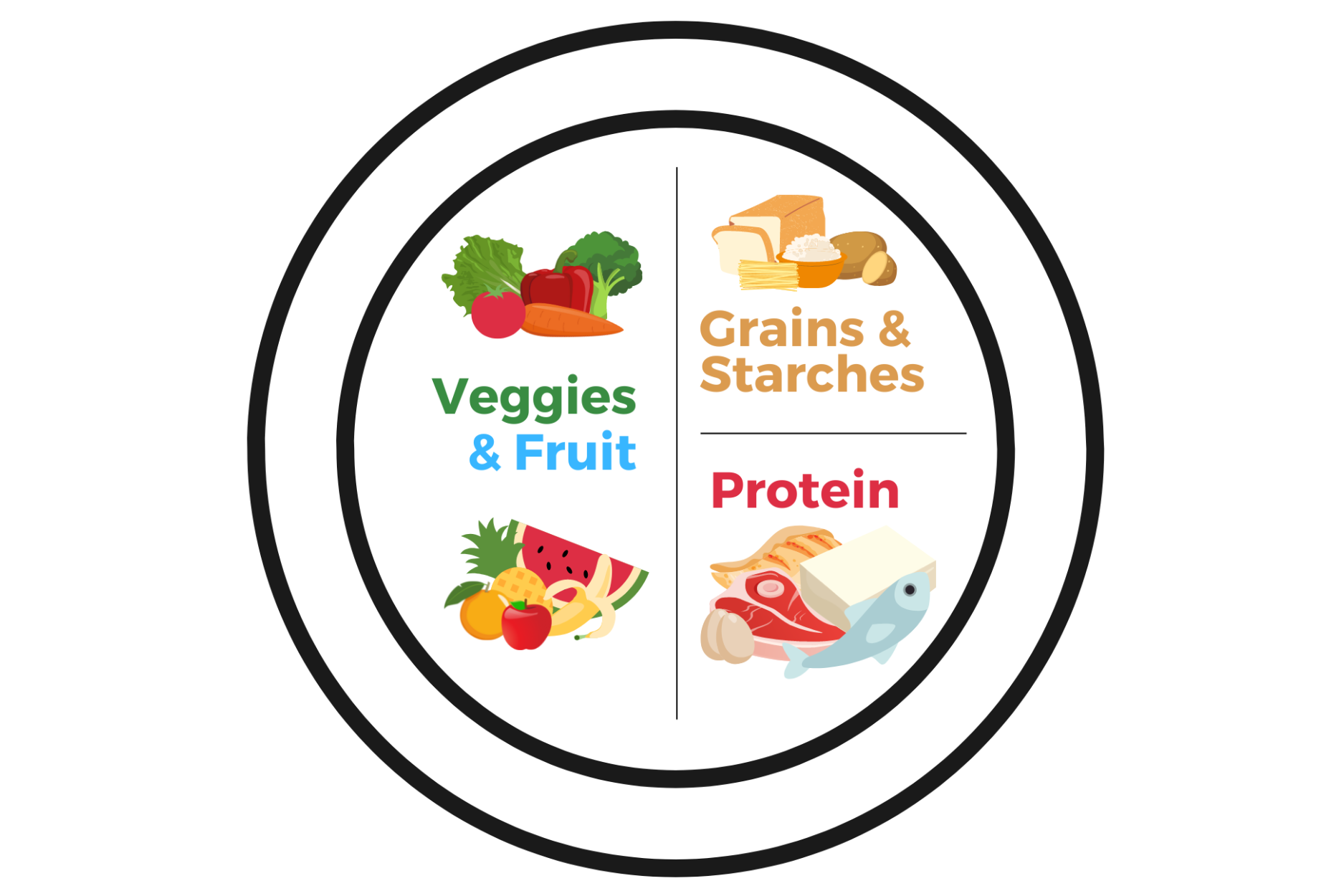
This model is based in large part on the USDA’s MyPlate model which was published in 2015. It shows what your plate should look like at meal times according to four major food groups: vegetables (veggies), fruit, protein, and grains/starches.
Click below to download a printable version of the Healthy Plate model to keep in your kitchen as a reminder:
-
Jayd (00:00):
The best and simplest way that you can lose weight, build muscle is to just follow generally a healthy diet. If you can master how to follow just a generally baseline level healthy diet, you'll be able to reach your goals. Once you master some very basic principles, it's all just fine tuning and optimizing from there.
(00:34)
Hey there. Welcome to the Coaching Corner podcast. I'm Jayd Harrison. I'm a personal trainer and health coach, and I've created this podcast to help you to eat better and build a body that you love. In today's episode, we're going to go over one of the simplest ways that you can clean up your diet and eat better. It's called the Healthy Plate Model, and it's a mixture of different models of healthy eating from the MyPlate model to the Harvard Plate model. Following this model will help you to choose the right foods every time that you sit down for a meal. The thing that I love most about the Healthy plate model is that it allows you to build a healthy plate at every meal without having to meticulously track everything that you eat and drink. Now, tracking is an important skill to master, especially when you are trying to change your eating pattern. But following a simple healthy plate model will allow you to get started and changing the habits that you need to change in order to eat better and give your body the nutrients that it needs. Following the healthy plate model will also roughly help you to eat the right amount of calories to sustain a healthy body weight. So without further ado, let's get into the episode.
(01:48)
So today I want to tell you about one of the easiest ways that you can clean up your diet and eat healthy. I know that there is a lot of garbage information out there on social media. There's always some kind of nutrition or fitness influencer who wants to tell you, don't eat this or check out this new superfood or check out this fad diet. I'm telling you, in my experience, and I've been in this world for a very long time, the best and simplest way that you can lose fat, burn weight, burn weight, burn fat, lose weight, build muscle is to just follow generally a healthy diet. If you can master how to follow just a generally baseline level healthy diet, you'll be able to reach your goals more or less. Once you master some very basic principles, it's all just fine tuning and optimizing from there.
(02:48)
And I think a lot of times these fitness and nutrition influencers, they are jumping the gun. They're putting the cart before the horse by focusing on all of these little things like, oh, you only eat this amount of this thing and only eat this amount of this thing and avoid this superfood, and then don't worry about if you're feeling overwhelmed with that stuff. Yeah. So I, and I live in this space. I've been in this industry for a long time. It hurts my brain how confusing in fitness influencers make this seem. It is not complicated. Okay. It's not complicated. I would say the hardest thing about eating healthy, at least in terms of speaking as an American, speaking as someone who lives in the West is what we have to combat is convenience foods, okay? Convenience. Foods that are not fresh, that are just packaged food with lots of added sugars, lots of added preservatives, lots of added junk.
(03:43)
But in general, if you can return to the roots of healthy eating and just follow some very basic principles, I guarantee you, you will make progress, especially if what you eat for the most part right now is a lot of restaurant food or packaged food or processed food. So I don't want to just say to you, don't eat this, don't eat that, because I don't actually think that that's helpful, and in fact, it kind of puts you in a negative mindset, and I don't want you to feel ashamed about what your food choices are. I want you to think more about abundance, eating more of X, Y, Z, filling your plate with X, Y, Z, increasing your intake of X, Y, Z. This is the type of language that I want you to take to your approach, to your diet, regardless of whether you're trying to burn fat or build muscle.
(04:39)
But I think especially if you're trying to burn fat, thinking more about, I can't have this, I can't have that, I shouldn't eat this, I need to eat less of this. All of these are negative mindset approaches towards your food that maybe will work in the short term for a little while, but eventually your brain and your body is going to rebel against that. Instead, I would encourage you to focus on increasing and developing more of a mindset of a abundance where you're trying to get more of the types of foods that are actually going to help you with your goal. So let's take a look at how we can very, very simply clean up your diet and get your body the right amount of fuel in general for maintaining for what your body would be a healthy weight and what's going to give your body the building blocks that it needs to actually build muscle and achieve a healthy body composition.
(05:35)
Honestly, the easiest way, the simplest way that I've been able to help my clients to build a healthier diet and make it more suitable towards fat loss or towards muscle gains is by following what I call the healthy plate model. And it looks like this. The healthy plate model is just a picture of what your plate should look like, that you generally want to use when you sit down to eat a meal, when you plan a meal in your kitchen that you're going to cook for yourself, or when you sit down at a restaurant, you want to use this as kind of a general guide. So according to the healthy plate model, you divide your plate in half a standard general dinner plate. We're not going to talk about exceptions to ginormous. We're not talking about those ginormous plates or potlucks and stuff. This is like a normal dinner plate.
(06:27)
Okay? So you divide the plate in half and on one half of the plate, you want to fill up that side of the plate with vegetables, either two servings of vegetables or a serving of vegetables and a serving of fruit. So half of what you eat, you want it to come from vegetables. That's the principle here. So vegetables, again, they're plants or they're parts of plants that you can eat. Now, fruits and grains are also plants and parts of plants, but we usually reserve the term vegetable for specific parts of the plant. So roots like carrots and turnips, these are vegetables, leaves like leafy greens, salad, lettuce, spinach. These are vegetables. The stems like celery. These are vegetables bulbs like garlic and onion are vegetables and flour, even like broccoli or artichoke. Now, vegetables are a good healthy source of carbohydrates and healthy fats, which are unsaturated fats.
(07:31)
So this is where we want the majority of our carbohydrate intake to come from vegetables and also from the grains or starches side of the plate, which we'll talk about next. Now, fruit is also a part of a plant, but it's a specific, it specifically refers to the part of the plant that has the seeds or is the ovary of the plant. These tend to have higher sugar, but it's natural sugar. So it's generally the type of sugar that is safe for you to eat because it comes buddied up with nutrients and dietary fiber that your body needs to be healthy. However, if you are in a fat loss phase, or if you're specifically focused on reducing your calories, you may want to just omit fruit and just go with another serving of vegetables, because in general with the higher sugar intake, fruits are going to be generally higher calorie than vegetables.
(08:23)
At the same time though, they're going to be lower calorie than eating a muffin or a bag of chips. So just like I try to stress for everybody, track what you eat, write it down, or enter it into MyFitnessPal to make sure that it fits within what your calorie goals are. But following this, just generally thinking about, I'm going to put on half of my plate vegetables or vegetables, and fruit is a great way to get your body the nutrition that it needs. Okay, so then on the other half of the plate, you have kind of roughly divided into fourths protein, which is the larger fourth. So you want to include a good source of protein. A lean source of protein is preferable. So sources of protein include things like animal products like meat, poultry, but you want to choose lean cuts of meat or lean mixes of ground meat or white meat like chicken and Turkey.
(09:21)
Breast egg whites are also a great source of protein as well as fish and plant protein. Sources of protein include things like tofu, tempe, edamame, and beans, legumes, lentils. So these are all great sources of protein, and you want to make sure that you're including them at every meal. In general, you want 20% of your daily calories to come from protein. Protein is super important to help your body, to build muscle and to repair a damaged tissue. It helps to keep your immune system boosted, and it also will help you if you are in a fat loss phase. Protein dense foods protein is generally pretty satiating. It fills your belly, and especially if you're eating low lean sources of protein, you're going to get full off of relatively lower calories. And then on the other last fourth of the plate is your grains and your starches.
(10:19)
So grains and starchy vegetables, namely. So your grains are things like foods that are made from wheat, like bread and pasta. It also includes rice, quinoa, oats, and other types of grains, barley, pharaoh and whatnot. But this also includes specific types of vegetables, the types of vegetables that are high in starches. That means potatoes, yucca, plantains, corn. These are starchy vegetables. They tend to be higher calorie, and that's why we generally want to restrict them to this fourth of the plate rather than being on the other side and being half the plate. And for people who are sensitive to blood sugar spikes, like people with type two diabetes, you may want to avoid putting starchy foods on your plate. Although the American Diabetes Association nowadays kind of recommends everybody needs to have sort of an individualized plan, just keep an eye on your blood sugar levels.
(11:27)
Some starchy foods may affect your insulin, others may not affect it quite so much, so just kind of keep an eye on all of that. But yeah, in general, this is kind of the guidance that you want to follow when you are building a healthy plate, when you're cooking at home, when you're at a restaurant, this is generally what you want to follow, and if you follow this model for most of your meals, you're generally going to have a pretty healthy diet, and you can do that without having to track what you eat, which for some people is not really a great option. A lot of people don't like to track what they eat in MyFitnessPal or keep a food journal. That is arguably one of the best ways that you can keep track of your calorie intake or if you're trying to hone in on something specific in your diet.
(12:16)
But that's not something that you have to do all the time, and again, it's not really something that everybody has to do, but you can still clean up your diet and make gains and burn fat if you follow this model. So this model I actually sort of created, it's a modified version of the MyPlate model that came out with the 2015 guidelines for, or the 2015 dietary guidelines for Americans. It's also informed by the Harvard Healthy Plate Model, so there's a couple of different models out there for how to structure your plate, and all of them have their benefits. This is what I use for my clients. This is what I teach. I go into much more detail on this in my Healthy Diet Makeover program, which you can find on my website, and I'll link in the show notes. The Healthy Diet Makeover program is a five-step program.
(13:10)
It's very quick. You can do it in two weekends to help you to structure your diet in a way that fits your fitness goals. You can find more information on that. There's an entire module on the Healthy Plate where we go into much more detail about how to select good sources of lean protein, how to find vegetable dishes that you like and that fit within your calorie goals. We also go into the other details of how many calories you should eat, how many grams of protein, et cetera. All of that is in my Healthy Diet Makeover program, so you can find information for that in the links in the show notes. I recommend actually keeping this image in mind, but also printing it out and keeping it in your kitchen so that when you're planning your meals and you're setting something up for lunch or for dinner or for breakfast, you can just look up at the healthy plate model that's on your fridge or on your cabinet for a quick reference and to help remind you how to put healthy food on your plate.
(14:13)
And there is a downloadable, there's a printable version that you can download from my website, and I'll include the link to that in the show notes. But yeah, so those are my tips for how to very, very simply, without having to track what you eat and without having to do too much, you can follow this as a very simple way to clean up your diet. But if you need more information, if you need more support, if you want to go a little bit deeper into any one part of how to follow the Healthy Plate model or other aspects of eating healthy, check out my Healthy Diet Makeover program, and you can also apply for one-on-one coaching, and also make sure to sign up for my email list and make sure to check that you are interested in emails about nutrition tips, because that's the group that I send a lot more information on eating healthy and building a healthy plate too. All of that you can find on my website and in the show notes to this episode.
(15:18)
Thank you so much for watching or listening to this episode. Again, I'm Jayd Harrison, AKA Jaydigains. I hope that you found this information helpful. Make sure to subscribe to this podcast wherever it is that you're listening or watching. You'll get notified every time I drop a new episode and also check out my social media. I'm Jaydigains everywhere. If you would like to ask fitness questions live, I go live on my Twitch channel on Tuesday afternoons and answer fitness questions. They also do a technique review and get my own workout in, so please feel free to join me there. That's Twitch.tv/jaydigains. Give me a follow to get notified whenever I go live. Thank you so much again. I will see you in the next episode. In the meantime, make sure that you're following the healthy plate model, getting in those veggies, getting in that protein and drinking water, and of course, prioritizing your self-care, and I'll see you soon.
Know Your Food Groups
What I love most about the Healthy Plate model is its simplicity and adaptability. Keeping the Healthy Plate graphic in mind, there are infinite combinations of healthy meals that you could create. All you have to do is know your food groups:

Veggies (Vegetables)
On half of your plate, include 1-2 servings of veggies. Veggies (or vegetables) are plants (or parts of plants) that you can eat. Fruits and grains are also plants, but we usually reserve the term “vegetable” for specific parts of the plant like the roots (like carrots and turnips), leaves (like lettuce and spinach), stems (like celery), bulbs (like garlic and onion), and flowers (like broccoli). Veggies are a great source of carbohydrates and healthy fats (i.e., unsaturated fats).

Fruit
Fruits are plant products that tend to be higher in sugar content, giving them a sweet taste. This group is optional and can take up 1 portion of the vegetable side of your plate. They include things like berries, cherries, apples, grapes, pears, and mangoes. The higher sugar and calorie content of fruits make them a food to be eaten in moderation–no more than a quarter of your plate at meal times.
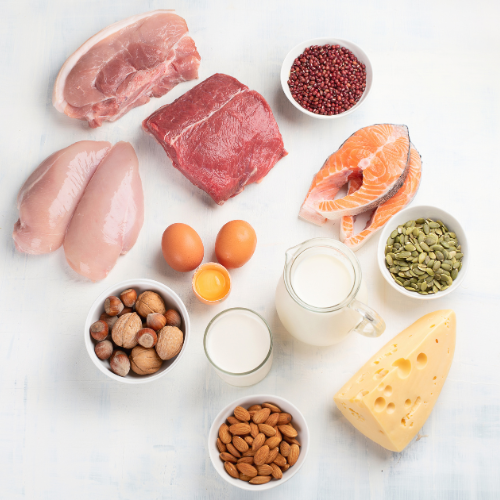
Protein
On at least a quarter of your plate, include a lean source of protein. Protein is both a source of energy for your body and a building block for your body tissues (like muscle). Eating a high-protein diet will help your body to more efficiently build muscle and keep your metabolism boosted (high-protein in this context means 20% of your daily calories come from protein). Prioritize lean sources of protein–items that come with little to no saturated fat like white meat (chicken breast & turkey breast), egg whites, fish, plant protein sources (tofu, tempeh, & edamame), and lean cuts of red meat.

Grains/Starches
On the remaining quarter of your plate, include a grain or starchy food. Grains are essentially seeds and include foods made from wheat (bread & pasta), rice, quinoa, and oats. Try to include whole grains as much as possible (things like brown rice, oatmeal, whole wheat, quinoa, etc) in place of refined grains (white wheat, white bread, or white rice). Whole grains are more generally more nutritious, having more vitamins, minerals, and dietary fiber than refined grains.
Some vegetables (like potatoes, corn, yuca, and plantains) are high in Starches (complex carbohydrates). Starchy vegetables tend to be high-calorie, and may not be suitable for every diet (for example, people with Type II Diabetes may want to avoid them). These kinds of vegetables should be limited to no more than a quarter of your plate, especially if you are trying to burn fat.
Tips for Building a Healthy Plate
When you first start to practice the Healthy Plate model, you’ll likely need to experiment a lot to find what recipes you like and what works best for you.
Cookbooks are a great resource that may already be in your kitchen or bookshelf at home. General cookbooks like the Better Homes & Gardens New Cookbook and Betty Crocker’s Cookbook have entire chapters devoted to vegetable-based dishes, meat, breads, pastas, and more. Specialty cookbooks like the America’s Test Kitchen Complete Vegetarian Cookbook are full of recipes dedicated to one of the major food groups.
Online recipes are another easy and accessible resource. The MyPlate Kitchen website has tons of recipes, videos, and other resources to help you build healthy plates at home. Another great tool is allrecipes.com—a site that allows you to search for healthy recipes using whatever ingredients you’d like to use. It also has plenty of cooking tips and meal ideas to browse and is updated pretty regularly!
You can also check out my recipe collections available here on my website. I update these collections every few months according to the most popular or requested recipes.
For more guidance on building a healthy diet, check out my Healthy Diet Makeover program. This short course can be done in as little as two weeks, during which you’ll learn more about building a healthy plate and how to eat to reach your fitness goals. Click below to learn more!

Clean up your diet in 5 simple steps!
ABOUT ME
Hey there! 👋 I’m Jayd Harrison (Jaydigains), and I’m a personal trainer and health coach. I help people build muscle, burn fat, and clean up their diets with my online coaching programs. Check out some of my coaching videos on Youtube, or join me live on Twitch and follow on social media:
Sign up for updates ✉️
Sign up to get notified whenever new episodes drop. Opt in for more tips on training, fat loss, and nutrition by filling out the form below:
Your privacy is important to me! I will never share your information with any third party. Unsubscribe from the email list at any time.
Episode 19: When to Deload Your Workouts
Deloading your workouts allows your body to catch up on recovery while resensitizing your muscles to training. It can also help relieve the symptoms of overtraining and reduce your risk of injury.
Deloading your workouts allows your body to catch up on recovery while resensitizing your muscles to training. It can also help relieve the symptoms of overtraining and reduce your risk of injury.
Hey there 👋 I'm personal trainer Jayd Harrison, and in this episode, I explain the concept of 'deloading,' which is a period of training where you reduce the intensity of your workouts to prevent over-training syndrome.
Over-training syndrome occurs when your body cannot keep up with the damage caused by intense workouts, which leads to slower recovery, decreased performance, and a higher risk of injury.
I cover how to tell when your body needs a deload period by noticing the signs of over-training, which include:
recurring aches and pains
decreased performance during workouts or competitions
feeling unmotivated to train
feeling like you need more sleep or rest than usual
tightness in the muscles that doesn’t seem to get better
an erratic appetite (sometimes you feel super hungry, other times you may have no appetite at all)
trouble sleeping (even though you feel tired all the time)
If you start to notice the signs of overtraining, consider planning a deload period in your training by reducing your workout intensity by 40-50%. You can even take a week off from training altogether (or longer, depending on the severity of your overtraining syndrome, you may need as long as a month to deload. This allows your body to heal and become resensitized to the training stimulus, leading to better gains in the long run.
-
Jayd (00:00):
After you have added on so much weight and so much weight and so much weight and so much volume, so much volume, so much volume, you're going to reach a tipping point. Most of us reach a tipping point where your body just cannot keep up with the amount of damage that you're doing in your workouts, and when you reach that point, then your body is going to get slower at recovering and you're going to have a harder time recovering and your body's going to start to exhibit a lot of these other symptoms that are usually associated with over training syndrome.
(00:36)
Hey there. Welcome to the Coaching Corner podcast. I am Jayd Harrison, AKA Jaydigains. I'm a health coach and personal trainer and I've created this podcast to help you to build a body that you love and live a healthier lifestyle. In this episode, we're going to talk about how to notice when your body's giving you signs that it's time to deload or when you are getting into some over-training syndrome territory. We're also going to talk about how to deload and things that you can do to prevent your body from needing to deload in the first place. Now, if you do any kind of intense exercise like lifting heavy weights or doing some kind of a sport, it's likely that at some point you're going to need to deload and you may start to develop some symptoms of over-training or overreaching. It happens to everybody, so it's a totally normal thing, but you want to be prepared for how to respond to it correctly so that you don't over exhaust your body and put yourself at an increased risk of injury. And before we get started, make sure to hit the follow button and subscribe wherever you're listening to or watching this podcast. And also keep in mind that I have an email newsletter that you can join at my website that's jd gaines.com. This email newsletter will give you notifications of when new podcast episodes drop, as well as other things that are going on in my community. You can sign up for that in the link that's in the show notes. Now without further ado, let's get started on the episode.
(02:07)
Okay. We do need to talk about deloading. Not everybody has to deload. It's not something that everybody has to do, but it is a thing to be aware of. If you spend time with people who train hard, who lift heavy weights, you'll probably hear the term deload where they'll be like, you ask them what are they training today? And they might be like, well, I'm on a deload week or I'm deloading right now. And a deload is a planned period of time where you are lifting or you're doing your training program at a reduced intensity or reduced volume, and the point of the deload is to give your body some time to catch up on healing essentially. So a deload might occur anywhere between every four and six weeks to just whenever you feel like it, but it's a planned period of time that you are reducing your volume, reducing your intensity.
(03:04)
A general rule of thumb, you can reduce the intensity or whatever it is that you're doing by 40 to 50% or even more. Some people will take an entire week off of lifting altogether when they deload. There's no one size fits all of how you should deload, just like there's no one size fits all question when it comes to when or how often you should deload, but it is something that you want to keep in your back pocket as an option for yourself if you start to notice your body showing symptoms of overreaching, non-functional overreaching I should say, or if you suspect that you might be kind of venturing into some over-training territory. So that's in essence what a deload is. It's a planned period of time where you're still working out. Maybe if you are working out, you're going to reduce the intensity by 40 to 50% or even more and you're just can still work out, but you're just not pushing yourself because the priority during a deload period is to allow your body to catch up on the rest and the recovery that it's maybe not been able to keep up with over the course of your training block.
(04:26)
Okay, so that's kind of an essence what a deload is. Does that make sense? Some coaches will plan deload periods in their training programs where they'll say they have your program that you train continuously for four to six weeks progressively overloading, and then at week five or at week seven, they'll plan a deload where you will reduce intensity in your workouts for that week or you might not lift at all and you might do some mobility or some recovery type workouts during that week. Other coaches or during other programs, a deload would be recommended, not necessarily by terms of how many weeks have you been training, but more along the lines of how does your body feel. There's certain symptoms that your body will exhibit when it's time to deload, when you are approaching non what's called non-functional overreaching. So in order to get stronger over time, we need to overreach.
(05:35)
We need to constantly be giving our muscles more load than what they're used to and push them to do more than what they currently can. And when we push our bodies with heavier weight or higher volume than what they're used to, that triggers the adaptations in the body to get stronger. So it's like we're doing a little bit of damage to the body when we're working out and we're overreaching in our workouts by pushing with more weight or more volume. We create microscopic tears along the muscle tissue and also, but our ligaments also receive some damage and other tissues also receive some damage. As long as you are able to balance out the amount of damage that you do to your body and your workouts with adequate rest, then you shouldn't really need to deload. Some people never deload and those are the people who maybe only workout two or three times a week where they're lifting only two or three times a week.
(06:38)
They're getting for every week like four rest days, three or four rest days, and for them, that's long enough for their bodies to recover and repair the damage that's done during their workouts. But for people who are on more frequent training programs where they are working out five, six days a week, sometimes even four days a week, you can need a deload with only one or two rest days per week after you have added on so much weight and so much weight and so much weight and so much volume, so much volume, so much volume, you're going to reach a tipping point. Most of us reach a tipping point where your body just cannot keep up with the amount of damage that you're doing in your workouts, and when you reach that point, then your body is going to get slower at recovering and you're going to have a harder time recovering and your body's going to start to exhibit a lot of these other symptoms that are usually associated with over-training syndrome.
(07:36)
So or when it's time for you to deload, here are some of the symptoms of that. One is you get recurring aches and pains, especially in your joints if you are getting all these little minor injuries and it just keeps popping up. It's like one thing right after another, or you have this nagging little injury that just keeps happening again and again and again and again. These are signs that either your training program itself is too much load for your body or if you have been doing that and now all of a sudden if you've been doing that training program and it was fine for a couple of months and then all of a sudden you're having trouble recovering, it may be time for you to do a deload. If you notice a decreased performance in the gym, all other factors are accounted for. Nothing else has changed, but you're all of a sudden just having a really hard time moving the bar or adding weight to the bar and increasing your performance in that sense, then that may be a sign that your body is having a really hard time keeping up with the load of your workouts.
(08:43)
If you are suddenly starting to feel really unmotivated to train, you just really don't want to do your workouts or you start dreading doing your workouts again, nothing's really changed. You've been following your program, you've been eating and just all of a sudden you're just like, I just don't want to do this anymore. That can be a sign that you're overreaching and you're entering into what we call non-functional overreaching zone. So we need a little bit of overreaching just to get the muscles to adapt, but there comes a point where it's not functional anymore because your body can't keep up with it. If you feel like you need more rest and you feel like you need to nap all the time or a lot more than you usually do, this is also a sign that your body is entering into that non-functional overreaching zone or that you might need to deload if you have this ongoing tightness in the muscles and it's just like no matter what you do, you cannot get them to relax and you can't get them to loosen up.
(09:46)
This can be a sign of inflammation that just isn't going away in your body, that inflammation isn't going down. That's a sign of overtraining and overreaching, and you may need to deload. Your appetite might also be suppressed. So even though your output has the same, and maybe in the beginning of your program you were eating a lot and you had a lot of an appetite, you were growing so much muscle. When you start to enter into that non-functional over training zone, you often will experience a drop in your appetite along with other things, a drop in your libido. Again, just feeling really tired. A lot of people report that they just feel heavy, especially in their legs. They just feel really, really heavy, just like, oh my God, just moving, just walking just feels so hard. That's another sign. And then another sign of over-training or entering to that non-functional overreaching where you may need to deload.
(10:52)
Another sign is trouble sleeping. So if you feel tired all the time, but you have trouble getting to sleep or you have trouble staying asleep or you have trouble getting restful sleep, all of these are signs that your body is struggling to keep up with the amount of damage that you're doing to it in your workouts. Again, I want to just make super clear, we need to give our muscles more than what they're used to in order to stimulate growth, in order to stimulate strength gains. And as long as you're able to adequately balance that out with rest because it's when you're resting that your body actually rebuilds the tissue and makes it stronger. But if you're not balanced out with adequate rest, then you can start to venture into that non-functional overreaching and that non-functional overreaching is when you're pushing yourself and you're kicking your ass in the workouts or you're getting your ass kicked in the workouts and it's not actually doing your body any because you're not actually doing the repairs, what makes you stronger?
(11:58)
It's the repairs that make you stronger. It doesn't matter how hard you push yourself in the gym if you cannot adequately balance that out with proper rest. So again, for athletes who are only working out two or three days a week with resistance training and then they're getting three or four days of rest every week, they rarely need to deload because that's plenty of rest for them. So they're balancing out the effort that they're putting in the gym with adequate rest. But for the people who are working out four or five, six days a week, that's where after weeks or months of training, you can start to exhibit these symptoms of overreaching, non-functional overreaching, or even further into over-training syndrome, which can have many long-term negative effects, negative effects on your gains and on your health. One thing that I didn't mention before is mood instability is a big part of over training, irritability, agitation, just not having a lot, not having a lot of patience, just feeling really irritable if you're a person who menstruates, sometimes over training can feel like that irritability right before you're going to start your period or when you're on your period.
(13:19)
That just heightened just like everything is just too much. That's something that you can also experience when you are in that non-functional overreaching or if you are actually fully in over training syndrome. Another thing that also tends to accompany over training is what's called bradycardia. I think I'm pronouncing that correctly. I've never actually heard the word spoken out loud. I've only ever read it. Bradycardia, Brady, bradycardia, hold on. Let me see. That's different from what I thought. Bradycardia. So bradycardia is when your resting heart rate is super low, so a normal resting heart rate is between 60 and 100 beats per minute, and if you resting, heart rate is normally somewhere between 60 and 100 beats per minute, but then you're getting all these other symptoms of over-training syndrome, and then your resting heart rate is also really, really low. This is another sign that you could be over-training.
(14:18)
Another sign is tachycardia, which is when your heart rate is higher than 100 beats per minute. If your heart rate is doing something different from what it normally does, then that can be a sign that you're in over-training syndrome. The thing about over-training syndrome is it's not really something that someone can diagnose in the moment. It's usually something that's diagnosed after you have actually rested after a period of time, either a week, two weeks to a month of resting and then your symptoms go away. That looking back, you can get diagnosed with, oh yeah, you had over-training syndrome, lack of mental concentration as well. There's cognitive effects to over-training syndrome, and we'll talk a little bit more about the mechanics of what might be going on in over-training syndrome and why it affects us in these ways. But there's cognitive effects related to feeling irritable suffering, depression, agitation, but also lack of mental concentration.
(15:27)
So taken altogether, if you are feeling like shit in your workouts and you're eating the way that you should be, or at least you're trying to follow your macros, you're eating the amount of calories that you should be eating and nothing has changed. First of all, you do want to make sure that you check with your doctor to rule out any kind of illness, particularly any kind of thyroid illness because thyroid illnesses can cause these symptoms as well. So you want to of course get your blood drawn and get tested. That's always kind of like best practices is checked with a doctor and gets some blood tests, but if everything comes back normal and there's no other underlying issue, and you also know, Hey, you know what? I actually have been training pretty hard for the last at least four weeks and nothing else has changed and I'm getting all of these symptoms. Why don't I take a week to deload? And you try that, just give yourself a week. Sometimes you're going to need longer, though. Some athletes, especially depending on how deep into over-training syndrome you are, some athletes need to take as much as a month off, right?
(16:41)
Mundo Dia, right? We know him as Diabolic Dia Mundo Fitness, that was his name back when we first started on Twitch, but Dia, I believe it was last year, took an entire month off of lifting because he was just feeling really fucked up. He was getting a lot of recurring aches and pains, and I believe it was his back got really fucked up or something, and so he just took an entire and he was burned out. Yeah, burnout is another word for a deload, which we can get into other terms for it or over-training, sorry, burnout is another word for over-training or that's commonly used. But yeah, so he ended up just taking an entire month off from lifting and just did yoga. Just hung out and he said it was just the best thing that he could do for his gains, and then when he came back to lifting, everything felt so much better and he started also making gains again, because this is one of the things that's another thing that really is a big red flag for me is you slow down in progress that decrease in performance.
(17:57)
You might notice that, oh, I was able to add on more weight pretty consistently or do more reps pretty consistently, and all of a sudden I am just struggling just to get one more rep and I'm struggling even to keep up with what I was doing before. Or you may notice, and this is really important why I say take video of your lifts and analyze them during your workouts or after your workouts. If you start notice, you're getting little technique errors that normally you would never do. You're making technique errors that are not out of character. Why am I doing that? That's so weird that I started doing that. That's a performance, that's a dip in performance, and that can be one of those signs. So when you take all of these things together, if you suspect that you are either in that non-functional overreaching zone or in the more extreme you have over training syndrome, which is more of like a medical diagnosis, it's a good idea to plan a deload period for yourself.
(19:04)
You'll hear over training called many, many things. It's not something that has been studied. I mean there are studies, but it's not something that's been as extensively studied as maybe it should be, and it is such a hard thing to study because some of many of the symptoms are so subjective, and again, it's something that can usually only be diagnosed after the fact because if you rest and you take a deload and then you get better, then it's like, oh, yeah, that was over training syndrome. But you might also hear this referred to as burnout. Burnout is a big thing. I've heard it called burnout staleness. I feel stale. You might hear that. Failure adaptation is another term that's a lot of times used under recovery training, stress syndrome, and chronic fatigue. These are all other terms that mean basically kind of the same thing.
(20:08)
I do want to say, if you do start to suspect that you're developing over-training syndrome or non-functional overreaching, please don't beat yourself up over this. This is something that is so, so common, which is why so many coaches just go ahead and program deload weeks into their programs for their athletes. It's something that I would say, I don't know, a single lifter who lifts more than three days a week who hasn't at one point or another experienced what they might call burnout. So common for example, there was one study that found nonfunctional overtraining happened in roughly 60% of elite male and female runners. It's more likely to happen with elite runners than it is with non elite runners, but it is very pretty common. 33% in non-elite female runners. There was another survey that found 35% of adolescent swimmers had been overtrained at least once.
(21:16)
You know that other terms staleness estimates of staleness were reported five to 30% of swimmers over the course of a season. 50% of elite British elite athletes reported at least once in their careers the duration of your over-training, non-functional overreaching or over-training syndrome really varies. You can take a deload week off, but sometimes that's not always going to be enough for these British athletes. Their episodes, they averaged two episodes over the course of their careers lasting about four weeks. So if you feel like, oh, damn, I feel like what's going on, I feel like shit, my lifts are feeling shitty, I'm tired, I'm cranky. It's so easy to internalize that and interpret it as I'm doing something wrong. You're not doing anything wrong. It's just part of the life lifecycle. Remember, just like everything else, your fitness has different seasons. It's not reasonable to expect your body to be able to give the exact same output 24 7, 7 days a week, 52 weeks a year, okay?
(22:36)
There's going to be seasons where you're going to need to step back in your intensity because remember, your workouts are only going to benefit you as much as you can recover from them, but sometimes you don't know that you're overreaching until you've overreached. That's the other thing to keep in mind. It's hard to prevent. It is very hard to prevent. You can preemptively handle it if you do say for yourself, oh, I'm going to deload every four to six weeks. I'm going to take a deload week, depending on the intensity and the volume of your program, but that's not always going to be, not going to be 100% surefire way to prevent over-training or overreaching, non-functional overreaching. What a lot of coaches that I have worked with have said is they go by, your body will tell you when it's time to deload, so train according to your program, continue to progressively overload according to your program.
(23:37)
If you're not following a written program, just continue to progressively overload within reason, adding between 10 and 20% to your workload at a time. Safest thing to do is to go by a rule of two. If you can do the same exercise with the same weight and the same number of reps two times in a row, then it's time to progress. If you progress that way, that's a nice way to be a little bit more gradual, which can help to prevent you going into non-functional overreaching. It's just enough overreaching to give your body a stimulus. These are just rules of thumb that you can follow. Again, it's not going to 100% prevent you from needing a deload week, but if you start to notice yourself exhibiting those symptoms that we talked about earlier and you know that you've been training for four to six weeks pretty consistently and nothing else has changed, you've ruled out any underlying illness that might be happening, then it may be time to deload.
(24:40)
Another symptom that we didn't talk about before, but it is something that is observed in non functionally overtrained or overreached athletes is if you find that you are getting sick a lot, this is a big thing. Upper respiratory illnesses are more likely to occur when you are in that non-functional overreaching zone, so that's something that if you're like, damn, I'm sick again, you keep getting this. Upper respiratory infections is a really common thing, but again, the evidence is not super definitive in terms of the study showing that, yeah, this is what happens, but it's not uncommon for that to occur as well aside from needing to deload because you've just been pushing, pushing, pushing in your training program maybe too long, too much for too long. There are other things that can trigger over training syndrome, and I think it's worthwhile keeping these things in mind because I mean, you still probably should take a deload if you end up in Overtraining syndrome. If you end up overreaching, it's probably best practices to plan a deload anyway, but sometimes other things can trigger it beyond just, well, your program is too much and you've been doing it for too long.
(26:06)
Again, if you increase your training load too fast without adequate recovery, that can cause you to enter into Overtraining syndrome. So say your coach gives you a program and you're supposed to be just gradually increasing the percentage of the weight over time or the gradually increasing the number of reps that you're doing over time, and then you decide to go off program one day and test your PRS or something. This could potentially cause you to go over what your body can recover from, and you can put yourself into over-training syndrome, so then at that point, you're going to have a harder time catching up with the recovery that's needed from your workouts. Sometimes the monotony of training, if you've had the exact same program for a really long time and you've progressively overloaded, you've added more reps, you've added more sets, you've added more, you've added more weight over time, and you just haven't changed anything about your program, that can also overtrain you too just by the sheer monotony of it.
(27:10)
If you are a competitor, if you're an athlete and you compete in some way, if you have too many competitions, that can cause you to go into Overtraining syndrome because when you're in competition, you're giving it all you got, right? You're given 110%. Well, if you're given 110%, then you need to recover 110%, but if you've got competition after competition, after competition with not enough recovery time for you to recover and heal from the damage that your body sustains during those competitions, then you put yourself at risk of developing over training syndrome, sleep disturbances, I see this a lot with my athletes who just had kids. If you had a baby, if your wife just had a baby, you just adopted a baby. If you just adopted a puppy or I don't know, for some reason you're just not sleeping, and this is where it can become like a chicken and the egg kind of thing.
(28:04)
The sleep disturbances can cause over-training, which can make it harder for you to sleep, which just continues, but that can make it harder for you to recover from your workouts. Stresses outside of your workouts like personal life stresses, emotional stresses, any kind of stressor at work, these put you at. This makes it harder for your body to recover from your workouts. So if you push yourself really, really hard in your workouts and you're also stress the fuck out at work or you're going through a breakup or a divorce or your kid is sick, these extra stressors make it harder for you to recover and put you at risk of developing Overtraining syndrome. It becomes easier to overreach, non functionally overreach. If you've had previous illness, this is like what we talked about a couple weeks ago on the podcast, coming back to training after being sick.
(29:00)
You want to do what I call a reload, which is like a deload week, but you're coming back into training after being sick. If you hit the gym too hard, too much intensity, too much volume after you've been sick, you can risk putting yourself into that non-functional overreaching or over-training syndrome, altitude exposure. I have clients and besties who live in Colorado and Colorado is a mountain place and they'll go skiing or something and they'll try to keep their workouts that they do with me when they're at lower, closer to sea level, and then they come back from their trip just totally exhausted because the altitude exposure, the higher you are up in the atmosphere, the harder your workouts are going to be, the harder it's going to be for you to recover from your workouts. A heat injury episode also makes it harder for you to recover, and then also if you have an injury of some type, which the authors of the article that I'm referencing here that I'm pulling a lot of this information from, listed this symptom as, or this trigger as a severe bunk.
(30:13)
If you suffer a severe bunk, if you get hit on the head or you get injured and you have an injury that your body is healing, remember your body's process for building muscle is the healing process. So if you get a severe bonk, if you get hit in the head, if you get an injury, if you get cut, if you get a huge bruise, if you end up in a car accident and there's some kind of other trauma done to your body, it's hard to recover from your workout. So just all of these will necessitate you reducing your workload, reducing the volume, the intensity of your workouts. It's just going to make it harder for you to recover. Note to self, avoid bonks. I'm serious. That's the term they use. It's so funny. Let me pull it up here. This is the study that I'm pulling this information from. Really good study. It's a survey diagnosed with bonk induced ey.
(31:14)
This maybe laugh was reading it like 5:00 AM this morning here, Izzy, I'm not making it up. Potential triggers of over-training syndrome, increased training load without adequate recovery, monotony of training, excessive number of competitions, severe bunk. It's amazing, but apparently this, it comes from this study prevention diagnosis, treatment of overtraining syndrome. I couldn't actually read the full study because I'd have to pay for it and I didn't want to pay for it. I can read the abstract, but I kind of want to pay for it so that I can see the use of bon in a scientific paper. Thankfully, I've only suffered a moderate bonk. Isn't that so funny, Sai, have you ever seen the word bonk used in a scientific paper? So either these people, anytime I see concussion now I'm just replacing it with severe bonk.
(32:11)
Yeah, dude, isn't that so funny? So cute. I love scientists. I don't think I've ever suffered a severe bonk myself. Yeah, concussion or just any kind of trauma, body trauma, whatever. So that's like over training syndrome. What causes it? How to notice if you are over training. Again, it can't really be diagnosed until after the fact, but let's talk about what to do if you do suspect like, Hey, I might be overreaching non functionally, or I might be actually an over training syndrome. Then what you want to do is you want to plan a deload, and a deload can be anywhere between one week to four weeks. It depends on how intense the overtraining syndrome is or how overreached you are. Basically, you deload until your symptoms get better. In general, like a rule of thumb is a global load reduction, global load reduction, meaning overall reduction of the intensity or the energy output.
(33:21)
I talk a lot about deload in terms of weight training, but deload can be also from running or whatever your sport is overall, you want to bring the intensity, bring your energy output down 40 to 50%, sometimes even more. Sometimes you may want to take an entire week off of training altogether or a month off of training altogether. A deload is a good time to try other types of training to focus on mobility work. You could try yoga just as long as it's not a really intense type of yoga because these days they've got yoga classes that are basically strength training classes. You want to avoid that kind of thing. You want to avoid pushing your body. That's the name of the deal, name of the game, that's the name of the game. That's the deal. You want to avoid stressing your body, so everything that you do during your deload time should be more about let's move.
(34:17)
Let's get some blood flow. Let's just work on mobility. Let's just keep things moving, but not stress. So we don't want to put stress on the body during this time. Let's see if you don't, you just continue to push yourself, push yourself, push yourself, push yourself. You may think, oh, I'm going to lose all my gains if I do a deload, I can't possibly stop lifting this heavy or I'm going to just lose everything or I'm going to get all the fat back. The opposite is true, especially if you've noticed a reduction or a decrease in your performance. If you're having a hard time executing your lifts or executing your sport with good technique, you're getting sloppy or you're just having a hard time continuing to add on more and more and more and more. Your body probably needs that time not only to heal, but to become sensitive to the training again by taking some time off, either by reducing the intensity of your training, you still do your workouts, but you do at a reduced intensity or you take completely off when you come back to your workout program, when you come back to your training program, your body is going to be resensitized to the stimulus, so you will be able to start making gains again, and if you don't take that time off, if you don't do that deload, you're just not going to make those gains.
(35:42)
So it's like the difference between like, oh, without a deload, you're just going to plateau and probably even see a reduction because when you are in Overtraining syndrome, your body goes from being anabolic. You may have been anabolic and you're going to be more catabolic at that point, meaning there's going to be more breaking down of tissue that's happening in your body than there is building up of tissue, and so you may reach a point where your body starts actually metabolizing the protein in your muscles because it's not able to keep up with the recovery that's going on. So by not deloading or by just continuing to overtrain and over push yourself, you're actually taking your gains and just pouring them out. You're sacrificing gains for that, so it is worthwhile. And then there's other things that can result. Not only will you maybe plateau in your progress, but you also increase the risk of injury.
(36:43)
Again, your body is not able to keep up with the damage that you're doing to your body, and this can lead to serious injury, especially as your form and your technique gets sloppier and sloppier. That's where ACL tears happen. That's where sprains happen. So as you have a harder time keeping up with the recovery and your performance is going down, you're just increasing your risk of injury little bit by little bit, which ultimately if you get injured, then you can't train at all. You might suffer an injury so bad that you have to completely get out of training for however long it takes you, especially if you end up having to have surgery that's going to take you out of training for a really long time, so that's going to cause you to lose more gains than anything. So either you give your body the rest that it needs or it is going to force that rest on you.
(37:44)
So for my boys and girls, then thems who like to chase the pump ego lift or try to prove how much of a badass they are in their workouts, just watch out. That's not training smart. You can only do that for so long, so you want to make sure you're managing your energy and be ready to deload when your body starts to give these signs that it's like, okay, we're overreaching. There's nothing wrong with taking a deload. It's very, very normal. It's what most experienced lifters end up having to do. It's what most elite athletes end up having to do, and by planning deloads, you can help to prevent your body from getting into over-training syndrome and also by just being more intentional and smart about your training and how you schedule your energy output when you're planning out your workout program, making sure that you can work out six days a week, but not every one of those days is going to be a heavy day or a high intensity day or high volume day.
(38:52)
Some of those days are going to be more recovery like days. Some of those days are going to have to be not as energy intensive. If you're giving 100% on all six days of the week that you're working out, then you're probably going to reach over training much sooner. Then if you were just following a three or four days a week, maybe five days a week training program where you have two or three days of rest each week, your body will have an easier time recovering from that and you'll be less likely to need to over or you would be less likely to need to deload. So it's just a matter of the more intense, the more frequent you train, the more frequently you're probably going to need to. Deload is what I would say is a general rule of thumb.
(39:44)
Thank you so much for watching this episode of The Coaching Corner Podcast. Again, I'm Jayd Harrison, AKA Jaydigains. If you would like to hang out with me while I'm live on my Twitch channel, just go to twitch.tv/jaydigains and hit the follow button. If you'd like to join my Coaching Corner Discord community to get even more content and interact with me when I'm not live, go to the link that is in the show notes. For more information on my training programs and other content, go to my website, jaydigains.com, where you can also sign up for my email newsletter. This newsletter will give you notifications when new episodes of the podcast drop and other announcements and coaching tips. Thanks again for watching. I'll see you in the next episode. In the meantime, make sure to eat your protein, eat your veggies, drink some water, and prioritize your self-care.
Work out with me 🏋️♀️
Build strength and tone your body with expert-guided workouts by Jayd Harrison.
ABOUT ME
Hey there! 👋 I’m Jayd Harrison (Jaydigains), and I’m a personal trainer and health coach. I help people build muscle, burn fat, and clean up their diets with my online coaching programs. Check out some of my coaching videos on Youtube, or join me live on Twitch and follow on social media:
Sign up for updates ✉️
Sign up to get notified whenever new episodes drop. Opt in for more tips on training, fat loss, and nutrition by filling out the form below:
Your privacy is important to me! I will never share your information with any third party. Unsubscribe from the email list at any time.
Episode 18: How to Get Your Friends & Family into the Gym
The most important thing you can do to influence your loved ones to start a fitness journey is to focus on your own fitness journey.
The most important thing you can do to influence your loved ones to start a fitness journey is to focus on your own fitness journey.
In today's episode, I share a conversation I had with my Twitch chat after one of my followers asked "How do I get my friends to go to the gym?"
No matter your best intentions, it's important to respect others' boundaries and consent.
I live by the motto "Be responsible for your own gains." This means focusing on your own journey and letting others make decisions for their own health.
Pressuring people to go to the gym could potentially harm your relationships and also push people away from wanting to get in shape. The best way to influence others is to live a healthy lifestyle and respect their autonomy.
With that said, in this discussion, we also go over some ways to invite someone to the gym without pressuring them or making them feel bad.
-
Jayd (00:00):
When you're on a fitness journey, you need to be focused on your fitness journey. Don't be looking at other people and judging other people for not doing what you're doing. They have their own journey. Their path is their path. Their life is their life, and you have to respect their consent and their boundaries. Focus on you. Focus on, because here's the thing, you don't know who you are inspiring. When you do focus your energy inward and focus on what you have control and responsibility over, which is your path and your fitness. When you're just minding your goddamn business and just doing the thing, you actually are going to have a lot more influence over people than if you are approaching them trying to nudge, nudge, nudge consciously. Don't try to nudge people. Live your life, keep pursuing your fitness and the people who are receptive and who want that as well, they're going to see that and they're going to be inspired by it, and then when they're ready, they can come with questions.
(01:12)
Hey there. Welcome back to the Coaching Corner podcast. I'm Jayd Harrison, AKA Jaydigains. In today's episode, I'm going to share with you a conversation that I had with my Twitch chat when I was live on Twitch and one chatter asked the question, how do I get my friends or family into the gym? And the answer that I gave might surprise you, especially considering that I am a professional fitness influencer and content creator and personal trainer. I live by the saying, you are responsible for your own gains. Everyone is responsible for their own health journey. It's not really the responsibility of any one person to make another person take better care of themselves. And in fact, if you do try this approach of trying to manipulate somebody into getting in shape, you may actually be doing some more harm than good. So we talk about the essential mindset shift that you need to have as a fitness advocate if you really want to have that type of influence on the people that you love and you want to approach this in a way that respects consent and boundaries.
(02:21)
With that said, I do also give some actionable tips for how you can cultivate more influence in your circle and maybe open the door to one of your friends or family members to start taking better care of themselves, but it's a topic that is very sensitive and it takes a lot of emotional and social intelligence to do well. So today we're going to dive into that topic. Now, before we get into the episode, keep in mind that I do have an email newsletter and if you sign up for that, you will get notified every time that there's a new podcast episode that goes live. You'll also get notified on new services and products that I come out with, so make sure to check that out. That's at jaydigains.com. So now let's get into the episode.
(03:20)
I know you can't make anyone go to the gym, but how do you encourage friends and clients to go? I'm going to just say that I can only speak from my personal point of view and ethics. Consent is everything. To me, consent is a really important core value. It's like at the bedrock of everything that I do. I'm never ever trying to just make someone do something that they don't already want to do, even if it's something they like that's better for them. At the end of the day, I respect people's ability to be grown ass adults and make decisions for themselves. What I can do is make what I see as the right choice or the better choice, more accessible, and if they want to make that choice, then I can help them make that choice and I can help them to build structures into their lives that make it easier for them to make those choices.
(04:13)
But you cannot, if you are really, really concerned with making another person do anything, my encouragement would be to redirect that back towards yourself. Are and you alone are responsible for you. Everybody else is only responsible for themselves because if you are in a space in your relationships where you're constantly trying to influence or manipulate someone, they will feel that energy and they will resent it unless they've consented and specifically asked for it, but you should not be trying to manipulate anybody even if it's for their own good. You should not be trying to manipulate someone to go to the gym or to eat a certain way because at the end of the day, you're not in their head, you're not in their body. You don't know what their life is like and what likely you'll end up doing is causing more harm because a lot of times when people are trying to manipulate people or influence them, what you end up doing is you end up piling on more frustration and shame because you don't know what that person is going through and you don't know what they've tried in the past.
(05:22)
The best that you can do is live your best life and set an example of self-love and self-responsibility and that might inspire them, and if you are not pushing stuff onto them, you actually make yourself more of a trustworthy source that when if and when they're ready to make that change, they'll actually be more likely to come to you for advice or encouragement or resources, but if you're trying to push it on them all the time, they're going to actually shut you out and you may actually be pushing them further away from the thing that you're trying to influence them to do. Respectfully, I think we all need to mind our own goddamn business.
(06:13)
I hate that shit. I do not like when someone is trying to manipulate me, even if it's for something that maybe is for my own good. You are responsible for your own gains and they are responsible for their own gains and you have to respect other people's consent. You have to respect other people's autonomy, and if you don't, then you're actually doing the opposite of what you're trying to do. You're going to make them associate the thing that you're trying to influence with manipulation, with all these negative connotations, so they're going to be less likely to actually make the choice that you want them to make because especially from a trauma-informed perspective, I do a lot of work and I talk to a lot of counselors and a lot of trauma therapists, even therapists will tell you, you can't make other people do things. All you can do is be the example of what you think is good and try to be that person more and more every day, but it is overstepping to even.
(07:26)
It's overstepping to just look at a person and decide that you know better than them because a lot of unhealthy behaviors, what we consider as unhealthy behaviors, they're coping mechanisms dude, people who overeat, people who stress eat, people who undereat people who don't exercise, people who rot in bed over the weekend every weekend after work, it's not because they're fucking lazy, it's not because they're sloths or they're, I don't know, whatever judgment you want to pass on them. Most of the time, and this is what trauma therapists will tell you, this is what counselors will tell you most of the time, our behavior is governed by our nervous systems. These are coping mechanisms that these people need to regulate, and it's a big red flag for someone to look at another person and decide that they know better what they should be doing with their lives.
(08:29)
I'm a personal trainer, I'm a health professional, and I know what the recommendations are for if you want to live your healthiest. I put it as, hey, you get to choose how you live and I love you and I support you, whatever choices you make because you are in control of your life, but if you want to do this, if you want to feel more energized, if you want to feel stronger, if you want to have more energy, if you want to live independently for longer, these are some things that you could do, but you don't have to and I'm not going to judge you if you don't. I'm not going to judge you if you don't exercise, if you don't eat vegetables three times a day. Ultimately, you have reasons for why you live the way you live and I ultimately respect your autonomy.
(09:24)
I'm never going to try to influence someone without their consent, and that's just a hard line for me. Not trying to manipulate, just want what's best, just want to be there for them best way I can. If you want to really be there for them, then you need to actually be there for them and treat them like an adult. It's very easy from the outside to look at someone and diagnose all of their problems. It's very easy to look at them and be like, oh, they should X, Y, z, but you can't do that if you want to have a good relationship with them. If you actually want to have influence, that's the worst thing that you can do. The worst thing that you can do is approach a relationship with someone with a spirit of I know better. I know what's best for you than what I mean.
(10:12)
I'm telling you, if someone approaches me like that, I can smell that right away and it's an immediate red flag that's an immediate shutdown. That's immediately like, okay, I'm going to sign you to the outer circles. You're not coming anywhere close to my inner circle. You're not going to be a close friend to me if I can sense that you are trying to do that. If you approach me with this attitude of even if you think that you're hiding it well, no, people can sense that. People can sense when you're judging them and that's a good way to lose your influence over them. If you want to have influence, you have to let go of the power and you have to let go of the assumption that you know better than the other person. If you want to have influence, you have to let go of this idea that you're the hero of the story.
(11:03)
You're not, and if you want to be the hero of the story, then you're not going to have as much influence as you want. You have to approach the other person like they are the hero of the story. They are the one who makes the choices. You're just the guide you're there for when they ask questions and if they choose the path that you're an expert in, then they know that they can come to you and they trust you and you have a good connection with them. They'll ask you questions and they'll trust your planning and your advice that you give, but if you're constantly approaching them with this error of better than them, you're going to lose that position of you're not going to be able to be their guide. They're not going to go to you. This is why a lot of teenagers do not go to their parents by the way, because especially once you become a teenager, you get really allergic to your parents trying to treat you like they know better and a lot of times they do know better, but nobody likes to be talked down to.
(11:56)
Nobody likes to be looked down on and it's the people who empower other people and say, you are the one with all the choices and are the one. You have the power. It's those people who end up having more influence, so I think that that's something that we maybe all need to reflect on a little bit more. When you're on a fitness journey, you need to be focused on your fitness journey. Don't be looking at other people and judging other people for not doing what you're doing. They have their own journey. Their path is their path. Their life is their life and you have to respect their consent and their boundaries focus on you because here's the thing, you don't know who you are inspiring when you do focus your energy inward and focus on what you have control and responsibility over, which is your path and your fitness.
(12:54)
When you're just minding your goddamn business and just doing the thing, you actually are going to have a lot more influence over people than if you are kind of approaching them trying to kind of nudge, nudge, nudge consciously. Don't try to nudge people. Live your life, keep pursuing your fitness and the people who are receptive and who want that as well, they're going to see that and they're going to be inspired by it and then when they're ready, they can come with questions, but you really got to, I know it's exciting and I know you love all of the benefits that have come from getting in shape for yourself and you want that for your friends. You want that for your family and that's okay, but at the end of the day, you have to remind yourself of boundaries. You and you alone are responsible for your gains and they alone are responsible for their gains. You haven't tried it yet, but you do plan to encourage your younger brother to work out with you at least once a week. Be careful with that because I'm telling you right now, I've been doing this for over 10 years. You want to be very, very careful when you are encouraging or trying to influence the people in your life to get on a fitness journey because it can often be read as you judging them and you might not realize that you're adding more shame onto something they already feel badly about.
(14:23)
Just be very careful in how you approach it. Try not to approach it with this sense of you should do this and try to bully them into it. Sometimes people will try that approach that really just does nothing but turn people off and actually pushes them further away. What I would say is you want to extend an invitation, but always make sure it is just like the rules of consent. The rules of consent apply, that there has to be an enthusiastic yes and that consent can be revoked at any time. You have to make sure that it's absolutely explicit that it's okay for them to say no and that they don't have to and that you're not trying to pressure them, you're not trying to shame them. It's just that you want to spend time with them and you think it would be fun and they don't even have to do your workout.
(15:19)
You would just like them to be around. Make sure that you make it super, super, super explicit that they can say no and that you're not trying to pressure them and that you support them whichever choice they make. That is key here, guys. You got to support them. Whichever choice they make. If you make it so that it's like if they say no, you're going to give them a hard time that I'm just telling you, if you want to have any kind of influence on them, that is going to be going in the opposite direction. You got to keep it positive. You have to empower them, and part of empowering people is allowing them to make the other choice and supporting them and making that other choice. They're allowed to. You should encourage them to make choices for themselves and knowing that the choices that they make are not always going to be the choices that you want them to make.
(16:12)
That's okay because they're responsible for their own gains and you are responsible for your gains. My wife eats plenty of healthy food and moves around plenty, but she hates exercising in the traditional sense. Yeah, totally fine. She feels bad about her body and says so to you. Often, I just do my best to remind her that I don't see her body in any kind of negative way and remind myself that we live in a culture that programs people to see their bodies that way. That is what I'm fucking ducking about. I love to see it pa because you've been on your fitness journey and you've been seeing the benefits and I really, really love that you tell her, you don't have to do what I'm doing. I love you. I love you as you are. You don't have to make the choices that I'm making.
(17:00)
I think that that's really such a powerful, you don't realize how powerful that is and it's just probably nudging her a little bit further along to maybe doing something that might help her body to feel better. I would only do it with Karen without any form of pressure. Yeah, that's the way to do it. You got to be super duper careful. Just don't put pressure. Don't put pressure. Pressure is the worst thing you can do if you're trying to influence somebody to get fit. If you really want to influence someone to get fit, the best thing you can do is live your fitness journey, walk your walk and do not try to push it on anybody else or tell anybody else this is the way you should be doing it too. Mind your business. Do the thing, put it on display. Be open about it, but you got to make sure that nobody likes a self-righteous person.
(17:56)
Nobody likes someone with a moral superiority complex, whatever it is, religiously health-wise, smartness wise, nobody likes a self-righteous person coming along and telling them, oh, you should be living the way that I'm living. Never, never do that. Please don't do that if you're part of my community, if you're part of the Gains gang, please don't do that. That's not part of our group ethos, okay? Part of our group ethos, part of how we do this is we are all responsible for our own gains individually and we share our growth with each other for encouragement and to encourage other people, but we are also just as supportive and just as hype about people's growth journeys that maybe don't have anything to do with fitness. We are just as hype about our friends. Many of our friends in the community do not work out. Many of our friends in the community don't eat healthy, but they still have a place here.
(19:04)
We still love them. We still celebrate them. We still want them around. We still celebrate them and I would say if you want to have influence, hype your friends up, hype your family up, whatever it is that they're into, whatever it is that they're into, whatever it is that they are, make a big deal out of that. Make them feel like you are a big fan of them as a person. Celebrate them as a person. That's the best way that you can actually have real influence because when you celebrate them as a person and you also support their autonomy, you support their consent, you support their boundaries, that actually makes it more likely that they would if they were like, you know what? I really like that. I really like that rich guy. He always makes me feel so good about myself and I'm thinking I want to get strong and he knows a lot of stuff about strength, so maybe I'll ask him some questions.
(20:04)
That is the best way that you can form that relationship with them, but please, please be careful about how you're trying to go about influencing people towards health. You got to be a fan of the person whether regardless of whether they are actually doing strength training or eating healthy or losing weight, you got to just love the people as they are and know that sometimes they might not ever get on a fitness journey and that's okay. It's okay. You're still going to love them. You're still going to be a big fan of them. I hate to give tough love, but I've been on the receiving end of that. I've been on the receiving end of that and it doesn't feel good and it actually makes me hate the person. If someone approaches me and they have this can just sense it that they have this attitude of they think they know better than me. It's been health-wise received that from a religious perspective. I've experienced this from people who think that they know something about my business and they want to critique something about my business, but they're not even fucking doing what I'm doing.
(21:21)
That irritates me and then it actually makes it so that I don't even want to talk to that person and maybe they actually do have some value to offer in other aspects, but I close myself off to that person. I'm not going to listen to what they have to say at that point because they think they know better than me and I don't fuck with people like that. I've been that person and this is another reason probably why it's a little bit more on the tough love side. I've been that person and I've hurt a lot of people by being that person. I've hurt a lot of people. I've hurt a lot of people's self-esteem. I've hurt a lot of people's progress and their self love by approaching them with that attitude and that's something that I look back on in a period of my life when I really had that.
(22:10)
I think I know better than you attitude and I will always mourn the negative impact that I had on people because now I only want to leave people better than I found them and I just know from experience the harm that it does approaching people. Even if you do know maybe better in a certain topic, you might know more, right, but you got to at the end of the day, you got to respect people and their autonomy. If you want to really have a benefit to their life, your heart may be in the right place, but at the end of the day you got to be very aware of your approach. I think that we all need a little bit of cognitive behavioral therapy training. We all need a little bit of trauma-informed therapy training as well because I'm telling you right now, it has been the quest of my life for the last 10 years.
(23:09)
How do I help people live a healthier life? That's literally my profession. I've made it my professional quest to discover how do I influence people to eat better and to exercise? What I found is it has to be a choice that people are empowered to make but not pressured or shamed into making. At the end of the day, it's about connection, it's about empowerment, and I support all of my friends in everything that they do, and I found that when I've kind of stepped back and I make very explicitly clear to my friends, I love you and I support you. Whatever you want to do, you don't have to do what I do, right? I'm a nerd. I'm a nerd about strength. I love getting strong and I know a lot about fat loss if that's something that you want to do, but you don't have to.
(24:04)
At the end of the day, I still think you're really cool. I still want to hear what you say. I want to hear everything about you. I am a big fan of you, and when I've had that approach, that is when people actually are more likely to approach me with questions and openness to cleaning up their diets and getting more active, but that's not something that I'm trying to do. My whole goal is I'm going to put this information out there for the people who want it. I'm no longer trying to convert people into do this because you should do this because it will make you healthy. I'm going to put this information out there for the people who want it, and if you don't want it, that's fine. We can vibe and we can bond over other things, but I'm putting this information out there because I know that there's people who want it and I know that people are, they have got questions and I want to help in whatever way that I can, so I'm going to put that out there, but I'm not going to pressure anybody to buy in.
(25:08)
I think that that is the healthiest way to try to influence people. Just put it out there, make it available, but don't push it on people. I don't think that it's ethical to approach your relationships with this sense of better than other people, and that's just part of my ethics. That's part of my moral code. That's part of how I move through the world. I don't think that you should be approaching other people with this. I'm going to set out to make you do something that I think you should do, even if it's something that would make them healthier. Maybe you got to focus on you. If you approach it as my hobby's better than your hobby, that's actually a pretty quick way to lose your friends too, and it's also going to make people not want to do. It's going to make people think that people who are into fitness are assholes or they think they know better than everybody.
(26:04)
You want to be really careful about that. The best thing you can do is focus on your own journey and then also connect with other people who are already on a fitness journey so that you can have your healthy competitions and encourage each other and at that point when you have people's consent, some people are like that and they're not fun to hang out with. They're not, and the thing is, you can be like that about any hobby you can be that you can be like that about whatever it is that you're into. We had someone in here the other day who, first of all, I 100% support the vegan diet and the vegan lifestyle. I have clients who are vegans. I love vegan diets. I love vegan food. That's like half of what I eat is vegan food. I'm mostly vegetarian, okay? I'm a big fan of veganism.
(26:52)
We had someone in chat here the other day who got really ugly and combative and pushy about veganism and it was a total turnoff and it was pissing people off because it was like, dude, you got to, at the end of the day, you have to respect other people's autonomy and choices even if you think you know better than them, just stop. Okay. If you want to invite your friends to the gym, you got to read the subtext. What is the subtext? How are they going to interpret that? You got to get out of your own head and you need to think about their experience. How is someone going to interpret your invitation? You got to be careful not to put it in a way of like, I'm inviting you to the gym because I think you're a fat ass and I think you need to work out more and I know better than you.
(27:43)
I would not invite someone to work out unless they themselves brought up the subject or fitness or health first. All you can do is focus on yourself, be real about your journey and them you don't know who you're going to be inspiring, and then the people who actually want it, they'll show up. They'll bring their questions, so a gym invitation when that person hasn't stated they're interested is just a coded way to shame them and shame is the worst thing that you can do if you really want this person to get healthy or get in shape. It's like saying, I'm offering you a solution to the problem I've decided you have. Yeah, exactly. God, I hate that. I hate that so much, and again, I've had people talk to me like that about so many things, but yeah, let people make their own decisions around their health.
(28:37)
Even if by certain measures, if they were to go to the gym, their heart health would improve measurably, their strength would improve, measurably, their bones would get stronger, which we can make a moral judgment of like, yeah, that's better. That's not always the case. And gyms also, you got to remember, a lot of people have a lot of anxiety around gyms. A lot of people have a lot of anxiety around gyms. They don't want to go to a gym and suggesting that they go to a gym is going to make them feel like stressed or threatened. I would say, again, I think it's really best sound advice is don't even bring it up unless they bring it up. If they say and they start to express, I want to get in shape or I want to eat healthier, then you can be like, oh, well, you can come to the gym with me sometime, but always make it super explicit that they can say no and that you're not going to judge them if they say, no, I can't stress how important that is.
(29:33)
If you already know that it's something that they want to do, that's one thing, right? If it's something they've already expressed that they want to do, then sure have at, but also I would also though ask for consent confirmation before you start really lobbying them because the thing is people sometimes do need that. I'll give that to you. Sometimes people do need their friends to be like, come on, let's go, let's go, let's go. Sometimes they're like they need the pressure, but only apply that pressure if they specifically asked for it and they specifically consented to it. You got to have a conversation around that. Otherwise, you might be doing more harm than good. I know plenty of people like, listen, I'm zombie mommy or whatever. I got plenty of my specifically male clients need me to bully them, but there's a conversation around that, right?
(30:29)
There's a conversation around that where I am not going to just bully them and pressure them for the sake of bullying and pressuring them unless I'm 100% sure that it's something that they have specifically asked for consented to, and we've talked about it and we've talked about boundaries around it and they have expressed that is what I need from a coach to stay motivated. That's a different story, but you can't be applying pressure or trying to push in any way unless someone has specifically asked for it or consented to it. Maybe they need the pressure if they say things like, man, I want to go get to the gym, but I can't find time, so if they say something like that, if they say something like that, if you hear your friend or your family member or partner say, I want, they express, I want to go to the gym or I want to eat healthy, but fill in the blank.
(31:28)
Again, if you want to have influence and you want to be a good influencer, you have to remember that your job is to be the guide. The guide has a plan, has ideas. Ultimately though it is the hero, the other person, it's their choice of like to follow the plan or get on the plan. You make the plan available as an option, well, would you like me to? Would you like some support? Would you like me to remind you or maybe put a little pressure? Is that something that you would like me to do to help you? And then you leave it up to them. You specifically ask for that consent and then go from there. They may have wanted to before I asked, but I definitely did not pick up on it. Just thought it was a good way for us to bond at the time.
(32:12)
I think it is also something to, there is a gendered experience here that I think we probably should touch on. There is a gendered experience here where especially for young men, the gym is traditionally, especially lifting weights has traditionally been one of those spaces, one of those third spaces where men go to outside of work, outside of the home, and that's where a lot of men do have bonding time with each other. That's where a lot of men make friends, so the gym is a social, can be the gym can be a social space, but again, it kind of depends on, you got to really know how is it that that other person sees it? Did they see it that way? I know plenty of men that I'm friends with and some of them who are my clients who, because where they are in their journey in their health at the moment, the suggestion of going to the gym can be really anxiety inducing, and again, it can induce shame.
(33:19)
So again, I would say if they have expressed, if they have specifically expressed that it's something that they want to do and that's an opening to invite them, you can talk about, this is something that I do. I have so much fun. I'm really proud of my progress that I've made. I really love the friends that I've made. This is a relationship lesson. If you want to have good relationships with people, what influence is about. Influence is about having a good relationship with people to where they trust you and they want to take your advice. My recommendation would be to focus on building relationships and build your own fitness journey and let the opportunities that come along come along, but don't force people into, don't force people into conversations that they're not already explicitly wanting to have when opening. I'm thinking of if you suspect that someone is interested in going to the gym, but they're too shy to say it out loud, you could frame it, I need help at the gym. Would you like to come and assist me? Oh, that's good. That's a good one. I can see this working for you. Don't even need to ask someone to be your spotter, but that can work. I'm going to the gym. I don't have a spotter. I'm scared to bench press without one would be interested in being my spotter. Also, you could ask them to be your camera person.
(34:46)
I need to get video of my bench press so that I can look at my form so that I can send it to my coach. Would you take the video for me? Would you hang out with me while I work out and take video of my form so I can send it to my coach so we can spend time together? No pressure. You don't have to hang out. I really need someone that I don't want to give my phone to some rando. You know what I mean? And I don't want to walk around with a tripod, which is a legitimate concern. That could be a way to include someone in your fitness journey without pressuring them and maybe making it more of an open space for them, a more welcoming space for them. But again, you just want to really want to make sure that you are super explicit that there's no pressure for them to work out.
(35:31)
Really make it annoyingly explicit. Make annoyingly explicit that you're not trying to make them work out, that you just need their help and that you would also love to spend time with them while you do something that you like, but then also give them the opportunity to do the same. Maybe they got something that maybe they could use a hand with, so do the same. Maybe they're like building miniatures or something and they need somebody to help them paint under their army, so it's more of like, I'm inviting you to be a part of my hobby. You don't have to do the thing, but I also want to be included in your hobbies too. It's a mutual thing, so if I were dating, and I'm going to say this specifically about my girlies, I feel like I had a friend, a friend who's a girl, or if I was dating a woman who is not really into the gym or if I was dating a dude who is not really into the gym, although the not going to happen, we all know that I'm feral for big muscles, but if I have a girlfriend or if I have a friend and she's a little intimidated by the gym and she wants to hang out with me and I want to include her in it, I'm not necessarily trying to get her to work out because her journey is her journey, but I might be like, will you be my camera person?
(36:49)
Because I need somebody who's not creepy and I don't want to hand my phone to these jokers at the gym and I don't want to carry around a fucking tripod. Then this would be a way for me to spend time with her. This would be a way for me to include her, and then if she decides I want to be able to do that, then okay, well, we're already here, so let me teach you a thing or two, but always let her, for them, they are the ones with the reins. Okay, this is a good discussion though. I think this is a good discussion. I'm happy that we talked it out because I think it's probably something that we should talk about maybe more often because we don't want to be those schmucks. We don't want to be those schmucks. We don't want to be those influencers who are assholes, who bully people.
(37:35)
We don't want to be those people in the gym who make people feel bad about their bodies. We certainly don't want to make the people that we love feel bad about themselves while we're on our finished journey. Everybody is the hero of their own story, which means that they're the ones who make the choices about what they're going to do with their time and what they're going to do with their bodies, and even if they make choices that you think are bad choices, you don't know why. There's really powerful reasons why people do the things that they do, especially when the things that they do are bad for them. I'm not going to lie. There's some pretty powerful reasons why people do things like drink a lot or abuse substances or overtrain. You can be addicted to working out or eat unhealthy or binge eat or starve themselves.
(38:26)
They're usually driven by trauma. They're usually driven by experiences that they've had, and you are not equipped to unravel that with them. You're not their therapist, nor should you try to be their therapist. They should be working with a therapist and even within the scope of a therapeutic context, it takes a lot of work. It takes a lot of building trust between the person and their therapist. It takes a lot of practice. It takes a lot of exercise, and it can be very damaging psychologically to try to force a breakthrough on someone. Breakthroughs when people actually confront the causes of their, what we usually call maladaptive behaviors, that can be traumatic, that can cause a mental breakdown, that can cause a panic attack, and you, I'm going to just guess, are not equipped to handle that in a way that's healthy. We cannot be forcing deconstruction on people, so again, the best thing that you can do is lead with respect, love, empathy.
(39:36)
You can be open about what you're doing and just be open about just let them lead. Okay, so please do a respect, do a love. There are big reasons why people do the things that they do, and you do not know best for other people what they should be doing with their lives, especially if they do have a history of trauma and you're only going to damage your relationship with them. If you try to force the quote fitness or a healthy lifestyle on them, you may be doing way more damage. The best you can do is support them and love them and accept them for where they are, meet people where they are. I can't stress that enough. I, as a trauma-informed coach, I cannot stress enough how important that is.
(40:24)
Thank you so much for watching or listening to today's episode. I hope that you found it helpful. Remember that the best thing that you can do to have influence and promote a healthy lifestyle is to just live your best healthy life, respect your friendships, respect your relationships as they are, accept people as they are, regardless of whether they're going to the gym or not, and try not to put pressure on them. Let me know what you think about this episode. If you are watching on YouTube, leave a comment in the comments section, and also if you want to interact more with my community, hop into the Coaching Corner Discord server. The link for that is in the show notes. You get notifications when I go live on Twitch, and that's where I spend a lot of my time hanging out with my buddies and my friends. We talk about all kinds of different topics including fitness topics, but hobbies we share, pet pictures, all of that stuff, so you can hop into the discord if you want to hang out with me a little bit more. Thanks again for watching. Again, I'm Jayd Harrison, AKA Jaydigains. For more information about my products and services, check out my website, which is jd gaines.com, and I'll see you guys in the next episode. In the meantime, make sure that you eat your protein, eat your veggies, drink some water, and prioritize your self-care.
Work out with me 🏋️♀️
Build strength and tone your body with expert-guided workouts by Jayd Harrison.
ABOUT ME
Hey there! 👋 I’m Jayd Harrison (Jaydigains), and I’m a personal trainer and health coach. I help people build muscle, burn fat, and clean up their diets with my online coaching programs. Check out some of my coaching videos on Youtube, or join me live on Twitch and follow on social media:
Sign up for updates ✉️
Sign up to get notified whenever new episodes drop. Opt in for more tips on training, fat loss, and nutrition by filling out the form below:
Your privacy is important to me! I will never share your information with any third party. Unsubscribe from the email list at any time.
Episode 17: Exercises to Reduce Belly Fat
There’s no one exercise that will eliminate belly fat. Let’s look at the things that actually work to help you burn fat.
There’s no one exercise that will eliminate belly fat. Let’s look at the things that actually work to help you burn fat.

Hey there! I’m personal trainer and health coach Jayd Harrison, and in this episode of The Coaching Corner podcast, I’ll share with you the most effective ways to burn body fat, particularly belly fat.
Despite what many social media fitness influencers say, doing exercises for your abs, obliques, and other core muscles does nothing for burning fat in the belly. It does, however, help you to get a strong core—which is important for doing the kinds of exercises that can help you burn more fat (squats, lunges, deadlifts, etc).
Burning body fat is all about being in a calorie deficit, where you consume less energy through food than your body spends every day.
No matter what kinds of exercises you do, if you don’t manage what you eat, you won’t see results in your fat loss.
Beyond getting into a calorie deficit, some things can help your body burn more visceral fat in the belly, like limiting your sugar intake, eating more protein, and consuming plenty of fiber.
It’s also super important to exercise smart to burn fat, meaning your weekly training routine includes both cardio and strength training. Cardio will help your body to burn more calories and strength training will help to reduce muscle loss while you’re in a calorie deficit (which will help keep your metabolism fast).
Don’t fall for the myth that doing a bunch of crunches and planks will reduce your belly fat. Follow the tips in this episode, and you’ll see some measurable progress!
-
Jayd (00:00):
As you can see, this is the main way to get your body in the most effective way to burn fat. You have to manage what you eat either by tracking what you eat every day or following a meal plan that is created around the number of calories that you need to eat every day.
(00:25)
Welcome to The Coaching Corner podcast. I'm Jayd Harrison, AKA Jaydigains. I'm a personal trainer and health coach, and I've created this podcast to help you learn how to build a body that you love and a healthy lifestyle. One of the most common questions that beginner clients ask me is, what are some exercises that I can do to reduce my belly fat? And my answer is always the same. There are none. There's no one exercise that is going to help you to reduce belly fat, and anyone who tells you differently is just giving you bad information or they're probably trying to sell you something. The truth is that when it comes to reducing belly fat, it has more to do with what you eat than any one exercise that you do. So in today's episode, we are going to go over what my professional personal trainer tips are for reducing belly fat and how you can tackle it through your diet and through exercise to see some progress there.
(01:25)
The biggest takeaway from today's episode is that burning body fat, whether it's in your belly or elsewhere, is all about being in a calorie deficit, right? Calories are the way that we measure the energy that we get through the food that we eat. When you take in less energy through the food that you eat than what your body spends every day, your body will tap into its fat stores and use the energy that's there, and that's how you burn fat. So think of body fat as your body's battery packs. Your body is going to tap into those battery packs when it's not getting the energy that it needs through the food that you eat. So in order to burn fat, we need to eat less energy than what our bodies burn. So that's what it is to be in a calorie deficit, and there's a couple different ways that we can get our bodies into a calorie deficit, but that is what it's all about. There's no one exercise like doing a bunch of crunches, we're planks or Pilates. That's going to reduce your belly fat if you are not managing what you eat and making sure that you are eating a calorie deficit.
(02:41)
So let's back up and talk about what exactly belly fat is. Most of belly fat is what we call visceral fat. There's a couple of different types of fat that we store in our bodies. One is subcutaneous fat. That's the fat that's under our skin and that you find all over your body in your arms, your legs also in your belly too. But visceral fat is particularly the type of fat that surrounds your organs and it's in the abdominal cavity. And this type of fat does serve a lot of purposes for a body. So it's not all bad. The amount of fat that you have, whether it's too much or too little, can affect your health in negative ways. So visceral fat's main function is to help to keep your core temperature where it needs to be for you to be healthy. It's also there to cushion your organs.
(03:31)
So if you get punched in the stomach or you bump up against something, you won't have to worry about your organs getting damaged because organ damage is devastating for your health. We also need fat for the absorption of certain vitamins, and it also plays a key role in the regulation of our hormones. So having a certain amount of fat is actually really good for your body. There's a healthy range of percentage of your body weight that's made up of fat for both men and women. So for women, a healthy body fat range is between 15 and 23%. Whereas for men, a healthy body fat range is between 8% and 21%. So this is where we generally want to try to shoot for our body fat to be at any given time throughout our fitness journeys, we want to have at least that 15 or 8% so that we can keep our bodies healthy so that we can continue to have healthy hormone balance, absorb certain vitamins, keep our body at the right temperature, and have just enough cushion to keep us safe.
(04:35)
Having a super high body fat percentage can lead to all kinds of health risks like the development of certain types of cancer, increased risk of type two diabetes, heart disease, and stroke. Although these things can also be mitigated by having a healthy diet. Now you can measure your body fat percentage or how much of your body is made up of fat in a number of different ways. One way is that you can use a smart scale that measures bioelectrical impedance or bioelectrical impedance analysis. So it sends a little bit of electricity from one side of your body through to the other and measures the speed that that signal travels at and gives you a rough estimate of how much of your body weight is made up of lean muscle tissue versus fat. Electricity moves a lot faster through water, and your muscles are mainly made of water versus fat, so the signal will move faster through muscle, and that's how it's measuring it.
(05:31)
You can also measure your body fat percentage using calipers, which takes the skinfolds, and that's specifically looking at your subcutaneous fat. You can also get a professional measurement of your body fat by doing a hydrostatic analysis. A lot of gyms will have this and some specific weight loss facilities will have it as well. At the facility that I work at in person, they use what's called a FIT 3D scan that does a total body scan. Any of these are good ways to get an estimate of your body fat percentage. Keep in mind that all of these ways of measuring your body fat have a standard rate of error. So they're not always going to be 100% accurate, but they're good for giving us an idea of what your body fat percentage is. Now when it comes to actually changing your body fat percentage and reducing it, there is no one exercise that's going to do that for you.
(06:24)
There's a lot of bad influencers out there on social media who will create posts that are like five exercises to burn belly fat, and it'll be like a bunch of core training exercises. So like ab crunches or Russian twists, things that are exercises that hit the muscles in the torso, exercising the muscles in the torso is not necessarily going to help you to burn belly fat. It is going to make you stronger in your torso and probably give you more muscle there, but it's not going to reduce the belly fat. Reducing the belly fat is mainly an effect of being in a calorie deficit, so you need to make sure that you are managing what you eat if you are particularly concerned with reducing fat. So if your goal is to burn belly fat, you need to focus on overall fat loss and that belly fat will reduce over time as you continue to burn overall fat.
(07:15)
So to get into a calorie deficit, the main thing is that you need to manage what you're eating. You first need to figure out what your maintenance level of calories is. That is the number of calories that you need to eat every day for your body to stay exactly the same, not build muscle or not burn fat for your weight to stay completely level. Once you figure out what your maintenance level of calories is, then you can plan to eat below that number to burn fat. So to figure out what your maintenance level of calories is, you'll need to track what you eat every day and also track your body weight and figure out at what number of calories your body weight stays roughly the same over the course of a couple of weeks. You can get a rough estimate of what your maintenance level of calories would be using an online calculator, but keep in mind that this is really just a rough estimate.
(08:05)
Your body's actual maintenance level of calories may be different. So you'll need to test whichever number it is that you use and that you calculate to figure out what your actual maintenance level of calories is. So you can start with that calculated number and then try to eat that number of calories every day, tracking what you eat or following a meal plan that is created for that number of calories, and you do that for at least a week and weigh yourself every day. And if you see your weight go down, then that means that the number of calories that you're eating every day on average is actually below your maintenance level of calories. So you'll need to add between 50 and a hundred calories and then try again for another week, tracking what you eat and eating that new goal number of calories and continue to adjust until you see your weight staying the same over the course of a week.
(08:53)
The same thing goes if you see your weight go up after eating that calculated number, reduce the number of calories by between 50 and a hundred calories, and then eat that new goal. Keep adjusting and testing the number until your weight stays roughly the same. So once you've figured out what your maintenance level of calories is, then you have the power to actually put yourself into a calorie deficit. Each pound of fat is about 3,500 calories. So over the course of a week, if you want to burn a half a pound of fat, that would be about 250 calories below maintenance that you would need to eat every day. I would start there and eat that for two or three weeks. And then if you want to accelerate your fat loss, then you could bump it up to a 500 calorie deficit by taking away 250 more calories from your daily target goal, and then you're going to eat that 500 calories below your maintenance level for a couple of weeks to try to see about a pound of fat loss per week.
(09:54)
The most aggressive approach that I would take and that I would recommend is a 1000 calorie deficit, which could yield about two pounds of fat per week. If you wanted to really get your fat loss going, just keep in mind that the lower that you go, the faster your body is going to adapt to whatever calorie deficit that you're in. Eventually, your body is going to catch up to the fact that you're not giving it more food, and it's going to say, okay, we need to slow everything down and not burn as many calories every day. So over time, you might hit what's called a plateau where your body stops burning fat as much as it used to before. So the deeper your calorie deficit goes, the more likely you're going to hit a plateau eventually. And when you do hit that plateau, you're going to need to bring your calories back up.
(10:44)
You're going to need to reverse diet to increase your maintenance calories every day. But that is in general the process that I take my clients through. If you want more information on this process, I would check out my Healthy Diet Makeover program, which is linked in the show notes, or you can reach out to me and my coaching corner Discord server for some nutrition coaching if you need some help with your fat loss. So as you can see, this is the main way to get your body in the most effective way to burn fat. You have to manage what you eat either by tracking what you eat every day or following a meal plan that is created around the number of calories that you need to eat every day. And we can also get our bodies to burn more calories every day by exercising the type of exercise that you do can really help to increase your daily calorie burn.
(11:32)
So a lot of people when they are in a fat loss phase will do a lot of what's called cardio cardiovascular exercise, and cardiovascular exercise is a style of training where you're basically kept moving for an extended period of time. Your goal is to get your heart rate up. You keep moving, and the more you move, the more you burn calories. So a lot of my athletes will add cardio or increase their cardio in their training programs and in their weekly schedule when they're trying to burn fat. Also, it's super important to include strength training into your fat loss workout routine because building muscle is a calorie expensive activity for your body, and maintaining more muscle is also a calorie expensive process. And also you want to keep in mind that when we are in a calorie deficit, your body is going to burn fat, but it's also going to break down muscle tissue to access the energy that is stored there.
(12:29)
And as your body breaks down muscle tissue, that can actually decrease your daily calorie burn, it can suppress your metabolism. So to combat that process to combat muscle loss, which will slow down your metabolism, the best thing that you can do is do traditional strength training. And you can do this two to three times a week. Follow a very simple pattern of hitting total body two or three times a week, making sure that you are building muscle throughout your entire body. You're going to get the most bang for your buck by practicing compound exercises like squats, deadlifts, bench press, lunges, these types of exercises that use your whole body because the more that you stimulate your muscles, the more muscle growth you're going to get overall. Now, for those of you who are afraid of building muscle because you think that it's going to make you bulky, the truth is that it's not okay.
(13:21)
Muscle is very dense. When we build muscle, it actually just gets more compressed and dense. It's not going to make you appear bigger. It's not going to make your body bigger. What makes you look bulky is fat. So if you are focusing on reducing fat, you're going to reduce the bulk or the overall size of your body. Building muscle is not necessarily going to make you bulky or make your body bigger. In fact, when you build muscle and burn fat and you're doing a recomposition at the same time, most of the time what you're going to see is that your body shrinks and it becomes more dense. Okay? That is how you get what fitness influencers call that toned look, right? When you want muscle definition, you want to reduce your body fat percentage. You want to reduce the amount of fat that you have, and you want to look like you have some muscle definition.
(14:13)
In order to get that look, you have to build muscle, okay? It's not going to make you bulky. It's going to make you look more toned. And also it's just really important for your health as well as you lose muscle when you're in a calorie deficit that puts you at risk of weakening your bones and losing coordination, losing balance, all of these things decline enough already as we age. So doing some resistance training and building muscle is really important just for maintaining health. But it's especially important when you are in a calorie deficit and you're losing weight. Now, there are a couple of things that we can do to help our body to burn visceral fat in particular. So visceral fat, that fat that's in our abdomen surrounding our organs is less responsive to being in a calorie deficit than subcutaneous fat. You will reduce visceral fat when you're in a calorie deficit, but there are certain things that will cause your body to actually hold onto visceral fat even if you are in a calorie deficit.
(15:15)
So one thing that you want to do is try to limit your intake of sugar or sugary beverages. So sugar is half glucose and half fructose, and when you eat a lot of added sugar, your liver gets overloaded with fructose, and it's forced to convert that into fat. So when you reduce your intake of refined sugars and added sugars, you're reducing the amounts of that energy that's going to be converted into belly fat. Another thing that you can do is eat more protein. Protein is so important, especially when you're in a calorie deficit. It's one going to give you the building blocks that you need to reduce the loss of muscle tissue and to help you build muscle more effectively. But protein is also a very satiating macronutrient when you eat it and makes it less likely that you're going to have sugar cravings. And also, many sources of protein are pretty low calorie, so you're going to feel more full off of less calories by eating good sources of protein.
(16:16)
And there was one study that actually showed that people who had a high quality high protein diet had less abdominal fat, and you can find the link to that study in the show notes. Now, also, eating plenty of fiber, particularly soluble fiber, is a great way to help reduce your visceral fat. When you eat soluble fiber, it forms a gel. It bonds with water in your digestive tract, and that helps to suppress your appetite, and so that reduces your overall cravings, which means that you're less likely to mindlessly snack or have intense sugar cravings. This also slows the movement of the food through your digestive tract, which means that your body is going to be better able to absorb the nutrients from that food, and you're going to need to eat less food, and you'll get more benefit out of the food that you actually do eat.
(17:06)
So one five-year study reported that eating 10 grams of soluble fiber per day was linked to a 3.7% reduction in the amount of visceral fat in the abdominal cavity. Another review study found that an additional 14 grams of fiber per day was linked to a 10% decrease in total calorie intake and a weight loss of around 4.5 pounds or two kilograms over four months. Links for those studies are also in the show notes. So these are great ways that you can help to push your body to reduce that belly fat, but you also need to make sure that you're doing the other things to reduce your overall body fat, right? So maintaining a calorie deficit, making sure that you're exercising smart, which includes both cardio and strength training. Make sure that you are tracking what you eat or following a meal plan that is built around your daily calorie goal.
(18:03)
Again, if you want more help in figuring out what your maintenance level of calories is and what your calorie deficit should be, check out my Healthy Diet Makeover program that's linked in the show notes, or you can reach out to me for nutrition coaching, and we can get you on track in six weeks towards figuring out what your calorie deficit should be and making some progress in your fat loss. Remember, doing a bunch of ABS workouts is not going to reduce that belly fat, but it is important because it helps to promote stability and will keep your spine safe when you're doing the compound exercises that do actually help your body to burn more fat like squats and deadlifts. So the stronger your core is, the better you're going to be able to do those types of exercises, but it's not necessarily going to reduce that belly fat.
(18:52)
So that is the episode for today. I hope you found it helpful. Thank you so much for watching or listening wherever it is that you are. If you found this helpful and you're watching on YouTube, leave a comment and make sure to subscribe to get notified anytime I post a new video to my YouTube channel. If you're listening to this podcast, make sure to subscribe to the podcast so you never miss an episode. If you want more content from me, make sure to sign up for the email newsletter from my website. That's jaydigains.com or jaydharrisonfitness.com. You can also join me live when I go live on my Twitch channel on Tuesdays and Fridays in the fitness and health category, and ask your questions there. That's twitch.tv/jaydigains. Make sure to follow me there so you get notified when I go live. Have a wonderful rest of your day. I'll see you in the next episode. In the meantime, make sure that you drink plenty of water, eat your veggies, eat your protein, and prioritize your self-care.
Links
References:
Stanhope KL, Havel PJ. Fructose consumption: considerations for future research on its effects on adipose distribution, lipid metabolism, and insulin sensitivity in humans. J Nutr. 2009 Jun;139(6):1236S-1241S. doi: 10.3945/jn.109.106641. Epub 2009 Apr 29. PMID: 19403712; PMCID: PMC3151025. https://www.ncbi.nlm.nih.gov/pmc/articles/PMC3151025/
Pollock NK, Bundy V, Kanto W, Davis CL, Bernard PJ, Zhu H, Gutin B, Dong Y. Greater fructose consumption is associated with cardiometabolic risk markers and visceral adiposity in adolescents. J Nutr. 2012 Feb;142(2):251-7. doi: 10.3945/jn.111.150219. Epub 2011 Dec 21. Erratum in: J Nutr. 2013 Jan;143(1):123. PMID: 22190023; PMCID: PMC3260058. https://www.ncbi.nlm.nih.gov/pubmed/22190023
Loenneke, J.P., Wilson, J.M., Manninen, A.H. et al. Quality protein intake is inversely related with abdominal fat. Nutr Metab (Lond) 9, 5 (2012). https://doi.org/10.1186/1743-7075-9-5
Leidy HJ, Tang M, Armstrong CL, Martin CB, Campbell WW. The effects of consuming frequent, higher protein meals on appetite and satiety during weight loss in overweight/obese men. Obesity (Silver Spring). 2011 Apr;19(4):818-24. doi: 10.1038/oby.2010.203. Epub 2010 Sep 16. PMID: 20847729; PMCID: PMC4564867. https://www.ncbi.nlm.nih.gov/pmc/articles/PMC4564867/
Howarth NC, Saltzman E, Roberts SB. Dietary fiber and weight regulation. Nutr Rev. 2001 May;59(5):129-39. doi: 10.1111/j.1753-4887.2001.tb07001.x. PMID: 11396693. https://pubmed.ncbi.nlm.nih.gov/11396693/
Hairston KG, Vitolins MZ, Norris JM, Anderson AM, Hanley AJ, Wagenknecht LE. Lifestyle factors and 5-year abdominal fat accumulation in a minority cohort: the IRAS Family Study. Obesity (Silver Spring). 2012 Feb;20(2):421-7. doi: 10.1038/oby.2011.171. Epub 2011 Jun 16. PMID: 21681224; PMCID: PMC3856431. https://www.ncbi.nlm.nih.gov/pmc/articles/PMC3856431/
ABOUT JAYD HARRISON
Jayd Harrison (Jaydigains) is a personal trainer and content creator. She helps people to build muscle, burn fat, and clean up their diets with her online coaching programs and social media content. Check out some of Jayd’s coaching videos on Youtube, or join Jayd live on Twitch and follow on social media:
Sign up for updates ✉️
Sign up to get notified whenever new episodes drop. Opt in for more tips on training, fat loss, and nutrition by filling out the form below:
Your privacy is important to me! I will never share your information with any third party. Unsubscribe from the email list at any time.
Episode 16: My Doctor's Recommendations to Avoid Getting Sick
I sat down with my doctor to create a plan for navigating this allergy & germ season to avoid getting sick.
I sat down with my doctor to create a plan for navigating this allergy & germ season to avoid getting sick. What’s your plan?
If you’ve been following me on Twitch, you’ll know that over the last few weeks, I have been dealing with a nasty respiratory illness that I picked up while hanging out with my nieces and nephew.
Since I was little, I’ve always struggled to stay well when respiratory bugs are going around. Having allergies and asthma makes me particularly sensitive to getting sick and staying sick.
In this latest bout, I sat down with my doctor to create a plan to help my body fight off illness and bounce back faster. In this episode, I share the plan that we came up with.*
*Disclaimer: The content provided in this blog and podcast is for informational purposes only and is not intended as a substitute for professional medical advice, diagnosis, or treatment. Always seek the advice of your physician or other qualified health provider with any questions you may have regarding a medical condition. Never disregard professional medical advice or delay in seeking it because of something you have read on this website. Reliance on any information provided in this blog is solely at your own risk.
-
Jayd (00:00):
The deal is that she expects me to get sick a lot more in the coming year because during lockdown, we lost a lot of our immunities to just everyday germs that because we had two or three years where we were having limited exposure to each other. And now that we're in the mix, really common viruses that we would've had immunity to we're now getting exposed to and it's making us sick, and that's why everybody is sick.
(00:35)
Hey there. Jayd Harrison, AKA Jaydigains here. Today I'm going to share with you a conversation that I had with my Twitch chat after I came back from about of being sick. Now, if you've been following the Coaching Corner podcast, you'll know that a couple of episodes ago I talked about recommendations for how to get back into the gym after being sick. And after I recorded that podcast a couple days after that, I went to go visit my brother, and my brother has three daycare babies and they shared daycare germs with me. And I ended up getting sick and losing my voice for about a week. So when I came back, I was sharing with my Twitch chat the recommendations that I talked about with my doctor for how I'm going to handle sickness in the future because I lost my voice for so long and I was out of being able to record podcasts and stream normally and even teach my personal training clients.
(01:31)
It was a mess. So I wanted to brainstorm with my doctor how do I navigate in the future? So we put together my doctor and I a little plan of action for how we're going to navigate the coming year as I get exposed to more germs thanks to the babies. And then just in post covid life, as things continue to open up, we are going to continue to be exposed to things that we've probably lost a little bit of immunity to. So if you find that you keep getting sick or if you have a hard time getting over it when you're sick, you're not alone. A lot of us are struggling with that right now, but especially if you have asthma, these tips that my doctor gave me may be helpful for you. So give it a listen and let me know what you think. If you are following me on YouTube, you can leave a comment in the comments below this video. Make sure that you subscribe wherever it is that you are, whether you're watching on YouTube or you're listening via podcasts. So without further ado, let's get into the tips that my doctor gave me for staying healthy and getting over sicknesses faster in the coming year.
(02:42)
I just went to the doctor. Do you know what she told me? Silly woman. She's like, yeah, you're going to need to rest your voice as much as you can when you're not working. And I was like, woman, I'm always working. What else can I do? And she's like, you want some steroids? And I was like, yes. So it turns out I'm not actually sick, sick. It's just my asthma being asthma. E, it used to happen a lot when I was younger is that when I would get a respiratory illness, it would just stick around for a month or two and it was just like my asthma just going nuts. But now I am on steroids now, so I'm going to get fucking huge. Just kidding. I have some recommendations from my doctor to help me stay healthy. Now that we know that I'm probably just going to be getting exposed to a lot of yucky stuff because of my brother's babies.
(03:38)
Thanks guys. Thanks. The deal is that she expects me to get sick a lot more in the coming year because during lockdown, we lost a lot of our immunities to just everyday germs that because we had two or three years where we were having limited exposure to each other, and now that we're in the mix, really common viruses that we would've had immunity to we're now getting exposed to and it's making us sick. And that's why everybody is sick. Flu and cold and strep throat and RSV, it's all in the mix, and we had had very little immunity to it. So buckle up guys, because you're probably going to get sick. I never fear though, because my doctor gave me, we created a little plan. We created a plan specifically for me and how to navigate this as a person with asthma, because as a person with asthma, it's just a given that if I catch one of these respiratory illnesses, I'm going to be sick with it for a long time.
(04:45)
So y'all are just going to have to get used to hearing scratchy voice. Jade and Jade will not be able to redeem sing me a song for probably at least a good third of the time. But here is part of our plan. I'm not going to share this without saying first, I am not a doctor. My doctor is not your doctor, and this is not medical advice. You need to see your own damn doctor and create your own plan of action for how you are going to navigate all of the germs that are going around right now. However, I thought that sharing the plan that my doctor and I created together might be helpful for some of you. So one of the things is she wants me taking my vitamins two times a day to make sure that I am blasting my system with particularly vitamin C and zinc because those help boost the immune system.
(05:42)
And zinc also helps you to cut down on the amount of time that you spend sick. So I'm already taking a multivitamin and she recommended that I take it twice a day so that I'm just really making sure I'm covering my bases on those guys. And I am not mad about this because I love my multivitamins. They're delicious. They're delicious, yummy gummies. So I get to eat them twice a day. Another thing is something that we have talked about before on Stream and on the podcast, maybe on the podcast, I'm not sure I've talked about on the podcast, but staying in a calorie surplus is going to be really, really important for me on a number of levels. One, I am trying to build muscle, and it's really hard to build muscle when you are staying right at maintenance with your calories or if you're in a calorie deficit.
(06:34)
And I've talked about before, how much I have struggled to even eat maintenance because I have untreated, well sort of treated. I have band-aid treated A DHD, I'm not on Adderall or anything like that, was when I was younger. I was misdiagnosed as just having run of the mill anxiety and OCD, which is largely the case with little girls. When little girls have a DHD, a lot of times it's misdiagnosed as anxiety or OCD, and we get put on SSRIs, which they do help, at least with the anxiety side of things. What a bki boy, my doctor just thought, oh, she just has anxiety. And it come to find, I'm one of the late diagnosed people who actually have a DHD and autism who, anyway, I don't have, I'm not on one of those focus stimulants, but I do drink a lot of coffee and I am on an SSRI, which does help to a certain extent.
(07:43)
But no matter how medicated you are, you still have a DHD, you're always going to have a DHD. It's just that being medicated in whatever way helps you to manage it a little bit better. But you're never going to just magically be cured than be a neurotypical person. So A DHD, the way that interacts with a lot of people's dietary habits is it can go one of two ways, and the same person can have both expressions at different times. Sometimes they might have one expression, sometimes they might have another. For me in general, I spend most of the time in the expression of A DHD in that I hyperfocus on whatever it is that I'm working on, and I will go hours without eating or drinking or going to the bathroom and I'm in the zone and I don't even realize that I feel hungry or I've just gotten so used to ignoring my hunger.
(08:41)
And this is a real problem because what it ends up is that I'm malnourished and I lift heavy. I work out hard, and I have a very active job. I cannot afford not be eating the amount of energy that my body needs. And so I end up in a calorie deficit way more than I need to be and way more than is healthy, and it makes me further exposed to getting sick. And it's always that I get sick when I have been slacking on my eating, my planned eating starvation. I know a lot of people will always be like, oh, I need that load out of a DHD. Trust me. It's not actually something that you want because it means you're malnourished. Eating not enough calories for your body to be healthy is just as bad as eating too many calories and accumulating too much adipose tissue.
(09:38)
They're both unhealthy, they're both not desirable, right? You want to eat within that middle range of what's healthy. And I've struggled to be on a bulk for the better part of last three years. Every time I've tried to go on a bulk, something has happened in my life that I've had to really focus and problem solve, and that almost always ends up in me slacking on eating the way that I need to eat. So staying in a calorie surplus is number one as part of my plan for trying to avoid getting sick and trying to cut down the amount of time that I spend sick when I do get sick, because my body is starved of the energy and the nutrients that it needs. And this is not to say that it happens all the time, it's just particularly when I'm working on a project, and again, this is not something that is desirable, so that's one way that it can go.
(10:29)
The other way that it can go, especially if you have a DHD, is that you can eat for a stem is a behavior that you do to keep your nervous system stimulated so that you can function at a baseline. We all have STEM behaviors, even neurotypical people have STEM behaviors like fidgeting, right? It's just that for a DHD people, fidgeting is a lot more prevalent and necessary for our brains to function. And so for a lot of people, they get the stimulus from eating, and that's their preferred stimulus to keep their brain functioning. So they find themselves often eating when they're not actually hungry or mindlessly snacking or it's like an emotional coping mechanism to help them maintain a good emotional baseline. And neither is good. Neither is good. So one is in one case, the case that's more often the case for me is that food is overstimulating.
(11:29)
The fact thinking of when I'm hungry, it's like, okay, well, what am I going to eat? And if I haven't meal prepped, if I haven't meal planned, if I don't have anything ready to go at that moment, then the whole having to stop what I'm doing, switch mindsets, think about what am I going to eat and then make the thing and then sit down to eat it. By the time I sit down to eat it, I am overstimulated because I've already been hyper-focused, and then I overload my brain further with these extra processes of planning what I'm going to eat and then prepping what I'm going to eat by the time I sit down. If I try to put that food in my mouth, I will feel nauseous and gag because I'm overstimulated. That's a really common thing to happen for people with A DHD, I have a bunch of things that I'm going to be doing, and I'm going to share them on my podcast of meal prep tips specifically for people with a DHD of things and share my loadout of plans or my strategy for how I'm going to navigate this in the future to make sure that I'm nourishing my body with the nutrition that it needs to stay healthy and to avoid getting sick.
(12:41)
So that's going to be a future episode that will come out probably in a couple of weeks or maybe next week, who knows? But yeah, staying in a calorie surplus is going to be really important. If you think about it, when you are in a calorie deficit, which is what we always say is just be aware that when you're in a calorie deficit, your immune system is going to be suppressed, right? All of your systems will be suppressed. You'll notice that your skin will start to look really dry, maybe poor quality. Your hair will be more brittle, your nails will be more brittle. All of your systems are suppressed when you're in a calorie deficit and including your immune system, so you're more likely to get sick. So for me, staying in a calorie surplus is going to be number one, and I have a couple of strategies that I'm going to put into place to help me tackle that.
(13:27)
And then there's a couple of daily things that she wants me to do. Of course, I'm on an oral steroid now, and I also have a steroid inhaler to help keep my lungs from going super crazy and help manage my asthma a little bit better so that my lungs will be strong enough to kick whatever it is that I pick up and get rid of the current thing that I'm struggling with. She also recommended that I netty pot every day to help me especially navigate the allergy season, because here in North Carolina, allergy season is bad. We literally have, it looks like it snows sometimes the pollen will be so thick. It's pine pollen. I think it's so thick. It looks like it has snowed green snow. It's super gross, dude. It's so gross. And then when it rains, the good news is that it rains often during the pine pollen season, but when it rains, the rainwater gets green and it looks like there's slime on the ground.
(14:35)
It's so gross, and you end up breathing that stuff, you'll blow your nose and it'll be green and you're not sick. It's just pollen. It's so gross, dude. Yeah, the green clouds, it's so gross. I'll be standing here Back when used to podcast back, I used to stream over there. I would be looking out the window while I was talking to the camera, and I remember a couple of years ago just talking to you guys, and I think I stopped and I was like, oh my God, I just saw this cloud of pollen just over the road as someone drove by. It was so gross. So netty potting every day, but if you are going to be netty potting, what she and the Netty pot people also recommend is you got to keep that shit clean. You got to wash it with hot water and soap, and it's also a good idea to pop it in the microwave for 40 seconds to sterilize it, and you want to use only distilled water.
(15:36)
And I asked her specifically, if I buy a jug of distilled water, how long can I use that on my nutty pot? And she said, about a month, throw it away after a month with me nutty potting every day. I'm probably going to go through that really fast. But if you're doing it like every once in a while, just don't keep your nutty pot. I'm sorry. Don't keep your distilled water for longer than a month. But yeah, you want to disinfect it before every use or maybe after every use and before every use, and make sure you're only using distilled water. I feel like here where I live, the city I live, the city that I live has immaculate water. We have crazy good water in this city. I feel like I could probably get away with using the city water, but there's also lots of ways that bacteria can get in the water, even if the water from the city is good because your faucets or whatever.
(16:27)
So you just want to use distilled water with that. There are these little neti pot and similar companies. They make these electronic nasal rinse systems that actually disinfect the water before it even goes through. It's electronic, so you can use one of those if you don't have access to distilled water, if you don't want to be buying distilled water all the time, you can do that. I said, I am on a steroid inhaler. I'm on an oral steroid, which particularly for me because I have asthma, that's just what I have to do. And we talked about, I don't necessarily need to be on these things all the time all year round, but because I am seeing these fucking Petri dishes once a month. Side note, I love my nieces and nephew. Please don't get me wrong. I adore them. I love them to pieces. I would lay down my life for them.
(17:22)
I'm just really annoyed with them right now, and I know it's not their fault for passing along illnesses. They're just babies. They're in daycare. It's not their fault, but it's still very frustrating. So I'm seeing the fucking Petri dishes at least once a month. Our plan is, well, during allergy season, I'm going to be using the steroid inhaler every fucking day, twice a day. Once allergy season calms down, I'm probably just going to use it in the week leading up to when I go spend the weekend over there, and then in the week when I come back, and then so two weeks out of every month so that I'm not always using the steroid and my body stays sensitized to it, right? Hot tea and honey. Of course, we've been doing a lot of that. We've been doing a lot of hot liquids, hot, hot tea.
(18:06)
I love tea. You don't have to convince me, you don't have to pull my arm to drink hot tea with honey. Cough drops is one that I wasn't really using a whole lot of that I need to reinvest in. I need to order a bunch of new cough drops that really did help that day that I used, and that yes, sinking green. You're absolutely right. A good household filter. I have lots of filters in my house because I as a person with asthma and allergies, especially living in North Cackie where the pollen is so bad, it's really important to me to have good filters. And also because I see clients at my house, I have a couple of clients who actually come to my house, and so I want to make sure that I'm not bringing any germs to them. So I have a UV light filter that sterilizes the air as it goes through that stays by my desk.
(18:59)
I have a HEPA filter that lives in the dining room, and then I also have a HEPA filter that lives in the upstairs in my bedroom. Yeah, filters are a good idea as well. And it's not a bad idea to just wear a fucking mask, especially if you're going to a place where it's really heavily populated and you want to reduce your exposure. I know a lot of people feel some type of way about wearing a mask, but if you're concerned about your exposure, it's an easy way to kind of at least reduce that. And if you do get sick, it's conscientious for you to wear a mask to avoid sharing germs with other people. Also, in addition, as part of calorie surplus is of course, and I say this all the time, you need to make sure you're eating enough protein and enough vegetables.
(19:47)
And those two things actually play a key role in your immune system. In addition to just trying to eat in a calorie surplus, I'm going to really focus on getting lots of good veggies in and make sure that I'm reaching my calorie goal. Jade is just a bunch of filters in a trench coat. Yeah, basically. So yeah, that's our plan. And I'm hoping that I can reduce the amount of time that I spend sick in the coming year. But again, she was saying is because now I work in a facility like an in-person facility, however, that in-person facility also has UV filters. We use UV filters in my facility, which I think that's another reason why I'm a big fan of that place. I feel safe working there from germs. Yeah. So anyway, yeah, with me working in a facility and visiting the babies, it's just kind of a given that I'm going to spend more time in the coming months sick than I did in the same months last year.
(20:49)
And so what I can do is try to keep myself healthy and reduce the amount of time that I spend sick, but it's something that we kind of have to plan for and plan to mitigate. So that's our plan. I thought I would share it with you guys because I know some of you guys also might have asthma or you guys are probably also getting exposed to all this stuff, and we are in this together. But I also don't want you guys to fear losing your gains when you get sick. It's a part of everybody gets sick, even competitive bodybuilders, competitive power lifters, everybody gets sick. And so what if you lose a little bit of strength? It's going to come back. You might feel like shit because your cardio, especially if you get a respiratory illness, your cardio is going to go downhill, but it will come back, especially once you get healthy, it'll come back.
(21:41)
It'll come back pretty fast. So don't worry about that. Thank you so much for watching or listening wherever you are. Make sure that you subscribe to the Coaching Corner podcast, either on YouTube or wherever it is that you listen to your podcasts. Again, I'm Jayd Harrison, AKA Jaydigains. You can come hang out with me when I'm live on my Twitch channel. That's twitch.tv/jaydigains. I go live twice a week on Tuesdays and Fridays. And also make sure that you subscribe to the email newsletter where I send out lots of goodies every week, including announcements for the podcast, as well as different things that we have going on in the community. If you are interested in working with me, we want to try one of my workout programs. Check out my website, jaydigains.com. Now, I will see you in the next episode. I hope that you enjoyed this one. Don't forget to make sure you drink some water, eat your veggies, eat your protein, and prioritize your self-care, and I will see you soon.
My doctor’s tips for navigating allergy and sick season
1 Take a multivitamin

Taking a multivitamin can boost your immune system by providing essential vitamins and minerals that may be lacking in your diet. Vitamin C, vitamin D, and zinc are particularly important for strengthening the body's immune response and reducing oxidative damage from free radicals. This, in turn, will help you to better fend off infections and illnesses. Keep in mind, however, that multivitamins should complement a healthy diet—not replace it!
2 Use a neti pot
Using a nasal rinse system like a neti pot, pressure irrigation system, or electronic system can help prevent illness by clearing nasal passages of irritants, allergens, and pathogens. This can reduce the likelihood of contracting a respiratory infection.
It definitely takes some getting used to when performing nasal rinses—but I think it’s well worth it. Just make sure that you use distilled water and clean your nasal rinse system before and after every use (use hot water and soap). For good measure, I like to pop my Neti pot in the microwave for 40 seconds to disinfect it after washing before every use.


3 Eat enough calories
Eating enough calories is another essential part of my doctor’s plan for keeping me healthy. This has been a struggle for me with my ADHD and busy schedule—but I’ve noticed that I tend to only get sick when I have been slacking on my nutrition and not eating enough.
When your body is well-nourished and has enough energy, it can most efficiently produce immune cells and antibodies to fight off infections and pathogens. Eating sufficient calories also helps to keep inflammation in check and ensures that you can repair any damaged tissue. Plus, you’ll recover better from your workouts and build more muscle.
To ensure that I’m eating enough, I’m going to plan and prep my meals ahead of time. This will allow me to grab and go, even when I’m busy and focused on a project.
4 Eat protein & veggies
In addition to eating enough calories, it’s also important to be mindful of the kinds of foods that those calories come from. Our bodies need a variety of vitamins and minerals to stay healthy and fight off infection.
Eating plenty of protein helps with the production and function of immune cells, antibodies, and other molecules involved in immune response. This, in turn, helps the body fight off infections. Great sources of protein include lean cuts of meat, poultry, egg whites, beans, and low-fat dairy. In general, shoot for between 0.7 and 1 gram of protein per pound of body weight per day (or 1.5 - 2.2 grams per kilogram of body weight).
Vegetables are packed with vitamins, minerals, antioxidants, and phytochemicals that boost immune function too. Vitamins A, C, and E are found in many vegetables and help maintain the integrity of the skin, respiratory tract, and other barriers that protect against pathogens. Antioxidants in vegetables also help reduce inflammation and oxidative stress—which can weaken the immune system. The dietary fiber in vegetables also promotes a healthy gut microbiome, which plays a key role in immune function. It’s important to eat a serving of vegetables at every meal to get the most benefit from this food group.
5 Take your medicine
I’ll also be taking a few medicines to help get me through allergy season and visits with the babies. However, it’s important to consult with your own healthcare provider before adding any medicines (even over the counter) to your health routine. I’ll be taking a daily antihistamine to keep my allergy symptoms under control—especially right now during pollen season in North Carolina. I’ve been using Allegra for this for years, and I really like it because it doesn’t make me drowsy.
I’ll also be using a nasal corticosteroid (Flonase) to keep my sinuses from getting overly inflamed—which can lead to infection. I’ll limit this to just allergy season and whenever I visit the babies so that I’m not on a steroid all the time, since this can have other negative health effects.
Although I haven’t needed to use it in years, my doctor also refilled my prescription for an emergency inhaler just in case. I also have a corticosteroid inhaler on hand just in case I get sick again and have a hard time kicking the cough (this last one stuck around for 3 weeks).
So that’s our plan! I’m crossing my fingers and hoping that this can cut down on how often I get sick over the coming months. However, my doctor did note that illnesses are becoming more common now as a result of lockdown—when we lost a lot of our normal immunities. Maybe with these measures in place, however, I can at least reduce the amount of time that I’m down for the count 🤞
Links
ABOUT JAYD HARRISON
Jayd Harrison (Jaydigains) is a personal trainer and content creator. She helps people to build muscle, burn fat, and clean up their diets with her online coaching programs and social media content. Check out some of Jayd’s coaching videos on Youtube, or join Jayd live on Twitch and follow on social media:
Sign up for updates ✉️
Sign up to get notified whenever new episodes drop. Opt in for more tips on training, fat loss, and nutrition by filling out the form below:
Your privacy is important to me! I will never share your information with any third party. Unsubscribe from the email list at any time.
Episode 15: 5 Quick & Easy Meal Prep Ideas
Meal Prep is a great way to save time, money, and brainpower while reaching your daily nutrition goals.
Meal Prep is a great way to save time, money, and brainpower while reaching your daily nutrition goals.
As a busy coach and athlete with ADHD, I’m a BIG fan of meal prep. This involves preparing my food ahead of when I plan to eat it, which allows me to go about my day-to-day life without the hassle of deciding what to eat.
This way of organizing your eating can help you to:
stay consistent in reaching your daily nutrition goals
avoid overeating while practicing portion control
spend less time in the kitchen at meal times
-
Jayd (00:00):
So by meal prepping and having my food ready, I'm able to continue to hyperfocus on whatever it is that I'm working on. I don't have to break my concentration, I can just grab and go.
(00:18)
Hey there. Welcome to the Coaching Corner podcast. I am Jayd Harrison, AKA Jaydigains. I've created this podcast that I can share some of my most commonly asked questions among my personal training clients and my Twitch followers about fitness. My hope is that the topics in this podcast will help you to get on track in your fitness journey and build a body that you love. In today's episode, I'm going to be talking about some meal prep strategies that you can use to save time and energy to reach your nutrition goals every single day. Now, as a busy coach and person with ADHD, it's really important for me to plan ahead and prep ahead what I'm going to eat every day. Otherwise, I really struggle to meet my nutrition goals. So when I meal prep and when I plan ahead, I just notice that everything feels so much better, I have more energy and recovering better and I make more gains. So meal prep and meal planning are a big part of how I reach my goals, and it's a big part of how many of my clients are also able to reach their nutrition goals. We're going to take a look at a couple of different strategies that you can use to plan and prep ahead for your nutrition, and these tips will help you regardless of whether you have ADHD or not and regardless of how busy you are. So without further ado, let's get into the episode.
(01:44)
Let's talk about meal prep. Now, meal prep is probably a term that you've heard if you hang out anywhere on the internet in the fitness and health social media landscape. So let's talk about what meal prep is. Meal prep is the practice of preparing your food ahead of time ahead of when you're going to actually eat it. Now, there's lots of different strategies for how you can do this, but the most typical way that I tend to see meal prep practiced is that you prepare your food ahead of time and actually split the servings up into separate entree containers that you store in your refrigerator or in your freezer. That way when you're ready to eat, you just grab and go, and this helps in a number of ways. One is that it takes the guesswork out of when you are hungry. I don't know about you, but when I'm already hungry, I don't tend to make the best choices, right?
(02:41)
If I'm already hungry, especially if I'm already hungry and I've been hungry for a while, I'm usually going to grab whatever sounds tastiest or I'm going to grab whatever is most convenient and it may not be the most nutritious. When you practice meal prep, basically your food is already prepared for you. You've already planned ahead, so you've made sure that the food that you have available is going to reach your nutrition goals, like how many calories you should be eating, what your macros need to be, right? You've got the right food groups in there, your veggies, your protein, your whole grains. It saves you from that. What am I going to eat? And then just grabbing something that's convenient but not actually nutritious. Now, another thing that it really helps with as a person with A DHD, I tend to get really hyper-focused on whatever it is that I'm working on.
(03:32)
I love my work. I'm very passionate about it, and sometimes I get a little bit sucked into whatever I'm doing, and it can be really disorienting to have to stop and interrupt what I'm doing to decide what am I going to eat, and then cook whatever it is that I'm going to eat. If I have meal prepped, I don't really have to break my concentration. All I have to do is walk over to my refrigerator, pop, whatever it is into the microwave, and then I can come right back to whatever it is that I was doing with very little interruption to my focus. And this is really big for me and my A DHD because the way that my brain will work is like if I have to stop what I'm doing to decide what to eat and then prepare what I'm going to eat, like spend 20 minutes cooking or whatever, I'm going to just opt to not eat.
(04:24)
And this is a problem. It's a big problem because it tends to leave me underfed, malnourished, and then I later on have to pay for it in my workouts, and I have a really hard time recovering from my workouts, and I sacrifice my gains, which is not what I want. I'm trying to build muscle. I'm trying to get strong. So by meal prepping and having my food ready, I'm able to continue to hyperfocus on whatever it is that I'm working on. I don't have to break my concentration. I can just grab and go. Another thing that a lot of people find meal prep helpful for is portion control. When you go ahead and you prepare your food ahead of time, you don't have to worry as much about overeating if you miss your body's fullness cues because what you have to eat is what you have meal prepped in that single container entree that you have prepared for your lunch or for your dinner.
(05:20)
That is what you have to eat. And so it helps to cut down on if you have the habit of continuing to eat past when you're actually full or if you tend to overshoot your calories at mealtimes because you continue to eat, you have a select portion of what is available and you eat just that. So if you are especially on a fat loss phase of your journey and you struggle with portion control, meal prep can really help with that. So these are just a few of the benefits that I've found to be really powerful for myself and for my personal clients in helping us all to stay on track with our nutrition. So I really think that meal prep is just like God gamer when it comes to reaching your nutrition goals every day. So now let's talk about a couple of different strategies that you can use for meal prep because it's not really a one size fits all strategy.
(06:14)
There's lots of different ways that you can prepare your food ahead of time. Today we're going to look at five different strategies that I have found really helpful for myself and for my clients, but I would love to hear what strategies you are using. If you practice meal prep, you can leave them in the comments of the YouTube video that is associated with this podcast episode. You can also talk about it in my Coaching corner Discord server. The link for that is in the show notes to this episode. So here's five of my favorite meal prep strategies. The first strategy, which is my personal favorite is batch cooking. Batch cooking is when you prepare one dish with lots of servings and then you just divide out those servings so that you can grab and go throughout the week. So a good example of this would be like a crockpot or slow cooker recipe like making a soup or a stew.
(07:09)
This works really well with casserole, but there's lots of different dishes that work well with batch cooking. But essentially you just pick a recipe that makes enough for six to eight servings, so you have a family of six to eight, but you're preparing it for yourself and you're dividing up those servings for yourself. Now, I really like this strategy because many years ago when I first started trying to meal prep, I did not know about batch cooking, and so I was preparing a bunch of separate dishes at once, and I would spend hours in the kitchen over the weekend. I remember one Sunday, many years ago, I was in the kitchen for four hours just preparing my dinners, just preparing my dinners for that week because I was making a bunch of separate dishes. I had my vegetable dish, and that was like 45 minutes of cooking, and then I had my protein dish, which was another 45 minutes of cooking and prep with all the together.
(08:07)
It ended up being about four hours with all the stuff together and all the components. I do not recommend this unless you really like cooking. If you love being in the kitchen, go for it. Go crazy, create separate dishes and then put them all together. Wonderful. I love that for you, not for me. I need to spend as little time as possible in the kitchen. I hate being in the kitchen. My kitchen is really small, so it feels really claustrophobic and I just feel it under stimulating as a person with a DHD. Cooking is one of those activities that I just find incredibly boring and tedious, so I want to make sure that a little bit goes a long way. And so for myself, I'm going to be cooking dishes that make a lot of servings and it's the full dish. So a couple of examples of types of dishes that work really well for this, a lot of slow cooker recipes, slow cooker or crockpot recipes.
(09:01)
These are awesome because you basically can just dump all of your ingredients into the crockpot and press cook and the recipe will just cook itself over the course of four to eight or 10 hours. Another thing that I really like about this is you don't have to babysit the food. You literally can just put it in the crockpot and then walk away. You can go to bed, you can go to work, and you don't have to worry about actually doing anything to the dish, and it just cooks itself. And by the end of the time that it's cooking, it's ready to eat and you can divide it up among your meal prep containers and then stick it in the refrigerator and you're good to go. That's my top tier. Favorite way to meal prep. I love the slow cooker stuff, but one pan recipes also work really well for this because that'll save you a lot of time and a lot of mess.
(09:51)
And that's basically where you bake everything on one pan in the oven. So you dump your vegetables, your protein, whatever your starchy vegetable is, or if you're doing grains, you dump all of that into one pan, put it in the oven, roast it or bake it, and it's good to go. This works really well with casseroles as well. You put everything into a casserole dish, but you can also batch cook cold dishes like salads, and you'll probably hear meal prep bowls or sea meal prep bowls on social media. These are basically cold dishes that are salads where all of the ingredients are put together into a container, and you don't have to cook anything. You can eat it cold right out of the refrigerator. Salads are super, super easy to batch cook because you just get all of the ingredients together. You lay out your entree containers and you can just dump in all of your lettuce and then your carrots and then whatever toppings.
(10:50)
I would suggest, however, getting some separate little containers for your dressing or your sauce because if you're storing a week's worth of salads in the refrigerator by the end of the week, that salad's going to be pretty soggy if you go ahead and put your dressing or if you go ahead and put your sauce on it. So you may want to have some separate containers for your sauces and your dressing, but that's a real quick way. You don't have to cook, you don't have to fire up the oven, you don't have to use a crock pot. Just drop everything together in those containers, salads and meal prep bowls. Awesome. I love them. And then wraps and sandwiches are also really good for batch cooking because just like with the salads, you can lay out your breads or your wraps and then just dump all your salad greens and then your proteins and then whatever other toppings, and then wrap them up, pop 'em in the fridge, they're good to go.
(11:47)
Easy peasy lemon squeezy. So batch cooking is probably the most popular way to meal prep. It's probably the way that if you've seen anything about meal prep on social media, this is probably the style that you've seen and it works really well. I would say that the drawback though, especially for those hot dishes, is if you don't like reheated food, if you don't like the taste and the consistency of leftovers, because for the hot dishes, you are going to probably have to pop them in the microwave before you eat them. They're already cooked, right? And you're not going to necessarily be eating them right after they've been cooked. And for some people that is a no-go, right? I have a couple of clients who just absolutely hate the taste of meat when it has been reheated in the microwave and some stuff just doesn't have a good consistency.
(12:41)
When you reheat it in the microwave, a lot of times you'll lose the crispiness that maybe had the topping before you popped it in the refrigerator. So for people who really don't like the taste or consistency of leftovers, I think one of the best options is to do a partial prep strategy. So the next two strategies will help with that if that's your issue with meal prep. So we're going to do a partial prep, which means we're going to get all of the ingredients together, but we're not going to actually cook them until right before you eat them. So one of my favorite ways to do this is to marinade and then cook right before you're going to eat something. So you can get a bunch of glass containers and put your chicken or whatever protein you're going to be doing, your vegetables, everything, all of the components of the meal into that container, and then 20 to 30 minutes before you're going to actually eat it, that's when you pop it in the oven or that's when you dump it into a frying pan or a wok or something.
(13:46)
So basically you're going to assemble all of the ingredients together, but you're not going to actually cook them until you're ready to eat. So this does a couple of different things. One, you're already getting the portion control that you would get for the regular meal prep, right? You already have in that container. That is your entree, that is what you're going to be eating, and you also don't have to decide right before you're going to eat, what am I going to eat? It's already there. It's already prepared, but you don't have to worry about that leftover microwaved consistency or flavor of the food because you're going to actually cook it right before you eat it. This works really well for stir fry recipes or just marinated meat and vegetables. You can just leave them marinating in the refrigerator. In fact, the longer that you leave it marinating in the refrigerator, it's going to have way more flavor by the time you actually cook it and eat it.
(14:44)
So this is a great strategy that can make sure that you're getting the consistency and the flavor that you like without having to do all of the cooking or all of the deciding of what you're going to eat at mealtimes. And third, a similar strategy to this, which is freezer meal prep. Now, this is kind of a new strategy for me. I've been reading a lot about it and I'm intrigued. I haven't quite practiced it as much myself, but this is similar to that like marinade and prep. But basically, you're going to take all of the ingredients of your meal. You're going to go ahead and chop up your vegetables, add your seasonings, and dump everything together into a freezer safe bag, like a Ziploc bag or one of those endurable silicone bags. And you're going to put all of that in the freezer before you cook it, and then at mealtime, you just take out that bag, thaw the ingredients, and then you cook it.
(15:44)
So this is a really interesting strategy that I think would work really, really well if you're super busy. And the thing that I also really like about it is that this will keep for a lot longer than if you do the marinade and cook strategy or even the cook before you eat it, the traditional batch cooking. Because a lot of times there's weeks where I don't have time to meal prep. I don't have time to plan what I'm going to eat, and that can be really stressful because either it might be birthday parties or maybe a project over the weekend, and I just don't have as much time as I would like to go ahead and just put everything together for the week. Having something in the freezer that's ready to go, all I have to do is thaw it and I maybe prepared it a month ago.
(16:35)
What a great strategy for saving more time and more energy and more saving on stress about your meals. So I really love this idea. There's a creator that I really like who makes great content around freezer prep. It's Olga's Flavor Factory. The link for that website is in the show notes to this episode. So Olga makes a lot of freezer prep meals, and she talks a lot about how it can be helpful for if you're entering into a busy season, if you know that you're going to have time where you're just not going to have as much time to meal prep or you're not going to have as much time to think about what am I going to eat? For example, Olga used this strategy right before she was going to have her baby because she knew after having her baby that she wasn't going to have a whole lot of time for cooking and planning her meals.
(17:27)
So she went ahead and stocked her freezer with a bunch of ready to cook meals, which is so smart. But if you have a really busy job where you have seasons that are just super, super busy, if you're an accountant or something going into a couple of weeks that you're not going to have as much time to meal prep and meal plan freezer, meal prep is the way to go. I love the strategy. And the other thing that I like about it is, again, if you are the type of person where you don't really like the taste of leftovers in general, you're going to be cooking these meals right before you're going to eat them. You just have to thaw them and then pop them in the oven or however it is that you're going to be cooking them. What a great strategy. So you don't have to worry about that reheated meat taste.
(18:14)
This is a really great option that I'm going to be exploring a lot more of in the coming months. Now, another really cool strategy that can help save time and energy is the partial prep or ingredient prep. So with ingredient prep, you're not actually preparing the whole meal. You're just going ahead and preparing and cooking different components of the meals, like cooking the vegetables, cooking the rice, and you assemble your meals right before you eat them. Or you may have certain components that you cook right before you eat them, but you have other components that are already ready to go. They're cooked, and all you have to do is add them. Nikki gets Fit is a YouTube channel that gives a lot of information and a lot of strategies for how to do this well. So the link for Nikki gets fit is going to be in the show notes to this episode as well.
(19:07)
She does a really great job of explaining how to do ingredient prep or partial prep. So the way that this strategy can be super helpful is if you tend to not like to eat the same thing every day. So if you're batch cooking, for example, you're going to be eating the same thing at lunchtime every day for a couple of days, if not the entire week. I don't mind this for me and my brain type that works just fine. I love the consistency, but for some people that will drive them crazy, they will get so sick of eating the same thing every day. If you ingredient prep, it adds a variety to your meals because you have all of these ingredients that are ready to go, but you can combine them in different ways at mealtime, so you can make some sandwiches by using the prepped onions, the cheese, and whatever meat.
(20:05)
This works really well because at meal times, you can combine all of the different ingredients that you have ready to go in your refrigerator or in your kitchen, and you can put them into different combinations to give yourself some variety so you're not eating the same thing every day. But you also know that what you are eating is going to be nutritious, it's homemade, and you're in total control of what goes on your plate. I do actually do ingredient prep from time to time. One of my favorite ways to do this is like I will cook a bunch of chicken breast at the beginning of the week, so I'll either put it in the slow cooker or I'll bake it or roast it in the oven, and then throughout the week, I will put that chicken into different dishes. I'll make a chicken salad, which I can have on crackers or in a wrap or on a sandwich, and then I'll also add it to a salad or a sandwich or a wrap, or I'll top it into another thing that I've prepped like soup or a pasta dish.
(21:12)
So ingredient prep can save some time for you and also ensure that you're reaching your nutrition goals, especially if you're doing it with your proteins or your veggies. Having them prepped and ready to go is a great way to make sure that you're getting them in at meal times, but you're also not eating the same thing all the time. So I like this strategy, especially for my clients who really hate to eat the same thing every day. So check out Nikki gets fit. She's got so many videos and so many resources on how to do ingredient prep. Now, for the last strategy, I want to remind you that you do not have to cook everything that you eat. I think that sometimes we get this idea in our minds that there's this moral imperative that you have to prepare from scratch everything that you eat to do it well to be healthy.
(22:02)
And that's just not realistic for many of us. And I know some of my clients tend to feel really guilty because they're just like, I don't want to be cooking all the time, and I don't like to cook all the time. How can I meal prep? Can I still meal prep and can I still eat healthy? And the answer is absolutely yes. You can use already pre-prepared or pre-cooked stuff. You do not have to cook everything from scratch. There are some people who love cooking and they're good at it, and they want to cook everything from scratch. Awesome. I love that for them. But for myself and for many of my clients, we do not have the patience or the time, and you're not a bad person if you want to use already prepared or pre-cooked food in your meal prep. In fact, you'll probably save some time and some energy for yourself.
(22:53)
So I really like to use pre-prepared stuff from the grocery store. For example, I really hate cooking chicken. I will do it. I will cook meat, but I hate to do it. And so sometimes I'll just straight up buy already cooked rotisserie chickens from my grocery store, and then I will use that in my chicken salad or on my sandwiches or topping salads and pasta dishes. There's nothing wrong with using something that's already pre-prepared, especially if it means that it's the difference between you actually meal prepping and reaching your nutrition goals versus just yolo dieting and just eating whatever or not eating at all. So rotisserie chicken, that's one of my favorite things, but a lot of times will peruse the deli section of my grocery store because there's a lot of pre-prepared stuff that you can add to your meal prep to just save time.
(23:57)
There's also already cooked protein and vegetables in the freezer aisle of your grocery store. All of these things are totally fine to use in your meal prep. You do not have to cook everything from scratch. Now, if you cook everything from scratch, the benefit is that you are going to have less sodium, less preservatives. You have more control over what actually goes on your plate. But for most of us, especially if you're in a really busy season or you have a really busy day or busy week, just go ahead and use what's already prepared. There's a lot of really healthy options in the deli section or in the freezer section of your grocery store. Also, there's nothing wrong with stocking up your freezer with actually frozen meals. There are a lot of great options. Now, we've come a long way in the food industry over the last 20 years in preparing frozen food that's nutritious.
(24:54)
It has a minimum amount of sodium and preservatives, lean cuisine, healthy choice meals. These are all really great options. If you haven't meal prepped or you don't have time to meal prep, just grab one of those from your freezer. There's nothing wrong with that. Just know that these tend to have a little bit higher sodium though when you're going with these pre-prepared and frozen foods. And so if you eat a lot of them, and if you go through a week and that's what most of what you're eating is, you may notice that the scale goes up because your body is going to be retaining more water. And you also just want to be careful about your sodium intake in general because high sodium can lead to high blood pressure. But there's nothing wrong with incorporating these things into your meal prep strategy. You can combine them with batch cooking.
(25:46)
You do a little bit of batch cooking, and then you have a few meals that you just eat frozen, like Lean cuisine. You can use any of these strategies in combination. You don't have to just pick one. Now, when we're talking about meal prep, it's really important to also consider storage solutions. I have for many, many years used little plastic entree containers. I've liked these because they allow me to divvy out all of the servings and stack them in my refrigerator so I can grab and go throughout the week. However, one of my goals in this year is to reduce my use of plastics. And so I recently invested in a bunch of glass meal prep containers, and I really like these for a number of reasons. One, I know that I'm reducing my exposure to microplastics because when you store food in plastic, there's always a little bit of microplastic leakage that can happen.
(26:38)
And so I'm trying to reduce that in my own diet. Also, meal prep containers that are plastic over time tend to take on the flavors and odors of the food that you store in them, which can carry over into whatever food that you store in them later, which is really gross. So I am using glass containers. Another thing that I like about the glass containers is you can actually cook the food right in them. So glass containers work really well for those partial prep strategies. If you're marinating and then you're going to cook right before you eat, you can just marinate and store your food in the glass containers, and then you can pop that glass container right into the oven. So there's a number of reasons why I love these. They do tend to be heavier, and they are more fragile, of course, than your plastic containers.
(27:27)
But for me, I've been using them for half a year at this point, and I really love them. I don't have that carryover flavor from past meals. And also plastic containers sometimes can just, even if it doesn't pass on food flavors from previous dishes, there's still that plasticy type of flavor or smell, and I absolutely hate that. So I love that my glass containers kind of just allow the food to keep its own flavor. However, if you're going to be practicing the freezer prep or if you're concerned with the glass containers, breaking plastic is okay. But personally, I would recommend getting something that's like a non-plastic lightweight type of container like made of silicone or get some BPA free plastic containers. I have links to suggested containers in the show notes of this episode. For some food, especially for that freezer prep, you may want to use Ziploc bags, but if you want to reduce your use of plastics, Ziploc actually makes silicone-based bags of all sizes that work well in the freezer.
(28:36)
They're re washable and reusable links for that are in the show notes. Another of my absolute favorite meal prep containers is insulated containers or thermos. Now, I love these because you can take whatever the food is that you're going to be eating, and if it's hot or if it's cold, these containers will keep the food the same temperature without you having to reheat it or put it in the refrigerator. So if you're on the go, you don't have access to a refrigerator or a microwave to reheat your food. These are awesome. And if you are on the go a lot, I do recommend investing in a lunchbox that's insulated. I love my lunchbox. It has two compartments. So I have the bottom compartment that I'll put sometimes my cold dishes in, and then I'll put my hot components in the top compartment. I've got links for some suggested lunchboxes there.
(29:32)
So this will allow you to carry your food with you and keep your meal prep with you, and you can stock up on all of your snacks, keep all of your snacks, all of your dishes for the day with you. So check out the show notes for suggested links for those different types of storage solutions because that is going to help you to stay consistent on your meal prep and make sure that you're actually eating what you prepare for yourself. So that is the episode for today. I hope that you found it helpful. I'm really curious to see what strategies you actually like for practicing meal prep and reaching your daily nutrition goals. Again, you can leave your comments in the comment section on the YouTube channel for this episode of the podcast, or you can join my Coaching Corner Discord server and keep the conversation going there in the nutrition section.
(30:21)
I would really like to know what your favorite meal prep strategies are. Don't forget also to sign up for my email list where I send notifications about new podcast episodes every week, as well as lots of free trainer tips for moving forward and staying motivated in your fitness journey. I've also created some meal planning worksheets that can help you to plan out your meal prep every week. The link for that is in the show notes to this episode. It's a free download, so check that out. And also, if you are not really sure what your nutrition goals should be, check out my Healthy Diet Makeover program. I break down everything you need to know in terms of how to build a healthy plate and how many calories you should be eating, how to split up your calories among macronutrients, and more tips on meal prep. All of the information for that is linked in the show notes.
(31:18)
Thank you so much for watching or listening to this episode of The Coaching Corner podcast. I'm Jayd Harrison, aka Jaydigains. And if you'd like to hang out with me while I'm live on Twitch, check on my Twitch channel, which is twitch.tv/jaydigains. You can also find a lot more information on the services that I provide and more coaching tips on my website, which is jaydigains.com. If you are interested in diving a little bit deeper into planning your nutrition and figuring out what your nutrition goals should be, make sure to check out my Healthy Diet Makeover program. This is a short course that will teach you everything you need to know from how to put the right types of food on your plate to how many calories you should be eating every day, and where those calories should be coming from in terms of your macronutrients.
(32:04)
We also cover a lot more in detail about how to meal plan and meal prep in that course. So you can check that out in the links that are in the show notes to this episode. That's the Healthy Diet Makeover program. And also make sure to check out my free downloadable meal planning worksheets, which are linked in the show notes to this episode. Thank you once again for watching. I will see you next time. Have a wonderful rest of your day. Don't forget to eat your protein, eat your veggies, drink water, and prioritize your self-care.
Meal Prep Strategies
There are many different variations of meal prep strategies to choose from. In this episode, we’ll take a look at 5 of my favorite strategies to prep ahead and stay on track in my nutrition.
1 Batch Cooking
Batch cooking is perhaps the most popular style of meal prep. This involves cooking a large batch of a meal ahead of time. Most people do this over the weekend and then store the separate servings in entree containers to take with them to work throughout the week.
When I first started meal prepping, I made the mistake of making super complicated meals that had too many different parts. I’d be stuck in my kitchen for 4 hours or more on a Sunday. I don’t recommend doing this! Since then, I’ve figured out much faster and easier ways to meal prep with much less cleanup afterwards.
Slow Cooker recipes are one of my favorite minimal-cleanup options for batch cooking. You just dump a bunch of ingredients into a slow cooker or crock pot, set it and forget it. The food will cook over the course of between 4 and 10 hours without you having to do anything to it. You can literally leave the food to cook while you sleep or work. When the food is done, separate the servings into separate containers, or you can literally throw the entire pot and lid into your refrigerator in a pinch and just divy out new servings for youself throughout the week.
One Pan Recipes are great if you especially want to cook something with a crispier or more charred texture and flavor. My favorite one pan recipes include things like casseroles, or just a ton of veggies and protein cooked together with some seasoning or marinade.
One Pot Recipes are similar to slow cooker recipes in that you dump everything into a single large pot to cook, but they usually cook in a much shorter time period.
Salads & Meal Prep Bowls are one of my go-to options for cold dishes if I don’t want to worry about microwaving something. You can throw together a bunch of nutritious items with a variety of textures and flavors into an entree container and add dressing just before you eat it.
Wraps & Sandwiches are another super simple way to prepare cold dishes with tons of nutrition, with the added benefit that you can literally eat them while you’re on the move. No fork or spoon needed!
2 Marinate Prep
Another great way to cut down on time in the kitchen before you eat is to do a partial prep strategy—where you get the meal ingredients ready ahead of time and bunched together so that all you have to do is pop it in the oven or into a frying pan just before you eat it.
3 Ingredient Prep
Some dishes work best if you go ahead and cook a few parts ahead of time. You can later add them to different dishes. This is a great option if you hate eating the same thing every day and want some variety.
For example, I’ll often slow cook or bake 2 pounds of chicken breast at the beginning of the week. Then throughout the week, I’ll add that chicken to salads, pasta, and sandwiches when I feel like I need the variety. This works well for dishes like:
chicken salad, tuna salad, or salmon salad
sandwiches and wraps
adding protein to top other dishes like soups, pasta, or salads
Ingredient prep also works really well if you don’t like the taste or consistency of leftovers. By having the meal ingredients ready ahead of time and bunched together, all you have to do is assemble and pop the meal into the oven or into a frying pan just before you eat it.
I suggest subscribing to Nikki Gets Fit on YouTube for more information on how to ingredient prep. She makes tons of content with tips and tricks that many of my clients swear by!
4 Using Pre-Prepared Foods
Another variation of this is to buy already-prepared items from the grocery store or food market to incorporate into your meal prep. I’ll often buy a rotisserie chicken from my local Harris Teeter and add it to my meals throughout the week.
Frozen foods are also a really convenient option for pre-prepared foods. I keep certain veggies like peas, edamame, and broccoli in my freezer at all times to quickly microwave or steam and add to my meals. I also try to keep one or two ready-to-eat meals in my freezer at all times for when I haven’t meal prepped and need nutrition in a pinch. Healthy Choice and Lean Cuisine make some great options for dishes that are packed with protein vegetables.
5 Freezer Meal Prep
Freezer prep is something that I honestly don’t do nearly as often as I should! There are two main ways to use your freezer for meal prep.
The first method involves cooking your meals and then freezing the individual servings to eat later. It’s like making your own Healthy Choice or Lean Cuisine meals—but more tailored to your nutrition goals and with fewer preservatives.
The other method involves chopping & assembling ingredients, then freezing everything BEFORE you cook the meal. Later, when you’re ready to eat, simply thaw and cook. This is a great option if you don’t like the taste or texture of re-heated meals!
Olga’s Flavor Factory is an excellent resource for recipes, tips, and tricks for making delicious and nutritious freezer-prep meals.
Recommended Equipment:
Before you start practicing meal prep, make sure that you have the proper containers to store the food until you’re ready to eat it!
I recommend investing in some sort of entree-size containers so that you can more easily grab and go at meal times. This also makes your food easier to pack in a lunch box if you’re on the go.
For years I used plastic entree containers because they were cheap and lightweight. But over time, these containers tend to absorb odors and get stained, and I also worry about ingesting microplastics.
So recently I invested in glass meal prep containers and I absolutely love them!
Glass food storage containers are not only more durable and sustainable, but they also don’t tend to retain any odors or stains. Also, you can cook your food directly in a glass container—which cuts down on cleanup after cooking. Here are the ones I suggest:
Although they can be heavier and more fragile than plastic meal prep containers, glass containers are my preferred go-to option.

However, if you plan on freezing your meal prep, you might want to use either silicone or BPA-free plastic containers:
For some food items, you may want to use a bag with a zip lock. For plastic-free options, check out reusable and washable silicone bags:
Another favorite storage solution is stainless steel insulated food containers or thermoses. I love these especially for days when I want to keep the temperature of my food consistent until mealtime and won’t have access to either a refrigerator or microwave.

If you’re on the go a lot of times, I also suggest getting a lunch box that will keep your food insulated. I have a multi-compartment lunch box that I use on days when I’ll be in the office for long periods of time.
Clean up your diet 🥦
Clean up your diet and reach your fitness goals in 5 steps.
ABOUT JAYD HARRISON
Jayd Harrison (Jaydigains) is a personal trainer and content creator. She helps people to build muscle, burn fat, and clean up their diets with her online coaching programs and social media content. Check out some of Jayd’s coaching videos on Youtube, or join Jayd live on Twitch and follow on social media:
Sign up for updates ✉️
Sign up to get notified whenever new episodes drop. Opt in for more tips on training, fat loss, and nutrition by filling out the form below:
Your privacy is important to me! I will never share your information with any third party. Unsubscribe from the email list at any time.
Episode 14: 10 Reasons You’re Not Losing Weight
Learn how to break past weight loss plateaus with this checklist of 10 things that might be holding you back.
Learn how to break past weight loss plateaus with this checklist of 10 things that might be holding you back.
One of the most common things I hear from new personal training clients is:
“I don’t understand! I’m exercising and eating healthy, why am I not losing weight?”
Years ago, before I became a personal trainer, I had that exact same problem. I was taking group fitness classes every week and eating what I thought was a healthy diet. And yet, it seemed like I could never break past the weight I was at and get lean.
It wasn’t until I learned how to balance my energy budget and work out effectively that I began to get that “toned” look of having more lean muscle and less body fat.
Today I’m going to share with you my checklist that I use to help my clients identify what might be holding them back from shedding their excess body weight.
But first, it’s important to understand the difference between your body being in an anabolic versus catabolic state.
Anabolism vs Catabolism
Anabolism and catabolism are both processes of your metabolism, and they involve either breaking body tissue down or building new tissue. Both of these processes help organize molecules by freeing and capturing energy to keep your body running strong.
Anabolism involves growth and building new tissue. In this process, smaller molecules are built up into larger, more complex ones. An example of this is muscle protein synthesis, which involves turning amino acids into the proteins that make up your muscle tissue. Anabolism involves the hormones like estrogen, insulin, growth hormone, and testosterone.
Catabolism involves breaking large, complex molecules down into smaller, more simple ones. This is what happens when you digest food or during lipolysis—the process involved in breaking down fat for energy. Catabolism involves hormones like adrenaline, cortisol, cytokines, and glucagon.
Anabolic and catabolic processes can happen at the same time in our bodies. However certain things can cause our bodies to run more of one type of process:
When your body is running more anabolic processes, this is called being in an anabolic state—which means you’re building and maintaining your muscle mass.
Running more catabolic processes is called being in a catabolic state—which means you’re breaking down or losing overall mass, both fat and muscle.
Whether your body is in an anabolic or catabolic state will have an impact on what the scale reads every day. Both building muscle and storing fat can cause your body to be heavier, whereas losing mass (muscle or fat) can cause your weight to go down.
For this reason, the scale may not always be the best way to measure your fitness progress. On weeks when your body is more anabolic, you may see your weight stay the same or even increase as you build more muscle. On other weeks where you’re more catabolic, you may see your weight go down—but there’s no way to know how much of that weight loss is fat versus muscle by measuring weight alone.
Whether your body is running more anabolic versus catabolic processes is determined by a few factors.
Certain thyroid problems can affect the release of hormones into your body, so it’s always a good idea to check with a healthcare provider and get tested if you suspect a hormonal imbalance.
How you eat and exercise can also impact whether your body runs more anabolic versus catabolic.
Anabolism is encouraged when you perform resistance training regularly and eat either a maintenance level of calories or a surplus.
Catabolism is encouraged when you perform cardiovascular exercise and eat below a maintenance level of calories (i.e., a calorie deficit).
So as we go through the checklist of 10 things that could be preventing you from losing weight, keep these concepts in mind.
-
Jayd (00:08):
Hey there. Welcome to the Coaching Corner podcast. I'm your host, Jayd Harrison, AKA Jaydigains. I've been a personal trainer for about 10 years and I created this podcast to educate my clients and followers on everything you need to know to get started and make progress in your fitness journey. We're going to talk about everything from how to exercise to how to eat to build a body that you love. In today's episode, I'm going to be sharing with you 10 reasons why you're not losing weight. So if you've been at a weight loss plateau for a while, or maybe you've just started one creeping in, or maybe you want to prevent one from happening in the first place, you might want to take out a pen and some paper to write down these 10 things. Now, before we move forward, keep in mind that I do have an email newsletter that you can sign up for and I will send you podcast updates as well as announcements of the things that are going on in my community. You can sign up for that in the link in the show notes, and without further ado, let's go ahead and get started.
(01:05)
If you have ever caught yourself saying something like, I don't understand, I'm exercising, I'm eating healthy, but I'm not losing any weight, what is happening? This is a super common problem that a lot of my new clients and followers face on their fitness journey. When you reach a point where your weight isn't moving and it hasn't been moving for two weeks or more, we tend to call this a weight loss plateau. So a plateau, you think about in topography, that's when the land, it is like a top of a mountain and it just kind of is flat. That's a plateau and a plateau when it happens with our weight loss is when we just don't see our weight moving anywhere. Now, there's a lot of things that can lead to a weight loss plateau. Not all of them mean that you're not making progress. So in today's episode, I'm going to share with you 10 things that could be contributing to you not seeing the scale move very much.
(02:01)
But before we get into those 10 reasons why you're not losing weight, we first need to talk about the way that our bodies store energy and burn energy. So if you are trying to lose weight, I can wager that your actual goal is fat loss. Remember that all of our body's tissues make up our total body weight. It's not just fat, it's bones, it's muscle, it's the water that your body retains as well as the fat if you're trying to lose weight. Keep in mind that not all weight loss is good weight loss. So body fat is our body's stores of energy. It's like our battery packs, right? And when we eat more energy than what our bodies burn, our bodies will store that energy as fat. So you'll notice it subcutaneous fat underneath your skin and that's everywhere, all over your body. You also have visceral fat that's around your organs, right?
(02:56)
So belly fat and then there's brown fat usually is in infants and little children and that reduces as they age. Now, our bodies do actually need a certain amount of fat to just be healthy. So there's a certain range of body fat percentage, which is the amount of your body weight that's made up by fat that you need in order to stay healthy. For men, that's usually around seven or 8% minimum, and for women it's about 15% minimum. So that's like the bare minimum amount of body fat that you need to just stay healthy because fat is important for the regulation of our hormones, for the absorption of vitamins, our brain function, keeping our skin tissue and other tissues healthy. And also it's good to have some extra stores of energy just in case. And when we want to reduce our body fat, if we have a high body fat percentage or if we want to get lean like for bodybuilding competition, what we need to do is put our bodies into an energy deficit so that our bodies can tap into those energy stores.
(04:03)
And when we do this, we're actually putting our body into what's called a catabolic state. This is as opposed to an anabolic state. These are two main functions of our metabolism. So catabolic processes are processes that break stuff down, right? It breaks food down into molecules so that your body can access that for energy as well as apply the vitamins and the minerals and your food to your actual body tissues to keep you healthy. So whenever our bodies are breaking things down, that's a catabolic process. Now we also have anabolic processes where our bodies build tissue or build stuff up, arrange smaller molecules into bigger molecules. So things like protein, muscle synthesis. When your body is actually building the muscle in your body, that is an anabolic process. So anabolic and catabolic processes are happening in your body all the time, and whether you burn fat or build muscle has a lot to do with the percentage of your metabolism that is going towards catabolic or anabolic processes.
(05:11)
In general, if you want to break tissue down, namely fat, you need to be in what we call a calorie deficit, which means that your body is taking in less energy than what your body spends on average for the anabolic processes. These run so much better when our bodies are in what's called a calorie surplus. When you're actually eating more energy than what your body is burning on average, having that excess energy gives your body that extra energy that it needs to build new tissue. So this is why a lot of times you might hear people say, oh, I'm a hard gainer. I have a really hard time building muscle. Almost 100% of the time when someone is a hard gainer and they have a hard time building muscle, it's because they can't get into a calorie surplus. They're having trouble getting as much of their metabolism to go towards anabolism or anabolic processes as they can.
(06:03)
People who struggle to lose weight or burn fat tend to have a hard time getting into a catabolic state. They have a hard time getting into a calorie deficit. So there are lots of reasons why you may struggle to get your body to be more catabolic or breaking stuff down, breaking down fat versus being in a more anabolic state. When you are trying to achieve a healthy physique, most of the time what we recommend is that you focus on burning fat, but preserving or building muscle. And the reason for that is because muscle is one of the best drivers of your metabolism. You can get your body to actually burn more calories and then therefore burn more fat If you build muscle, having more muscle means that your body is going to on average, burn more calories on a day-to-day basis, even on the days that you don't work out.
(06:52)
So when you're working on recomposition in your body or losing weight, you want as much of that weight loss to come from body fat and as little as possible to come from muscle. You want to minimize the breakdown or the catabolism of your muscle and you want to maximize the amount of metabolism that happens towards your fat, and there are some things that we can do to help encourage our bodies to do that. So let's go over my checklist of 10 things that I like to go over with my clients when they are struggling to see the scale move and they're not seeing any more weight loss. So number one on this list is that your calorie intake is still too high. You can eat healthy and still be eating a calorie surplus. Remember that when you're in a calorie surplus, you're eating more energy than what your body is burning, and you can do this with healthy food.
(07:46)
There are calorie dense healthy foods that a lot of people don't realize they're actually overshooting their energy budget. Things like nuts and seeds are a big one for a lot of my clients. Also, oil, even if you're using olive oil and healthy vegetable oils, a little bit goes a long way. Fat in general is very calorie dense. One gram of fat is nine calories as opposed to one gram of protein or one gram of carbohydrates, which is four calories. So it's very energy dense and a little bit goes a long way. So if you're not tracking what you eat in a calorie tracking app or a food journal or using one of my nutrition tracking sheets that are downloadable, and I'll include a link to that in the show notes. If you're not tracking what you eat, you may not be aware that you're actually eating more energy than your body is burning, even though the foods that you're eating are healthy.
(08:42)
So that can make it so that your body isn't actually burning fat because you're not getting into that catabolic state. You're staying in a calorie surplus, you're still eating more energy than what your body's burning Number two is, maybe your calorie intake is actually too low for too long. This is another really common thing that I see with new clients in particular, whenever I have taken on a nutrition coaching client almost every single time when they tell me that they're struggling to lose weight, we take a look at how many calories they've been eating over the course of months, and it's almost always the case that their calorie intake is too low and it's been that way for a really long time. So you might be thinking, that doesn't make any sense If I eat less calories, shouldn't I be in a calorie deficit? Your body is going to adapt to whatever calorie intake you give it, and this is actually a good system.
(09:39)
This helps to keep you alive. If we were in olden times and experienced famine or crop failure, your body has this ability to rev everything down so that you burn less calories every day so that you can stay alive during periods of scarcity. So if you have been eating a really low calorie intake for a really long time, your body will set into this mode where it's going to be burning fewer calories than it used to. So everything will slow down and you're going to have a hard time burning fat at that point. You're not even in a calorie deficit anymore because your body slowed down to bring your maintenance level of calories down to meet the average number of calories that you're eating every day. So this is why I usually like to have my clients cut or go on a diet for short periods at a time because your body is eventually going to adapt and in order to get your body burning fat again, you either need to cut calories again, which there's only so many that you can take away before you get into dangerous territory.
(10:39)
You don't want to eat less than a thousand calories a day, especially if you're a big dude, you know what I mean? So if you've been eating too little for too long, that's also going to stop your weight loss. In that case, I would recommend doing a reverse diet and starting to gradually add calories into your daily intake on a very gradual basis, like on a week by week basis, adding only 50 calories to a hundred calories at a time, and slowly bring your calorie intake up to the point where you're able to eat more calories and your body weight is still staying the same. And once you reach a point where you're eating the amount of calories that someone of your size should be eating, then you can cut again. Then you can cut calories. But again, you want to make sure that it's a short period of time, six to 12 weeks because your body will eventually adapt to that.
(11:30)
Number three is you're not building muscle. If you have been eating healthy and exercising, but you're not exercising in the right way, this can also impact your weight loss. So remember that we talked about how muscle is a main driver of your metabolism. If you are not careful, if you're in a calorie deficit and you're not actually training to build muscle, your body will actually break down muscle in addition to fat, to access the energy that's stored there. As this happens, your overall daily calorie expenditure is going to go down. If you're not actively building muscle or trying to preserve the muscle that you have, you're going to see your daily calorie expenditure go down. That means your body's going to burn fewer calories. So if you want to prevent this from happening and keep your metabolism revved up, one of the best things you can do is resistance training.
(12:26)
Resistance training. You don't even need more than two or three times a week. But if you're doing a lot of cardio, especially a lot of high intensity cardio like beach body workouts or group fitness or HIIT workouts, then you're likely burning away your muscle. So it's really important to incorporate strength training, traditional strength training, learn how to lift weights, learn how to do calisthenics in a way that builds muscle because this is going to keep your metabolism revved up so that it doesn't slow down and you can prevent a weight loss plateau. Number four is you aren't sleeping enough. Sleep is so important when it comes to fat loss, weight loss and just establishing health and wellness. When we don't get enough sleep, it completely disrupts our hormonal balance. Leptin is the hormone that signals fullness, so you know when to stop eating, so when you don't sleep enough, your body doesn't actually produce enough leptin so you have a harder time knowing when it's time to stop eating.
(13:28)
So this can lead to overeating and over-consuming calories, ghrelin increases and that makes it so that you feel like you have more of an appetite and you feel like you need to eat more. So with these two things combined, it's just a recipe for overeating and mindless snacking. Also, when you don't sleep enough, you're likely going to feel tired, which is going to make it harder for you to show up and exercise or do your workouts. And if you do this often enough and you experience chronic sleep deprivation, there's a lot of long-term down the road effects that this can have that will impact your weight loss, not only disrupting your metabolism, but also impacting your insulin sensitivity and putting you at an increased risk of developing diabetes or complications from diabetes. So please make sure that you're getting enough sleep. Everybody's sleep needs are different, so you want to make sure that you do a sleep journal or a sleep study to figure out how much sleep that your body needs, and if you have a condition that makes it hard for you to sleep, I strongly recommend doing a sleep study or getting on medicine to help you because this is going to impact so many areas of your life even beyond your ability to lose weight.
(14:41)
Now, number five, very similar to number four is that you're overstressed. Now when you are really stressed, just like when you haven't slept enough, your hormonal is going to be totally out of whack and your body is going to produce a lot more specifically of the hormone called cortisol, and cortisol is essentially like your stress hormone. Now, a little bit of stress is actually healthy for us. Acute stress that happens in the moment, it helps to motivate us to get ourselves to safety or to take action when we need to. But the problem comes when we have chronic stress and we're in this fight or flight state for long periods of time very often, and this can lead to all kinds of problems for our health and also impact our weight loss. Cortisol, which is the main stress hormone, can actually cause your body to store more visceral fat, which is the fat in your belly that surrounds your organs.
(15:39)
Now, having a lot of visceral fat is associated with a lot of other comorbidities, meaning illnesses. People who have higher visceral fat are usually at increased risk of certain types of cancers, diabetes, heart disease, so it's not really good. We don't want visceral fat or we don't want too much visceral fat. Also, when we're stressed, we tend to reach for comfort foods, which a lot of times are calorie dense. So if you're stressed eating or if you do emotional eating or you eat a lot of comfort foods, you may not realize that you're actually eating more energy and this can cause you to stay in a calorie surplus, which makes it hard for your body to burn fat and to lose weight. So it's super important to practice stress management, and there are a number of ways that you can do this from learning breathing exercises like in yoga and looking into mindfulness practice and seeing a therapist is also a good idea.
(16:38)
One of my favorite types of therapies as a neurodiverse person is EMDR, eye movement desensitization and reprocessing, and this is a somatic therapy that helps you to process trauma as well as regulate a dysregulated nervous system. Cognitive behavioral therapy can help you to organize your life and structure your life in a way that minimizes stress as well. So a lot of options out there. You do not have to live in this chronic stress, and if you want to lose weight, it's going to be really important that you get a handle on it. Number six is that you may actually be working out too much. This is related to being overstressed because a lot of the impact is the same. When you work out too much or too hard and you don't have a good balance of the intensity or the volume of your workouts, you may be overstressing your body, which again makes your body release more cortisol, which is going to make it harder for your body to recover from your workouts and is actually going to lead to you retaining more visceral fat.
(17:47)
Also really intense can increase your appetite, and a lot of people don't realize that after they have done a really hard workout, they end up mindlessly snacking, they eat more, and they end up actually overshooting their calories and keeping their body in a calorie surplus. I remember it. To burn fat, we want our bodies to be in a calorie deficit. So if you work out really, really hard and then you treat yourself with a high calorie after workout snack or smoothie or something, you're not going to be really impacting your fat loss. However, you may actually be helping yourself to build more muscle because building muscle happens best when you're in a calorie surplus, but if you see the weight is not moving, if you see that your scale isn't moving and you tend to do a lot of really hard, really intense workouts, but you're not tracking what you eat, you may want to take a look at what you're eating, especially on the days that you work out or the days following that you work out.
(18:44)
You don't really need to blast yourself in the gym to make progress in your fat loss. It is all about managing your energy budget. You can work out very moderately and still make a lot of progress, but it's important that you are only working out as intense as your body can actually recover from overstressing. The body is going to just add more problems. So try to strike a balance with your exercise intensity, frequency and duration with proper rest and make sure that you are monitoring what you're eating. Another thing to keep in mind if you work out really, really hard is how does that actually impact your frequency? Because a lot of people when they first start in the gym, they hit it really, really hard and then they end up being really, really sore and they end up not really showing up for the gym again after the first week because they were so sore, they had such a hard time and they got off their schedule and then they just can't get back on, right?
(19:44)
It's better for you to do a lighter intensity workout that you can recover from and then show up the next day and do it again. Frequency, being able to show up again and again and again is going to be so much more impactful to your weight loss than hitting a workout really, really hard just once a week and then spending the rest of the week recovering. It's better to be more active at a lower intensity than it is to just really blast yourself, and that leads us also to number seven. Your workouts are inconsistent. Frequency is everything when it comes to burning fats and achieving a body that you love, you have to put that consistent work in. So just like with number six, if you're working out too much and that's impacting your consistency and your ability to show up consistently to do your workouts or to consistently eat the way that you need to eat, then you need to reexamine how you're spending your time and you need to get organized.
(20:44)
So I would recommend getting on a training program with an actual schedule of when to do your workouts and what you're going to do when you do your workouts so that you can build some consistency. Now, I create workout plans like this for all of my clients. Every single one of them has a training program that we run for between four and six weeks usually, and the routine is the same for those four to six weeks. They work on the same exercises, trying to add more reps and more weight over time, and this gives them that sense of consistency that they need. And I highly recommend getting on a schedule, get your workouts done on the same days every week at the same time, set it as a recurring event in your calendar so that you can show up consistently because that is going to be key when it comes to consistently making progress in your weight loss.
(21:37)
Now number eight has to do with your food intake. If you're not eating enough protein, you are going to struggle to lose fat and to lose weight protein is so important for helping your body to burn more calories. Eating a higher protein diet actually makes your body burn more calories during the digestion process, but also the protein is a building block for your muscles. And remember, we want to preserve as much muscle as possible when we are in a fat loss phase or when we're on a weight loss phase. If you don't have enough protein in your diet, you increase the likelihood that your body is going to take away energy from your muscles and break your muscles down to make up for the energy that you're not getting in your diet. So eating a high protein diet is super important at all times, but especially when you are in a fat loss phase.
(22:30)
The recommendations for these range really, but a good rule of thumb is to say 0.7 grams per pound of body weight. If you are really overweight and you have a high amount of body fat, you can base that off of your centimeters of height and you can say one gram per centimeter of height. This is usually a pretty good rule of thumb. Now, one of the places that I work at actually does these 3D body scans and they can tell you exactly how much of your body weight is fat versus lean muscle tissue, and a lot of times registered dieticians will take a look at that and they'll base your protein intake off of your actual lean tissue and how much lean tissue you have in your body and how much of your body weight is lean tissue. But just I think good rule of thumb between 0.7 and one gram per pound of body weight is how many grams of protein you should eat every day is a pretty good rule of thumb.
(23:27)
And if you are really overweight, then you can just use the centimeters of height. But if you want a more specific number, I would say talk to a registered dietician. Number nine related to this is you may not actually be drinking enough water. Your body needs water. Water is what hydrates us. It keeps us healthy, keeps our immune system strong. It helps to flush out cellular waste from all of our body's processes. In addition to this, a lot of people actually mistake the cue that your body says, I'm thirsty for, I'm hungry. So you've probably experienced this before where you just feel hungry or you feel like your appetite is up and you want to eat something. A lot of times it has to do with sugary stuff in my experience, and a lot of times my body will crave like sugary stuff and I'll think like, wait, when was the last time I had some water and I drink a bunch of water, and then the craving goes away.
(24:19)
So if you tend to experience sugar cravings like that throughout the day, check to see how much water you're drinking and make sure that you are drinking plenty of water. Your specific water needs are really individual to you, your body, your level of activity, and it will change on a day-to-day basis. But the best rule of thumb that you can do is check the toilet when you pee. So the darker that your urine is the more water you need to drink. So if you see a really dark orange or yellow color in the toilet, that means that you need to drink some more water. We want our pee to be watered down lemonade kind of color. Okay, I know that's kind of gross, but to think about and to talk about, but it's really important. Your dehydration levels is really a life or death kind of situation.
(25:08)
You need to stay hydrated to stay healthy, but then also if you really want to see your fat loss go anywhere, you need to make sure that you're drinking plenty of water. Now finally, number 10, the reason why you might not be seeing the scale move and you may not be losing weight is because your body is in a recomp. A recomp is short for recomposition. Now this means that your body is doing both burning fat and building muscle at the same time. And when this happens, you're likely not going to see the scale move very much at all over a really long period of time. But that doesn't mean that you're not making progress because you absolutely are. You're building muscle and you're burning fat, but remember that both muscle and fat add weight to your body. So as you build muscle, your body is naturally going to be heavier.
(25:58)
And then as you burn fats, your body is going to be lighter as you're doing both. Sometimes they can cancel each other out and look like the scale is not moving at all, but you'll know that you're making progress because you can see some other indicators. For instance, your clothes may be fitting really loosely. You might have to go down in a belt size. Maybe your pants are fitting really loose, maybe you need to get some new clothes. If you take your measurements, you should see your measurements changing, especially around the belly. If you can see your inches or your centimeters going down around your belly, this is usually a good indication that you are making progress and burning fat, but you're also building muscle and that's why you're not seeing the scale move. Again, getting a fit 3D scan or some kind of a body fat analysis is one of the best ways that you can check to see if you are making progress, if you're really worried about not seeing the scale move.
(26:55)
But this is really common. A lot of people in the first year or two of their fitness journey and in advance people as well, anybody can do a recomp. It's just that when you're doing both burning fat and building muscle at the same time, it's very slow. And that's where it can be kind of frustrating, is that you're making progress, but you're making progress in both directions, burning fat and building muscle. And so it's just going to be slower than if you were in a real calorie deficit, not a real, but a deeper calorie deficit where more of your body system is going towards catabolism, breaking down tissue, breaking down fat. The more catabolic you are, the more you're going to burn fat and break tissue down. And some of that is going to be muscle. So a lot of people say when they're in a deep calorie deficit, they lose measurably, they lose strength, they lose muscle because it's just a battle to keep that muscle, to keep your body from breaking that down as well as the fat.
(27:54)
When you're in a really catabolic state and when you're in an anabolic state, that's really the best place that you can be if you really want to put on muscle. If you're a skinny guy and you're really concerned with putting on weight, putting on size, you need to keep your body more anabolic. So if you're trying to do both at the same time, you're going to see pretty slow progress in both directions. But that doesn't mean that you're not making progress, but you can turn some dials by increasing your calorie surplus or decreasing your calorie surplus to affect whether your metabolism is going to be more anabolic or catabolic. And just remember, the more anabolic you are, the more that your adaptation to your workouts is going to be build muscle, and you're also going to store a little bit of fat. It's hard to avoid that even if you had a very, very small calorie surplus, you're going to have a little bit of fat gains when you are in anabolic state.
(28:52)
Now, when you are really catabolic and you're blasting the fat, you're going to lose some muscle likely as well. So that's the trade-off, but they're faster, right? So you'll make faster progress in your muscle gains if you're more anabolic, you'll make faster progress in your fat loss if you're more catabolic. But the downside is that you're going to trade off that muscle loss for the fat loss as well, and you're going to trade off a little bit of fat gain when you are also gaining muscle. So I hope that this gave you a lot to think about in terms of your own weight loss progress, and let me know if you found something confusing and you would like a little bit more information. If you are following me on YouTube, you can leave those comments and questions in the comments underneath the video for this podcast episode.
(29:42)
If you're in my Coaching Corner Discord server, you can also post your questions in the public chat channel and make sure that you also join my email list so that you can always get notified when I drop new podcast episodes, and you can get announcements about other things that are going on in the community. So make sure to check out all of those resources. They are linked in the show notes of this episode. Thank you so much for watching or listening wherever it is that you are. Have a wonderful rest of your day. Don't forget to eat your protein, eat your veggies, drink water, and prioritize your self-care. I'm Jayd Harrison, AKA Jaydigains, and I will see you soon.
Checklist: 10 Things That Might Be Keeping You From Losing Weight
1 Your calorie intake is still too high
You can eat healthy but still be in a calorie surplus. Many people don’t realize that even certain healthy foods are pretty high in calories (nuts, avocados, and fruit). If you’re not tracking what you eat to learn the caloric content of your food then you may not realize you’re overshooting your calories.
2 Your calorie intake is too low for too long
If you have been eating a low number of calories for a long period of time (at least six weeks) your body will adapt to that caloric intake level. So you won’t be burning as many calories as you used to. This is the case for many of my new clients, and for these people, it’s usually recommended to first reverse diet before cutting calories again.
3 You’re not building muscle
When you’re in a caloric deficit, your body is more catabolic, meaning it’s breaking down muscle tissue as well as fat. Over time, this can cause your body to burn fewer calories every day. Building muscle, on the other hand, is a great way to increase your daily calorie burn—even on the days you don’t work out.
If you’re doing lots of cardio or boot camp-style classes, chances are you’re not really building muscle. Even if you’re using weights and other equipment, most classes like this are aimed at keeping your heart rate up—which isn’t the same as training to build muscle.
4 You’re not sleeping enough
Insufficient sleep can disrupt your hormone balance, especially for the hormones that regulate hunger and satiety (leptin and ghrelin). When you don’t get enough sleep, your leptin levels decrease and your ghrelin levels increase. This leads you to experience more hunger while having a difficult time feeling “full.” This hormonal imbalance often results in increased caloric intake, particularly for high-carb and sugary foods.
Moreover, fatigue from lack of sleep can decrease your motivation to get up and moving. So you’re more likely to skip your workouts and burn fewer calories.
5 You’re overstressed
A little bit of stress here and there is good for you. But when you’re stressed out most of the time, that can wreak havoc on your body weight and overall health.
When we’re stressed, the body releases a hormone called cortisol. High cortisol levels can lead to increased appetite, particularly for comfort foods rich in carbohydrates and fats. Many people stress eat as a coping mechanism, which leads to over-eating and mindless snacking.
Having too much cortisol in your system can also cause you to accumulate visceral fat (belly fat) and can slow down metabolism—making it easier to gain weight and harder to burn fat.
As you can see, it’s important to manage your stress through various coping strategies. You can do this through exercise, mindfulness, and regulation techniques.
6 You’re working out *too* much
When it comes to a healthy exercise routine, more isn’t always better. In general, you should seek to be active on most days. However too much exercise (or too intense exercise) can actually do more harm than good in your weight loss.
Working out too much or too hard can elevate stress hormones (particularly cortisol). This can cause your body to store fat, especially around the abdominal region.
Intense exercise can also increase your appetite, which can lead to mindless snacking or overeating.
7 Your workouts are inconsistent
When you’re trying to lose weight, consistency is so important for making progress. If you struggle to show up consistently for your healthy eating or workouts, this can definitely stall your weight loss. Not only are you missing out on an opportunity to increase your daily calorie burn by getting your muscles moving, but you also miss out on other benefits like getting stronger and improving your coordination. Get on a schedule and stick to it!
8 You’re not eating enough protein
Not eating enough protein can have a major impact on your body’s ability to burn calories and build muscle. Eating plenty of protein will increase your daily calorie burn but can also decrease your calorie intake—since many protein-dense foods are also low-calorie. Try to get between 0.7 and 1 gram of protein per pound of body weight per day.
9 You’re not drinking enough water
It’s easy to mistake the body’s thirst signal for appetite or hunger. This can lead to unnecessary snacking—which can increase your calorie consumption and keep you in a calorie surplus or maintenance level. Next time you get an intense craving for a snack or sugary treat, ask yourself “when was the last time I had a glass of water?” Drink up, and see if the craving goes away.
10 You’re in a recomp
Sometimes you can still be making progress while not seeing the scale move at all. That’s because you’re both burning fat and building muscle at the same time. Although you may be getting lighter because of fat loss, the muscle that you build still adds to your weight. This is why it’s important to track the size of your body in addition to your weight when you’re trying to measure fat loss. If the inches or centimeters around your belly are going down or if your clothes are fitting looser, these are signs that your body is moving in the right direction.
Links
Work out with me 🏋️♀️
Build strength and tone your body with expert-guided workouts by Jayd Harrison.
ABOUT JAYD HARRISON
Jayd Harrison (Jaydigains) is a personal trainer and content creator. She helps people to build muscle, burn fat, and clean up their diets with her online coaching programs and social media content. Check out some of Jayd’s coaching videos on Youtube, or join Jayd live on Twitch and follow on social media:
Sign up for updates ✉️
Sign up to get notified whenever new episodes drop. Opt in for more tips on training, fat loss, and nutrition by filling out the form below:
Your privacy is important to me! I will never share your information with any third party. Unsubscribe from the email list at any time.
Episode 13: How to Get Back Into the Gym After Being Sick
Personal trainer Jayd Harrison gives tips for getting back into your workout routine after time away to avoid injury and getting sick (again).
Personal trainer Jayd Harrison gives tips for getting back into your workout routine after time away to avoid injury and getting sick (again).
Many people work out way too hard on their first workout back in the gym after being sick or taking time off. In this episode, I spoke with my Twitch chat about how to get back into training in a way that will help, not harm, your body.
We also talked about why people feel the need to “punish” themselves or “catch up” from time away from the gym—and why that’s not necessary to get back in shape.
-
(00:00):
A lot of people feel really guilty and they feel really bad when they haven't worked out for an extended period of time. There's a lot of shame. You want to be really careful about that. You want to keep an eye on that kind a disordered relationship with exercise that you think like now you have to punish yourself extra, right? Or you feel like you got to make up for the time that you lost. And that leads a lot of people to pushing themselves way too hard when their body is still fighting off an infection or the immune system is still suppressed.
(00:37)
Hey there friend. It's Jayd Harrison, AKA Jaydigains. Welcome back to the Coaching Corner podcast. In this episode, we are going to talk about how to get back into the gym after some time away, especially if you have been sick. Now, this is one area that I find a lot of people make really common mistake, which is hitting the gym way too hard to make up for the time that they had away. So in this episode, I'm going to talk about the problem with doing that and what the possible results could be from hitting the gym too hard after you have had some time away, and I'm going to give some actionable tips for how to get back into the gym in a way that's not going to put you at further risk of getting sick again or injuring yourself. But first I want to remind you that I have a lot of new products and services coming this way, so make sure that you are subscribed to my email list. You can subscribe to that at jaydigains.com. Also, if you are interested in hanging out with me when I'm live on my Twitch channel, you can follow me there. That's Twitch.tv/jaydigains. So without further ado, let's get into the episode.
(01:44)
One big mistake that I see a lot of people make when they take time off from the gym or if they get sick and they come back or whatever the case is, the last thing that you want to do is jump right back into your program at the same intensity level, the same volume that you left off with when you stopped because your body is deconditioned. You had to work up to the point of being able to lift that much weight or do that many reps or that many exercises. If you do try to jump back in at the same intensity, the same volume, et cetera, you risk hurting yourself or just blasting your body to the point where you have a really hard time recovering and you may not feel like working out the rest of the week.
(02:29)
And so it can really, really make it difficult to get back in again. Or, oh my gosh, one of the worst is, oh geez, this happens if you hit the gym too hard on your first day back. You can actually cause yourself to have a relapse if you're coming back from being sick. Because if you think about it, building muscle is an immune system response and your body recovering from your workouts is an immune system function. And when your immune system is already suppressed, even if you're feeling better, you're going to be suppressing your immune system even more when it's already working hard to clear out your system of whatever it was that you had when you were sick. So when you hit the gym way harder than you need to on your first or second workouts back, you can actually cause your body to get sick again.
(03:18)
Some people are able to continue lifting and working out through being sick. It can be good for getting the blood flowing right, but even then you still, it's best practice to just reduce the intensity. You don't want to be hitting it super, super hard when you're sick, when you're working out, if you do decide to work out while you're sick. I would just recommend working at a deload intensity because again, if you hit your workout super, super hard, you're going to be triggering that immune system response and your immune system is already going to be suppressed from whatever it is that you're fighting. That's just something to keep in mind. If you do want to work out, it might make you feel better just to get the blood flowing, but work at a reduced intensity is what I would say. A lot of people feel really guilty and they feel really bad when they haven't worked out for an extended period of time.
(04:13)
There's a lot of shame. You want to be really careful about that. You want to keep an eye on that kind of a disordered relationship with exercise that you think now you have to punish yourself extra, right? Or you feel like you got to make up for the time that you lost. And that leads a lot of people to pushing themselves way too hard when their body is still fighting off an infection or the immune system is still suppressed. You don't need to make up for anything. You were sick. Your system has been like high, high functioning, trying to kick whatever infection you have or whatever the illness is, and that is work that's work on your body, that's energy expended. Don't feel guilty for that. If you do feel guilty for that, just remind yourself that your body has been doing what it's supposed to do, which is kicking the infection, kicking the illness, and you want to be careful about your energy management because some of your energy is still going to be going towards recovering your immune system and recovering your whole system.
(05:13)
And so when you work out, you want to be conscious of that. Energy management is everything. You don't need to push super, super hard to get yourself reconditioned properly and pushing super, super hard when you're just getting back into it can be dangerous. It can put you at risk of injury or getting sick again, so it's not worth it. So what I recommend for people when they take some time off from the gym is do a reconditioning block, set the foundations again, and basically you're going to do the same kind of level of intensity that you would if you were doing a deload or that you would do if you were a beginner with my clients who do online training or if they do it for their homework workouts, I try to stress to them, your first time back, I want you to work in an RPE seven, right?
(06:03)
That means leaving three reps in the tank. You're not going all the way towards muscle failure. You're just kind of approaching it a little bit, but you're leaving plenty of room between yourself and muscle failure at the end of every set. And the reason we do that is because your immune system is still suppressed. So that's going to do two things. One, it's going to make it harder for you to recover from that workout as it is. So even if you did RPE seven workout, you're still going to struggle to recover from that more than what you think you should, and that's because your immune system is already super, super pressed, right? But two, you're going to make yourself susceptible to getting sick. Again, it may not be a relapse of exactly what you just got sick from and you just got over because your immune system has probably kicked it, but you make yourself more susceptible to some new infection, and I see it all the time, all the time.
(06:53)
And so what I stress with my clients, especially the ones that I see for one-on-one personal training sessions when they come back and they restart their sessions after being sick for the first week, sometimes week or two, but for the first workout back, especially I'd say for the first week, we work at a deload. We do, I call it a reload or reconditioning, and you're doing everything at an RPE six or seven. Treat it like a mobility kind of training where you're not trying to approach muscle failure too, too much because even just that, even working at a lower intensity, you're still going to build muscle from that because your body has gotten no stimulus. You don't need quite as much stimulus to get the muscles building again as you don't need as much as you did when you stopped. Just do a deload intensity for the first workout, maybe the first two or three workouts.
(07:46)
It depends on how sick you were, and it depends on what kind of sickness it is. Sometimes you're going to be feeling kind of off or yucky, especially if it's a respiratory thing, you might be feeling kind of gross for a while, so just listen to your body deload as needed and just let your body heal. You're going to get back to where you were. That's just your brain lying to you. If it says like, oh, I'm never going to get back to where I was, yes you are. Shut up. Yes you are. You're going to keep showing up now that you can. You're going to get your butt in the gym. You're going to stay consistent. You're going to clean up your diet, you're going to start eating your protein. You're going to start eating your veggies again. It's going to happen. You're going to get back to where you were and then you're going to get even further along than you ever have been.
(08:28)
Okay? So that's just your brain, that's just your anxieties. That's just your insecurities, but they're not telling the truth. It's not the truth. You're going to get back to where you were, I promise you. And the another secret to keep in mind is this happens to all of us. It doesn't matter how in shape you are, it doesn't matter how athletic you are. Even competitive athletes, we all go through these cycles and setbacks. It is part of the healthy lifestyle. This is literally part of a fit lifestyle is experiencing setbacks and then coming back into it. I think some people have this misunderstanding of what it is to be fit and what it is. To be healthy, you have to be working out all the time, and you have to be eating exactly right all the time. We all experience setbacks, but the thing is, what you do most of the time on the grand scale is what matters most.
(09:25)
That's what your body is going to reflect. So if you get yourself back into the place where most of the time you're hitting your workouts, and most of the time you're eating the right number of calories, most of the time you're hitting your protein goals, most of the time you're getting enough sleep. If are most of the time doing the things that you've committed to, you're not going to be as affected or set back as you think you would be. I will say the one thing that's going to make it difficult, and I think that sometimes can lead to this spiral, is when you get sick and it doesn't take very long of not working out for your cardio system to go downhill, that system goes downhill very quickly, and that's the part that's really difficult to recover, and it takes time to build up.
(10:16)
But even with that, if you stay consistent, you're going to make gains. So don't worry about the past. Don't worry about even if you took time off and it wasn't because you were sick, maybe you took time off for other reasons. It doesn't matter. What matters is what are you going to do right now? What matters is, are you going to continue to show up? Can you let it go, and can you show up consistently for the things you've committed to? If you can do that, you're going to reach your goals. It's going to happen. It's just going to happen. Okay, I promise. I promise. So whenever you're doing any kind of workout, especially with resistance training, I encourage you to listen to your body in more than one way. One is like, listen to your body. Read your overall energy levels. If you feel something like a sharp pain, stop what you're doing immediately check your form.
(11:07)
Reduce the weight. Sharp pain is something we never want to experience while we're working out. Muscle fatigue, muscle burning, that type of sensation, that's fine. But there's also kind of different degrees to that, right? The closer that you get to muscle failure, which is when your muscles completely give out in the context of a muscle building workout, you're going to experience a lot of burning as lactic acid builds up in your muscles. If you were to go to RPE 10, you would go until your muscles completely give out, right? RPE seven is like trying to leave three more reps. You think about leaving three more reps, estimating for yourself. If I did three more reps, then my muscles would give out after that. So that's kind of where we want to be in your first workout, at least for your big exercises like squats and deadlifts, you can push yourself to an RPE eight on your accessories.
(11:58)
That's like your isolation exercises that just work one muscle or maybe like a small muscle group. That's fine. But again, listen to your body. If you're starting to get really, really gassed, remember, especially if you're sick and your body's still recovering, you probably want to back off a little bit. Now, you can repeat the same workout in the second week. If you do it a second time, then you can start to push yourself a little bit more, get a little bit closer to an RPE eight, which would be like approaching muscle failure, leaving two more reps in reserve so you stop when you feel like you could do two more reps and then your muscles would fail. And then when you've been working out for weeks and weeks and weeks and you're used to your routine and you're feeling good, your energy levels are good, you're conditioned.
(12:41)
Again, that's where you can start to bring in that RPE nine where you're leaving one rep in the tank. Best practices though, in general for most of the time, is to leave one rep in the tank. Unless your program says to do an AM rep, set as many reps as possible, that's when you actually go to muscle failure. Or if you're doing a max test where you're trying to lift as much as you can or hold a position or do as many reps as you can, that kind of thing, then you actually allow your muscles to fail. If you're going to be doing full muscle failure or going really close to muscle failure like an RPE nine, it's a good idea to have some safeties up if you're squatting or benching or have someone there to spot you, because sometimes it's hard to judge how close we are to muscle failure, and sometimes we don't know that we're close to muscle failure until our muscles literally fail.
(13:32)
So again, the first time that you do a new workout or a new routine, especially if it's been a long time since you've lifted, or if you are brand new, you want to think about on a scale of one to 10, how hard am I working overall, you want to work at about a 7, 7, 8 ish. Okay? As you get more and more shape, you can push it to an RPE eight/nine.
(13:53)
Thank you so much for watching or listening to this episode of The Coaching Corner podcast. Remember that this podcast is available on YouTube and wherever you get your podcasts, so you can watch or listen wherever you are. I hope that you found this information helpful, and let me know what you think about what we talked about in this episode. You can leave a comment below if you are watching on YouTube, or you can leave a comment on the website page associated with this episode on my website, jaydigains.com. Just click on podcast in the top menu. I will see you soon for another episode. In the meantime, make sure that you eat your protein, eat your veggies, drink your water, and prioritize your self-care, and I will see you soon.
I filmed this podcast episode just before recording my first guided workout in my new Body Sculpt program. This program will help you build a solid foundation in the gym, either for the first time or while reconditioning. See more info below:
Body Sculpt
Build strength and tone your body with expert-guided workouts by Jayd Harrison.
ABOUT JAYD HARRISON
Jayd Harrison (Jaydigains) is a personal trainer and content creator. She helps people to build muscle, burn fat, and clean up their diets with her online coaching programs and social media content. Check out some of Jayd’s coaching videos on Youtube, or join Jayd live on Twitch and follow on social media:
Sign up for updates ✉️
Sign up to get notified whenever new episodes drop. Opt in for more tips on training, fat loss, and nutrition by filling out the form below:
Your privacy is important to me! I will never share your information with any third party. Unsubscribe from the email list at any time.
Episode 12: 5 Types of Resistance Training Programs
In this week’s episode of the Coaching Corner Podcast, we’re talking about 5 different options for scheduling your workouts according to your experience level and goals.
Check out these 5 ways to organize your resistance training to get strong and build muscle consistently each week.
A great way to stay consistent and make gains is to get onto a program that focuses your training on specific muscles or movements in each session.
In this week’s episode of the Coaching Corner Podcast, we’re talking about 5 different options for scheduling your workouts according to your experience level and goals.
-
(00:00):
When it comes to resistance training, it's one of the best ways that you can keep your metabolism high and increase your daily calorie burn if your goal is to burn fat. And it's also the pathway to developing that toned look that a lot of people are after. A lot of people don't just want to lose weight and be skinny. They want to look strong and healthy and resistance training is the way to do that. So there's lots of reasons to do resistance training.
(00:33)
Hey there, Jayd Harrison here, AKA Jaydigains. Welcome to the Coaching Corner podcast. In today's episode, I'm excited to share with you five different ways that you can organize your resistance training. This is one of my favorite topics to discuss with my Twitch chat and to write about and talk about with my clients because resistance training is honestly the secret magic bullet of getting in shape. A lot of people don't realize just how powerful it is to do resistance training and develop your muscles. Now, resistance training isn't going to automatically turn you into Arnold Schwarzenegger, which is a common fear that a lot of people have, especially women. But resistance training is so much more than just trying to get your muscles to be big. Also, side note, if you are a woman, it's actually really, really hard to get your muscles to grow big.
(01:22)
Even if you're a man, it's hard to get big muscles. It takes many, many years of training, training in a specific way, eating a specific way to grow big muscles. So if you have some hesitance about starting to incorporate resistance training into your weekly exercise routine, and you're afraid that you're going to turn into a bodybuilder and look super masculine and look like Arnold Schwarzenegger, it is just not going to happen. Okay, so rest at ease. It's not going to happen. I'm telling you, even if you were to try to get big muscles as a woman or as a beginner, it's just literally not going to happen. And if you want to get big muscles, that's another discussion for another day that takes a lot of work and a lot of specific training. So when we talk about resistance training and its role in a healthy, active lifestyle, we do it because it has so many benefits for our bodies.
(02:28)
Did you know that actually as we age, our bodies get weaker over time and we actually lose muscle as we get older? This is a process called sarcopenia, and it especially is a threat to people who have a sedentary lifestyle. So when it comes to your muscles, it's use it or lose it unfortunately. So if you don't use your muscles, you're going to lose them. Your body will break that tissue down to access the energy that's there. Remember that our bodies are super systems and they will react to whatever stimulus you give it. So if you don't need to be strong in your everyday day-to-day life, then your body is going to be like, but we don't really need much muscle because we're not really using our bodies anyway. Now, the problem with this, with sarcopenia and the loss of muscle is that it has a direct negative impact on our overall health.
(03:23)
As our muscular strength declines, as our lean muscle mass declines in our bodies, we lose coordination. We lose bone density and we lose balance, which are all things that can contribute to injury as people age, there's a common saying that as soon as someone falls down and breaks a hip and has to get a hip replacement and then they're sedentary, it's really not long after that that they end up actually passing away. This is a really common thing, but if we keep our muscles strong, we can improve our coordination, we can improve our bone density and our overall mechanical control and ability to live longer, live healthier for longer. Now, there's a bunch of other benefits of keeping your muscles strong. For example, whenever you build muscle, you actually improve your body's insulin and glucose sensitivity. So if you are at risk of diabetes or if you have diabetes, performing resistance training and building muscle is one of the best things that you can do to help manage that condition.
(04:26)
Resistance training and building muscle can also help to improve your blood lipid profiles. That is your cholesterol as well as your blood pressure. So you'll actually improve your heart health and reduce your risk of developing heart disease or having a heart attack or a stroke. As you make your muscle stronger, you also improve your bone density. And this is especially important for women because as we age, our bone density tends to decline pretty rapidly and we develop a high risk of osteoporosis, which is when our bones become more porous, which means that they're more likely to break and have a harder time healing when they do break. And then of course, when it comes to resistance training, it's one of the best ways that you can keep your metabolism high and increase your daily calorie burn if your goal is to burn fat. And it's also the pathway to developing that toned look that a lot of people are after, right?
(05:20)
A lot of people don't just want to lose weight and be skinny. They want to look strong and healthy and resistance training is the way to do that. So there's lots of reasons to do resistance training, and for that reason resistance training is a huge part of the personal training sessions that I run for my one-on-one clients and in the training programs that I create. So in today's episode, let's take a look at the recommendations for resistance training, incorporating it into your weekly exercise routine, and we'll go over five different ways that you can organize your weekly schedule to make sure that you are hitting the as often as they need to be hit to stay strong and improve your lean muscle tissue. Now, what is resistance training specifically when you think of resistance training, you probably imagine people going into the weight room at the gym and pumping some iron, right?
(06:12)
They might be doing some bicep curls, maybe some deadlifts and some squats. All of these are examples of resistance training exercises, but specifically resistance training is any type of exercise where you are challenging your muscles to perform or do their job against some form of resistance. So if I want to make my bicep muscles stronger, then I'm going to make my bicep do its job, which has bend the elbow using some kind of resistance. A lot of times people use weights like dumbbells or barbells, maybe kettlebells. Sometimes you can use machines which add resistance using a pulley system, usually with some weights that are scaled against some kind of mechanism that you're sitting in. But you can also use resistance bands and even your own body weight to add more resistance to a movement. So in the example with the biceps, I could perform a biceps curl with the dumbbells or with a resistance band, and the goal here is to make the bicep do its job against resistance to the point where the muscle starts to fatigue or get tired.
(07:22)
Now, in practice, what this often looks like for a lot of people is that the muscle starts to burn. That's typically the sensation that people describe it as. It's like a burn. As the muscle starts to get tired, you can feel it getting tired. And for building strength and growing muscle, we want to allow the muscle to approach the point where it would completely tire out, which we call muscular failure. So muscular failure is the point where your muscle just completely gives up and it cannot do even a single rep more. Now for beginners and even intermediate exercisers, you don't necessarily need to train all the way to muscle failure to the point where your muscles give out. In fact, it may not really be safe, especially when you're still learning the technique of different exercises. In general, what we want to do is what we call approach muscle failure, where you do an exercise fatigue the muscle to the point where it's close to the point where it would give out or stop working.
(08:19)
And usually what I tell my clients is you want to stop when you feel like you could do maybe one, two, or three more reps. So at the end of a set, when you have just maybe one, two, or three more reps in the tank, you stop your set, you stop the exercise, and then you rest. You let the muscles recharge for about 30 to 60 seconds, and then you do the exercise again to fatigue the muscle. You do this usually two to three sets. Sometimes you'll do more sets, but in essence, you're doing these sets to try to fatigue your muscle practice doing repetition after repetition until your muscles are burning and you feel like you could only do 1, 2, 3 more reps. So what this does is you are actually causing microscopic damage to your muscles while you're training like this, and that microscopic damage is what your body is going to read as injury.
(09:10)
So after you finish your workout, when you go home, you eat a good meal with protein, carbohydrates, and healthy fats, and then you go to sleep and while you're sleeping, your body is going to start the repair process. It's going to flood that area with some healing hormones, protein, white blood cells, and it's just going to send all of that into that muscle area and your body is going to start the repair process. So it's going to repair the damage that's done to the muscle fibers, and it's also going to fortify them. So that next time you go to do that same task, your body is stronger, you're able to perform that same task, that same amount of weight, that same number of reps. You'll be able to do it without getting as tired. So this process of over and over and over again, over the course of weeks, if not months, of doing microscopic damage to the muscles, letting them heal, get fortified, and then doing it again is how your muscles get stronger and stronger over time.
(10:08)
So now let's talk about what the recommendations would be for how often you should do resistance training, how hard you should train. We'll go a little bit more into detail of that, and then I'm going to talk about how you can actually split up your resistance training over the course of a week to make sure that you're hitting all of the muscles and you're going to be improving the strength of your muscles throughout your whole body. So let's talk about how often you should train. So this really depends on a lot of factors. First and foremost, it depends on your level of experience. So if you're a brand new beginner to resistance training, you really don't need more than two or three days a week to improve your muscular strength and build some muscle. So if you've been exercising for less than six months consistently, I would recommend starting with two to three days a week of incorporating resistance training into your routine, and you don't need to set more than 30 to 60 minutes aside for resistance training here.
(11:08)
If you are more intermediate and you have been doing resistance training for more than six months, then you can add on another day and work out for three to four days a week. However, I do have to say there are plenty of advanced exercises who only train resistance training two or three times a week, and it does depend on the block of their training and what they're focusing on, but don't feel like you have to add in more days. But just keep in mind that as you get stronger and as you get more advanced, your muscles are going to need more of something to continue to get stronger and improve their strength. So for some people, that might look like adding in another training day or adding two more training days, but for some people they might not have the availability to do that. In that case, you might just add more exercises or more difficult exercises or more weight so you don't have to add on another day.
(12:01)
But I wouldn't recommend as a beginner starting out with four, five, or six days of training a week, if you have been training for less than six months, stick to that two to three day range. Now, if you are advanced and you have been working out for one to two years and you've been doing resistance training, you can do four to five days a week according to the American College of Sports Medicine. Now, keep in mind that the more frequently you train, the more you're going to have to moderate what we call the intensity, which is how hard you push yourself and what muscles you're pushing during your resistance training workouts. We'll talk about that a little bit more when we get into the different training program, splits or schemes and how you can split out what muscles you're working. If you're doing something that's like a body part split, you can get away with training six to seven days, but in general, you do not need to train for six or seven days a week in order to make gains.
(12:59)
Now today we're going to talk about five common ways that you can organize your resistance training to split out which muscles you're hitting every time you train, when you're a beginner, when you've been training for less than six months, I recommend taking your two to three days a week of resistance training and doing what we call a total body training. So in a total body training session, you are hitting muscles everywhere. You're hitting upper body, lower body, and your core. So upper body would be the muscles in your arms as well as in your back and in your chest. Lower body exercises are going to target the muscles in your legs primarily, and then your core is the muscles in your torso, so your abs obliques your back muscles. So in a beginner level training program, I'm usually going to recommend total body training two to three days a week.
(13:52)
So you're hitting each muscle group one time with one to two exercises for two to three sets per exercise. I like this because when you are a beginner, you don't really need that many exercises on a muscle group to make gains. You might only need to hit the quadriceps for three sets with one exercise in order to get stronger, which is usually the case with beginners. You can do maybe two exercises per muscle group and that's fine, but you really don't need a whole lot of stimulus to build strength and build muscle as a beginner when you're in the first six months of your training, there's plenty of people who are more advanced who train total body as well, but just keep in mind that the more advanced you get, the more you're going to have to put load on your muscles during your total body training sessions.
(14:43)
So as you get more advanced, you're going to have to push a lot harder in those sessions. So a lot of intermediate and advanced exercises say that total body training days are killer and they're really hard to recover from because you have to hit the muscles a lot harder than you did when you were a beginner in order to make gains. But plenty of people do it, especially people who are limited in their availability and the amount of days that they can train. A lot of them will stick to a total body two or three times a week training split even when they're more advanced and they just know going into it that they're going to be really, really tired. Also, for my athletes who are in season, a lot of times I'll have them do two to three days a week of total body, but their intensity will be a little bit lower.
(15:30)
We'll incorporate a lot more mobility, style training, lower intensity, lower volume because when they're in season, their workouts need to be really supplementary to the sport that they're in. So in general, total body splits work for everybody, but a lot of times I'm going to start beginners off with total body. Now a second really common intermediate level, I would say type of splitting out your workouts is to do what's called an upper lower split. So in upper lower splits, we focus each training session either on your upper body or your lower body. So for upper body days, you're going to be doing exercises that are focused on your arms and probably your core as well. Although sometimes people will train core on lower body days as well. You can kind of fit in core training, abdominals, obliques your back, you can fit that in on either day, but the focus of an upper body day is going to be a lot of exercises for the chest, the shoulders, biceps, triceps, et cetera.
(16:29)
Now, the benefit of this, especially for intermediate people is it allows you to hit the same muscle group with a few more exercises. So if you have kind of hit a plateau trading total body two to three times a week, splitting out your workout sessions so that you're hitting the same muscle group with a couple more exercise varieties, a few more sets, performing the exercises to fatigue will help kind of stimulate those muscles to get stronger again or to start growing again For a lower body day, that's going to incorporate a couple of different exercises that all hit the legs, your quadriceps, your hamstrings, your glutes, your calves, all of those. All of those are going to get hit multiple times with multiple different exercises. Though I really like the upper lower body split. You can do this in two days a week. You can do this in four days a week.
(17:22)
Now another way that you can split out your workouts that's similar to the upper lower split is what's called a push pull legs split. Now, this can be practiced between 3, 4, 4 or five, six days a week. Essentially what you do is every workout session, you alternate between push focused exercises, whole focused exercises and exercises that target your legs. This split of your workouts is focused more around types of movements and a type of performance for your body versus just hitting a muscle group. So for athletes, push pull legs is a really great workout split that helps them to develop different movement patterns. So it's really great for training like functional movement. So a push day would include all of the muscles involved in different types of pushing exercises or pushing movements like pushups, bench press, overhead press, tricep dips or tricep push downs. The muscles that we're going to hit on a push day are going to be mainly like the chest, the shoulders, the triceps.
(18:32)
Anything that would be involved in pushing away from the body against some kind of resistance pull day is mainly going to feature muscles like the lats as well as the back of the shoulders and your back as well as your biceps because these muscles are all involved in pulling things closer to your body against resistance. So with the push day, we want to push out away from our body with the pull day. We want to be pulling things toward our body in different movements involving these muscle groups. Usually. Now you might have some exercises that you do on both a push day and a pull day. They fit for both. For example, like face pulls, I sometimes put those on a push day because they target the back of the shoulder, which is an important stabilizer for the shoulders in different push exercises. But I might also put it on a poll day because it's a literal polling exercise, so it doesn't have to be like a super black and white distinction or split, and you can mix it up over the course of your different blocks of training to give yourself some variety.
(19:35)
But in general, this is the theme of the workout. And then your leg day is just all legs. All legs. You can split these out between doing squats and squat based movements, or you can incorporate some deadlifts. Sometimes people will put deadlifts on their pole day because it is a literal polling exercise. Some people will prefer to put that on their leg day though because the deadlift is heavily involving the legs. So again, there's not really clear cut like black and white where everything goes. Just think about it as this is the theme of this training scheme. Push pull legs, and I really like this for my athletes. I really like this for people who are training for functional strength because these are movements that we practice in our everyday life, and especially if you're an athlete, you need to be able to perform these different types of movements.
(20:24)
Now, another way that you can split out your resistance training based on movement patterns is to do something where you are splitting out your days focused on different kinds of more specific style movements. So for example, you might have one day that is a squat emphasis that does exercises that are squat based. So you squats, lunges, different types of movements that involve squatting or that support the strength involved in squatting. And then you may have a hip hinge focus day where you're not really focusing on bending the knees very much. It's all about hinging at the hips. So this kind of a day would involve things like deadlifts and kettlebell swings, leg curls, these types of movements that involve your hips bending and straightening, and then you may have a push day and a pull day just like you would in a push pull leg split.
(21:23)
But also another important movement pattern that's included in the movement pattern emphasis type programs is rotational, which I really love because it's so important to involve rotational exercises because our bodies move in rotation, rotation through the spine rotation in our legs and our hips. So rotation and stabilizing type exercises, which you might put on a separate day would include things like wood chops, like with a cable or with bands, Turkish get ups, Russian twists. All of these are exercises that involve some kind of rotation and then some type of stabilizing exercises where you have to hold a plank or hold a squat while one part of your body is moving and doing something else. All of these are very functional movement patterns that you need for life. This style of training is really what the physical therapists at the office that I do personal training out of, they typically will train their clients using the movement pattern split because for them, they're trying to specifically diagnose and strengthen different movement patterns to help people move more functionally.
(22:36)
So this is a really common style of training. If you work with someone who is a physical therapist and a personal trainer, right, they're a lot of times going to give you a movement pattern split, which is a great way to train. And then finally, you have what is called the body part split or often the bro split. Now the bro split or the body part split is a style of splitting out your workouts so that each day you're focusing on one or just a couple different muscles at a time. Now, the bro split is really good for people who are specifically interested in building muscle size. So bodybuilders will often train according to a body split program or a body part split or a bro split because they're specifically trying to develop their muscles in isolation to develop them and give them more size.
(23:29)
So this is what I'm talking about what it takes to build big muscles. Bodybuilders have to do a lot of different exercises for the same muscle group to get the muscles to grow big, so they'll have an entire day that's just devoted to chest or an entire day that's just devoted to biceps or triceps, right? There's a lot of different ways that you can split this out, but that's essentially the idea is that each day you're really slamming one or just a couple of muscles in that training session to try to get them to grow and try to get as much of those little microscopic tears in the muscles as you can get, training the muscles to fatigue over and over and over again with different types of exercises from different angles, from different equipment so that you can maximize muscle growth. So a common bro split that we see is usually people will start the week off.
(24:20)
Their first date of the week will be training chest or chest and shoulders or chest and triceps. There's a joke that we like to call Monday International push day or international Chest Day because when you go to the gym, a lot of the people who are there are there to grow big muscles, and so they're going to be hitting chest and triceps or chest and shoulders or push on a Monday. So it's going to be really hard to get the bench available on a Monday if you go, because usually with a bro split, a lot of people are starting the week off with chest or chest, shoulders, chest triceps or chest, shoulders and triceps, and a common day for them to follow that up with is back day or back and biceps day. So this is going to be a lot of pulling exercises. So deadlifts might be included, but sometimes people will save their deadlifts for leg day pull-ups, lap pull downs, different types of rows and lots of different bicep curl type exercises.
(25:14)
And then for a third day, they might focus on a muscle group like the shoulders, and then they finish off with legs. There's lots of different ways that you can do a bro split. There are some people who train a bro split across seven days where they hit chest one day, shoulders the next day, back the next day, biceps the next day. They're hitting everything in isolation every single day of the week. Now, a lot of people are able to get away with this without developing symptoms of over-training because each muscle group is only getting hit one day a week, so they're slamming that muscle group, but they have seven whole days before they hit that muscle group again to recover and build. Now, this works for people who have been training for a long time and their body is really efficient and effective at recovering.
(26:00)
However, if you try to go into a six or seven day bro split as a beginner, you're probably going to risk developing the symptoms of over-training, which is when you are doing too much and your body is having a hard time recovering. So if you feel like super overly fatigued, even though you've been training consistently for three or four weeks, your body isn't getting better at recovering and your recovery is just like it feels like garbage. You might experience dips in your appetite or intense appetite, cravings. It could go the other way. You might be feeling tired all the time, but you're having trouble sleeping or you are getting lots of chronic aches and pains or injuries. These are all signs that you're doing too much in the gym. You're doing more than what your body can effectively recover from. And when we do more than what our body can recover from, it doesn't matter what you're doing in the gym, you're just not going to grow as much muscle and you're not going to get as much strength.
(26:52)
You're actually harming your body at that point. So in order to keep your training effective, you want to make sure that you're only doing as much as your body can properly recover from. So if you're interested in doing a bro split and you're a beginner, I would say do no more than four days a week and do day one chest and triceps, day two, back and biceps day three, shoulders day four legs, something like that. But I mean, I still personally, I'm never going to recommend a bro split to someone who's been training for less than six months, right? At that point, you do not need to spend an entire training session on your chest or an entire training session on your shoulders. You don't really need to hit those muscles more than with one exercise for 3, 2, 3 sets. So it just keep that in mind.
(27:36)
You don't need to blast your body to make progress, especially in the beginning. A little bit is going to go a long way, whichever way that you decide to split out your workouts. In general, we want to shoot for 10 to 20 sets for each muscle group total over the course of a week. That's how you want to organize it, and then you can split it out however you like. Again, I recommend that when you're starting out to start with total body training, because if you do a leg day and you're a beginner and you hit your quads for 10 sets in one training day, your legs are going to be cooked, you are going to have a really hard time recovering from that, right? So this is why I recommend starting with total Body. Now, what do I mean by a set? Okay, so a set is a period of time where you're actually doing the exercise.
(28:26)
We usually define a set by a number of repetitions. Now, a repetition is one time doing the exercise. So if you're squatting one time down and back up, that's one rep in general, especially for people who are beginners or even intermediate. The American College of Sports Medicine recommends doing roughly between eight and 12 repetitions for each set of every exercise. That's a good general recommendation personally for me in how I teach my clients. And if you do one of my training programs, one of my body sculpt programs, a lot of times you're going to see that I actually recommend doing between 10 and 15 reps per set, and I like to do this rep range because one, it's memorable, eight to 12 is kind of like weird numbers for people, especially if they've never done any kind of exercise before. So I would say 10 to 15, easy to remember.
(29:28)
Two, it also is a higher rep range, which means that you're going to not need to use as heavy resistance or as heavy of a weight, and you're going to get more reps in to practice the technique. So especially for beginners, 10 to 15 is my favorite rep range to recommend for people. You don't have to stay to that. You don't have to do that yourself. I just find that that is what my clients respond best to. And I've trained both. I've done eight to 12, I've done six to 10, and I've done 10 to 15. And in general, 10 to 15 seems to be the Goldilocks zone for my especially beginner clients because it's memorable. And again, they don't have to use quite as much weight to get the muscles burning when they're going to 15 reps or somewhere between 10 and 15 reps.
(30:19)
Now, over time, as someone gets stronger, I'm going to reduce their reps as they get closer to wanting to develop more strength and power training. However, when you are just starting out, you can stick to one of those larger rep ranges. We call this high volume training. High volume meaning a high number of repetitions, 10 to 15 is a high number of repetitions. Eight to 12 is also a high number of repetitions, especially when you consider advanced lifters who are lifting really heavy weight for up to six reps, right? You'll see heavy lifters or power lifters doing super heavy weight for just one rep or two or three. We call that singles, doubles or triples. I don't recommend trying to do singles, doubles and triples with heavy weight until you have been training at least one or two years. You want to have one to two years of resistance training, exercise and solid technique before you start trying to mess with the heavy stuff.
(31:17)
Now, another note that we should take is you don't really need to set aside more than one hour or an hour and a half at most for resistance training. When you go to the gym and you're going to do a resistance training session, you don't need to be in the gym for hours and hours and an hours. Now, I know that some people do like to train for two or three hours, but keep in mind that when it comes to resistance training and working out in general, that you're going to get a diminishing return on the investment of energy that you put into your workout. So whatever you do at the beginning of your workout is what is going to benefit the most. And if you work out for hours and hours and hours, what you train towards the end, you're not really going to get a whole lot of benefit from it.
(31:57)
Versus if you were to train that within an hour and an hour and a half, our central nervous systems, they fatigue over time and you're just not going to get the muscle activation that you would get if you kept your workouts to a shorter period of time. And so when we're trying to grow the muscles, when we're trying to build strength, we want the central nervous system to be able to activate as much of the muscles as possible. So keep that in mind. You do not need to be working out for hours and hours and hours. Some people do it because they think it's fun. Some people do it because they feel like they need to, but that's just not the case. And in fact, you may actually be hurting your gains if you are in the gym for more than an hour and a half hitting those muscles because again, you may put yourself at risk of over-training.
(32:41)
Your body is only going to yield as so much benefit from those exercises. There's a diminishing return on that investment. Now, with that said, I recommend putting your compound or more technically difficult exercises at the beginning of your workout because that's when your body is fresh. That's when your central nervous system is able to activate everything. And so you want to put your technically complex things like squats and deadlifts at the beginning or towards the beginning of your workout. You don't necessarily need to do it first, but when you are more fresh, that's going to be safer for you because you're going to be able to activate your muscles more. Your central nervous system is going to be more connected to your muscles, so you're less likely to slip on your technique, and then you can kind of finish off as your workout goes along.
(33:29)
You can finish off the little muscle groups in isolation with more isolation exercises like bicep curls, tricep, kickbacks that work just one muscle. Save those towards the end of your workout. So we get the more complex compound exercises first, and then work your way down to the isolation exercises. And then one more note when we're talking about resistance training. If you want to continue to build muscle over time, you want to continue to get stronger over time, you need to make sure that you are always giving your muscles a little bit more challenge than what they're used to. So over time, as your muscles get stronger, you're going to need to add more repetitions or you're going to need to add more weight or more exercises or more frequency, something more to your muscles to give them the challenge that they need to keep getting stronger.
(34:20)
Remember, your body is a smart system. It's going to adapt to whatever stimulus you give it. So if you work out for weeks and weeks and you use the same amount of weight and you do the same number of repetitions for the same exercises, you're going to reach a plateau. And a plateau is a point where your body doesn't change very much or it doesn't change at all, right? You're not getting stronger, you're not burning more fat, you're not burning more calories. Your body is just staying like this. So if you have been doing the same exercise, the same routine, and you haven't changed anything or added more reps, added more weight, you're going to be in that plateau. So if you've hit a plateau, change something, do something different in your workouts, add something more, add more reps, add more weight, add another training day, add another exercise to hit the same muscle group.
(35:06)
We call this the principle of progressive overload. So we always want to be giving the muscles a challenge a little bit more than what they're used to. That said, I highly recommend tracking your workouts. Write them down or use some kind of a workout tracking app. Now, I have actually created some workout tracking worksheets that you can download, print out and put into a little notebook for yourself to write down and track what you do every time you go to the gym. You want to write down what exercises you do, how many reps you do in each set, how much weight you use or whatever resistance you're using, and then how hard it was for you, your scale of one to 10 rate of perceived exertion, or write down how many reps you had in the tank. And you want to use this data to help yourself know when it's time to progress.
(35:55)
For example, if you have been working out and you've done the same routine three or four times, and you look back at your workout tracking logs and you've used the same weight, you've done the same number of reps, you know it's time to advance. So keeping a record of your workouts, writing them down is a great to consistently practice that principle of progressive overload. I've also very recently come out with some new journals that you can buy off Amazon. These are monthly fitness tracking journals that you can use to track your progress, including your workouts, and they come in a variety of different designs. So check out the link in the show notes for those. And the link to the free downloadable tracking sheet is also in the show notes. Now, if everything that I said went way over your head and you're just like, I still am not sure how to organize my workouts, it's okay.
(36:50)
A lot of people really don't like to program for themselves, meaning they don't like to schedule what exercises they're going to do and how they're going to organize their workouts. So in that case, I recommend getting onto a pre-planned program, which is an exercise program where someone tells you this is the schedule, these are the exercises you do on day one. These are the exercises you do on day two. You can look up different workout programs on bodybuilding.com. There's a ton of free programs available on the internet if you specifically want to try one of my programs. There's a couple of different ways that you can do that. I do have some follow along workouts that are available on Vimeo. If you go to the link underneath this video or the link in the show notes, I have a subscription service where I'm adding new follow along workouts to my Vimeo channel every month.
(37:39)
And you can just follow along with those. And you don't have to think about splitting up your workouts because those workouts are already planned out for you. So you can follow along with those. There's also an app version of those workouts that you can access through the Trainer Eyes app and the link for that, the Body Sculpt Program on Trainer Eyes is in the description and in the show notes as well. So if you specifically want to do my programming and access my videos, and I'll break down how to do these exercises, check out those links. Thank you so much for watching or listening to this episode. Again, I'm Jayd Harrison, AKA Jaydigains, and if you found this episode helpful, I would love if you could leave a like and a comment on the YouTube or subscribe wherever it is that you get your podcasts. I'll see you again soon in the next episode. And in the meantime, make sure that you stay hydrated, drink some water, eat some protein, eat your veggies, and I'll see you soon.
1: Total Body Training
If you’re in the first 6 months of your resistance training, I suggest sticking to a 2-3 day program doing Total Body training in all of your workouts. Total Body workouts train all major muscle groups in each session (upper body, lower body, and core).
This style program is recommended for beginners because you don’t really need to hit each muscle group for more than 1 or 2 exercises per day to get stronger and build muscle. Once you have been training consistently for at least 6 months, then you can split out your workouts to focus on one or a handful of muscle groups (like in the options below).
Note that this style program is also great if you have limited time available to train during the week, even if you are more intermediate or advanced.
2: Upper-Lower Split
Once my clients have been doing resistance training consistently for 2-3 days per week for 6 months, I move them into an Upper-Lower 4-day split program.
This style program focuses each training session on either upper body muscles (arms, chest, back, etc) or lower body (legs & glutes).
Training like this allows you to increase the amount of load each muscle group gets in your training sessions (doing 2-3 exercises for the chest, then the lats, etc). In a beginner-level Total Body program, for example, you might do 1 or 2 exercises for the legs in one training session. However, with an Upper-Lower split, you’ll hit the legs with 3 to 5 different exercises. This increase in load will give the muscles the increased challenge they need to keep making gains.
3: Push, Pull, Legs (PPL)
Another way to split up your exercises throughout the week is to do a Push, Pull, Legs routine. This type of workout split is based on movement patterns and is especially helpful for athletes.
For a Push, Pull, Legs split, each workout focuses on a specific type of movement pattern involving a certain group of muscles.
Push Day exercises usually include movements primarily targeting the muscles of the chest, shoulders, and triceps (like chest press, shoulder presses, and triceps dips).
Pull Day workouts are focused on exercises that emphasize pulling movements, primarily targeting the muscles of the back and biceps. This often includes pullups or pulldowns, rows, biceps curls, and different deadlift variations.
Legs Day workouts include exercises that heavily involve the legs muscles, like squats, lunges, leg press, and certain deadlift variations.
4: Movement Pattern Emphasis
Similar to a Push, Pull, Legs split, a Movement Pattern Emphasis split program focuses on movement patterns such as squatting, hinging, pushing, pulling, and rotating. This can help improve functional strength and athletic performance.
5: Body Part Split (“bro split”):
Body Part Split programs are popular among people who are interested in building muscle and achieving an aesthetic physique. In this style of programming, each gym session targets a specific muscle or muscle group with at least 2 exercises, usually with high volume (many reps). Bodybuilders and “gym bros” often train with a body part split to maximize hypertrophy (muscle size).
Plan your program and track your gains with one of my monthly fitness journals, now available on Amazon.

ABOUT JAYD HARRISON
Jayd Harrison (Jaydigains) is a personal trainer and content creator. She helps people to build muscle, burn fat, and clean up their diets with her online coaching programs and social media content. Check out some of Jayd’s coaching videos on Youtube, or join Jayd live on Twitch and follow on social media:
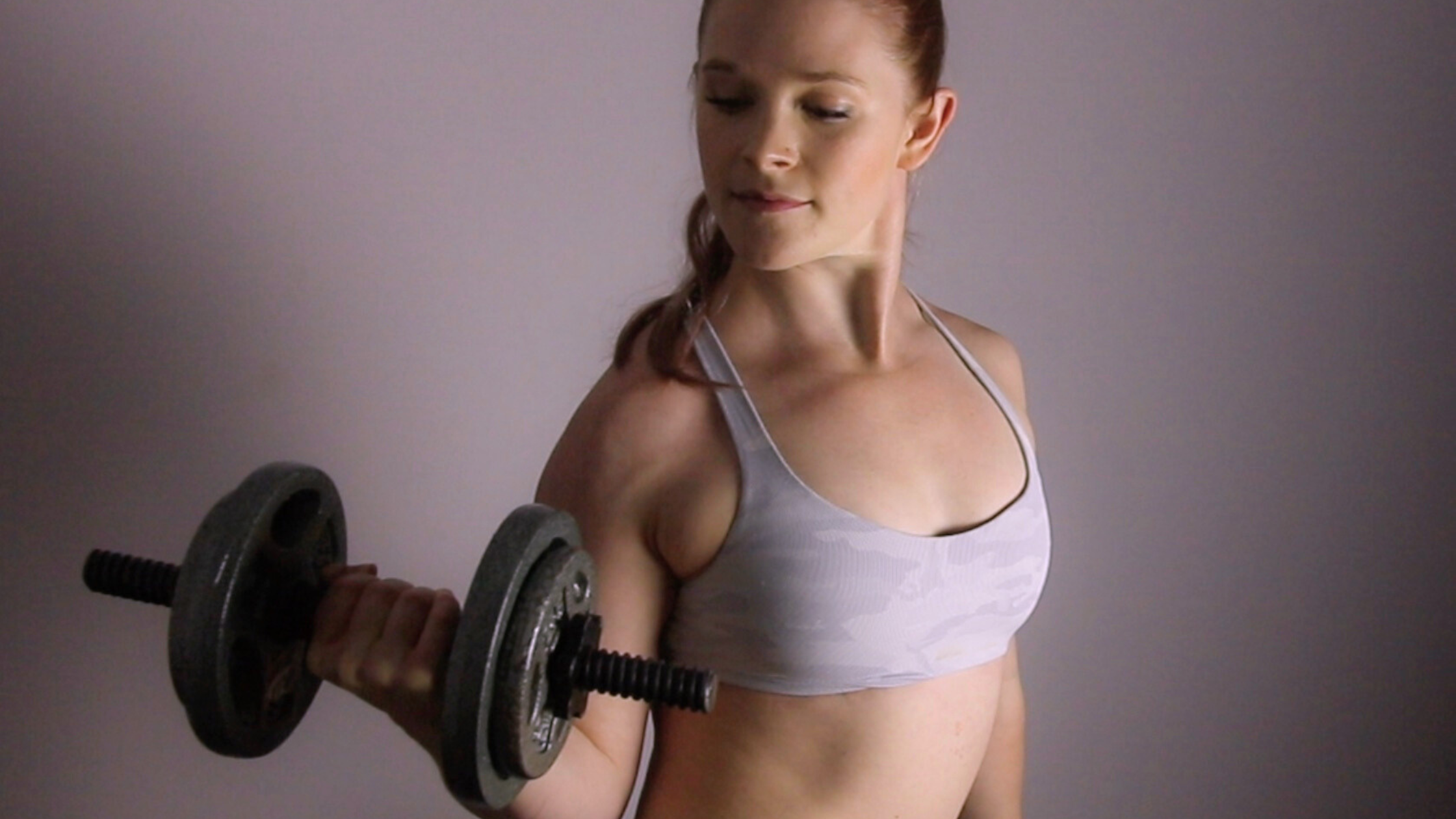
Sign up for updates ✉️
Sign up to get notified whenever new episodes drop. Opt in for more tips on training, fat loss, and nutrition by filling out the form below:
Your privacy is important to me! I will never share your information with any third party. Unsubscribe from the email list at any time.