Ep 88 | My Fat Loss Journey Part 1: Starting Snapshot
I'm Starting My Own Fat Loss Journey — And I'm Bringing You Along
After over a decade of coaching clients through fat loss, it's my turn.
I've spent years designing and refining my Fat Loss Transformation Program for my personal training clients. I've watched people burn fat, build muscle, and completely transform their relationship with their bodies using this program. And now I'm going through it myself — all six months of it — and documenting the entire process right here.
-
Jayd (00:00):
Hey there, I'm Jayd Harrison and today I'm starting my fat loss journey. Over the next six months, I'm going to be vlogging my weekly check-ins as I go through the same program that I designed for my personal training clients. I've been a personal trainer for over a decade and I designed this program, my fat loss transformation program, to help my clients to burn fat and keep it off for good while also building muscle and improving their health. And now it's my turn. Hey there. Welcome to the Coaching Corner Podcast. I'm personal trainer Jayd Harrison. I've been a personal trainer for over 10 years and I've created this podcast to share tips and strategies and inspiration to help you to build a body that you love without shame and without burnout. In today's episode, I'm launching the first episode of a six month series where I'm going to be covering my personal fat loss journey.
(00:59)
I'm going to be sharing with you my process of going through my fat loss transformation program, which is the same program that I use for my personal training clients. My goal with this program is to reduce my body fat percentage while maintaining the amount of muscle that I've built over the last two years. I want to see if I can even build more muscle while I'm in this fat loss phase. So I'm going really slow and I'm giving myself a really long time to achieve my goal so that I can stay in a very modest calorie deficit while prioritizing burning fat while also building muscle with my resistance training. So I hope that you enjoy this process and you find it inspirational or entertaining. And if you would like to join me and go on your own fat loss journey, you can apply to work with me in the link that's below this video if you're watching on YouTube or in the show notes of the podcast episode.(01:50)
This program is open to all levels. So if you are just starting on your fitness journey, this is a great way to die in the water and get started with the guidance of a professional who's also going through the process as well. And if you are more intermediate and advanced, don't worry. I will give you workouts that challenge you at your level using whatever equipment that you have. And without further ado, let's get into the first part of my six month Fat Loss journey.(02:21)
So the first part of the Fat Loss Transformation program is what I call the starting snapshot. This is where I'm going to sit down and I'm going to go through a series of questions and answer them honestly. And this is going to help me to get a sense of what my starting point is. And this will be really important to compare to the weekly reflections that I do moving forward to see how my routine changes, how my habits change, how my lifestyle changes, how I feel changes over time. Once my clients submit the snapshot reflection questionnaire, then they get an invite to my training app. And my training app is where I deliver their workouts and their meal plan and nutrition guidance. Then we'll actually use the training app to take progress photos and record our starting body weight, body fat percentage if you have it, and then body measurements.(03:13)
It's also where I'm going to track my day-to-day calorie intake as part of the nutrition snapshot, which is the assignment for week one. So let's go through the questions now. Okay. So for the first question is, how would you rate your current fitness level? Beginner, intermediate, advanced. I'd say advanced because I've been working out for over 20 years. How many days a week do you currently exercise? Okay. So my current programming, I've been getting two to three resistance training workouts a week, but then I also tend to walk my dog let's say three or four times a week for like 30 minutes. So we'll say four days. What types of exercise do you currently enjoy or engage in? Check all that apply. Weight training, of course. I love cardio. Yoga, Pilates. It's okay. High intensity interval training, love. Walking. What's your usual intensity level during your workouts?(04:09)
Well, I'd say depends on the workout, right? So we'll say hi for the resistance training. I maybe need to update that question because I almost always only do moderate intensity steady state cardio. I never really do high intensity interval training anymore. Resistance training is always really hard. I always work really hard during resistance training because I love it. What's your main goal with this program? I'd say my main goal with this program is I would like to get my body fat percentage down to 22%. So right now I'm about 141 pounds and I'm thinking that that probably will take me to about 135 or maybe 130 pounds. So I want to lose fat, but it's not so important for me to lose weight. I'm not super attached to a specific number on the scale because I know that body composition is way more important than body weight.(05:02)
If I stay at 141 pounds, but my body fat percentage goes down and my percentage of muscle goes up, that is a win for me. So improve body composition, body fat, 22%. Do you currently track your food intake? I do not. Like I said, I have not actually had the capacity to track my food. You don't really have to track your food all the time. Once you learn how to eat healthy, and especially if you're like me and you tend to eat the same thing all the time, you get a really good intuitive sense of what the nutritional content of the food that you're eating is and you can more or less meet your nutritional needs. So I have not, but that is something I'm looking forward to getting back into as part of this program so I can get a sense of what my intake is.(05:51)
I have a suspicion that often I tend to undereat, which is one of the reasons why I think my body is holding onto body fat because it's kind of staying in this sort of emergency mode. And so we'll figure that out as I start tracking what I eat and get a sense of what my intake is. How would you describe your current eating habits? Oh, that's a tricky one. I'd say like I do have regular meals. Let's say irregular because especially lately it hasn't been so regular. How many meals do you typically eat per day? Three to four. I'm a snacky girl. I like to eat small meals, like snacks and eat frequently. Do you follow any specific diet or eating plan? Yeah, I have been mainly pescatarian. I'm going to be so for real with you. I have really had it with meat and I haven't really had meat for a while now because I hate cooking with it and I very rarely enjoy the taste of it.(06:48)
I know that it's a really good source of protein so I may start to add it back in, but I just really can't stand it. But I just really don't like cooking with meat. But I will, we'll see after we start tracking what I'm eating. I might have to add it back in, but we'll see if you mark yes. I'm going to say mostly pescatarian. I do prefer a mostly pescatarian or vegetarian diet. I'm okay with eating like canned tuna. I'm okay with fish. I don't mind cooking with that. It's the poultry and beef is expensive. I can't eat pork because I'm allergic. How confident are you in understanding nutrition portion sizes? Very confident. Are there any specific foods you struggle to include or avoid in your diet? I'm allergic to pork and peanuts. Could definitely eat more protein and veggies. Do you have a sweet tooth or cravings for specific foods?(07:44)
Fuck yeah, girl. You know I do. I have hot chocolate mixed into my coffee like three or four times a day. I love sweets, dude. But I do notice that, especially on those days where I undereat and I don't prioritize actually getting like a good square meal three, four times a day. I tend to have wild cravings for specifically barbecue chips, that seems to be like my brain will go to that when I know that I'm like in a low calorie intake and my body is just like, "Give us some food." I crave barbecue chips a lot and I crave barbecue chips when I'm on my period as well. Do you have food allergies or intolerances? Yes, pork and peanuts. I hate chicken. I will eat it if it's like really mixed with stuff and you can barely taste it. People are always like, "Chicken doesn't have a flavor." Yes, it does.(08:33)
Yes it does. It does. It's gross. So I try to avoid it unless it's like it's got to be like in a casserole or like a quesadilla, but like lots of spices and lots of flavor, lots of cheese. There's got to be a lot of things going on to distract me from the flavor of the chicken because I just don't like it. And I recognize it's probably going to be something that I'm going to have to get over as I have to increase my protein intake, but we'll see. Have you followed a structured workout plan before? Hell yeah. I have worked with so many coaches over the years. Like I said, I've been working out for like over 20 years and I've worked with coaches in boxing. I've worked with weight training coaches. I've worked with mixed martial arts coaches. I've worked with a lot of coaches and I'm a big fan of coaching.(09:15)
I really do think that it's such a powerful thing. Have you followed a diet plan or fat loss programs in the past? I'd say yeah, because there are periods where I'm trying to cut fat in the past and I've tracked what I've eaten. I've had a specific calorie goal. Yeah. What is your experience with previous fitness or diet programs? I love fitness. I'm very fortunate that I personally have had really positive experiences with fitness and with nutrition. I've had amazing coaches. I've had amazing colleagues and friends that I've worked with over the years and I know that that's not everybody's experience. A lot of people have sort of like negative experiences with trainers or coaches or fitness. I have a very positive association with fitness. What do you think has prevented you from reaching your fitness goals in the past? Lack of time. Yeah, lack of time.(10:05)
I've been so busy in the last two years working on my new coaching programs. So I'd say lack of time. I definitely would like to be working out more and I would like to be spending more time actually being mindful of meal planning and taking better care of my nutrition. Do you have any specific goals or aspirations that aren't mentioned above? I would like to maintain or increase the amount of muscle I have while decreasing body fat percentage. What exercise equipment do I have access to? All the things. All the things. Yoga mat, mini bands, super bands, tube bands, dumbbells, kettlebells, barbells, squat rack, flat bench, incline bench, foam roller, cable machine and other. I have a full gym that I go to. I have several full gyms that I go to. Do you wear a fitness tracking device? Okay. So I have not been wearing my Apple watch for the past six months maybe.(11:07)
And for no other reason than that, I went to my brother's house for Christmas and then I packed my watch, I packed my charger and then I just didn't unpack my watch and my charger because ADHD I left it in my bag and it's been in my bag for six months. So that's going to be one of the things that I want to do. I want to get more data because I'm a data girly. I really like to know like how many steps I did and what was my heart rate when I was doing exercise. So I'm going to prioritize plugging that back in and I'm going to start wearing my Apple watch again and that is some of the data that I'll be sharing with you in the blog. So Apple watch. Thanks for submitting your starting snapshot. Head back to your program and move on to the next lesson.(11:47)
Sweet. Okay. So that's the questionnaire. Now we have to take my measurements, step on the scale and also take my starting progres photos. So I have a smart scale that I really, really like. It's from Weight Gurus and it has an app on my phone and the thing about this scale that I really like is that it not only takes my body weight, but it also estimates my body fat percentage. It uses like most smart scales bioelectrical impedance analysis. They essentially shoot an electrical signal from one side of your body to the other. And the idea is that electricity moves faster through water than through fat. And so using your other bio data like your height, your weight, your sex, et cetera, it compares how fast that electrical signal goes through your body from one foot to the other and it gives you an estimation of how much of your body weight percentage is body fat versus muscle mass.(12:46)
Now I do have to say with bioelectrical impedance analysis machines, whether you're using a smart scale or one of those like handheld Omron machines, there's a lot of variables that can skew the number and make it inaccurate. So it's important that whenever you're stepping on this kind of a scale or if you're using another type of machine that uses bioelectrical impedance analysis, you need to make sure that you're keeping all of the factors and variables more or less consistent, meaning you're measuring yourself at the same time every day under the same conditions because there are conditions like the humidity in the air, how sweaty you are, how dehydrated you are. All of these can impact how that electrical signal moves through your body. So what I'm going to be doing is I'm going to be taking my measurement as soon as I wake up in the morning right after I pee, before I take my dog out for his walk or drink coffee, because this is a more or less pretty consistent state, right?(13:47)
There's no humidity in the air because I haven't showered yet and I also am stepping on the scale before I've had anything to eat or drink. I've already emptied my bladder so this is a way that I can keep the measurement consistent and over time I'm going to be comparing the numbers to themselves. Now even as I try to keep everything consistent, it doesn't mean that what the numbers that the scale gives me are going to be super duper accurate. What we want to look for is trends over time. Over time, keeping all of these factors consistent, I want to see whatever the estimation of my body fat percentage is. I want to see that number trending down over time nice and slowly. So when I stepped on the scale this morning it came out to be 141 pounds and it estimated that my body fat percentage is 28% and muscle mass is 30%.(14:40)
And so now what I'm going to do is I'm going to enter this into my ABC Trainerize app so that I have that data and I'm going to take my measurements. To take my measurements, I'm using this telescopic tape measure that I really like because it makes measuring yourself a lot easier. It's generally pretty hard to measure yourself by yourself. It's better if you can have someone else do it for you, but this makes it a lot easier. So my neck circumference ended up being 12.75 inches. Next is the shoulders. So I tried my best to take the tape measure around my shoulders and make it as straight align as I possibly could. But like I said, it's just so much easier if you can get someone else to help you. And my shoulder circumference came out to 14.2 inches. So I entered that in my ABC Trainerize app.(15:29)
And next is the chest, which is incredibly hard to measure by yourself. But again, this little telescopic tape measure makes it so much easier. Now I'm going above my boobs here because I'm not trying to measure my boob growth. I'm specifically trying to measure the growth of my PAX muscles. I set them right above my boobs and try to make sure that it's as straight a line underneath my armpits as possible across my back. And the circumference here ended up being 34.2 inches. Next up I measured my waist. So here I'm using the midpoint of my belly, although I think I probably should have gone around and specifically measured the biggest part of my belly, which is more that area right by my belly button. So today I think I'm going to remeasure that so that I have the widest part of my belly measured because that's the part that I want to see reduce the most.(16:22)
But for now I just went with the smallest part of my waist and that ended up being 27.7 inches. And then I did my hips. With this, you want to go around the widest point possible and that ended up being 40 inches. And next up is my left side thigh. I'm measuring around the widest part of my thigh here and trying to stand normally and that ended up being 23 and a half inches and then I measured my left calf again around the thickest part and that ended up being 14 and a half inches. Next up, I'm going to measure my left side bicep right around the middle part of the bicep with my arm down and relaxed and that ended up being 12 inches. So I recorded that in ABC Trainerize and then finally my left side forearm, which ended up being nine and a half inches.(17:14)
And then now I'm going to move over to the right side of my body starting with my right side calf, which ended up being 14 inches. So I have a little bit of a difference of a half an inch between my left and my right side, and then I'm going to measure my thigh on my right side as well and that ended up coming out to 24 inches. So another about half an inch difference between my left and my right side. Then my right bicep, which ended up being 11 and a half inches, again, a little half an inch difference and then finally my right side forearm, which ended up being nine and a half, which is the same. I also made sure to include the body fat percentage estimation in ABC Trainerize when I logged it in and then next up we have my progress photos.(17:57)
This is the part that everybody hates, especially here in the beginning. It's so vulnerable and nerve wracking to stand in front of a camera and take a picture of yourself wearing very little and looking at your body from head to toe from the front, the side, the back, and the other side. But I had to tell myself what I tell my clients, which is remember that this is the starting point and these progress photos are so, so, so important because as we burn fat and as I approach my goal body composition, it's going to be so motivating to take a look back and compare my progress photos of the future to what they are today because especially when I hit that three month mark or that four month mark when I've been doing this for a long time, it's very easy to lose motivation at that point.(18:51)
And by that point, looking back at your progres photos from four months ago to now can help you to get a sense of, look, I did something. I did that. I'm making progress even though it feels slow, even though it feels excruciating. So it is a really important part of helping you to be motivated later on, even though it may not be quite as motivating to do your progress photos in the very beginning. In fact, you may find it really cringe or you might just be like, "Oh my God, I don't want to look at my body." That's totally normal. I would say most people, if not everybody that I've ever worked with feels this way about the progress photos, but if you can get yourself to do them and get past that feeling, it can be so helpful later on. So with that said, let's take a look at my progress photos.(19:44)
So with these, you want to be similar to when you step on the scale. You want to be keeping as many of the factors consistent as possible. You want to wear the same outfit every time you take your progress photos. You want to make sure that you're taking them in the same place with the same lighting so that you can really see the differences from one month to another. And when you take them, you want to make sure that they're like level with your chest or with your face and you want to make sure that your whole body is in frame. So here I am from the front showing from head to toe and then turning to this side and taking my arms out in front of me so that you can see the belly and the full profile and then from the back relaxed and then from the other side.(20:29)
Okay. So now we have my starting snapshot completed more or less. There is one more step that I need to do, which is track everything that I eat and drink over the next week to get a sense of what my current calorie intake is. We have to do that before we can make any changes to my diet because we want to see what my body is already used to eating every day. So that's going to be one of my main tasks for the first week of my body fat transformation.(21:00)
Thank you so much for watching or listening to this very first episode of my brand new series on my Fat Loss Transformation journey. I hope that you found it fun to listen to, maybe inspirational, and maybe you want to share a little bit about your own fitness journey. You can leave comments on the YouTube video, which is linked in the show notes if you are listening to the podcast episode. If you enjoyed it, make sure that you like the video and subscribe to my channel so you always get the latest episodes and other videos that I put out. And if you're listening to the podcast and you liked it, make sure to follow the show so you always get the latest episodes delivered to your device as soon as they drop. And don't forget that if you would like to work side by side with me on your own fitness journey, I am accepting clients into my Fat Loss Transformation program.(21:45)
You can find more information for that and sign up for the program and the link that's below in the description of this video or in the show notes of the episode. Wherever you are, I hope you have a good rest of your day. Make sure that you're taking care of yourself. Drink some water, eat some veggies, eat your protein, get your steps in and I will see you soon.
This isn't a "watch me get shredded in 90 days" situation. This is a slow, intentional, evidence-based fat loss journey, and I want to show you exactly what that looks like from the very beginning.
Why I'm Doing This
My goal is to reduce my body fat percentage to around 22%. Right now I'm sitting at approximately 141 pounds with an estimated body fat of 28%, which means my target is less about a number on the scale and more about body composition. If I stay at 141 pounds but my body fat percentage drops and my muscle percentage rises, that is an absolute win in my book.
I'm also giving myself a long runway — six full months — so that I can stay in a modest calorie deficit rather than slashing my intake and risking muscle loss. I've spent the last two years building muscle, and I'm not about to throw that away chasing faster results. The goal is fat loss with muscle retention. Ideally, muscle gain.
What the Starting Snapshot Is (And Why It Matters)
Every client who enters my Fat Loss Transformation Program starts with what I call a starting snapshot. Before we change anything, we need to know where we're starting from. That means going through a detailed intake questionnaire, stepping on the scale, taking body measurements, and — yes — taking progress photos.
The starting snapshot isn't just administrative busywork. It becomes one of the most motivating tools you have later in the program, especially around the three or four month mark when progress can start to feel slow and invisible. Having concrete data and photos from day one gives you something real to compare against, and that comparison is often the thing that keeps people going.
My Starting Stats
Here's where I'm at as of day one:
Body weight: 141 lbs
Estimated body fat: 28% (via bioelectrical impedance analysis)
Goal body fat: 22%
For measurements, I used a telescopic tape measure and logged everything into my ABC Trainerize app:
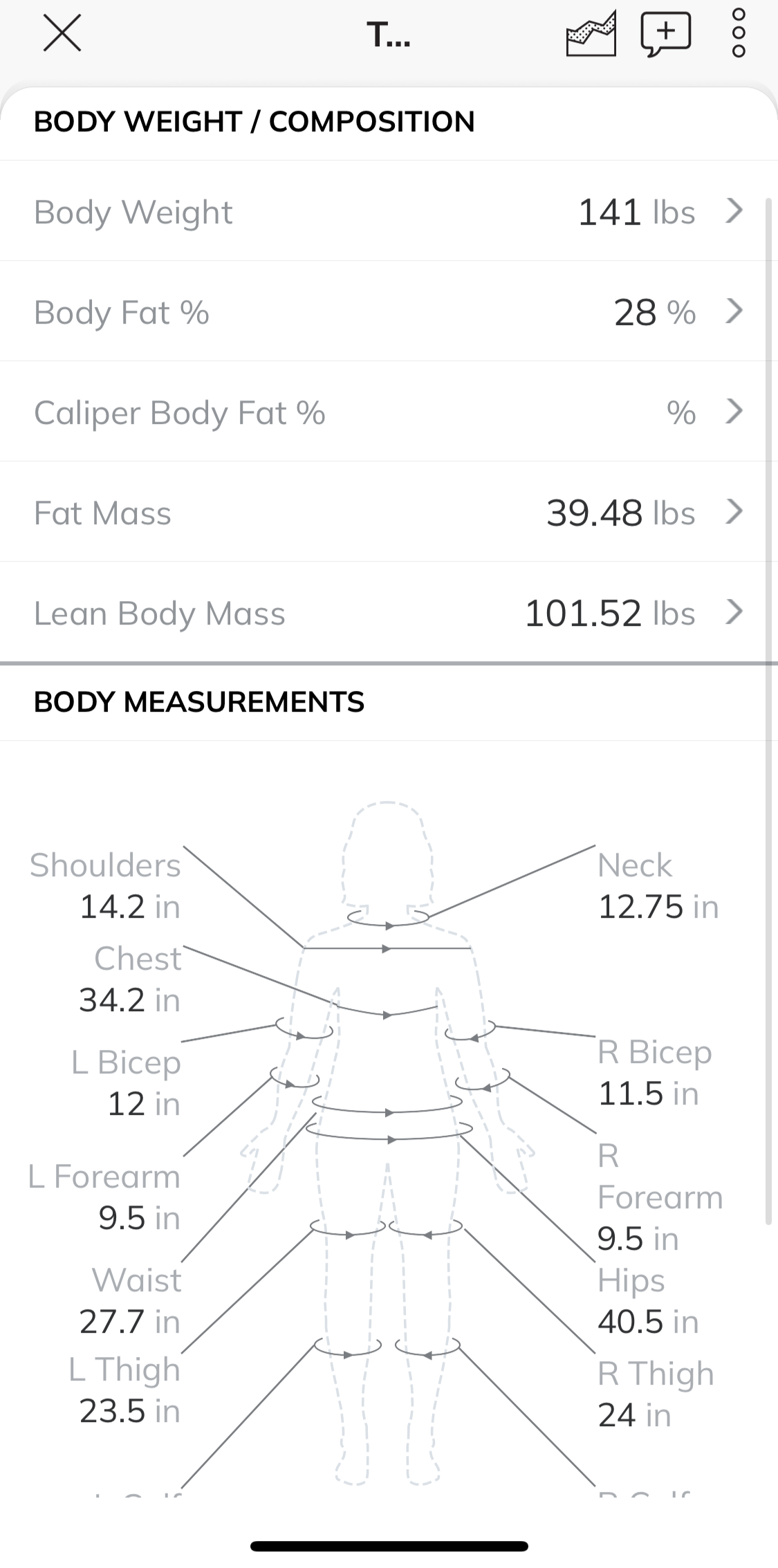
Neck: 12.75"
Shoulders: 14.2"
Chest: 34.2"
Waist: 27.7"
Hips: 40"
Left thigh: 23.5" / Right thigh: 24"
Left calf: 14.5" / Right calf: 14"
Left bicep: 12" / Right bicep: 11.5"
Left forearm: 9.5" / Right forearm: 9.5"
A quick note on the smart scale: I use a Weight Gurus scale that estimates body fat via bioelectrical impedance analysis (BIA). BIA isn't perfectly accurate — hydration levels, humidity, time of day, and other variables can all affect the reading. What matters isn't the absolute number; it's the trend over time. To keep my measurements as consistent as possible, I weigh in every morning immediately after waking up, after using the bathroom, and before eating, drinking, or walking the dog.
Where My Nutrition Actually Stands (Honest Edition)
Here's the real talk portion of this post.
I have not been tracking my food. At all. I eat mostly pescatarian — I genuinely can't stand cooking chicken or beef, pork is off the table due to an allergy, and I do fine with fish and canned tuna. I tend to eat three to four small meals a day, and I suspect I'm frequently undereating, which may actually be part of why my body has been holding onto fat. When your body thinks it's in an energy emergency, it adapts accordingly.
I also have a serious sweet tooth. Hot-chocolate-in-my-coffee, multiple times a day. And when I'm really under-eating, my brain goes straight to barbecue chips. Classic low-calorie craving spiral.
None of this is me beating myself up — it's just an honest picture of where I'm starting. And that's exactly the point of the starting snapshot: no judgment, just data.
Week One Assignment: The Nutrition Snapshot
Before I change anything about how I eat, I need to actually know what I'm eating. So week one's assignment is simple: track everything I consume for seven days using the Trainerize app. No dietary changes yet — just observation.
This baseline data will tell me what my body is currently used to taking in, which is essential before setting any calorie targets. You can't build a smart nutrition plan without knowing your starting point, and making changes before you have that data is just guesswork.
Progress Photos: The Part Everyone Dreads
I'm not going to pretend taking progress photos is comfortable, because it's not — even for a personal trainer who's been working out for over 20 years. Standing in front of a camera in minimal clothing and photographing yourself from every angle is vulnerable and a little cringe-inducing, and that's completely normal.
But here's what I tell my clients, and what I had to remind myself: these photos are a gift to your future self. Four months from now, when progress feels slow and motivation is lagging, being able to look back at where you started is one of the most powerful tools you have. The discomfort of taking them now is absolutely worth it.
The key to useful progress photos is consistency: same outfit, same location, same lighting, same angles every time. Front, side, back, other side. That's it.
What's Coming Next
Over the next six months, I'll be checking in weekly right here and on The Coaching Corner Podcast, sharing my data, my process, what's working, and what's hard. This is the same program my clients go through, and I think there's real value in seeing it from the inside — not from the coach's perspective, but from the participant's.
If you want to follow along, make sure you're subscribed to the podcast and the YouTube channel so you don't miss a check-in.
And if you want to do this alongside me — if you're ready to start your own fat loss journey with structured programming, nutrition guidance, and real coaching support — I'm currently accepting new clients into the Fat Loss Transformation Program. You can find all the details and apply at the link below.
Let's get to work.
Subscribe for Updates ✉️
Sign up to get notified whenever new episodes drop. Opt in for more tips on training, fat loss, and nutrition by filling out the form below:
Your privacy is important to me! I will never share your information with any third party. Unsubscribe from the email list at any time.