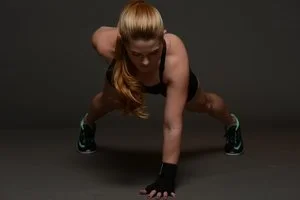
You don't need a fancy setup to build real strength at home — just these five essentials.
A lot of people assume that working out at home means either making do with nothing or spending a fortune turning a spare room into a full gym. Neither is true. After more than a decade of personal training, I've found that a small, intentional collection of equipment is all you need to build a solid foundation of strength and muscle — whether you're brand new to fitness or a seasoned lifter who just prefers to train at home.
This is the first post in my home gym starter series, focused specifically on beginners and anyone working with limited space. Here are the five pieces of equipment I recommend to every client starting out.
-
Jayd (00:00):
Most people think that if they want to work out at home, they have to build out a really fancy home gym using a ton of equipment and spending a lot of money and taking up a lot of space. But the truth is that you can work out consistently at home with very minimal equipment, but there are some pieces of equipment that are going to be really important for you to have. And so I'm going to share those with you today. Hey there. I'm Jayd Harrison AKA Jaydigains. Welcome to the Coaching Corner Podcast. I've been a personal trainer for over 10 years and I've created this podcast to share with you tips and strategies to help you build a body that you love without shame and without burnout. Today's episode is going to be centered around what pieces of equipment you should have when you're just starting your home gym.
(00:55)
And if you are a beginner to fitness, these five pieces of equipment alone are going to be enough to help you start your fitness journey, build a solid foundation of strength and muscle toning. And even for intermediate and advanced exercisers, these are must-haves for your home gym. Keep in mind that I'm going to provide links for all of the equipment that I recommend throughout this episode. So if you're watching this video on YouTube, you'll see the linked equipment within the video itself, but you can also find the links in the description of the video. If you're listening to the podcast episode, you'll find the links for the equipment in the show notes. And before we get into the episode, make sure that you like this video if you're watching on YouTube and subscribe to the channel so that you always get the latest episodes as soon as they drop.(01:43)
And if you are listening to this podcast, make sure to follow the show so that every new episode gets delivered right to your device. And if you are looking for an online personal trainer who can help you to make sustainable gains, whether you're working for fat loss, muscle building, or you want to get to that next PR, apply for my personal training program. You can find the link for that in the show notes or in the description of the video below. And without further ado, let's get into the episode.(02:14)
A lot of people prefer to work out at home for a lot of different reasons. Maybe you are not quite ready to join a gym or maybe you're just an introvert and you don't want to be around other people, or maybe you like the flexibility of having equipment at your house so that you can work out whenever you get a moment. This is definitely the case for a lot of my personal training clients, especially my clients who are stay at home moms. Having some gym equipment in their home allows them to sneak in some exercise when the babies are napping or when the kids are at daycare and between household tasks. And let's be honest, gym memberships can be kind of expensive. And in this economy, if you can work out at home and stay consistent and make gains, save a little bit of money, that's a win, but it can be kind of overwhelming when you start looking at gym equipment to fill out your home gym.(03:08)
And so that's why I've started this series. I want to give you kind of a starter guide from beginning to end of what I recommend as a personal trainer you start to add to your home gym. Now today's episode is all going to be focused on people who are just getting started on their fitness journey or people who like to do body weight training using very little equipment. And if you have very little space available in your apartment or in your house for your gym equipment, the equipment that I'm going to talk about in this episode is going to be perfect for you. So let's get into it. My number one piece of equipment that you should absolutely have in your home gym is an exercise mat, preferably two. So I usually recommend having a yoga mat, which is a thin mat that's a little bit grippy and also an exercise mat that's a little bit thicker.(03:59)
I myself have multiple exercise mats because I train people out of my home gym and I also work out in a variety of styles myself. When I'm doing floor work for my core, doing exercises like crunches or planks, I like to have a little bit more cushion underneath my joints because if you've ever tried to do crunches on a bare floor or a really thin mat, your spine is going to be ruised. So that's where I like to have a thicker exercise mat. If you're doing exercises from a quadruped position where you're on your hands and your knees, having a nice thick exercise mat underneath your knees can help to take away some of the discomfort that you might find if you try to do these exercises from a thinner yoga mat. Now I do also recommend having a thinner yoga mat because exercises where you have to balance are going to be really, really hard on a thick foam mat because that thickness adds instability.(04:58)
So if you try to stand on one leg or if you try to stand in an uneven stance like a lunge or a warry or one, two or three, it's going to be a lot harder for you to practice that position from a thick exercise mat than from a thin yoga mat. Depending on the size of the mat that you choose, it's not going to take up very much space. Ideally, you want to get something that is going to cover basically your height. So if you're 5'3" like me, you want to get a yoga mat or an exercise mat that is at least five feet to three inches long. And you can do a little bit longer if you like. So as long as you have the floor space for yourself to be able to lay down on the floor and then take your hands out to either side of you, that's about the amount of space that's required for this piece of equipment and it doesn't have to be permanently that way as well because when you're finished using your exercise mat, you can just roll it up and tuck it away.(05:52)
You can put it under a bed or you can put it in the corner of a room. If you want to save even more space, you could literally stack both of the exercise mats on top of each other and roll them up together. The reason why this is my number one piece of equipment is because the exercise mat, the yoga mat are the piece of equipment that's really best for practicing the fundamental exercises of building core strength and stability, especially if you are a beginner to fitness, you need to make sure that you are developing your core strength. That is the strength of the muscles in your torso and in your back, your abdominals, your obliques, your spinal erectors. And the types of exercises that we do to train these muscles are mainly floor exercises, things like crunches, planks, side planks, bird dogs, dead bugs.(06:43)
These are just a few examples of the types of exercises that my clients do to build core strength and stability. I also do core training at the beginning of every training session, especially when I'm lifting heavy because I want to make sure that my core is stable and fired up and locked in. Balance training exercises are just as important because they also help you to develop core stability and core strength while also building up endurance and strength in the muscles throughout the rest of your body like your legs and your arms. Many of these exercises don't require any equipment other than an exercise mat. So that is my recommended piece of equipment, number one. The second piece of equipment that I recommend you have in your home gym is a foam roller. Now this is a piece of equipment that a lot of people don't really know a whole lot about and maybe don't even know how to use, but as a personal trainer, it is a must have piece of equipment.(07:35)
You can use a foam roller at the beginning of your workout to basically roll over and massage the muscles that you're going to be using in your workout. This helps to get some blood flow there and it also helps to relieve tightness and tension in the muscles. A lot of times when my clients come to work with me, we need to use the foam roller at the beginning of their sessions because they often have something that's tight that's really hard to address through stretching alone. By adding some pressure to the muscle group that's really tight, this helps it to loosen up so that my clients can exercise with a full range of motion. If you've ever had a crick in your neck or in your back from sleeping in a weird way, you know it's really hard to exercise with that. But oftentimes when my clients come into the gym and they've got a crick in their neck, I use the foam roller to put pressure on the traps and on the back and that relieves the tension and they're able to exercise without discomfort.(08:29)
I also will sometimes use the foam roller in the middle of the workout if I'm doing an exercise, especially like squats and I feel a muscle group tighten up and get really tense, this often happens with my quadriceps and my hip muscles and if they get tight while I'm trying to perform squats, for example, I'll actually experience some knee pain. And so I will perform a set and then if I feel some tightness or I felt like my knee was really tight, I'll stop and during my rest period foam roll over the foam roller on my quadriceps and then I feel much better after that. Now this also does not take up very much floor space. You can store it right next to your rolled up mats or if you want to save even more space, you could literally roll it up in your exercise mats so that you only have one roll of equipment and then you can tuck that away in the corner or under your furniture or wherever.(09:18)
Now my third recommended piece of equipment is mini bands, specifically the fit simplify elastic mini bands. I have been using this brand of resistance bands for probably 15 years and the reason why I love mini bands in particular is because one, they take up very little space. They come in a little bag, you can roll these bands up and they basically fit into the amount of space that you could hold in your hand. So you can store them away very easily. They don't take up space. I keep mine in the front pocket of my gym bag. Some of my clients will keep them in a little drawer in their home gym area. Resistance bands are really helpful because they allow you to perform pole based exercises like rows or pulled downs that are really hard to practice without equipment. You need something to pull if you want to develop your back strength, if you want to develop the pull motion.(10:14)
Also, there are some exercises like monster walks or clamshells that really are best done with mini bands to add resistance. They're pretty versatile as well because you can also use them to add resistance to exercises that you might have been doing with just your body weight, like squats or lunges. You can even use them to secure them underneath your feet and perform deadlifts. So they're very versatile and they unlock movement patterns that wouldn't otherwise be available to you if you were just exercising with a exercise mat and a foam roller. The other thing that I really like specifically about the Fit Simplify minibands is that they are labeled according to the level of resistance that they have. So there's extra light, light, medium, heavy, and extra heavy. And if you're tracking what you do for your workouts and writing down what you do and what resistance level you're using, this allows you to see your progress over time as you get stronger.(11:08)
So you may start with the extra light band, which I call the number one band, and then work your way up to where you can perform with the medium band or the number three band and you can record that in your workout log or if you're one of my clients, you can record it in the ABC Trainerize app and we can see you getting stronger over time as you use heavier and heavier bands. Likewise, the number four piece of equipment that I recommend that you have in your home gym are handlebands or tube bands, specifically tube and handlebands that come with some kind of an anchor. Like the mini bands, these allow you to perform pulling based exercises, but they allow you to do a wider variety of exercises and you can use both arms going at the same time rather than having to secure one end of the band with one hand and then pull with the other hand the tube bands when they are secured to a door or around your feet or around a squat rack, they allow you to work both arms at the same time and you also can get a bigger range of motion using these larger bands.(12:12)
If you're trying to follow along with a workout program that requires cable machines as equipment, using the handle tube bands allows you to basically do the same exercise as you would with a cable machine. All you have to do is just make sure that the band is secured at the level that it would be for the cable machine. So you can do pull downs with this piece of equipment, you can do rows, you can also do some of my favorite core training exercises like the wood chops and external shoulder rotation exercises for healthy shoulders like pal off presses, pal off presses and raises. I do also recommend that you look specifically for a brand of tube bands that is labeled with a specific amount of weight. Now with that said, I should note that the amount of resistance that a band is labeled with, for instance, say you have a band that's labeled as 50 pounds, using that band for your rows or for your pull downs is not really going to be the equivalent of lifting 50 pounds of weight using a cable machine or using actual weights.(13:22)
And often you'll find that if you get bands from one brand and then you get another set of bands from a different brand, if both are labeled with a certain amount of weight, there can be a huge difference between what the 50 pound band feels like for one brand versus the other. I have a client who has multiple sets of tube resistance bands that are labeled with a certain amount of weight and 150 pound band feels like the 100 pound band of another set of bands. Take the label of the amount of resistance that they give with a grain of salt. And again, the purpose of having those labels is so that you can see progress on how you're getting stronger because when you start doing an exercise for the first time, you do want to use a lighter band and then as you get stronger, you can use a heavier band over time.(14:13)
And if you're writing your workouts down, you'll be able to se progress as you get heavier and heavier, but eventually you're going to reach a point where the resistance bands are not going to give you the amount of resistance that you need to keep your muscles challenged and to keep getting stronger. Eventually, if your goal is to build muscle and get strong, you're going to need to use weights, but you don't have to go out and purchase a big old squat rack, a barbell and plates or machines to keep your body advancing. When it's time for you to start doing heavier exercises, I recommend getting a set of adjustable dumbbells. Adjustable dumbbells come in a variety of different formats. I personally use spin lock dumbbells because these are pretty sturdy. They last forever and they're relatively inexpensive. Sometimes my clients will get power blocks, which use a completely different system for adding and taking weight off.(15:19)
My experience with the power blocks is that they tend to be kind of unstable and shaky and they do also malfunction. Some exercises are really hard to do with the power blocks like goblet squats or lap pullovers. I like the sturdiness of the spin lock dumbbells because once the spin lock is secured, that weight isn't going anywhere. It's not going to wobble. And if it does, it means I just need to tighten it a litle bit more. And it also doesn't really take up that much space either. You can just keep the handles and the plates stacked near wherever it is that you keep your other equipment, or you can get a tree that you can hang the weights on. This is pretty convenient and also takes up very little space. The dumbbells are going to unlock so many more exercises for you and are also going to allow you to use more resistance than what you would be able to use with bands alone.(16:11)
You'll be able to perform weighted exercises like goblet squats or Romanian deadlifts. You'll be able to start practicing heavier rows and overhead press. And as you get stronger, you don't have to have a whole big set of dumbbells from five pounds to 50 pounds. You can just add on another plate to the handle. Now these five pieces of equipment alone are awesome for helping you to build muscle and build strength. And I have clients who have been working out at home with me using my programming for years using just these pieces of equipment and they're making amazing gains, building muscle, burning fat. So that goes to show you, you do not need to have a big fancy home gym. If you want to make the most of this equipment, I recommend getting into a structured training program, one that is progressive and walks you step by step through building strength from the ground up.(17:06)
And that is something that I provide in my programming for my clients. So if you are looking for some programming that works, if you want to work with a coach who can help you to build a body that you love without shame and without burnout, with all of the guidance that you need and how to exercise and how to eat to achieve your goals, I can help you. You can apply to work with me in the link that is in the show notes of this episode or in the description of the video below if you're watching on YouTube.(17:39)
I hope that you found this episode helpful and I'd love to hear what questions you have and I'd also love to hear about what equipment that you have in your home gym that you absolutely love and recommend. You can leave them in the comments of the YouTube video. If you're listening to this podcast, you can find the link to the video of this episode in the show notes. Thank you so much for watching or listening. Once again, I'm Jayd Harrison, AKA Jaydigains. If you'd like to follow me on my socials, you can find me on Instagram, TikTok, YouTube and Twitch. My handle is Jaydigains. That's J-A-Y-D-I-G-A- I-N-S. And if you are interested in learning more about the programs and services that I offer, you can also go to my website, which is jaydigains.com. I will see you in the next episode of the Coaching Corner Podcast.(18:27)
In the meantime, make sure that you are taking good care of yourself. Eat your veggies, eat your protein, drink your water, and I will see you soon.
The Only 5 Pieces of Equipment You Need to Start Your Home Gym
1. An Exercise Mat (Preferably Two)
This is my non-negotiable number one. Specifically, I recommend having both a thick exercise mat and a thinner yoga mat — and yes, there's a reason for both.
The thick mat is your best friend for floor work: crunches, planks, side planks, bird dogs, dead bugs. Your spine will thank you. It also makes quadruped exercises (hands and knees) much more comfortable on hard floors.
The thin yoga mat is for balance work — lunges, single-leg stands, warrior poses. A thick foam surface adds instability that will make balance training significantly harder and less effective.
Storage is a non-issue. Both mats roll up, stack together, and tuck under a bed or into a corner. The only floor space required is roughly your own height plus arm-width — and only when you're actually using them.
2. A Foam Roller
Most people have heard of foam rollers but aren't quite sure what to do with them. Here's the short version: it's self-myofascial release, and it's a game-changer for keeping your body feeling good enough to train consistently.
I use the foam roller with almost every client at the start of a session. It's especially useful for breaking up tightness that stretching alone won't touch — a crick in the neck, tight hip flexors, quads that cramp up mid-squat. When I roll out my quads between sets of squats, I notice an immediate reduction in knee discomfort.
You can also use it mid-workout whenever a muscle group starts to tighten up. Roll it out during a rest period and continue training.
Storage hack: roll your foam roller inside your stacked exercise mats. One bundle, one spot in the corner.
3. Mini Resistance Bands
Mini bands are wildly underrated and absurdly convenient. My personal go-to is the Fit Simplify elastic mini bands — I've been using them for about 15 years. The whole set fits in the palm of your hand and easily slides into a gym bag pocket or a small drawer.
What makes mini bands essential is that they unlock pulling movements — rows, pull-downs, and exercises like clamshells and monster walks that really can't be done without them. They also add resistance to bodyweight exercises like squats and lunges, and you can loop them under your feet to mimic a deadlift pattern.
The Fit Simplify set is labeled by resistance level (extra light through extra heavy), which makes it easy to track progress in your workout log. When you graduate from the light band to the medium band, that's a measurable strength gain worth celebrating.
4. Tube Bands with Handles and an Anchor
Think of these as the upgrade to mini bands. Tube bands with handles let you work both arms simultaneously and give you a fuller range of motion — making them a solid stand-in for a cable machine.
With these and a door anchor, you can do:
Pull-downs and rows
Wood chops
Pallof presses and variations
External shoulder rotation exercises
One important note: the weight labels on tube bands are not standardized. A "50 lb" band from one brand may feel very different from a "50 lb" band from another. Use the labels as relative guides for tracking your own progress, not as comparisons to actual free weights or cable stacks.
5. Adjustable Dumbbells
At some point, bands won't be enough. If your goal is continued muscle growth and strength, you'll eventually need weights. But you don't need a full rack — you need one pair of adjustable dumbbells.
My preference is spin lock dumbbells. They're affordable, durable, and stable. Once that lock is tight, the weight isn't going anywhere. I've had less success with selectorized options like PowerBlocks, which can feel wobbly and limit certain exercises (goblet squats, lat pullovers).
Adjustable dumbbells open up Romanian deadlifts, goblet squats, overhead presses, and heavier rows. And as you get stronger, you just add another plate — no need to buy a whole new set.
Putting It All Together
I have clients who have been training with these five pieces of equipment for years and are making real, measurable gains — building muscle, losing fat, getting stronger. You don't need more than this to start. You need a program that's progressive and builds on itself over time.
If you're looking for structured programming and coaching that's evidence-based, shame-free, and built around your actual life, you can apply to work with me at jaydigains.com or find the link in the show notes of the Coaching Corner Podcast episode this post is based on.
Have a piece of home gym equipment you swear by? Drop it in the comments — I'd love to hear what's working for you.
Subscribe for Updates ✉️
Sign up to get notified whenever new episodes drop. Opt in for more tips on training, fat loss, and nutrition by filling out the form below:
Your privacy is important to me! I will never share your information with any third party. Unsubscribe from the email list at any time.