Troubleshoot Your Bench Press
If you want to have a strong upper body, bench press is one of the best exercises to train. This compound exercise targets multiple muscle groups, including the pecs, delts, triceps as well as stabilizing muscles throughout your core and legs.

The bench press movement mimics various pushing actions that we do in everyday life. Having a strong bench can improve your ability to perform tasks like pushing objects, lifting heavy loads, and improving sports performance in activities like football, basketball, and wrestling.
Another reason that I love practicing and teaching the bench press is that it’s a damn fun lift–especially when you get up into heavier loads. Everyone I’ve taught bench press says the same thing: it feels empowering to move big weight.
Before you start loading up the bar with heavy weight, however, it’s important to take the time to master the technique of the bench press with lower weight and high-rep sets.
Let’s take a look at how to do the bench press with good technique. I’ll share with you some of the important cues that I give my clients to help them get all the pieces moving together.
First, let’s talk about which muscles are engaged and responsible for movement during the bench press exercise. By understanding the actions and functions of each muscle group, you can focus on engaging them properly during the bench press. This awareness enhances your mind-muscle connection, which will help you to lift more safely and effectively.
The prime movers of the bench press (i.e., the muscles that extend and contract) are the pecs, deltoids, and tricep:
Pectoralis major (pecs): The pectoralis major is the primary muscle targeted during the bench press. It consists of the clavicular (upper) and sternal (lower) heads. When activated, the pectoralis major is responsible for horizontal adduction, which brings the upper arm toward the midline of the body. It also assists in shoulder flexion, extension, and medial rotation.
Anterior deltoids (delts): The anterior deltoids, located at the front of the shoulders, assist the pectoralis major in shoulder flexion during the bench press. They help raise the arms up towards the starting position and provide stability during the movement.
Triceps brachii: The triceps brachii, a three-headed muscle at the back of the upper arms, are heavily engaged during the bench press. They extend the elbow joint, allowing for complete extension of the arms during the pressing phase of the exercise. The triceps are responsible for the lockout portion of the movement.
Many other muscles have to also engage isometrically (meaning they stay fired up without moving) to stabilize your body while you perform the bench press. For example, your lats, external shoulder rotators, and traps all have to stay engaged to stabilize your shoulders on the bench. Your glutes, erector spinae, hamstrings, and quads also have to fire up to keep your lower body stable. Essentially everything from the shoulders down needs to be engaged to help you stabilize while performing the bench press.
How to Do the Bench Press
Before doing bench press, make sure that to set up the equipment properly:
If you’re using a detached bench, place the bench perpendicular to the rack so that your head will be right under the bar on the rack.
If you’re using j-hooks, set them to the height of just below where your hands would reach with your arms extended up while laying flat on the bench.
Place the bar on the j-hooks (or on the rack at the height just below where your hands reach while lying on the bench).
Set up your safeties to the height that would catch the bar if you fail the lift and need to bail. If you don’t have safeties, make sure to have someone there to spot you.
Now that your equipment is set up, it’s time to get into position for doing the exercise:
Lay down on the bench face-up with your feet on the floor (either heels or balls of your feet).
Reach up and grab the bar where your hands are equal distance from the center of the bar (use the rings on the bar as a guide)
Engage the muscles all along the back of your body:
fire up your back and push your shoulders into the bench
squeeze your glutes (butt) and push your feet into the floor
engage your abdominals
push your chest up towards the ceiling
Take a deep breath and brace your core, then unrack the weight, bringing it to right above your shoulders with your arms straight.
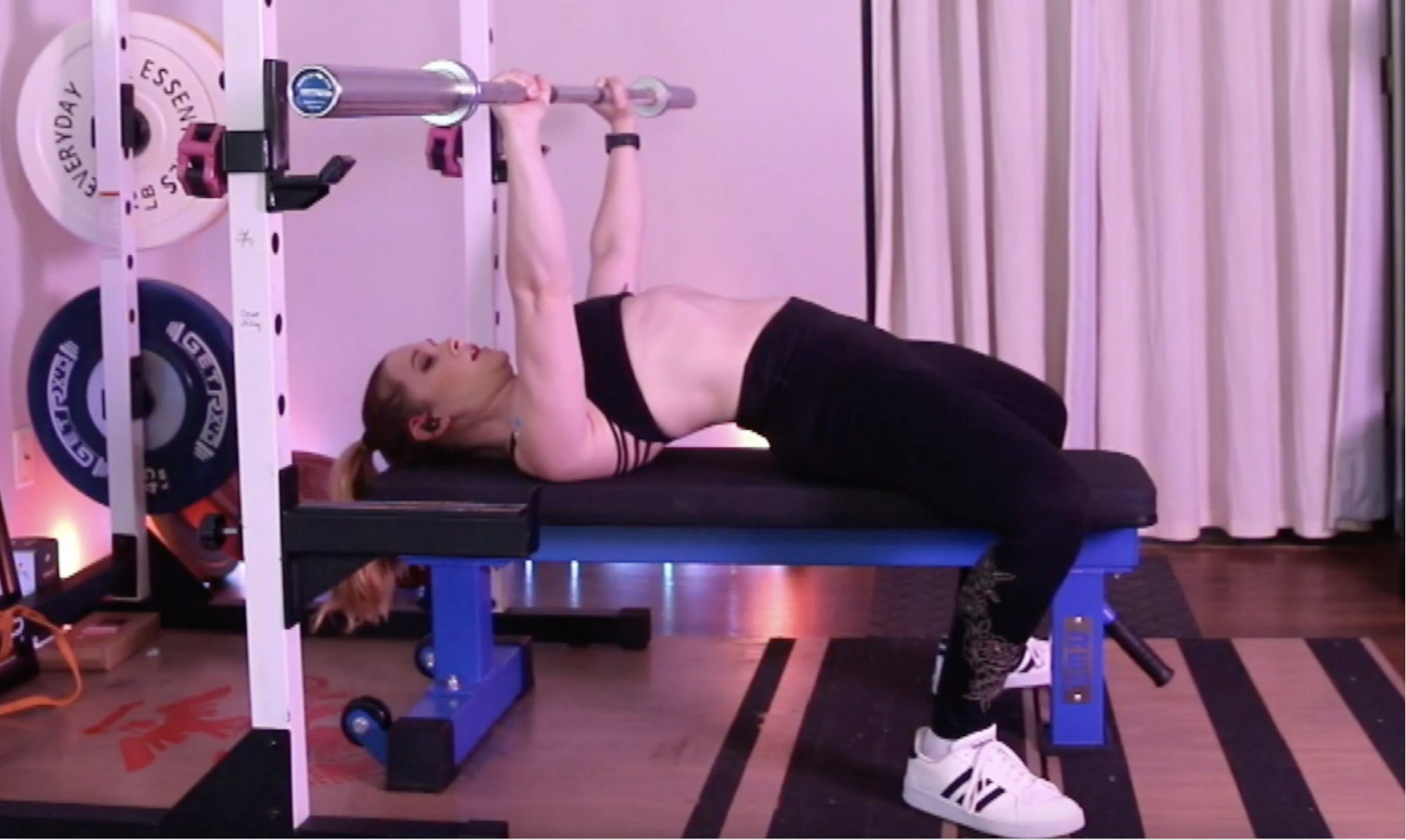
Take another optional shallow breath and keep your core braced with all the muscles in your back fired up. Then bend your elbows to lower the weight towards your chest while you keep pushing your chest up towards the ceiling. Stop when the bar is touching your chest.
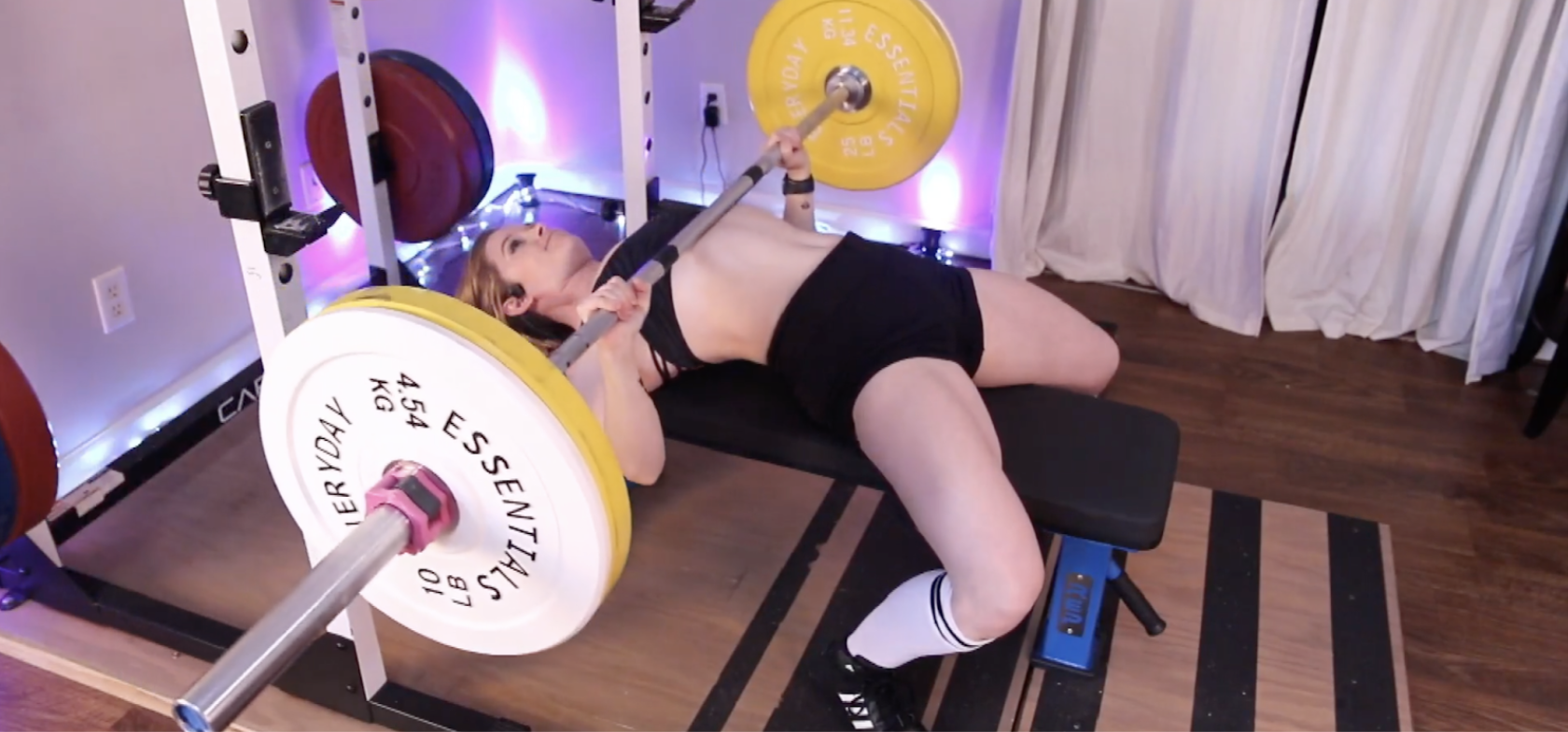
Drive through your legs, squeeze your glutes & back of your shoulders to push the weight back up to the starting position. Take a shallow breath and rebrace before doing another rep. Continue for the recommended number of reps in your training program.
Coaching Cues:
Pull the Bar to You: It’s important to engage your lats and the back of your shoulders to stabilize during this exercise. One thing that can help fire those muscles up is to think about pulling the bar to your chest on the descent. I suggest doing lat rows at a light weight before training bench press to prime this movement.
Leg Drive: Keep your legs pressing into the ground like you’re doing a bridge (I recommend doing bridges as priming exercises before bench for this reason).
Bend the Bar: To engage your external shoulder rotator muscles, think about bending the bar into a u-shape towards your feet.
Brace: If it is safe for you to do the valsalva maneuver, I recommend using it to brace and keep your body stable and rigid during this exercise. This involves holding your breath to create intra-abdominal pressure while the weight is in motion, and taking a breath between each rep or every couple of reps. This eliminates movement in the torso that naturally happens when we inhale and exhale–which can destabilize your base. The valsalva maneauver is not recommended for people with blood pressure problems, health conditions that make the eyes sensitive to pressure, or who are pregnant. For more info on this, check out the lesson on How to Breathe While Training.
For more tips on how to perform the bench press, check out the video below where I covered bench press during one of my Technique Tuesday live streams on Twitch:
Common Problems with Bench Press
Many people struggle with the bench press, usually because of issues with their technique, strength, and/or mobility. Here are the most common problems people experience and how to address them:
1. Weak Lockout (Triceps Weakness)
If you struggle with finishing the bench press at the top of the movement (i.e., the “lockout”), this may be due to having weak triceps. The triceps are responsible for straightening your elbows. A great way to fix this common problem is to incorporate more triceps-strengthening exercises in your workout routine by doing things like Close-Grip Bench Presses, Dips, and Triceps Extensions.
2. Off-Balance Bar Path
Another common problem with benching is that the bar may move unevenly or in the wrong direction. Ideally, the bar should move in a slight arc in both directions rather than going straight down and up.
To see whether you need to fix your bar path, take video of your bench press from the side profile view, and watch the line of the bar path as you move. The path you want to see should look like this:

At the beginning of the movement, the bar should be right above your shoulders. At the bottom, it should be somewhere between your sternum and “bra line” depending on your grip style (wide grip vs. close grip). On the way up, it’s important to “scoop” the bar up over your shoulders as soon as you can to leverage the strength pecs to perform the lift.
To practice this, reduce the weight and work on controlling your bar path with slow reps before adding more weight.
3. Shoulder Pain
Probably the most common problem that people experience with the bench press is shoulder pain. This is often the result of improper positioning, either by excessively flaring out the elbows or poor scapular positioning.
To fix this, practice keeping your elbows at about a 45-degree angle by engaging your lats and externally rotating your shoulders throughout the movement. Also, practice pushing your shoulders actively into the bench and push your chest up towards the ceiling—maintaining this positioning throughout the exercise.
To improve your scapular mobility, practice spinal extension exercises like Cat Cows, Cobra Stretch, Swimmers, Supermans, and Bird Dogs.
You may also need to work on improving your shoulder mobility by practicing exercises for internal rotation, external rotation, and general strength in the shoulders. Great exercises for this include Quadruped T-Spine Rotation, Band External Rotation, Band Internal Rotation, Back Flys, Rear Delt Flys, Up & Overs, and Resistance Band Pull-Aparts.
4. Weak Chest (Sticking Point at the Bottom)
If you struggle at the bottom of the movement getting the bar off your chest, this is likely due to having weak pecs (chest muscles). It may also be due to poor positioning, with the elbows flared excessively and/or insufficient scapular retraction (i.e., pulling the shoulder blades back and down toward the spine.
To fix this common problem, first make sure that you are in the proper position while performing the bench press:
Keep your shoulders pinned down toward the bench and your chest pushed up toward the ceiling through the entire range of motion
Engage your lats and externally rotate your shoulders to keep the shoulders in good position to engage the pecs.
In addition to focusing on positioning, you should also focus on strengthening your chest with exercises like Paused Bench Presses, Dumbbell Chest Presses, and Deficit Push-Ups.
5. Wrist Pain
Wrist pain while lifting can be due to a number of causes, chief among which is poor wrist positioning. Many people mistakenly bend their wrists back too much to the point where the bar isn’t resting above their wrist.
To fix this problem, practice using a neutral wrist position. I tell my clients to “punch the ceiling” to point their knuckles up. From the side, you should see the bar resting right above the wrist joint.
After fixing your positioning, you may still experience wrist pain. This may be due to poor grip strength, carpal tunnel, or tendonitis. To address this, work on your grip strength with other weight-bearing exercises like Farmer Carries and Romanian Deadlifts.
To reduce pain while training, consider wearing wrist wraps for weightlifting.*
6. Lack of Leg Drive
Many people don’t realize that the legs play an important role in a strong bench press. During the exercise, you should plant your feet firmly on the ground and push through the floor. This helps to stabilize your body during the lift and also helps you to generate more force.
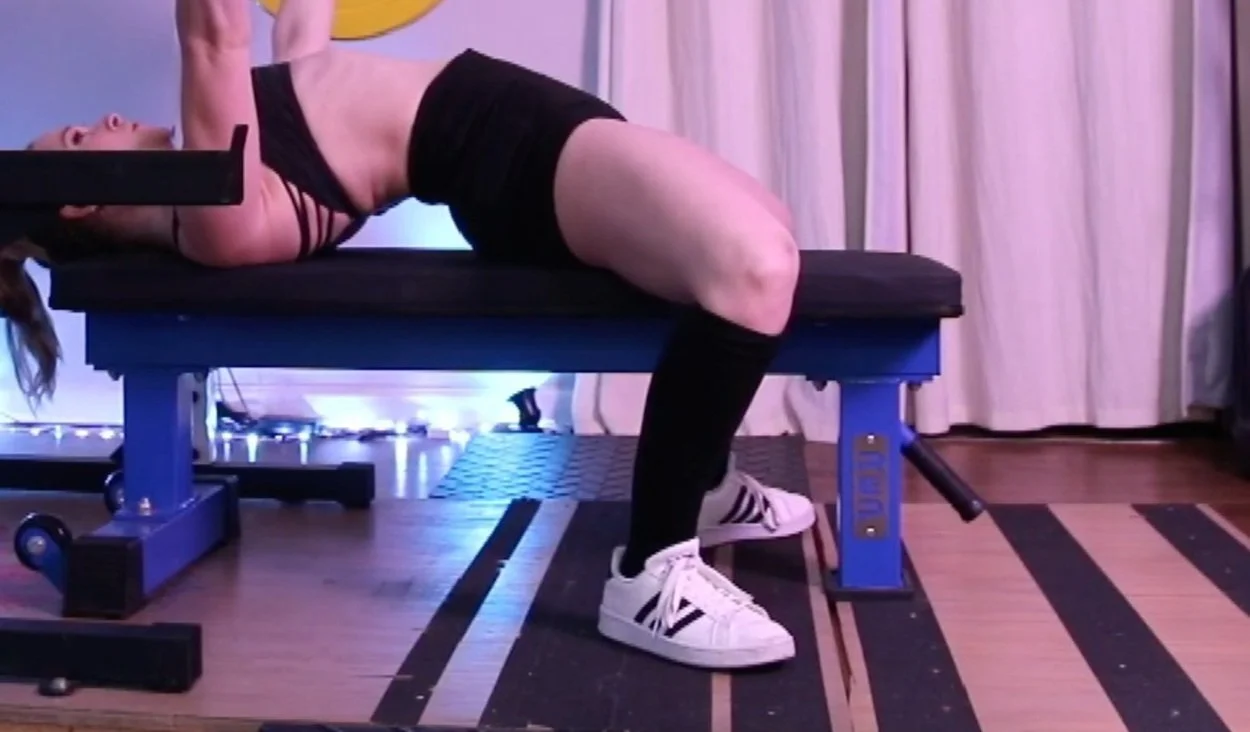
If you’re not using leg drive, you may feel like your legs are passive or loose. If your legs feel relaxed, you're missing out on extra power and stability. You may also feel your feet move or even lift off the floor. If your feet shift around or come off the floor, you’re not creating a stable base for power transfer.
Make sure you’re using your legs properly while doing bench press. Place your feet right under your knees. When you lift the bar off the rack, press your toes into the floor and engage your quadriceps like you’re about to do a leg extension.
7. Unstable Grip or Bar Wobbling
If the bar feels wobbly or unstable, check to make sure that your grip is even before you unrack the weight. Use your pinkies against the rings of the bar to ensure that your hands are evenly placed.
If the bar still feels unstable after checking your grip, you may have weak grip strength. Use chalk to help your hands grip the bar more solidly. Also, strengthen your grip by performing load-carrying exercises like Farmer Carries and Romanian Deadlifts.
8. Arching Too Much or Too Little
Whenever I lift on stream, I often get asked “why do you arch your back like that?” The back arch is another important component of a stable bench base, and if done correctly, it can help you generate more power.
Should you deliberately try to arch your back while lifting? Not necessarily. The arch is a natural product of proper positioning, which includes engaging the back muscles, firmly pressing your shoulders into the bench while driving the legs into the floor, and pushing your chest up towards the ceiling during the lift. For different people, the degree of arch that this creates will vary. Some people’s arch will look more dramatic than others.
Be careful not to excessively arch the back beyond what is helpful for stability. Too much of a back bend can strain the lower back, leading to pulled muscles or injuries to the spine.
Not having enough engagement in the back, glutes, and legs, however, can lead to loss of stability in the lift—which will also look like a lack of arch.
To find the happy medium of a useful arch, focus on driving your shoulders down into the bench, your chest up towards the ceiling, and your feet down into the floor. Avoid allowing your hips to come off the bench.
9. Not Controlling Eccentric (Lowering) Phase
Often, people mistakenly think they have to move fast through each rep, and will drop the bar too quickly to their chest on the eccentric (lowering) phase. Lifting like this leads to poor control and can increase your risk of injury. You can see this in the beginning of the video linked below:
Instead, practice lowering the bar in a controlled manner (2-3 seconds) before pressing the bar back up. This will allow you to maintain proper positioning while the weight is in motion.
10. Breathing and Bracing Issues
Whenever you do a compound or heavy lift, it’s super important to control your breath and keep your core engaged (meaning your abdominals, obliques, and back muscles are fired up). This helps to keep your torso stable to prevent any movement and reduce the risk of injury.
If your torso feels loose and “wobbly,” this may be due to a lack of bracing. To fix this, take a deep breath before lowering the bar and engage your core muscles just like you would while holding a plank. Focus on keeping your torso rigid throughout the movement. Once the weight is back at the top, exhale and inhale again before doing your next rep.
Keep Practicing!
Initially, the bench press may appear challenging or slightly intimidating. But with consistent practice and attention to technique, this exercise can bring a lot of benefits to your overall development in resistance training.
Don’t forget that you can always reach out if you have any questions about whether or not you are practicing the form correctly. Send me a message in Trainerize if you’re a 1-on-1 client, or take a selfie video and post it in the Coaching Corner Discord #🏋-technique-reviews channel.
*This and other equipment links are affiliate links (I will be compensated in part after you make a purchase).