3 Ways to Get Your Heart Pumping With Cardio
With the weather being cold, it’s hard to get outside for walks, hikes, gardening, and other activities that you do during the spring and summer.
Nevertheless, staying active is important to keeping your body strong and healthy. So, I recommend adding indoor cardiovascular exercise to your weekly training program if you aren’t doing it already.
Benefits of Cardio
Cardiovascular exercise (or “cardio” for short) is a style of training focused on getting your heart pumping for at least 10 minutes. This type of exercise improves the health of your heart & lungs, which deliver oxygen and nutrients to your body & brain.
Doing cardio regularly has many benefits:
reduced risk of illnesses like heart disease, high blood pressure, stroke, type 2 diabetes, and some types of cancer
boosted immune system, reduced risk of getting sick from viral illnesses like the cold and flu
reduced tension and anxiety (improved mental health)
improving your quality of sleep and overall energy levels[1]
Adding cardio to your regular training routine can also improve your gains! It increases your total calorie burn, which makes it a super effective training strategy for fat loss.
If your goal is to build muscle, cardio can also help maximize your muscle gains by improving the efficiency of your cardiovascular system—this allows your body to get more oxygen and nutrients to your muscles while you are training and recovering.
Some types of cardio (like high-intensity training) may also help to maximize your muscle gains by stimulating the release of anabolic hormones like testosterone, growth hormone, and IGF-1.[2, 3, 4]

Types of Cardio
Any exercise that gets your heart rate up counts as cardio!
One way to get your heart pumping during the winter months is to hop on a cardio machine like a treadmill, elliptical, rowing machine, stationary bike, etc for 20-30 minutes while watching tv or listening to music. This is called Steady State Cardio.
I myself am a big fan of Cardio Circuits. Circuits involve alternating between a couple of different exercises for a set period of time or number of reps. For example, I might do 30 seconds of jumping jacks, followed by 30 seconds of kettlebell squats, and then hold a plank for 30 seconds. I’ll do this for between 3 and 5 rounds, resting for 10 seconds between each exercise.
Another popular style of cardio is High-Intensity Interval Training (HIIT). For this style of training, you alternate between periods of vigorous activity and rest intervals. For example, you can do a HIIT speed-walk workout by alternating between 30-second periods of speed walking or jogging and 2-minute periods of slower walking for a total of 20 minutes. You can also do what’s called a tabata—alternating between 20 seconds of any exercise (like jumping jacks or squats) and 10 seconds of rest for 8 rounds.
How to Track Your Cardio
Click the button below to calculate your personal target heart rate zones, and make sure to write these down so you can reference them later!
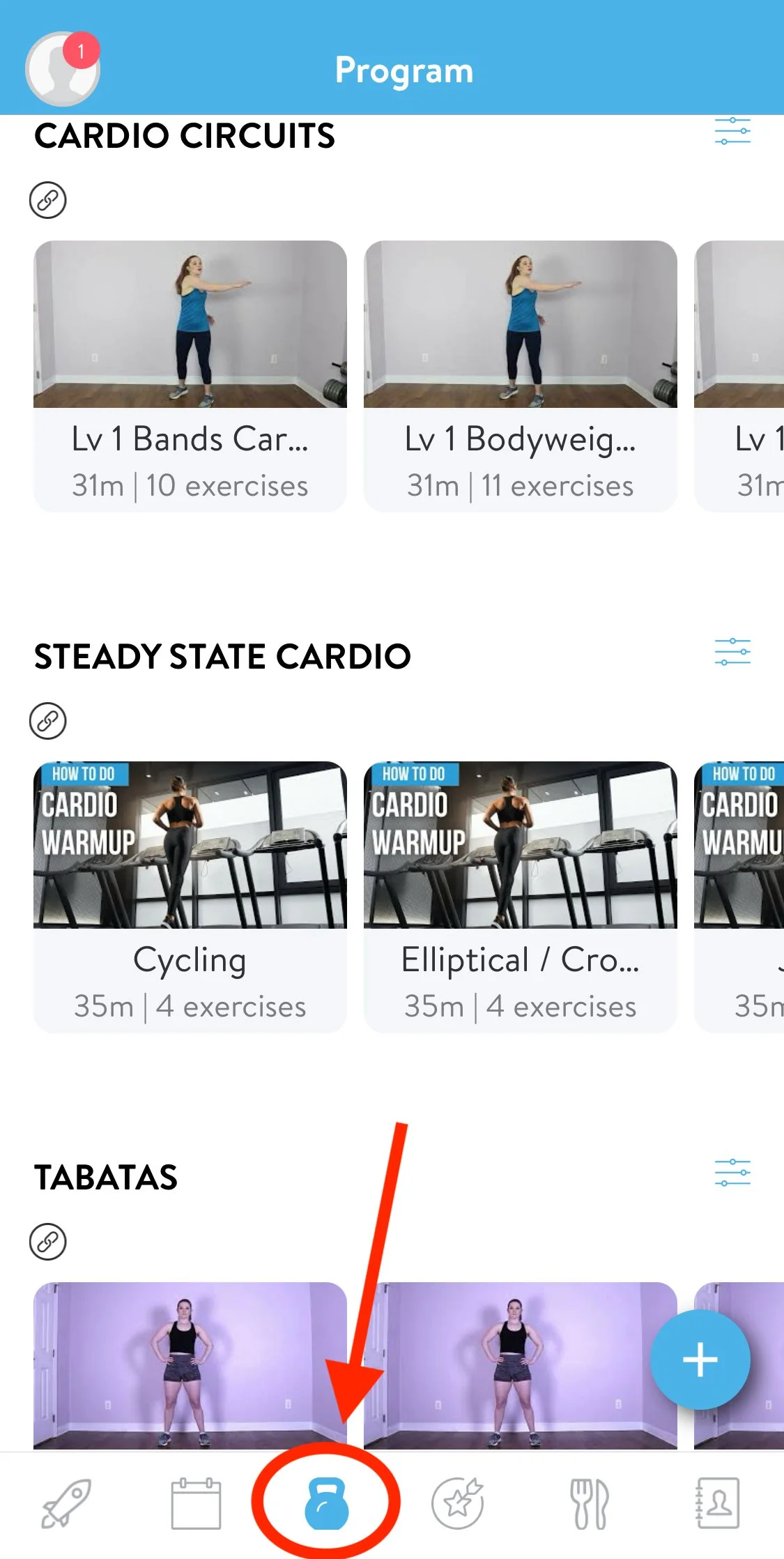
If you’re subscribed to one of my training programs or coaching programs, I’ve added to your ABC Trainerize account a few collections of cardio workouts that you can use whenever you like. Do these before or after your resistance training workouts, or on a separate day on their own.
To access them, go to your Program tab within the ABC Trainerize app and scroll down until you see the headings labeled Cardio Circuits, HIIT Tabatas, and Steady State Cardio. Scroll to the right and left in each section to see the available workouts.
The workouts are organized according to the equipment they use and the level of difficulty. I’ll add more to these collections over time, but at least for now you’ve got a nice collection to start with.
While doing cardio, your goal should be to get your heart rate into one of 3 target heart rate zones:
Low-Intensity Zone: between 55% and 63% of your max heart rate
Moderate-Intensity Zone: between 64% and 75% of your max heart rate
High-Intensity Zone: between 76% and 93% of your max heart rate[5, 6]
Use a heart rate monitor, a fitness tracking device, or track manually while you are exercising to ensure that your heart rate is in the right zone.
Check your heart rate every few minutes while you exercise to make sure it’s staying between 64% and 75% of your max heart rate. For the talking test, at the moderate-intensity level, you should be able to talk in full sentences, but you should not be able to sing.
How Often to Do Cardio
The American Heart Association recommends doing at least 150 minutes of moderate-intensity cardio total each week.[7] You can split this into 3-5 days per week of 30- to 50-minute cardio training sessions.
According to the American Heart Association, you can count each minute of high-intensity (or mixed high- and moderate-intensity exercise) as 2 minutes towards your weekly 150-minute cardio goal.[7]
Keep in mind that doing too much high-intensity exercise can keep your body in an inflammatory state and weaken your immune system—making you more susceptible to illness or injury. Experts recommend no more than approximately 40-50 minutes of intensity above 85 percent per week, and not more than 30-40 minutes cumulative time per week with your heart rate above 90 percent in order to prevent symptoms of overreaching.[8]