Planning your meals is a great way to ensure that you’re staying on track with your diet every day. In this post, I’ll show you my process for creating meal plans for myself and my clients.
Step 1: Get on a Schedule
Getting into a consistent eating schedule is one of the best strategies for hitting your health goals. People with irregular eating patterns are more likely to experience health problems like increased inflammation and difficulty processing insulin.
Consistent meal timing, on the other hand, has been shown to promote regular circadian rhythms. Your circadian rhythms coordinate the biological processes in your body so that they occur at the right times for optimal health & fitness. Getting onto a consistent sleeping and eating schedule in alignment with your circadian rhythms to reduce the risk of developing obesity, type 2 diabetes, and cardiovascular diseases.
When to Eat
When deciding on an eating schedule, the important thing to remember is that your eating schedule is only going to be as effective as you are able to stay consistent with it.
Evidence suggests that eating more frequently throughout the day can help reduce systemic inflammation and the risk of some kinds of cancer. Eating more food in the morning and afternoon versus at night as well as ending food consumption early in the evening may also help to reduce inflammation and cancer risk.
Experts recommend eating something within two hours of waking up, regardless of whether you feel hungry or not. This breaks your overnight fast and gives your body the energy and nutrients it needs to start the day. It’s ok if all you can do is eat something small–just try to get *something* in your system to stay in alignment with your circadian rhythm.
After you have your first meal, it’s recommended to eat again every three to four hours to prevent dips in blood sugar levels throughout the day. This will help you to avoid feeling “hangry” and will give you consistent energy all day long.
One eating schedule you probably have heard of is called intermittent fasting. This involves alternating between periods of eating and fasting on a set schedule. Studies show that intermittent fasting may help with weight loss and can also improve insulin resistance and reduce risk factors for cardiovascular disease.
There are many different approaches to intermittent fasting, including:
Daily time-restricted fasting. This involves eating normally but within a six- to eight-hour window each day and fasting for the other sixteen to eighteen hours. For example, people on a time-restricted diet might skip breakfast but eat lunch around noon and dinner in the evening between 6:30 and 8:00 pm.
5:2 fasting. This schedule involves eating normally for five days and fasting for two days each week.
Alternate-day fasting. This diet schedule involves eating a normal diet one day and either fasting completely or having one small meal of less than 500 calories the next day.
One of the main benefits of intermittent fasting is that it forces your body to get into a feeding schedule–which can help to reduce mindless snacking, sugar cravings, and overconsumption of calories.
It’s not necessary to go for longer periods without food (like 24-, 36-, 48- and 72-hour fasting periods), and such long fasting periods may be dangerous. Such long fasting periods might encourage your body’s metabolism to slow and start storing fat.
It takes about 3 to 4 weeks for your body to get used to a new schedule, so keep that in mind if you decide to change up your eating pattern. It will likely take a lot of discipline and you may experience hunger for the first few weeks.
Remember: the most effective diet pattern is the one that you will be able to sustain in the long run–regardless of whether you’re eating 3-5 meals + snacks every day or doing a variation of intermittent fasting.
Step 2: Plan Your Meals
Now that you know what your plate should look like, you can begin to plan your meals and snacks!
Whichever eating schedule you choose, it’s important that what you eat during your meal times or feeding windows comes from nutrient-dense foods that are in alignment with your daily calorie and macronutrient goals.
One of the best ways to ensure that your diet meets your needs is to plan what you will eat ahead of time. For this, I suggest using the Healthy Plate Model as a base template.
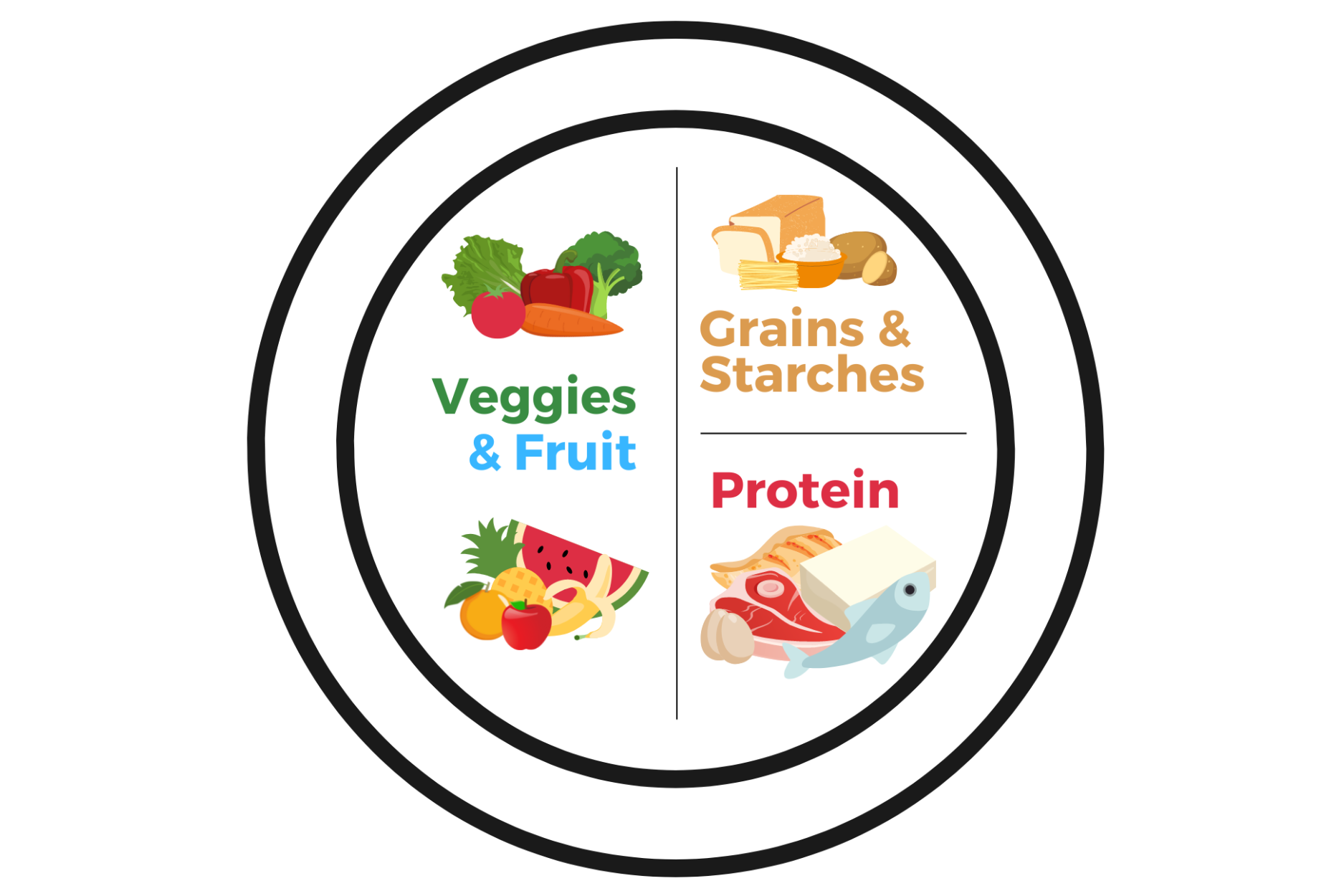
According to the Healthy Plate model, half of what you eat at every meal should be 1-2 servings of vegetables (or 1 serving of fruit and 1 serving of vegetables). The rest of what you eat should be divided between a serving of a source of protein and a serving of either a grains-based food (like bread, rice, or pasta) or a starchy vegetable (like potatoes, corn, plantains, or yuka).
Choosing Recipes
Before you begin choosing recipes, make sure to take stock of what kitchen equipment you have access to.
If you plan to cook your meals ahead of time, don’t forget about food storage solutions! Make sure that you have enough storage containers to hold your prepped meals. If you plan to “grab and go,” you’ll need a single entree container for each meal. For example, if you’re preparing 6 servings to grab and go throughout the week, make sure you have 6 separate containers on hand. Make sure they are microwave-safe for reheating!
Some dishes may require you to store some ingredients separately. I recommend getting some smaller containers or zip-top bags for storing things like snacks, sauces, and dressings.
You may also want to invest in a sturdy, insulated lunch box or cooler if you need to take your meals on the go to work or school. Some containers and lunch boxes have separate containers for keeping your food cold or warm, which makes them a great option if you don’t have access to a refrigerator or microwave while you’re out and about.
Building Your Meals
I recommend building each meal and snack around either vegetables or a good source of protein. These are the two food groups that people struggle with the most, so it can be helpful to focus on them as the priority of each meal.
To find some vegetable dishes that taste great, I suggest investing in a good vegetarian cookbook like the America’s Test Kitchen Ultimate Vegetarian Cookbook. I’ve learned some of my favorite recipes from this book and use it regularly in my own meal planning! It’s full of awesome recipes and also educational content on how to prepare vegetables for the best flavor.
For your protein dishes, I recommend finding a handful of ways that you like to prepare your favorite proteins and keeping those recipes in steady rotation in your meal planning. I myself like to roast, slow cook, and air fry protein foods like chicken breast, tofu, and beef. For variety, I alternate between different seasonings like McCormick Grill Mates seasonings or cajun seasoning.
It’s also a good idea to build up a list of some go-to recipes that you enjoy and can eat regularly. For example, baked chicken is always easy for me to make and add to dishes. Each week I bake about 3 lb of chicken breast with a variety of seasonings. I’ll either eat the chicken fresh out of the oven or store it in the fridge to add to salads, bowls, wraps, and sandwiches later in the week.
If you’re not keen on cooking or are limited in kitchen equipment, there are many already-cooked options that you can use from the grocery store. During weeks when I’m swamped and don’t have much time to cook, I buy a rotisserie chicken from my local grocery store. I add the already-cooked chicken to salads, wraps, sandwiches, and pasta dishes for fast, easy meal prep. You can do the same with canned tuna, tofu, or frozen protein options.
I also keep frozen vegetables like peas and stir-fry mix in my freezer at all times so I can quickly add some veggies to my meals. This helps to prevent spoilage and waste from fresh produce–especially during the weeks when I’m busy and can’t find time to cook.
After deciding on veggie and protein dishes, it should be pretty easy to decide which grain/starch item to include in your meals because let’s face it–that’s most people’s favorite part! You can’t go wrong with potatoes, pasta, brown rice, whole wheat bread, or another whole grain or starchy vegetable. It’s up to you!
Keep an Eye on Calories/Macros
While you’re planning you meals, use a calorie tracking app like MyFitnessPal or the FitBit app to keep an eye on the calories and macronutrients of each dish you plan to eat.
If you’re using MyFitnessPal, click here and follow the instructions.
If you’re using FitBit, follow the directions on this page.
Build Your Menu
As you decide on your meals and snacks, it’s helpful to write down your meal schedule or save it in your calorie tracking app. Use the worksheets linked below to record your meal plan and meal prep schedule to stay on track throughout the week.
Tips to Save Time
I know that the process of meal planning may seem overwhelming at first, but the more that you practice–the easier it gets!
There are, however, a few things that will make your meal planning and meal prep go much smoother in the beginning.
First, prepare your food in bulk by making multiple servings at a time. This allows you to cook just one time every few days and just grab and go on the other days. If you don’t like reheating leftovers, prepare cold meals like sandwiches, salads, and wraps.
You can also save time and energy by cooking minimal-prep recipes like “one pot” or “one pan” recipes. These dishes use a minimal amount of equipment, which will simplify both the cooking and the cleanup.
You can save even more time in the future by creating a rotating meal schedule of the same foods every 4 to 6 weeks. To do this, you’ll use the same handful of week-long meal plans, alternating between them on a weekly basis. For example, a rotating meal plan might look like this:
Week 1: Overnight Oats for Breakfast, Meal Prep Spaghetti & Meat Sauce for Lunch, Chicken & Potatoes with Green Beans for Dinner
Week 2: Protein Pancakes for Breakfast, Chicken Salad Wraps for Lunch, Beef Pot Roast with Veggies for Dinner
Week 3: Fruit & Yogurt Parfait for Breakfast, Tofu & Edamame Noodle Bowl for Lunch, Pork Chops & Roasted Veggies for Dinner
Week 4: Veggie Omelet for Breakfast, Meal Prep Shephards Pie for Lunch, Chicken Stir Fry for Dinner
After completing Week 4, you’ll go back to Week 1’s menu. This will allow you to save time because you only have to plan your meals once and you can keep recycling the same menu, grocery list, and routine. You might also save money by not having to buy ingredients that don’t get used up on the first go-round. For variety, you can always swap one recipe or dish out for another to keep things interesting.
Make sure to stay subscribed for more helpful tips on meal planning!