Are you ready to start your fat loss journey? Congratulations! 🙌
The first step to successfully burning fat and keeping it off for good is to understand how body fat works.
This will empower you to take control of how your body stores and burns fat.
The first thing to note is that body fat is stored energy.
Fat is like our body’s battery packs. It’s a built-in mechanism that allows us to store energy to use later if food becomes less available.
That’s because, for the majority of human existence, our ancestors were hunter-gatherers roaming the plains of Africa—where food availability was unpredictable. For many communities, there were long stretches of time when food may have been scarce.
To ensure that our ancestors didn’t starve to death, their bodies developed mechanisms for storing energy and reducing the amount of energy they spent every day. These same mechanisms are alive in our bodies today.
It’s easy to see body fat as a bad thingm thanks to all the fat-shaming and fat-phobia of our culture. But in reality, body fat is a crucial safety mechanism to ensure that we can stay alive during periods of scarcity.
There's nothing inherently bad about body fat. In the right amount, it’s actually necessary for us to stay healthy.

The problem that many of us face, however, is that we don’t live in an environment where food is scarce. In fact, we have pretty consistent access to an abundant amount of food. And much of the food we have around us is high-calorie, meaning it provides the body with a lot of energy.
We also aren’t as active as our ancestors were, so our bodies aren’t spending as much energy.
These two factors alone are the reasons why many of us struggle with high levels of body fat.
Not to mention the fact that other things like high-stress levels, poor sleep, poor hydration, and having a diet low in fiber and protein also contribute to higher body fat. All of this combined makes it super hard to maintain a healthy body fat percentage in the modern world.
But that isn’t the end of the story. You aren’t doomed to a life of being overweight.
You can turn things around by learning more about how your body stores and burns fat.
There are also many ways that you can “hack” your system to get your body burning through its fat stores.
That’s what this blog is all about—empowering you with the knowledge and strategies you need to take control and achieve your fat loss goal.
How to Get Started
As you go through your fat loss journey, always keep in mind:
Whether your body burns or stores fat is all a matter of energy balance.
In general, when you take in more energy than what your body spends, the extra energy gets stored as body fat.
On the other hand, to burn fat, you need to put your body in a state where it's burning more energy than what you eat–this will force it to tap into those energy stores!
There are two main ways to get your body burning its energy stores:
Manage what you eat
Increase your daily calorie burn
How to Eat to Burn Fat
To get your body burning fat, we need to put it into what is called a calorie deficit. This means that your body is burning more calories than what you eat.
There are many strategies for eating a calorie deficit—we’ll go over these in detail in future posts. For now, however, there are a few things you can do to get started:
1 Learn How to Build a Healthy Plate
In general, you should prioritize eating nutrient-dense foods and avoid what we call “empty calories.”
Nutrient-dense foods are things that have vitamins, minerals, and other nutrients that our bodies need to stay healthy. Eating plenty of nutrient-dense foods can help you to reduce the risk of getting sick or experiencing gastrointestinal problems.
“Empty calories” are foods that are high in sugars and fats–which makes them high in calories. They don’t really offer the body much more nutritious benefit other than that. These often include deep-fried food, desserts, chips, candy, and many highly processed and packaged foods.
The easiest way to eat nutrient-dense foods and avoid empty calories is to follow what I call the Healthy Plate Model.
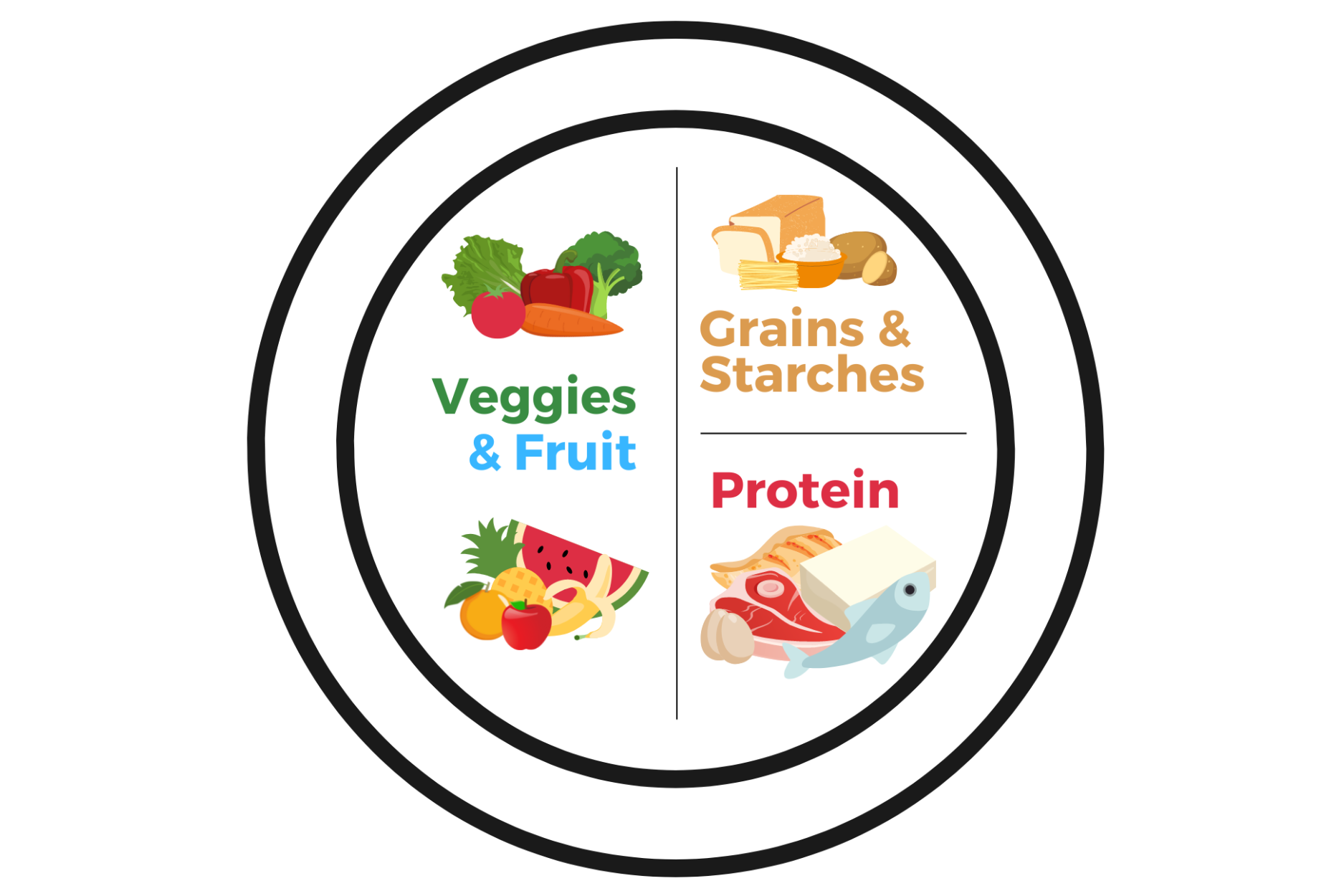
The Healthy Plate Model is a modified version of the USDA’s MyPlate that was published in 2015, and it shows what your plate should generally look like at meal times.
The Healthy Plate model is centered around 4 major food groups:
Protein: On at least a quarter of your plate, include a lean source of protein. Protein is both a source of energy for your body and a building block for your body tissues (like muscle). Eating a high-protein diet will help your body to more efficiently build muscle and keep your metabolism boosted. Prioritize lean sources of protein–items that come with little to no saturated fat like white meat (chicken breast & turkey breast), egg whites, fish, plant protein sources (tofu, tempeh, & edamame), and lean cuts of red meat.
Veggies: On half of your plate, include 1-2 servings of veggies. Veggies (or vegetables) are plants (or parts of plants) that you can eat. Fruits and grains are also plants, but we usually reserve the term “vegetable” for specific parts of the plant like the roots (like carrots and turnips), leaves (like lettuce and spinach), stems (like celery), bulbs (like garlic and onion), and flowers (like broccoli). Veggies are a great source of carbohydrates and healthy fats (i.e., unsaturated fats).
Grains/Starches: On the remaining quarter of you plate, include a grain or starchy food. Grains are essentially seeds and include foods made from wheat (bread & pasta), rice, quinoa, and oats. Try to include whole grains as much as possible (things like brown rice, oatmeal, whole wheat, quinoa, etc) in place of refined grains (white wheat, white bread, or white rice). Whole grains are more generally more nutritious, having more vitamins, minerals, and dietary fiber than refined grains.
Some vegetables (like potatoes, corn, yuca, and plantains) are high in Starches (complex carbohydrates). Starchy vegetables tend to be high-calorie, and may not be suitable for every diet (for example, people with Type II Diabetes may want to avoid them). These kinds of vegetables should be limited to no more than a quarter of your plate, especially if you are trying to burn fat.
Fruit: Fruits are plant products that tend to be higher in sugar content, giving them a sweet taste. This group is optional and can take up 1 portion of the vegetables side of your plate. They include things like berries, cherries, apples, grapes, pears, and mangoes. The higher sugar and calorie content of fruits make them a food to be eaten in moderation–no more than a quarter of your plate at meal times.
Following the Healthy Plate model is a great place to start when trying to clean up your eating habits. There are other details to maximize the effectiveness of your healthy plate, which we’ll go into in future posts. But for now, practice following the Healthy Plate at every meal to start the process of building your fat loss diet.
2 Manage Your Calorie Intake
Remember: our bodies use the energy from food to power everyday basic functions and everyday activities. We measure that energy in calories.
In general, to burn fat you need your body to burn more calories than what you eat every day.
Tracking what you eat in a calorie-tracking app like MyFitnessPal or a food journal* can help you measure exactly how much energy your body is taking in.
You can also figure out roughly how much energy your body burns every day by estimating your Total Daily Energy Expenditure (TDEE). You can get an estimate of your TDEE by using the online TDEE calculator.
Keep in mind that online calculators can only go so far toward estimating your TDEE. You’ll need to test the number you calculated to make sure that it’s accurate. You can do this by eating the number of calories that you calculated and weighing yourself for a week or two.
Once you know roughly how many calories your body is burning (i.e., your TDEE), you can aim to eat a calorie number lower than your TDEE to keep your body in a calorie deficit.
Getting your calorie intake right is a process that takes time and a lot of trial and error. We’ll go into more detail on that in future posts. For now, it’s a good idea to go ahead and calculate your TDEE and start to practice tracking what you eat by using either a calorie-tracking app like MyFitnessPal or a food journal.
How to Exercise to Burn Fat
Managing your diet is the most important thing to focus on when you’re trying to burn fat, but exercise can also play an important role in supporting your caloric deficit.
Whenever we move, our bodies burn calories to power that movement. In general, the more you move, the more calories you burn.
I encourage my clients to aim to get a total of between 150 and 300 minutes of move-time every week.

For your movement time, you can go for a brisk walk, do a workout, tidy up your house or office space, do a workout–anything that gets you up and moving around.
You can split this movement time up however you like—30 minutes every day, 50 minutes on several days, or some other combination.
Personally, I like to do several 10- to 20-minute walks with my dog each day. I also do resistance training workouts to challenge my muscles on several days each week.
Some activities burn more calories than others, depending on how fast you move, how many muscles you use, and how hard you push your muscles. We’ll go more into that in a future post.
For now, start practicing the daily habit of getting up and moving in some way for at least 10 minutes. Alternatively, block out times in your schedule to reach a total of 150-300 minutes of activity time this week.
Moving Forward
Stay subscribed for more guidance on your fat loss journey. I’ll be updating this blog once every week with tips on how to eat, exercise, and stay motivated.
If you’d like more personalized guidance, check out my online 28-Day Fat Loss Challenge coaching program. I’ll help you step-by-step through transforming your lifestyle to support your fat loss goals. Click the button below to sign up:
*This is and following links are affiliate links. I will be compensated in part if you make a purchase after clicking.